 (source)
|
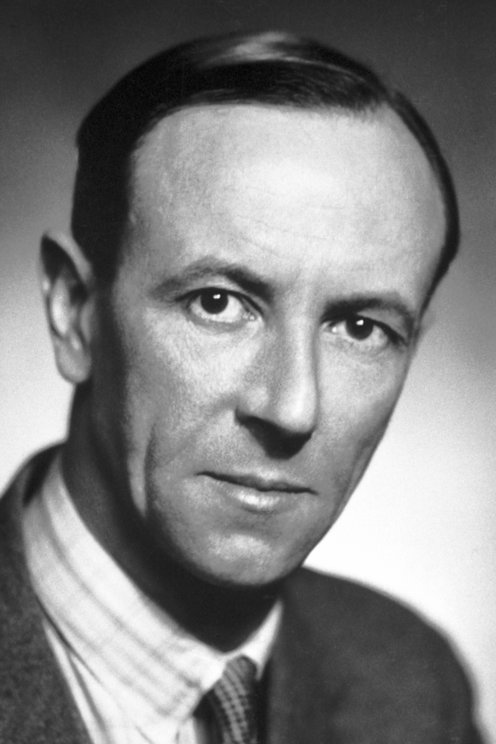
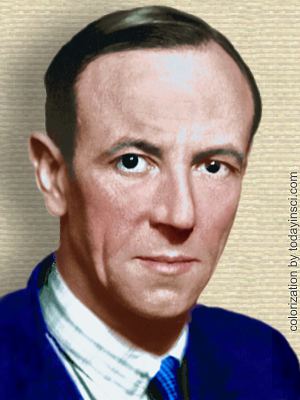
Sir James Chadwick
(20 Oct 1891 - 24 Jul 1974)
English physicist who was awarded the 1935 Nobel Prize for Physics for his discovery of the neutron, which was the name he coined for it.
|
Science Quotes by Sir James Chadwick (4 quotes)
I am afraid neutrons will not be of any use to any one.
— Sir James Chadwick
From interview, “when asked if his discovery had practical importance,” in Ferdinand Kuhn Jr., 'Chadwick calls Neutron ‘Difficult Catch’; His Find Hailed as Aid in Study of Atom, New York Times (29 Feb 1932), 1 and continued on 8.
I remember the spring of 1941 to this day. I realized then that a nuclear bomb was not only possible—it was inevitable. … And I had then to start taking sleeping pills. It was the only remedy, I’ve never stopped since then. It’s 28 years, and I don’t think I’ve missed a single night in all those 28 years.
— Sir James Chadwick
In oral history interview No. 3974-4 (20 Apr 1969) by Charles Weiner, Niels Bohr Library & Archives, on aip.org, American Institute of Physics website.
If we ascribe the ejection of the proton to a Compton recoil from a quantum of 52 x 106 electron volts, then the nitrogen recoil atom arising by a similar process should have an energy not greater than about 400,000 volts, should produce not more than about 10,000 ions, and have a range in the air at N.T.P. of about 1-3mm. Actually, some of the recoil atoms in nitrogen produce at least 30,000 ions. In collaboration with Dr. Feather, I have observed the recoil atoms in an expansion chamber, and their range, estimated visually, was sometimes as much as 3mm. at N.T.P.
These results, and others I have obtained in the course of the work, are very difficult to explain on the assumption that the radiation from beryllium is a quantum radiation, if energy and momentum are to be conserved in the collisions. The difficulties disappear, however, if it be assumed that the radiation consists of particles of mass 1 and charge 0, or neutrons. The capture of the a-particle by the Be9 nucleus may be supposed to result in the formation of a C12 nucleus and the emission of the neutron. From the energy relations of this process the velocity of the neutron emitted in the forward direction may well be about 3 x 109 cm. per sec. The collisions of this neutron with the atoms through which it passes give rise to the recoil atoms, and the observed energies of the recoil atoms are in fair agreement with this view. Moreover, I have observed that the protons ejected from hydrogen by the radiation emitted in the opposite direction to that of the exciting a-particle appear to have a much smaller range than those ejected by the forward radiation.
This again receives a simple explanation on the neutron hypothesis.
These results, and others I have obtained in the course of the work, are very difficult to explain on the assumption that the radiation from beryllium is a quantum radiation, if energy and momentum are to be conserved in the collisions. The difficulties disappear, however, if it be assumed that the radiation consists of particles of mass 1 and charge 0, or neutrons. The capture of the a-particle by the Be9 nucleus may be supposed to result in the formation of a C12 nucleus and the emission of the neutron. From the energy relations of this process the velocity of the neutron emitted in the forward direction may well be about 3 x 109 cm. per sec. The collisions of this neutron with the atoms through which it passes give rise to the recoil atoms, and the observed energies of the recoil atoms are in fair agreement with this view. Moreover, I have observed that the protons ejected from hydrogen by the radiation emitted in the opposite direction to that of the exciting a-particle appear to have a much smaller range than those ejected by the forward radiation.
This again receives a simple explanation on the neutron hypothesis.
— Sir James Chadwick
'Possible Existence of a Neutron', Letter to the Editor, Nature, 1932, 129, 312.
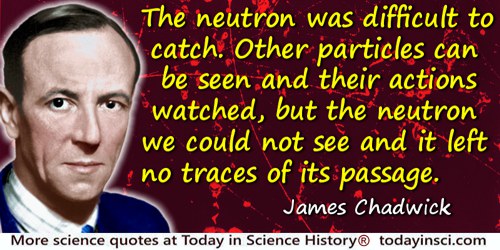
The neutron was difficult to catch. Other particles can be seen and their actions watched, but the neutron we could not see and it left no traces of its passage.
— Sir James Chadwick
In Ferdinand Kuhn Jr., 'Chadwick calls Neutron ‘Difficult Catch’; His Find Hailed as Aid in Study of Atom, New York Times (29 Feb 1932), 1.
Quotes by others about Sir James Chadwick (5)
There was, I think, a feeling that the best science was that done in the simplest way. In experimental work, as in mathematics, there was “style” and a result obtained with simple equipment was more elegant than one obtained with complicated apparatus, just as a mathematical proof derived neatly was better than one involving laborious calculations. Rutherford's first disintegration experiment, and Chadwick's discovery of the neutron had a “style” that is different from that of experiments made with giant accelerators.
From 'Physics in a University Laboratory Before and After World War II', Proceedings of the Royal Society of London, Series A, (1975), 342, 463. As cited in Alan McComas, Galvani's Spark: The Story of the Nerve Impulse (2011), 107.
In that same year [1932], the number of [known] particles was suddenly doubled. In two beautiful experiments, Chadwick showed that the neutron existed, and Anderson photographed the first unmistakable positron track.
In Nobel Lecture (11 Dec 1968), 'Recent Developments in Particle Physics', collected in Nobel Lectures: Physics 1963-1970 (1972), 241.
I am glad that Dr. Chadwick has stuck to the view that it [the neutron] is a combination of a proton and electron. Some people have said it was a new kind of ultimate particle. It was really too much to believe—that a new ultimate particle should exist with its mass so conveniently close to that of the proton and electron combined. It was nothing but a bad joke played on its creator and on the rest of us. Still, there is no doubt this neutron business is going to have many developments.
As reported in article on the York Meeting of the British Association for the Advancement of Science by Ferdinand Kuhn Jr., 'Finds Two Particles Make Up Neutrons', New York Times (6 Sep 1932), 12.
The discovery [of the neutron] is of the greatest interest and importance—possibly the greatest since the artificial disintegration of the atom.
In 'Discovers Neutron, Embryonic Matter', New York Times (28 Feb 1932), 1. James Chadwick’s announcement of the discovery of the neutron in a Letter to the Editor in Nature was published the day before.
When alpha rays are photographed, the plate is all cluttered up with traces of rays which fail to reach their objective inside the atom and usually they hide the most interesting part of the picture. In the case of neutrons, [the advantage is that they are not seen, so] the photograph gives clear evidence of the disrupted atom.
In Ferdinand Kuhn Jr., 'Chadwick calls Neutron ‘Difficult Catch’; His Find Hailed as Aid in Study of Atom, New York Times (29 Feb 1932), 8.
See also:
- 20 Oct - short biography, births, deaths and events on date of Chadwick's birth.
- The Neutron and the Bomb: A Biography of Sir James Chadwick, by Andrew P. Brown. - book suggestion.
 In science it often happens that scientists say, 'You know that's a really good argument; my position is mistaken,' and then they would actually change their minds and you never hear that old view from them again. They really do it. It doesn't happen as often as it should, because scientists are human and change is sometimes painful. But it happens every day. I cannot recall the last time something like that happened in politics or religion.
(1987) --
In science it often happens that scientists say, 'You know that's a really good argument; my position is mistaken,' and then they would actually change their minds and you never hear that old view from them again. They really do it. It doesn't happen as often as it should, because scientists are human and change is sometimes painful. But it happens every day. I cannot recall the last time something like that happened in politics or religion.
(1987) --