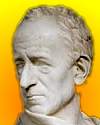
 (source)
|
Joseph Carpue
(4 May 1764 - 30 Jan 1846)
English surgeon and anatomist whose nose reconstruction operations mark the beginning of modern plastic surgery.
|
Joseph Constantine Carpue
(4 May 1764 - 30 Jan 1846)
Surgeon and Anatomist
[p.169] JOSEPH CONSTANTINE CARPUE, (1764 - 1846), surgeon and anatomist, was born in London on 4 May 1764. His father, a gentleman of small fortune, lived at Brook Green, and was descended from a Spanish catholic family. Young Carpue was intended for the priesthood, and was educated at the Jesuit's College at Douay. At the age of eighteen he commenced an extended continental tour. He saw much of Paris, both before and after the revolution. Carpue was of a somewhat erratic disposition, and, having decided against the church, thought first of becoming a bookseller, that he might succeed his uncle, Lewis, of Great Russell street, Covent Garden, the schoolfellow and friend of Pope. Later he felt strongly attracted in succession to the bar and the stage, being an enthusiastic student of Shakespeare. At last he fixed on surgery, and studied at St. George's Hospital. On becoming qualified he was appointed staff-surgeon to the Duke of York's Hospital, Chelsea., which appointment he held for twelve years, resigning on account of his objection to foreign service. His association with Dr. Pearson at St. George's Hospital led to his becoming an ardent vaccinator. In order to promote vaccination he visited many English military depôts; and finally, on his resignation of the hospital, he was appointed surgeon, with Pearson, of the National Vaccine Institution, a post he held until his death.
Carpue was, however, most distinguished as an anatomical teacher, although never on the staff of a medical school. At the Duke of York's Hospital he spared no trouble in perfecting his anatomical knowledge; and he commenced teaching in 1800, owing to an accidental observation of a medical student. His fee from the first was invariably twenty guineas. For many years he had an overflowing class. He gave three courses of daily lectures on anatomy, and lectured twice a week in the evenings on surgery. He made his pupils take a personal share in his demonstrations, and his readiness with chalk illustrations procured him the soubriquet of the “chalk lecturer.” He took a most affectionate interest in his pupils. Carpue lecturer till 1832. Early in his career he carried out the wish of Benjamin West, P.R.A., Banks, and Cosway, to ascertain how a recently killed corpse would hang on a cross. A murderer just executed was treated in this manner, and when cool a cast was made (Lancet, 1846, i. 167).
In 1801 Carpue published a “Description of the Muscles of the Human Body,” and in 1816 an “Account of Two Successful Operations for Restoring a Lost Nose from the Integument of the Forehead.” In 1819 he published a “History of the High Operation for the Stone, by Inscision above the Pubis.” He also studied medical electricity, and in 1803 brought out “An Introduction to Electricity and Galvanism, with Cases showing their Effects in the Cure of Disease.” He kept a fine plate (electrical) machine in his dining-room, and made many experimental researches on the subject.
Carpue was introduced to and much appreciated by George IV, both before and after his [p.170] accession to the throne. He was consulting surgeon to the St. Pancras Infirmary, but never received any recognition from the College of Surgeons, either by election to the council or to an examinership. He was a fellow of the Royal Society. He died on 30 Jan 1846, in his eighty-second year, having been much shaken in an accident on the South-Western Railway soon after its opening.
Carpue was a warm and faithful friend, abstemious and regular in habits, and a great admirer of simplicity in manners and appearance. He ordered his funeral to be of the simplest kind possible.
J.F. South, many years surgeon to St. Thomas's Hospital, and twice president of the London College of surgeons, gives the following uncomplimentary account of Carpue. He speaks of a private school, “conducted by a clever but very eccentric person, Joseph Carpue, a very good anatomist, who had but few pupils, and carried on his teaching by the very unusual method of catechism—for instance, he described a bone, and then made each pupil severally describe it after him, he correcting the errors whilst the catechisation proceeded. . . . Poor Carpue's school came to grief, and he then turned popular politician, but was not more successful in that character. I remember him a tall, ungainly, good-tempered, grey-haired man, in an unfitted black dress, and his neck swathed in an enormous white kerchief, very nearly approximating to a jack-towel.”
[Lancet, 1846, i. 166-8; Feltoe's Memorials of J.F. South, 1884, p.102.] G.T.B.
- 4 May - short biography, births, deaths and events on date of Carpue's birth.
- An Account of Two Successful Operations for Restoring a Lost Nose, by Joseph Constantine Carpue. - book suggestion.





