 (source)
|
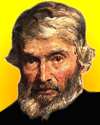
Thomas Carlyle
(4 Dec 1795 - 5 Feb 1881)
Scottish historian and essayist who in his early life taught mathematics at Annan (1814). In additional to his original works of history and biography, he translated Legendre's Geometry. Carlyle's writings influenced such social reformers as Charles Dickens and John Ruskin.
|
Science Quotes by Thomas Carlyle (37 quotes)
…persons, with big wigs many of them and austere aspect, whom I take to be Professors of the Dismal Science…
Coining “Dismal Science” as a nickname for Political Economy (though used earlier referring to social science in an article, Dec 1849).
Coining “Dismal Science” as a nickname for Political Economy (though used earlier referring to social science in an article, Dec 1849).
— Thomas Carlyle
'The Present Time', Latter Day Pamphlets, No. 1—Feb 1850, (1850), 43.
A witty statesman said you might prove anything with figures.
— Thomas Carlyle
In Chartism (1839, 1840), 9.
And the Social Science … a dreary, desolate, and indeed quite abject and distressing one; what we might call, by way of eminence, the dismal science.
— Thomas Carlyle
'Occasional Discourse', Fraser's Magazine (Dec 1849). Reprinted as a separate pamphlet (1853), reproduced in The Collected Works of Thomas Carlyle (1864), Vol. 13, 5.
Examine Language; what, if you except some few primitive elements (of natural sound), what is it all but Metaphors, recognized as such, or no longer recognized?
— Thomas Carlyle
Experience of actual fact either teaches fools or abolishes them.
— Thomas Carlyle
The Homiletic Review, Vol. 83-84 (1922), Vol. 84, 380.
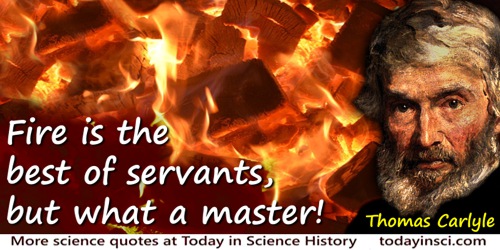
Fire is the best of servants, but what a master!
— Thomas Carlyle
In Past and Present (1843, 1872), 78.
Force, force, everywhere force; we ourselves a mysterious force in the centre of that. “There is not a leaf rotting on the highway but has Force in it: how else could it rot?” [As used in his time, by the word force, Carlyle means energy.]
— Thomas Carlyle
On Heroes, Hero-Worship and the Heroic in History (1840), 11.
Genius is an immense capacity for taking trouble.
— Thomas Carlyle
Louis Klopsch, Many Thoughts of Many Minds (1896), 105.
Goethe's devil is a cultivated personage and acquainted with the modern sciences; sneers at witchcraft and the black art even while employing them, and doubts most things, nay, half disbelieves even his own existence.
— Thomas Carlyle
In James Wood, Dictionary of Quotations from Ancient and Modern, English and Foreign Sources (1893), 128:24.
History, as it lies at the root of all science, is also the first distinct product of man’s spiritual nature, his earliest expression of what may be called thought.
— Thomas Carlyle
In James Wood, Dictionary of Quotations from Ancient and Modern, English and Foreign Sources (1893), 154:24.
I don’t pretend to understand the Universe—it’s a great deal bigger than I am. … People ought to be modester.
— Thomas Carlyle
Quoted in William Allingham's diary entry for 28 Dec 1868, from a conversation with Carlyle that day. In Helen Allingham and D. Radford (eds.), William Allingham: A Diary (1907), 196.
I grow daily to honor facts more and more, and theory less and less.
— Thomas Carlyle
I have no patience whatever with these gorilla damnifications of humanity.
[Referring to Charles Darwin.]
[Referring to Charles Darwin.]
— Thomas Carlyle
In William Howie Wylie , Thomas Carlyle: The Man and his Books (1881), 330.
If you will have your laws obeyed without mutiny. see well that they be pieces of God Almighty’s Law; otherwise, all the artillery in the world will not keep down mutiny.
— Thomas Carlyle
In History of Friedrich II. of Prussia: Called Frederick the Great (1869), 128.
Is not light grander than fire? It is the same element in the state of purity.
— Thomas Carlyle
It is a mathematical fact that the casting of a pebble from my hand alters the centre of gravity of the universe.
— Thomas Carlyle
In James Wood, Dictionary of Quotations from Ancient and Modern, English and Foreign Sources (1893), 190:1.
Laws, written, if not on stone tables, yet on the azure of infinitude, in the inner heart of God’s creation, certain as life, certain as death, are there, and thou shalt not disobey them.
— Thomas Carlyle
In James Wood, Dictionary of Quotations from Ancient and Modern, English and Foreign Sources (1893), 232:11.
Man is a tool-using animal [Handthierendes Tier] ... Without tools he is nothing, with tools he is all.
— Thomas Carlyle
Sarlor Resartus: The Life and Opinions of Herr Teufelsdröckh (1889), 36-7.
Man is a tool-using animal.
— Thomas Carlyle
Nature admits no lie.
— Thomas Carlyle
From 'Stump-Orator' (1 May 1850), No. 5 in Thomas Carlyle’s Collected Works: Latter Day Pamphlets (1850), 242.
Neither had Watt of the Steam engine a heroic origin, any kindred with the princes of this world. The princes of this world were shooting their partridges… While this man with blackened fingers, with grim brow, was searching out, in his workshop, the Fire-secret.
— Thomas Carlyle
From Chartism, collected in James Wood (ed.) The Carlyle Reader (1894), 73.
Philosophy dwells aloft in the Temple of Science, the divinity of its inmost shrine; her dictates descend among men, but she herself descends not : whoso would behold her must climb with long and laborious effort, nay, still linger in the forecourt, till manifold trial have proved him worthy of admission into the interior solemnities.
— Thomas Carlyle
In James Wood, Dictionary of Quotations from Ancient and Modern, English and Foreign Sources (1893), 347:42.
Professors of the Dismal Science, I perceive the length of your tether is now pretty well run; and I must request you to talk a little lower in the future.
— Thomas Carlyle
'The Present Time', Latter Day Pamphlets (1850), in Collected Works (1850), Vol.19, 54.
Science has done much for us; but it is a poor science that would hide from us the great deep sacred infinitude of Nescience, on which all science swims as a mere superficial film.
— Thomas Carlyle
In James Wood, Dictionary of Quotations from Ancient and Modern, English and Foreign Sources (1893), 382:31 .
Science must have originated in the feeling of something being wrong.
— Thomas Carlyle
In James Wood, Dictionary of Quotations from Ancient and Modern, English and Foreign Sources (1893), 382:29.
Shakespeare says, we are creatures that look before and after; the more surprising that we do not look round a little, and see what is passing under our very eyes.
— Thomas Carlyle
As quoted, without citation, in John Walker, A Fork in the Road: Answers to Daily Dilemmas from the Teachings of Jesus Christ (2005), 69.
Statistics is a science which ought to be honourable, the basis of many most important sciences; but it is not to be carried on by steam, this science, any more than others are; a wise head is requisite for carrying it on.
— Thomas Carlyle
Chartism (1839, 1840), 9.
Statistics, one may hope, will improve gradually, and become good for something. Meanwhile, it is to be feared the crabbed satirist was partly right, as things go: “A judicious man,” says he, “looks at Statistics, not to get knowledge, but to save himself from having ignorance foisted on him.”
— Thomas Carlyle
In Chartism (1839, 1840), 10.
Surround truth with bitter denial and contradiction and you furnish it with the soil for its permanent growth.
— Thomas Carlyle
As quoted in A.V. Morganstern, 'Misokainia', The Medico-legal Journal (1906), 24, 439. Caveat emptor! Webmaster has not yet been able to find this wording in a primary source by Carlyle, and reserves judgment on its authenticity. It is included here as an interesting aphorism, even if the authorship is uncertain. Perhaps Carlisle expressed the idea in a longer quote, which has been popularly summarized as shown here. If you know the primary source, please contact Webmaster.
Teaching a school is but another word for sure and not very slow destruction.
— Thomas Carlyle
In Thomas Carlyle and Charles Eliot Norton (ed.), Early Letters of Thomas Carlyle (1886), Vol. 1, 281.
The Builder of this Universe was wise,
He plann’d all souls, all systems, planets, particles:
The Plan He shap'd all Worlds and Æons by,
Was—Heavens!—was thy small Nine-and-thirty Articles!
He plann’d all souls, all systems, planets, particles:
The Plan He shap'd all Worlds and Æons by,
Was—Heavens!—was thy small Nine-and-thirty Articles!
— Thomas Carlyle
In 'Practical-Devotional', Past and Present, Book 2, Chap 15, collected in On Heroes, Hero-Worship and the Heroic in History (1840), 101. Note: “Nine-and-thirty Articles” of the Church of England.
The errors of a wise man are literally more instructive than the truths of a fool. The wise man travels in lofty, far-seeing regions; the fool in low-lying, high-fenced lanes; retracing the footsteps of the former, to discover where he diviated, whole provinces of the universe are laid open to us; in the path of the latter, granting even that he has not deviated at all, little is laid open to us but two wheel-ruts and two hedges.
— Thomas Carlyle
In James Wood, Dictionary of Quotations from Ancient and Modern, English and Foreign Sources (1893), 425:26.
The graceful minuet-dance of fancy must give place to the toilsome, thorny pilgrimage of understanding.
On the transition from the age of romance to that of science.
On the transition from the age of romance to that of science.
— Thomas Carlyle
In James Wood, Dictionary of Quotations from Ancient and Modern, English and Foreign Sources (1893), 431:5.
The steam-engine I call fire-demon and great; but it is nothing to the invention of fire.
— Thomas Carlyle
From Chartism, collected in James Wood (ed.) The Carlyle Reader (1894), 74.
This world, after all our science and sciences, is still a miracle; wonderful, inscrutable, magical and more, to whosoever will think of it.
— Thomas Carlyle
In Lecture 1 (5 May 1840), collected in On Heroes, Hero-Worship and the Heroic in History (1841), 11.
Thought once awakened does not again slumber; unfolds itself into a System of Thought; grows, in man after man, generation after generation,—till its full stature is reached, and such System of Thought can grow no farther, and must give place to another.
— Thomas Carlyle
Lecture, 'The Hero As Divinity' (5 May 1840). In On Heroes, Hero-Worship and the Heroic in History: Six Lectures (1857), 19.
We call that fire of the black thunder-cloud “electricity,” and lecture learnedly about it, and grind the like of it out of glass and silk: but what is it? What made it? Whence comes it? Whither goes it?
— Thomas Carlyle
The Carlyle Anthology (1876), 230.
Quotes by others about Thomas Carlyle (1)
The following story is true. There was a little boy, and his father said, “Do try to be like other people. Don’t frown.” And he tried and tried, but could not. So his father beat him with a strap; and then he was eaten up by lions. Reader, if young, take warning by his sad life and death. For though it may be an honour to be different from other people, if Carlyle’s dictum about the 30 million be still true, yet other people do not like it. So, if you are different, you had better hide it, and pretend to be solemn and wooden-headed. Until you make your fortune. For most wooden-headed people worship money; and, really, I do not see what else they can do. In particular, if you are going to write a book, remember the wooden-headed. So be rigorous; that will cover a multitude of sins. And do not frown.
From 'Electromagnetic Theory, CXII', The Electrician (23 Feb 1900), Vol. 44, 615.

 In science it often happens that scientists say, 'You know that's a really good argument; my position is mistaken,' and then they would actually change their minds and you never hear that old view from them again. They really do it. It doesn't happen as often as it should, because scientists are human and change is sometimes painful. But it happens every day. I cannot recall the last time something like that happened in politics or religion.
(1987) --
In science it often happens that scientists say, 'You know that's a really good argument; my position is mistaken,' and then they would actually change their minds and you never hear that old view from them again. They really do it. It doesn't happen as often as it should, because scientists are human and change is sometimes painful. But it happens every day. I cannot recall the last time something like that happened in politics or religion.
(1987) -- 




