 (source)
|
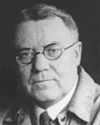
Walter Bradford Cannon
(19 Oct 1871 - 1 Oct 1945)
American physiologist and neurologist who devised the term homeostasis (1930) while referring to how the body maintains its temperature, among other key variables.
|
Science Quotes by Walter Bradford Cannon (12 quotes)
“These changes in the body,” he wrote in the review paper he sent to the American Journal of Physiology late in 1913, “are, each one of them, directly serviceable in making the organism more efficient in the struggle which fear or rage or pain may involve; for fear and rage are organic preparations for action, and pain is the most powerful known stimulus to supreme exertion. The organism which with the aid of increased adrenal secretion can best muster its energies, can best call forth sugar to supply the labouring muscles, can best lessen fatigue, and can best send blood to the parts essential in the run or the fight for life, is most likely to survive. Such, according to the view here propounded, is the function of the adrenal medulla at times of great emergency.”
— Walter Bradford Cannon
Quoted in S. Benison, A. C. Barger and E. L. Wolfe, Walter B Cannon: The Life and Times of a Young Scientist (1987), 311.
As he approached the place where a meeting of doctors was being held, he saw some elegant limousines and remarked, “The surgeons have arrived.” Then he saw some cheaper cars and said, “The physicians are here, too.” ... And when he saw a row of overshoes inside, under the hat rack, he is reported to have remarked, “Ah, I see there are laboratory men here.”
— Walter Bradford Cannon
The Way of an Investigator (1945, 1965), 207.
Chance throws peculiar conditions in everyone's way. If we apply intelligence, patience and special vision, we are rewarded with new creative breakthroughs.
— Walter Bradford Cannon
Told to his Harvard students. As quoted, without citation, by Marcus Bach, 'Serendiptiy in the Business World', in The Rotarian (Oct 1981), 139, No. 4, 40. If you know a primary source, please contact Webmaster.
Fear, rage and pain, and the pangs of hunger are all primitive experiences which human beings share with the lower animals. These experiences are properly classed as among the most powerful that determine the action of men and beasts
— Walter Bradford Cannon
From Bodily Changes in Pain, Hunger, Fear, and Rage: An Account of Recent Researches into the Function of Emotional Excitement (1915), vii.
Investigators are commonly said to be engaged in a search for the truth. I think they themselves would usually state their aims less pretentiously. What the experimenter is really trying to do is to learn whether facts can be established which will be recognized as facts by others and which will support some theory that in imagination he has projected. But he must be ingenuously honest. He must face facts as they arise in the course of experimental procedure, whether they are favourable to his idea or not. In doing this he must be ready to surrender his theory at any time if the facts are adverse to it.
— Walter Bradford Cannon
The Way of an Investigator: A Scientist's Experiences in Medical Research (1945), 34.
Since the stomach gives no obvious external sign of its workings, investigators of gastric movements have hitherto been obliged to confine their studies to pathological subjects or to animals subjected to serious operative interference. Observations made under these necessarily abnormal conditions have yielded a literature which is full of conflicting statements and uncertain results. The only sure conclusion to be drawn from this material is that when the stomach receives food, obscure peristaltic contractions are set going, which in some way churn the food to a liquid chyme and force it into the intestines. How imperfectly this describes the real workings of the stomach will appear from the following account of the actions of the organ studied by a new method. The mixing of a small quantity of subnitrate of bismuth with the food allows not only the contractions of the gastric wall, but also the movements of the gastric contents to be seen with the Röntgen rays in the uninjured animal during normal digestion.
— Walter Bradford Cannon
In 'The Movements of the Stomach Studied by Means of the Röntgen Rays,' American Journal of Physiology (1898), 1, 359-360.
The constant conditions which are maintained in the body might be termed equilibria. That word, however, has come to have fairly exact meaning as applied to relatively simple physico-chemical states, in closed systems, where known forces are balanced. The coordinated physiological processes which maintain most of the steady states in the organism are so complex and so peculiar to living beings—involving, as they may, the brain and nerves, the heart, lungs, kidneys and spleen, all working cooperatively—that I have suggested a special designation for these states, homeostasis. The word does not imply something set and immobile, a stagnation. It means a condition—a condition which may vary, but which is relatively constant.
— Walter Bradford Cannon
In The Wisdom of the Body (1932), 24.
The heat produced in maximal muscular effort, continued for twenty minutes, would be so great that, if it were not promptly dissipated, it would cause some of the albuminous substances of the body to become stiff, like a hard-boiled egg.
— Walter Bradford Cannon
The investigator may be made to dwell in a garret, he may be forced to live on crusts and wear dilapidated clothes, he may be deprived of social recognition, but if he has time, he can steadfastly devote himself to research. Take away his free time and he is utterly destroyed as a contributor to knowledge.
— Walter Bradford Cannon
From 'The Career of the Investigator', collected in J. McKeen Cattell (ed.), Science and Education: Vol. 2: Medical Research and Education (1913), 301.
The steady states of the fluid matrix of the body are commonly preserved by physiological reactions, i.e., by more complicated processes than are involved in simple physico-chemical equilibria. Special designations, therefore, are appropriate:—“homeostasis” to designate stability of the organism; “homeostatic conditions,” to indicate details of the stability; and “homeostatic reactions,” to signify means for maintaining stability.
— Walter Bradford Cannon
'Physiological Regulation of Normal States: Some Tentative Postulates Concerning Biological Homeostatics', 1926. Reprinted in L. L. Langley (ed.), Homeostasis: Origins of the Concept (1973), 246.
These changes—the more rapid pulse, the deeper breathing, the increase of sugar in the blood, the secretion from the adrenal glands—were very diverse and seemed unrelated. Then, one wakeful night, after a considerable collection of these changes had been disclosed, the idea flashed through my mind that they could be nicely integrated if conceived as bodily preparations for supreme effort in flight or in fighting. Further investigation added to the collection and confirmed the general scheme suggested by the hunch.
— Walter Bradford Cannon
The Way of an Investigator: A Scientist's Experiences in Medical Research (1945), 59-60.
Time... is an essential requirement for effective research. An investigator may be given a palace to live in, a perfect laboratory to work in, he may be surrounded by all the conveniences money can provide; but if his time is taken from him he will remain sterile.
— Walter Bradford Cannon
Quoted in S. Benison, A. C. Barger and E. L. Wolfe, Walter B Cannon: The Life and Times of a Young Scientist (1987), 253.
Quotes by others about Walter Bradford Cannon (1)
I heard Professor Cannon lecture last night, going partly on your account. His subject was a physiological substitute for war—which is international sports and I suppose motorcycle races—to encourage the secretion of the adrenal glands!
Letter from James McKeen Cattell to his son, McKeen. In S. Benison, A. C. Barger and E. L. Wolfe, Walter B Cannon: The Life and Times of a Young Scientist (1987), 319.
See also:
- 19 Oct - short biography, births, deaths and events on date of Cannon's birth.
- The Mechanical Factors of Digestion, by Walter Bradford Cannon. - book suggestion.
 In science it often happens that scientists say, 'You know that's a really good argument; my position is mistaken,' and then they would actually change their minds and you never hear that old view from them again. They really do it. It doesn't happen as often as it should, because scientists are human and change is sometimes painful. But it happens every day. I cannot recall the last time something like that happened in politics or religion.
(1987) --
In science it often happens that scientists say, 'You know that's a really good argument; my position is mistaken,' and then they would actually change their minds and you never hear that old view from them again. They really do it. It doesn't happen as often as it should, because scientists are human and change is sometimes painful. But it happens every day. I cannot recall the last time something like that happened in politics or religion.
(1987) -- 




