THE EXTINCT QUAGGA
from: Mostly Mammals, Zoological Essays (1903)
by Richard Lydekker
[p.252] When the Dutch first colonised that part of Africa of which Cape Town now forms the capital, they found the country absolutely swarming with a great variety of species of large game and other animals, whose form and appearance were for the most part unfamiliar. As they themselves came from a land which had long since been stripped of the larger members of its fauna, it is possible that unfamiliarity with these prototypes was one of the causes which led to the indiscriminate and often inappropriate bestowal of the names of the large mammals of Europe, or compounds of the same, on the animals of the new country. What, for instance, can be more inappropriate than the transference of the Dutch name for elk (eland) to the largest of the Cape antelopes—unless, indeed (which is scarcely likely), the settlers were acquainted with the fact that etymologically the word signifies, in its Greek original, “strength”? Neither is hartebeest (stag-ox) much better, although wildebeest (wild ox) is by no means an unsuitable designation for the animals known to the Hottentots by the title of gnu. Bastard hartebeest, on the other hand, is a cumbrous and senseless name for the antelope the Bechuanas call tsessabe, and it is much to be regretted that the Boers did not see fit to adopt for South African animals the native titles they found ready to hand.
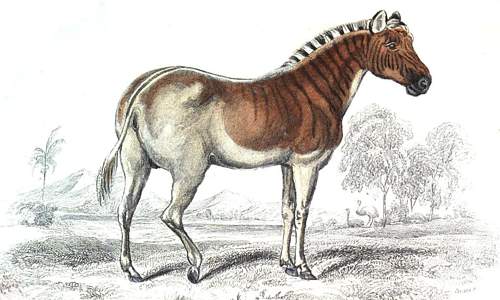
[p.253] In two instances, and apparently in two only, so far as the larger animals are concerned, they did, however, adopt this practice. The first instance is that of the large and handsome spiral-horned antelope now univer-sally known as kudu, a name which is certainly not Dutch, and is believed by Sir Harry Johnston to be of Hottentot origin, since it is unknown to the Kaffirs or other tribes who speak dialects of the Bantu language. The second case is that of the animal forming the subject of this article, which is now universally known as quagga, from a corruption of its Hottentot name quacha, pronounced by the natives as “quaha.” Even in this instance, however, the Boers appear at first to have displayed considerable reluctance to adopt the native name, for they originally called the animal wilde esel (wild ass) in the same way as they christened its cousin, Burchell’s zebra, wilde paard, or wild horse. Eventually, however, better counsels prevailed, and Equus quagga became known to the Cape Dutch by the aforesaid native name, while the wilde paard (whose early title still survives in Paardeberg) was renamed bonte quacha, or striped quagga. When, however, the true quagga became very rare and eventually exterminated, the prefix bonte was dropped from the Dutch designation of Burchell’s zebra, which was henceforth known throughout South Africa as the quacha, or quagga, pure and simple. Hence much confusion, and possibly also a factor in the extermination of the species to which that title of right belonged. For as the name in question continued to be in common use in South Africa at the time the the quagga was on the point of extermination, it is quite probable that this may have been the reason why the attention of naturalists in Europe was not drawn to its impending fate while there was yet time.
[p.254] According to the best obtainable evidence the quagga appears to have become extinct, in Cape Colony at any rate*, about the year 1865, at which date a specimen was actually living in the London Zoological Society’s menagerie; while another had died there only the year before. Of the latter example, a male, presented to the Society in 1858 by the late Sir George Grey, the carcase was fortunately acquired by the British Museum, where both its skin and skeleton are now preserved. The former specimen—a female purchased in 1851—survived till the summer of 1872, when its carcase was sold (apparently without the least idea of its priceless value) to a London taxidermist, from whom the mounted skin was acquired many years after by Mr. Walter Rothschild, for his museum at Tring. Not impossibly, this specimen was actually the last survivor of its kind, although, as already said, there was not even a suspicion that it belonged to a rare species. Most fortunately for natural history, a photograph of this animal was taken in the summer of 1870 by Messrs. York & Son, and it is from that picture that most of the later figures of the animal appear to have been taken. It is probably the only photograph of a living specimen in existence.
According to a note published by the Secretary, in the Proceedings for 1891, the only other example of the quagga in the London Zoological Society’s menagerie was one purchased in 1831. No record of its death appears to have been preserved, but it may have been the same [p.255] specimen of which the skin was exhibited in the Society’s old museum in 1838, or thereabouts. These, however, were by no means the only specimens brought alive to England, for as early as 1815 one was in the possession of Lord Morton, while somewhat later on in the last century Mr. Sheriff Parkins was in the habit of driving two quaggas in a phaeton about London, and in narrating this circumstance the late Colonel Hamilton Smith mentions that he himself had been drawn in a gig by one of these animals, which showed “as much temper and delicacy of mouth as any domestic horse.” Another quagga was in the possession of a former Prince of Wales, and there are records of others in England. The skulls of the two driven by Mr. Parkins, as well as a portrait of one of them, are preserved in the Museum of the Royal College of Surgeons.
In addition to the specimens in the British, Edinburgh, and Tring museums, several skins are preserved on the Continent. With one exception, all appear to be of the same general type as the London example photographed by Messrs. York in 1870. The exception is one in the Imperial Museum at Vienna, of which a description and photograph have recently been published by the Director, Dr. L. von Lorenz, In the Proceedings of the Zoological Society of London. Unfortunately there is no record as to the locality where the Vienna specimen (which is a female) was obtained, all that is known being that it was acquired by purchase in 1836.
Compared with the ordinary type of quagga, as exemplified by York’s photograph, the Vienna animal is of somewhat larger dimensions, with a creamy buff (instead of greyish or chocolate-brown) ground-colour on the upper parts, with the exception of the head, which is clay-brown. A more striking [p.256] difference is to be found in the broader dark stripes (of which there seem to be more in a given space), and a corresponding decrease in the width of the intervening light intervals. The stripes also seem to extend farther back on the body.
But there is also a difference between quaggas of the type of the one photographed by York and those figured by the early writers, as exemplified by the plate in Colonel Hamilton Smith’s volume on horses in the “Naturalists’ Library.” In the specimen there represented, which not improbably came from Cape Colony, the head, neck, and forequarters are marked by narrow black stripes on a chestnut ground. The markings are, indeed, as Dr. von Lorenz remarks, just the reverse of those of the Vienna specimen; the British Museum example and the one figured by York being in some degree intermediate between these two extreme types.
With some hesitation, Dr. von Lorenz suggests that there may have been local races of the quagga, as there are of Burchell’s zebra.
Even in the days of its abundance the quagga (which, by the way, takes its name from its cry) had a comparatively limited distribution, ranging from the Cape Colony up the eastern side of Africa as far as the Vaal River, beyond which it appears to have been unknown. In this respect it closely resembled the white-tailed gnu, which, however, is known to have crossed that river in one district. Curiously enough, the two species lived in close comradeship, and in the old days their vast herds formed a striking feature in the landscape of the open plains of the Orange River Colony. Both have now disappeared from the face of the country, (or the white-tailed gnu, if, indeed, any are now left, only exists in a semi-domesticated state on a few farms.
Owing to its rank flavour, and especially its yellow fat, [p.257] the flesh of the quagga was almost uneatable by Europeans, although it was keenly relished by the Hottentots, who, in the early days of the Cape Colony, were largely fed upon it by their Dutch masters. Whether this was the cause of its comparatively early disappearance from that part of the country, it is now impossible to say, but certain it is that when Sir Cornwallis Harris made his trip to the interior in 1836, quaggas were no longer to be met with in any numbers in Cape Colony, although Colonel Hamilton Smith, writing a few years later, states that they were still to be found within its limits. North of the Vaal River they occurred, however, in their original multitudes, and it was not till about the middle of the last century that the Boers took to hide-hunting, and thus in a few years accomplished the extermination of the species.
Allusion has already been made to the facility with which the quagga could be broken to harness, and it seems probable that the species could have been more easily domesticated than any of its South African relatives. Another trait in its disposition is worth brief mention. It was said to be the boldest and fiercest of the whole equine tribe, attacking and driving off both the wild dog and the spotted hyaena. On this account the Boers are stated to have frequently kept a few tame quaggas on their farms, which were turned out at night to graze with the horses in order to protect them from the attacks of beasts of prey.
Throughout the whole of the plain country to the south of the Vaal River the quagga was the sole wild representative of the horse family, the true zebra being confined to the mountains of Cape Colony and adjacent districts. North of the Vaal River the veldt was, however, dotted [p.258] over with herds of Burchell’s zebra, the aforesaid bonte quagga, which, inclusive of its local races, has a very extensive geographical distribution in East and Central Africa. It is scarcely necessary to say that this species differed from the quagga in having the whole or the greater part of the body striped, as well as by the more brilliant coloration and the pattern of the striping. One very remarkable feature in connection with this species must not be passed over without notice. In the original and typical race (now nearly extinct), which was obtained just north of the Vaal River, in British Bechuanaland, and therefore immediately adjacent to the northern limits of the quagga, the whole of the legs, as well as a considerable portion of the hindquarters, are devoid of stripes. In this respect the typical form of the Transvaal species comes much nearer to the last-mentioned animal than do the races from more northern districts, in which the hindquarters and legs are more or less completely striped; the striping attaining its fullest development in the most northern race of all, the so-called Grant’s zebra of Somaliland and Abyssinia.
Of course, these gradations towards the quagga type of coloration of the more southern representatives of Burchell’s zebra, as well as the differences in the coloration of the quagga itself as compared with zebras, have a meaning and a reason, if only they could be discovered. And it may be remarked incidentally in this place that unless we attempt to account rationally for such variations, there is little justification for the modern practice of distinguishing between the local races of variable species.
The striping of the zebras, which there is considerable cause for regarding as the primitive type of coloration of the horse family in general, is evidently of a protective nature. [p.259] It was stated some years ago that zebras a short distance off were absolutely invisible in bright moonlight, and I have reason to believe that the same is to a great extent the case in sunlight. For some reason or other the species inhabiting the plains (not the mountains, be it observed) of South Africa have tended to discard this striped coloration, the southern race of Burchell’s zebra exhibiting the first, and the quagga the second stage in this transformation. In North Africa the transformation has been carried a stage farther, the wild asses of the Red Sea littoral having discarded their stripes almost completely in favour of a uniform grey or tawny livery. In this part of the continent there is now no trace of a transitional form, whatever may have been the case in the past, and we thus have the sharp contrast between the uniformly coloured wild asses of the coast of the Red Sea on the one hand, and the fully striped zebras of Abyssinia and Southern Somaliland on the other.
Whether there is anything in the climatic and other physical conditions of the plains of Cape Colony which renders a partially striped species less conspicuous than one in which the striping is fully developed, the disappearance of the quagga makes it now impossible to determine. But observation might advantageously be directed to the comparative invisibility, or otherwise, of the wild asses of the Red Sea littoral and the fully striped zebras of the interior, and whether this would be affected in any degree by the transference of the one to the habitat of the other. Whatever be the explanation, the fact remains that at the opposite extremities of Africa some of the members of the equine tribe have developed a tendency to the replacement of a striped livery by one of a uniform and sober hue, and that in the south of the continent this tendency [p.260] exists only in the species inhabiting the plains. Moreover, it is only in South Africa that the transitional form is met with, and only in the north of the continent that the striping has been completely lost.
But, as I have already mentioned in earlier articles, this is only one phase of a general tendency among mammals to replace their spots or stripes by a uniformly coloured coat.
So far as I am aware, no one has ever attempted to give a philosophical reason for this remarkable tendency. But till an adequate explanation of the phenomenon be forthcoming, naturalists, to repeat the words of a well-known ornithologist, have left half their work (and I am inclined to think the more important half) undone. Without ascertaining the reason for phenomena of this nature; our zoological work is, indeed, as though a man were content with describing the mechanism of a complicated machine without an inkling as to its use.
One word more, and I have done. To the systematic zoologist, the quagga is an animal of special interest as affording evidence of the intimate relationship between the zebras and the wild asses. Although, judging from its geographical distribution, it was probably not the actual transitional form between the two groups, yet it serves to show the manner in which the transition was effected.
* From the fact that a skin was purchased by the Edinburgh Museum in 1879, Mr. G. Renshaw (Zoologist, February, 1901) has suggested that the species may have survived in the Orange River Colony till about that date; but the Edinburgh specimen appears to have been an old one at the date of its purchase.





