 (source)
|
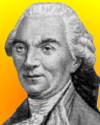
Comte Georges-Louis Leclerc de Buffon
(7 Sep 1707 - 16 Apr 1788)
French naturalist who formulated a crude theory of evolution and was the first to suggest that the earth might be older than suggested by the Bible. He proposed that the Earth was hot at its creation.
|
Science Quotes by Comte Georges-Louis Leclerc de Buffon (30 quotes)
>> Click for Comte Georges-Louis Leclerc de Buffon Quotes on | Nature | Observation |
>> Click for Comte Georges-Louis Leclerc de Buffon Quotes on | Nature | Observation |

Rassemblons des faits pour nous donner des idées.
Let us gather facts in order to get ourselves thinking.
Let us gather facts in order to get ourselves thinking.
— Comte Georges-Louis Leclerc de Buffon
'Histoire des Animaux', Histoire Naturelle, Générale et Particulière, avec la Description du Cabinet du Roi (1749), Vol. 2, 18. Quoted in Jacques Roger, The Life Sciences in Eighteenth- Century French Thought, ed. Keith R. Benson and trans. Robert Ellrich (1997), 440.
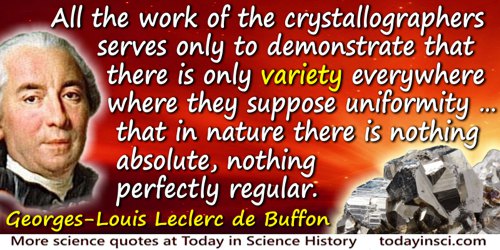
All the work of the crystallographers serves only to demonstrate that there is only variety everywhere where they suppose uniformity … that in nature there is nothing absolute, nothing perfectly regular.
— Comte Georges-Louis Leclerc de Buffon
In Histoire Naturelle des Minéraux (1783-88), Vol. 3, 433.
Although the works of the Creator may be in themselves all equally perfect, the animal is, as I see it, the most complete work of nature, and man is her masterpiece.
— Comte Georges-Louis Leclerc de Buffon
'Histoire des Animaux', Histoire Naturelle, Générale et Particulière, Avec la Description du Cabinet du Roi (1749), Vol. 2, 2. Quoted in Jacques Roger, The Life Sciences in Eighteenth -Century French Thought, ed. Keith R. Benson and trans. Robert Ellrich (1997), 437.
An Individual, whatever species it might be, is nothing in the Universe. A hundred, a thousand individuals are still nothing. The species are the only creatures of Nature, perpetual creatures, as old and as permanent as it. In order to judge it better, we no longer consider the species as a collection or as a series of similar individuals, but as a whole independent of number, independent of time, a whole always living, always the same, a whole which has been counted as one in the works of creation, and which, as a consequence, makes only a unity in Nature.
— Comte Georges-Louis Leclerc de Buffon
'De la Nature: Seconde Vue', Histoire Naturelle, Générale et Particulière, Avec la Description du Cabinet du Roi (1765), Vol. 13, i. Trans. Phillip R. Sloan.
As historians, we refuse to allow ourselves these vain speculations which turn on possibilities that, in order to be reduced to actuality, suppose an overturning of the Universe, in which our globe, like a speck of abandoned matter, escapes our vision and is no longer an object worthy of our regard. In order to fix our vision, it is necessary to take it such as it is, to observe well all parts of it, and by indications infer from the present to the past.
— Comte Georges-Louis Leclerc de Buffon
'Second Discours: Histoire et Theorie de la Terre', Histoire Naturelle, Ginerale et Particulière, Avec la Description du Cabinet du Roi (1749), Vol. 1, 98-9. Trans. Phillip R. Sloan.
Far from becoming discouraged, the philosopher should applaud nature, even when she appears miserly of herself or overly mysterious, and should feel pleased that as he lifts one part of her veil, she allows him to glimpse an immense number of other objects, all worthy of investigation. For what we already know should allow us to judge of what we will be able to know; the human mind has no frontiers, it extends proportionately as the universe displays itself; man, then, can and must attempt all, and he needs only time in order to know all. By multiplying his observations, he could even see and foresee all phenomena, all of nature's occurrences, with as much truth and certainty as if he were deducing them directly from causes. And what more excusable or even more noble enthusiasm could there be than that of believing man capable of recognizing all the powers, and discovering through his investigations all the secrets, of nature!
— Comte Georges-Louis Leclerc de Buffon
'Des Mulets', Oeuvres Philosophiques, ed. Jean Piveteau (1954), 414. Quoted in Jacques Roger, The Life Sciences in Eighteenth-Century French Thought, ed. Keith R. Benson and trans. Robert Ellrich (1997), 458.
For deciding what has occurred and even what will occur, we have only to examine what is occurring.
— Comte Georges-Louis Leclerc de Buffon
In Theory of the Earth, from the original French, “Pour juger de ce qui est arrivé, et même de ce qui arrivera, nous n’avons qu’à examiner ce qui arrive.” Collected in Théorie de la Terre (1749), collected in Oeuvres Complètes de Buffon (1837), 42. As quoted and translated in Reijer Hooykaas, Selected Studies in History of Science (1983), 513.
o2BGAAAAYAAJ - Translate this page
Georges Louis Leclerc comte de Buffon - 1837
For the little that one has reflected on the origin of our knowledge, it is easy to perceive that we can acquire it only by means of comparison. That which is absolutely incomparable is wholly incomprehensible. God is the only example that we could give here. He cannot be comprehended, because he cannot be compared. But all which is susceptible of comparison, everything that we can perceive by different aspects, all that we can consider relatively, can always be judged according to our knowledge.
— Comte Georges-Louis Leclerc de Buffon
'Histoire naturelle de l'Homme', Histoire Naturelle, Générale et Particulière, Avec la Description du Cabinet du Roi (1749), Vol. 2, 431. Trans. Phillip R. Sloan.
Genius is nothing but a great aptitude for patience.
— Comte Georges-Louis Leclerc de Buffon
Inaugural speech at the French Academy (1753). Quoted in Hans Theodore David, Arthur Mendel and Christoph Wolff, The New Bach Reader (1998), 20. Also seen translated as “Genius is simply patience carried to the extreme,” or shortened as “Genius is patience.” The latter is also sometimes seen attributed (incorrectly?) to Isaac Newton, for example, in Lady Isabel Burton, The Life of Captain Sir Richd F. Burton (1893), Vol. 1, 577. Webmaster has found no primary source from Newton. Also seen attributed to Santiago Ramon y Cajal, but he was only quoting Buffon, translated as “Genius is simply patience carried to the extreme,” in Advice for a Young Investigator (1999), 39. Translated from the original French, “Le génie n'est qu'une grande aptitude à la patience.”
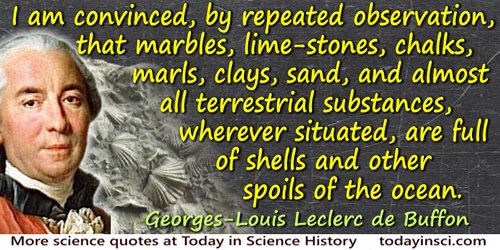
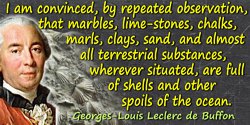
I am convinced, by repeated observation, that marbles, lime-stones, chalks, marls, clays, sand, and almost all terrestrial substances, wherever situated, are full of shells and other spoils of the ocean.
— Comte Georges-Louis Leclerc de Buffon
'Second Discours: Histoire & Théorie de la Terre', Histoire Naturelle, Générale et Particulière, Avec la Description du Cabinet du Roi (1749), Vol. I, 76-77; Natural History, General and Particular (1785), Vol. I, trans. W. Smellie, 13.
In general, the more one augments the number of divisions of the productions of nature, the more one approaches the truth, since in nature only individuals exist, while genera, orders, and classes only exist in our imagination.
— Comte Georges-Louis Leclerc de Buffon
Histoire Naturelle (1749), trans. by John Lyon, The 'Initial Discourse' to Buffon’s Histoire Naturelle: The First Complete English Translation, Journal of the History of Biology, 9(1), 1976, 164.
In Ireland, there are the same fossils, the same shells and the same sea bodies, as appear in America, and some of them are found in no other part of Europe.
— Comte Georges-Louis Leclerc de Buffon
'Preuves de la Théorie de la Terre', Histoire Naturelle, Generale et Particulière, Avec la Description du Cabinet du Roi (1749), Vol. I, 606; Natural History: Theory of the Earth (1749), Vol. I, Trans. W. Smellie (1785), 507.
It appears that all that can be, is. The Creator’s hand does not appear to have been opened in order to give existence to a certain determinate number of species, but it seems that it has thrown out all at once a world of relative and non-relative creatures, an infinity of harmonic and contrary combinations and a perpetuity of destructions and replacements. What idea of power is not given us by this spectacle! What feeling of respect for its Author is not inspired in us by this view of the universe!
— Comte Georges-Louis Leclerc de Buffon
In 'Premier Discours: De la Manière d'Étudier et de Traiter l'Histoire naturelle', Histoire Naturelle, Generale et Particulière, Avec la Description du Cabinet du Roi (1749), Vol. I, 11. Trans. Phillip R. Sloan.
Just as, in civil History, one consults title-deeds, one studies coins, one deciphers ancient inscriptions, in order to determine the epochs of human revolutions and to fix the dates of moral [i.e. human] events; so, in Natural History, one must excavate the archives of the world, recover ancient monuments from the depths of the earth, collect their remains, and assemble in one body of proofs all the evidence of physical changes that enable us to reach back to the different ages of Nature. This, then, is the order of the times indicated by facts and monuments: these are six epochs in the succession of the first ages of Nature; six spaces of duration, the limits of which although indeterminate are not less real; for these epochs are not like those of civil History ... that we can count and measure exactly; nevertheless we can compare them with each other and estimate their relative duration.
— Comte Georges-Louis Leclerc de Buffon
'Des Époques de la Nature', Histoire Naturelle, Générale et Particulière contenant les Époques de la Nature (1778), Supplement Vol. 9, 1-2, 41. Trans. Martin J. Rudwick.
Let us investigate more closely this property common to animal and plant, this power of producing its likeness, this chain of successive existences of individuals, which constitutes the real existence of the species.
— Comte Georges-Louis Leclerc de Buffon
'De la Reproduction en Générale et particulière', Histoire Naturelle, Générale et Particulière, Avec la Description du Cabinet du Roi (1749), Vol. 2, 18. Trans. Phillip R. Sloan.
Let us suppose, that the Old and New worlds were formerly but one continent, and that, by a violent earthquake, the ancient Atalantis [sic] of Plato was sunk ... The sea would necessarily rush in from all quarters, and form what is now called the Atlantic ocean.
— Comte Georges-Louis Leclerc de Buffon
'Second Discours: Histoire et Théorie de la Terre', Histoire Naturelle, Générale et Particulière, Avec la Description du Cabinet du Roi (1749), Vol. I, 96; Natural History, General and Particular (1785), Vol. I, trans. W. Smellie, 31.
Nature is the system of laws established by the Creator for the existence of things and for the succession of creatures. Nature is not a thing, because this thing would be everything. Nature is not a creature, because this creature would be God. But one can consider it as an immense vital power, which encompasses all, which animates all, and which, subordinated to the power of the first Being, has begun to act only by his order, and still acts only by his concourse or consent ... Time, space and matter are its means, the universe its object, motion and life its goal.
— Comte Georges-Louis Leclerc de Buffon
'De la Nature: Premiere Vue', Histoire Naturelle, Générale et Particulière, Avec la Description du Cabinet du Roi (1764), Vol. 12, iii-iv. Trans. Phillip R. Sloan.
Nature progresses by unknown gradations and consequently does not submit to our absolute division when passing by imperceptible nuances, from one species to another and often from one genus to another. Inevitably there are a great number of equivocal species and in-between specimens that one does not know where to place and which throw our general systems into turmoil.
— Comte Georges-Louis Leclerc de Buffon
Jean Piveteau (ed.), Oeuvres Philosophiques de Buffon (1965), 10. Trans. in Paul Farber, 'Buffon and the Concept of Species', in Journal of the History of Biology, 1972, 5, 260.
Nature, displayed in its full extent, presents us with an immense tableau, in which all the order of beings are each represented by a chain which sustains a continuous series of objects, so close and so similar that their difference would be difficult to define. This chain is not a simple thread which is only extended in length, it is a large web or rather a network, which, from interval to interval, casts branches to the side in order to unite with the networks of another order.
— Comte Georges-Louis Leclerc de Buffon
'Les Oiseaux Qui Ne Peuvent Voler', Histoire Naturelle des Oiseaux (1770), Vol. I, 394. Trans. Phillip R. Sloan.
One can descend by imperceptible degree from the most perfect creature to the most shapeless matter, from the best-organised animal to the roughest mineral.
— Comte Georges-Louis Leclerc de Buffon
'Premier Discours: De la Manière d'Étudier et de Traiter l'Histoire naturelle'. In Oeuvres Complètes (1774-79), Vol. I, 17.
Only those works which are well-written will pass to posterity: the amount of knowledge, the uniqueness of the facts, even the novelty of the discoveries are no guarantees of immortality ... These things are exterior to a man but style is the man himself.
— Comte Georges-Louis Leclerc de Buffon
'Discours prononcé dans l'Académie française, Le Samedi 25 Aout 1753', Histoire Naturelle, Générale et Particulière, Avec la Description du Cabinet du Roi (1753), Vol. 7, xvi-xvii.
The great workman of nature is time.
— Comte Georges-Louis Leclerc de Buffon
'Les Animaux Sauvages', Histoire Naturelle, Générale et Particulière, Avec la Description du Cabinet du Roi (1756), Vol. 6, 60. Quoted in Jacques Roger, The Life Sciences in Eighteenth -Century French Thought, ed. Keith R. Benson and trans. Robert Ellrich (1997), 468.
The greatest marvel is not in the individual. It is in the succession, in the renewal and in the duration of the species that Nature would seem quite inconceivable. This power of producing its likeness that resides in animals and plants, this form of unity, always subsisting and appearing eternal, this procreative virtue which is perpetually expressed without ever being destroyed, is for us a mystery which, it seems, we will never be able to fathom.
— Comte Georges-Louis Leclerc de Buffon
'Histoire des Animaux', Histoire Naturelle, Générale et Particulière, avec la Description du Cabinet du Roi (1749), Vol. 2, 3. Trans. Phillip R. Sloan.
The sublime can only be found in the great subjects. Poetry, history and philosophy all have the same object, and a very great object—Man and Nature. Philosophy describes and depicts Nature. Poetry paints and embellishes it. It also paints men, it aggrandizes them, it exaggerates them, it creates heroes and gods. History only depicts man, and paints him such as he is.
— Comte Georges-Louis Leclerc de Buffon
'Discours Prononcé a L' Académie française par M. De Buffon. Le Jour de sa Reception 25 Aout 1753'. Supplement a T.iv (1753), Histoire Naturelle, Générale et Particulière, Avec la Description du Cabinet du Roi (1777), 11. Trans. Phillip R. Sloan.
There are several kinds of truths, and it is customary to place in the first order mathematical truths, which are, however, only truths of definition. These definitions rest upon simple, but abstract, suppositions, and all truths in this category are only constructed, but abstract, consequences of these definitions ... Physical truths, to the contrary, are in no way arbitrary, and do not depend on us.
— Comte Georges-Louis Leclerc de Buffon
'Premier Discours: De la Manière d'Étudier et de Traiter l'Histoire naturelle', Histoire Naturelle, Generale et Particulière, Avec la Description du Cabinet du Roi (1749), Vol. I, 53-4. Trans. Phillip R. Sloan.
There is in Nature a general prototype in each species on which each individual is modeled, but which seems, in realizing itself, to alter itself or perfect itself according to circumstances. So that, relative to certain qualities, this is an extraordinary appearing variation in the succession of these individuals, and at the same time a constancy which appears wonderful in the entire species. The first animal, the first horse, for example, has been the external model and the interieur mold on which all horses which have been born, all those which now exist, and all those which will be born have been formed.
— Comte Georges-Louis Leclerc de Buffon
'Le Cheval', Histoire Naturelle, Générale et Particulière, Avec la Description du Cabinet du Roi (1753), Vol. 4, 215-6. Trans. Phillip R. Sloan.
To be and to think are one and the same for us.
— Comte Georges-Louis Leclerc de Buffon
'De la Nature de l'Homme', Histoire Naturelle, Générale et Particulière, Avec la Description du Cabinet du Roi (1749), Vol. 2, 432. Quoted in Jacques Roger, The Life Sciences in Eighteenth- Century French Thought, ed. Keith R. Benson and trans. Robert Ellrich (1997), 434.
We can only penetrate the rind of the earth.
— Comte Georges-Louis Leclerc de Buffon
'Second Discours: Histoire & Théorie de la Terre', Histoire Naturelle, Générale et Parliculière, Avec la Description du Cabinet du Roi (1749),Vol. I, 70; Natural History, General and Particular (1785), Vol. I, trans. W. Smellie, 6.
We may conclude, that the flux and reflux of the ocean have produced all the mountains, valleys, and other inequalities on the surface of the earth; that currents of the sea have scooped out the valleys, elevated the hills, and bestowed on them their corresponding directions; that that same waters of the ocean, by transporting and depositing earth, &c., have given rise to the parallel strata; that the waters from the heavens gradually destroy the effects of the sea, by continually diminishing the height of the mountains, filling up the valleys, and choking the mouths of rivers; and, by reducing every thing to its former level, they will, in time, restore the earth to the sea, which, by its natural operations, will again create new continents, interspersed with mountains and valleys, every way similar to those we inhabit.
— Comte Georges-Louis Leclerc de Buffon
'Second Discours: Histoire et Théorie de la Terre', Histoire Naturelle, Générale et Particulière, Avec la Description du Cabinet du Roi (1749), Vol. I, 124; Natural History, General and Particular (1785), Vol. I, Irans. W. Smellie, 57-8.
When I read an Italian letter [Saggio by Voltaire] on changes which had occurred on the surface of the earth, published in Paris this year (1746), I believed that these facts were reported by La Loubère. Indeed, they correspond perfectly with the author’s ideas. Petrified fish are according to him merely rare fish thrown away by Roman cooks because they were spoiled; and with respect to shells, he said that they were from the sea of the Levant and brought back by pilgrims from Syria at the time of the crusades. These shells are found today petrified in France, in Italy and in other Christian states. Why did he not add that monkeys transported shells on top of high mountains and to every place where humans cannot live? It would not have harmed his story but made his explanation even more plausible.
— Comte Georges-Louis Leclerc de Buffon
In 'Preuves de la Théorie de la Terre', Histoire Naturelle, Générale et Particuliere, Avec la Description du Cabinet du Roi (1749), Vol. I, 281. Trans. Albert V. and Marguerite Carozzi.
Quotes by others about Comte Georges-Louis Leclerc de Buffon (7)

Speaking one day to Monsieur de Buffon, on the present ardor of chemical inquiry, he affected to consider chemistry but as cookery, and to place the toils of the laboratory on the footing with those of the kitchen. I think it, on the contrary, among the most useful of sciences, and big with future discoveries for the utility and safety of the human race.
Letter to Rev. James Madison (Paris, 19 Jul 1788). In Thomas Jefferson and John P. Foley (ed.), The Jeffersonian Cyclopedia (1900), 135. From H.A. Washington, The Writings of Thomas Jefferson (1853-54). Vol 2, 431.
Majestatis naturæ by ingenium
Genius equal to the majesty of nature.
Genius equal to the majesty of nature.
Inscribed ordered by King Louis XV for the base of a statue of Buffon placed at Muséum National d’Histoire Naturelle de Paris. In M. Guizot, trans. by Robert Black, A Popular History of France from the Earliest Times, Vol. 6.
We may affirm of Mr. Buffon, that which has been said of the chemists of old; though he may have failed in attaining his principal aim, of establishing a theory, yet he has brought together such a multitude of facts relative to the history of the earth, and the nature of its fossil productions, that curiosity finds ample compensation, even while it feels the want of conviction.
In History of the Earth and Animated Nature (1774, 1847), Vol. 1, 73.
Buffon said unreservedly, "Genius is simply patience carried to the extreme." To those who asked how he achieved fame he replied: "By spending forty years of my life bent over my writing desk.”
From Reglas y Consejos sobre Investigacíon Cientifica: Los tónicos de la voluntad. (1897), as translated by Neely and Larry W. Swanson, in Advice for a Young Investigator (1999), 39.
[My uncle said to me…] When I read, forty years ago, that shells from Syria were found in the Alps, I say, I admit, with a slightly mocking tone, that these shells were apparently brought by pilgrims who were returning from Jerusalem. M. de Buffon reprimanded me very sharply in his Theory of the Earth, page 281. I did not want to quarrel with him over shells, but I remain of the same opinion, because the impossibility that the sea formed the mountains is evident to me. Some may tell me that porphyry is made of sea urchin spikes, I’ll believe it when I see white marble is made of ostrich feathers.
Voltaire is recounting one of the reasons his uncle (Abbe Ambroise Bazing) had told him, for disputing Buffon’s claim that the sea that made the mountains. Translated by Webmaster from 'La Défense de Mon Oncle: Des montagnes et des Coquilles', collected in Oeuvres complètes: Histoire.- Mélanges historiques (1817), Tome 15, Chap. 19, 133-134. From the original French; “Quand je lus, il y a quarante ans, qu’on avait trouvé dans les Alpes des coquilles de Syrie, je dis, je l’avoue , d’un ton un peu goguenard, que ces coquilles avaient été apparemment apportées par des pélerins qui revenaient de Jérusalem. M. de Buffon m’en reprit très-vertement dans sa Théorie de la terre, page 281. Je n’ai pas voulu me brouiller avec lui pour des coquilles, mais je suis demeuré dans non opinion, parce que l’impossibilité que la mer ait formé les montagnes m’est démontrée. On a beau me dire que le porphyre est fait de pointes d’oursin, je le croirai quand je verrai que le marbre blanc est fait de plumes d’autruche.” [Note: porphyry is a form of igneous rock. Also note, this passage does NOT appear in 'Les Singularités de la Nature', which may be found elsewhere incorrectly cited as the source. —Webmaster]
Genius itself has been analyzed by the shrewdest observers into a higher capacity of attention. “Genius,” says Helvetius … “is nothing but a continued attention,” (une attention suivie). “Genius,” says Buffon, “is only a protracted patience,” (une longue patience). “In the exact sciences, at least,” says Cuvier, “it is the patience of a sound intellect, when invincible, which truly constitutes genius.” And Chesterfield has also observed, that “the power of applying an attention, steady and undissipated, to a single object, is the sure mark of a superior genius.”
In Lectures on Metaphysics and Logic (1860), Vol. 1, 179.
The world is a museum in which all men are destined to be employed and amused, and they cannot be too much interested in the objects around them. Goldsmith the elegant imitator of Buffon, says “The mere uninformed spectator passes on in gloomy solitude; while the naturalist in every plant, in every insect, and in every pebble, finds something to entertain his curiosity and excite his speculation.”
From Introduction to a Course of Lectures on Natural History: Delivered in the University of Pennsylvania, Nov. 16, 1799 (1800), 19.

See also:
- 7 Sep - short biography, births, deaths and events on date of Buffon's birth.
 In science it often happens that scientists say, 'You know that's a really good argument; my position is mistaken,' and then they would actually change their minds and you never hear that old view from them again. They really do it. It doesn't happen as often as it should, because scientists are human and change is sometimes painful. But it happens every day. I cannot recall the last time something like that happened in politics or religion.
(1987) --
In science it often happens that scientists say, 'You know that's a really good argument; my position is mistaken,' and then they would actually change their minds and you never hear that old view from them again. They really do it. It doesn't happen as often as it should, because scientists are human and change is sometimes painful. But it happens every day. I cannot recall the last time something like that happened in politics or religion.
(1987) -- 





