 (source)
|
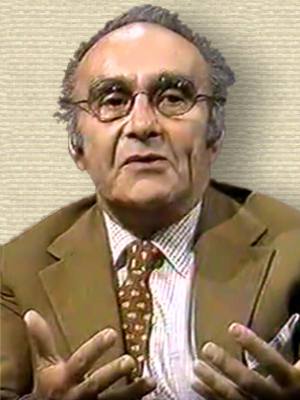
Jacob Bronowski
(18 Jan 1908 - 22 Aug 1974)
Polish-British mathematician and science writer who eloquently presented the case for the humanistic aspects of science as the writer and presenter of the BBC television series, The Ascent of Man.
|
Science Quotes by Jacob Bronowski (53 quotes)
>> Click for Jacob Bronowski Quotes on | Ascent Of Man | Knowledge | Nature | Science |
>> Click for Jacob Bronowski Quotes on | Ascent Of Man | Knowledge | Nature | Science |
[John] Dalton was a man of regular habits. For fifty-seven years he walked out of Manchester every day; he measured the rainfall, the temperature—a singularly monotonous enterprise in this climate. Of all that mass of data, nothing whatever came. But of the one searching, almost childlike question about the weights that enter the construction of these simple molecules—out of that came modern atomic theory. That is the essence of science: ask an impertinent question, and you are on the way to the pertinent answer.
— Jacob Bronowski
The Ascent of Man (1973), 153.
[Science is] the search for unity in the variety of our experience.
— Jacob Bronowski
…...
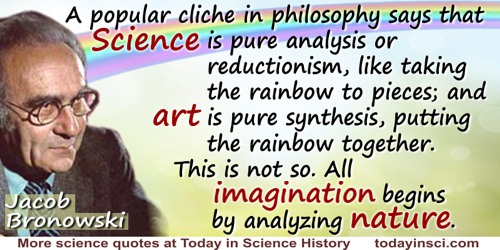
A popular cliche in philosophy says that science is pure analysis or reductionism, like taking the rainbow to pieces; and art is pure synthesis, putting the rainbow together. This is not so. All imagination begins by analyzing nature.
— Jacob Bronowski
In The Ascent of Man (1973).
Abstract thought is the neoteny of the intellect, by which man is able to continue to carry out activities which have no immediate goal.
— Jacob Bronowski
In The Ascent of Man (2011), 324. [The word neoteny refers to the retention of juvenile features in the adult animal. —Webmaster.]
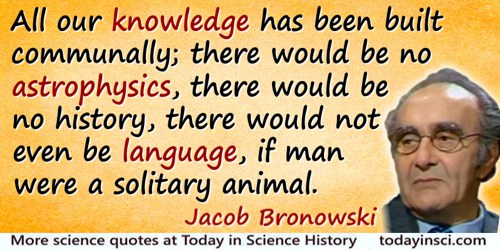
All our knowledge has been built communally; there would be no astrophysics, there would be no history, there would not even be language, if man were a solitary animal. What follows? It follows that we must be able to rely on other people; we must be able to trust their word. That is, it follows that there is a principle, which binds society together because without it the individual would be helpless to tell the truth from the false. This principle is truthfulness.
— Jacob Bronowski
In Lecture at M.I.T. (19 Mar 1953), collected in 'The Sense of Human Dignity', Science and Human Values (1956, 1990), 57.
Among the multitude of animals which scamper, fly, burrow and swim around us, man is the only one who is not locked into his environment. His imagination, his reason, his emotional subtlety and toughness, make it possible for him not to accept the environment, but to change it. And that series of inventions, by which man from age to age has remade his environment, is a different kind of evolution—not biological, but cultural evolution. I call that brilliant sequence of cultural peaks The Ascent of Man. I use the word ascent with a precise meaning. Man is distinguished from other animals by his imaginative gifts. He makes plans, inventions, new discoveries, by putting different talents together; and his discoveries become more subtle and penetrating, as he learns to combine his talents in more complex and intimate ways. So the great discoveries of different ages and different cultures, in technique, in science, in the arts, express in their progression a richer and more intricate conjunction of human faculties, an ascending trellis of his gifts.
— Jacob Bronowski
The Ascent of Man (1973), 19-20.
By the worldly standards of public life, all scholars in their work are of course oddly virtuous. They do not make wild claims, they do not cheat, they do not try to persuade at any cost, they appeal neither to prejudice nor to authority, they are often frank about their ignorance, their disputes are fairly decorous, they do not confuse what is being argued with race, politics, sex or age, they listen patiently to the young and to the old who both know everything. These are the general virtues of scholarship, and they are peculiarly the virtues of science.
— Jacob Bronowski
In Science and Human Values (1956).
Da Vinci was as great a mechanic and inventor as were Newton and his friends. Yet a glance at his notebooks shows us that what fascinated him about nature was its variety, its infinite adaptability, the fitness and the individuality of all its parts. By contrast what made astronomy a pleasure to Newton was its unity, its singleness, its model of a nature in which the diversified parts were mere disguises for the same blank atoms.
— Jacob Bronowski
From The Common Sense of Science (1951), 25.
Dissent is the mark of freedom, as originality is the mark of independence of mind. … No one can be a scientist … if he does not have independence of observation and of thought.
— Jacob Bronowski
Lecture, 'The Sense of Human Dignity', at the Massachusetts Institute of Technology (19 Mar 1953), printed in Science and Human Values (1959), 79.
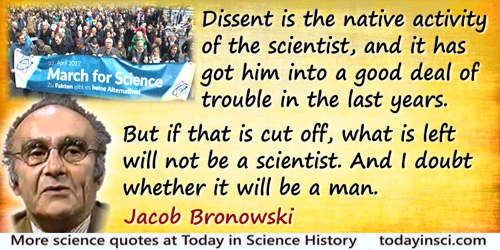
Dissent is the native activity of the scientist, and it has got him into a good deal of trouble in the last years. But if that is cut off, what is left will not be a scientist. And I doubt whether it will be a man.
— Jacob Bronowski
…...
Every thoughtful man who hopes for the creation of a contemporary culture knows that this hinges on one central problem: to find a coherent relation between science and the humanities.
— Jacob Bronowski
With co-author Bruce Mazlish, in The Western Intellectual Tradition (1960).
Fifty years from now if an understanding of man’s origins, his evolution, his history, his progress is not in the common place of the school books we shall not exist.
— Jacob Bronowski
In Ch. 13, 'The Long Childhood', The Ascent of Man, (2011), 328
I grew up to be indifferent to the distinction between literature and science, which in my teens were simply two languages for experience that I learned together.
— Jacob Bronowski
As quoted in J. Wakeman, World Authors 1950 - 1970, (1975), 221-23.
I should feel it a grave sense of loss (as you would) if a hundred years from now Shakespeare and Newton are historical fossils in the ascent of man, in the way that Homer and Euclid are.
— Jacob Bronowski
In The Ascent of Man (2011), 329. Although printed within single quote marks, these words are presumably not verbatim, but only a narrative recollection of a conversation with the author (during WWII, in a taxi, about von Neumann’s Theory of Games).
I wanted to preserve the spontaneity of thought in speech… [and to] guard the spontaneity of the argument. A spoken argument is informal and heuristic; it singles out the heart of the matter and shows in what way it is crucial and new; and it gives the direction and line of the solution so that, simplified as it is, still the logic is right. For me, this philosophic form of argument is the foundation of science, and nothing should be allowed to obscure it.
— Jacob Bronowski
On his philosophy in presenting the TV series, from which the book followed. In 'Foreward', The Ascent of Man, (1973), 14-15.
Induction is the process of generalizing from our known and limited experience, and framing wider rules for the future than we have been able to test fully. At its simplest, then, an induction is a habit or an adaptation—the habit of expecting tomorrow’s weather to be like today’s, the adaptation to the unwritten conventions of community life.
— Jacob Bronowski
It doesn’t matter whether you’re talking about bombs or the intelligence quotients of one race as against another; if a man is a scientist, like me, he’ll always say “Publish and be damned.”
— Jacob Bronowski
Quoted by George Steiner giving the first Bronowski Memorial Lecture, 'Has Truth a Future?' (1978) in London. As cited in Robert Andrews (ed.), The Columbia Dictionary of Quotations (1993), 812.

It is important that students bring a certain ragamuffin, barefoot irreverence to their studies; they are not here to worship what is known, but to question it.
— Jacob Bronowski
The Ascent of Man (1973), 360.
It is not the business of science to inherit the earth, but to inherit the moral imagination; because without that, man and beliefs and science will perish together.
— Jacob Bronowski
In The Ascent of Man (1973, 2011), 323.
Knowledge … is an unending adventure at the edge of uncertainty.
— Jacob Bronowski
In The Ascent of Man, (1973), 367.
Man is a singular creature. He has a set of gifts which make him unique among the animals: so that, unlike them, he is not a figure in the landscape—he is a shaper of the landscape.
— Jacob Bronowski
In The Ascent of Man (1973, 2011), 19.
Man is unique not because he does science, and he is unique not because he does art, but because science and art equally are expressions of his marvelous plasticity of mind.
— Jacob Bronowski
In The Ascent of Man (1973), 412.
Man masters nature not by force but by understanding. That is why science has succeeded where magic failed: because it has looked for no spell to cast on nature.
— Jacob Bronowski
Lecture, 'The Creative Mind' (26 Feb 1953) at Massachusetts Institute of Technology. Printed in Science and Human Values (1959), 18.
Never believe that the atom is a complex mystery—it is not. The atom is what we find when we look for the underlying architecture in nature, whose bricks are as few, as simple and orderly as possible.
— Jacob Bronowski
Quoted in Andrew Jon Rotter, Hiroshima (2008), 7, without citation. Also in 'ABC of the Atom'. Reader's Digest (Feb 1952), 40, 25.
Newton turned naturally to astronomy because it was the subject of his day, and it was so because finding one’s way at sea had long been a practical preoccupation of the society into which he was born. It should be added, mischievously, that astronomy also had some standing because it was used very practically to cast horoscopes. (Kepler used it for this purpose…)
— Jacob Bronowski
In 'The Creative Mind', Science and Human Values (1956, 1972), 7.
No science is immune to the infection of politics and the corruption of power. … The time has come to consider how we might bring about a separation, as complete as possible, between Science and Government in all countries. I call this the disestablishment of science, in the same sense in which the churches have been disestablished and have become independent of the state.
— Jacob Bronowski
In 'The Disestablishment of Science', Encounter (Jul 1971), 15.
One aim of physical sciences had been to give an exact picture the material world. One achievement of physics in the twentieth century has been to prove that that aim is unattainable.
— Jacob Bronowski
From The Ascent of Man (1973), 353.
Practical discoveries are not made only by practical men.
— Jacob Bronowski
In 'The Creative Mind', Science and Human Values (1956, 1972), 9.
Science has nothing to be ashamed of even in the ruins of Nagasaki. The shame is theirs who appeal to other values than the human imaginative values which science has evolved. The shame is ours if we do not make science part of our world...
— Jacob Bronowski
Lecture, 'The Sense of Human Dignity', at the Massachusetts Institute of Technology (19 Mar 1953), printed in Science and Human Values (1959), 94.
Science is a great many things, … but in the end they all return to this: Science is the acceptance of what works and the rejection of what does not. That needs more courage than we might think.
— Jacob Bronowski
From The Common Sense of Science (1951), 148.
Science is not a mechanism but a human progress, and not a set of findings but the search for them.
— Jacob Bronowski
In Science and Human Values (1956), 63.
Sooner or later every one of us breathes an atom that has been breathed before by anyone you can think of who has lived before us—Michelangelo or George Washington or Moses.
— Jacob Bronowski
From 'Biography of an Atom—and the Universe', New York Times Magazine (13 Oct 1963), 118.
The discoveries of science, the works of art are explorations—more, are explosions, of a hidden likeness. The discoverer or artist presents in them two aspects of nature and fuses them into one. This is the act of creation, in which an original thought is born, and it is the same act in original science and original art.
— Jacob Bronowski
From Science and Human Values (1956), 30.
The hand is the cutting edge of the mind.
— Jacob Bronowski
The Ascent of Man (1973), 115-6.
The idea that the universe is running down comes from a simple observation about machines. Every machine consumes more energy than it renders.
— Jacob Bronowski
In The Ascent of Man (1973).
The most powerful drive in the ascent of man is his pleasure in his own skill. He loves to do what he does well and, having done it well, he loves to do it better. You see it in his science. You see it in the magnificence with which he carves and builds, the loving care, the gaiety, the effrontery. The monuments are supposed to commemorate kings and religions, heroes, dogmas, but in the end the man they commemorate is the builder.
— Jacob Bronowski
The Ascent of Man (1973), 116.
The most remarkable discovery ever made by scientists was science itself.
— Jacob Bronowski
…...
The most remarkable discovery made by scientists is science itself. The discovery must be compared in importance with the invention of cave-painting and of writing. Like these earlier human creations, science is an attempt to control our surroundings by entering into them and understanding them from inside. And like them, science has surely made a critical step in human development which cannot be reversed. We cannot conceive a future society without science.
— Jacob Bronowski
In Scientific American (Sep 1958). As cited in '50, 100 & 150 years ago', Scientific American (Sep 2008), 299, No. 3, 14.
The Principle of Uncertainty is a bad name. In science or outside of it we are not uncertain; our knowledge is merely confined, within a certain tolerance. We should call it the Principle of Tolerance. And I propose that name in two senses: First, in the engineering sense, science has progressed, step by step, the most successful enterprise in the ascent of man, because it has understood that the exchange of information between man and nature, and man and man, can only take place with a certain tolerance. But second, I also use the word, passionately, about the real world. All knowledge, all information between human beings, can only be exchanged within a play of tolerance. And that is true whether the exchange is in science, or in literature, or in religion, or in politics, or in any form of thought that aspires to dogma. It’s a major tragedy of my lifetime and yours that scientists were refining, to the most exquisite precision, the Principle of Tolerance, and turning their backs on the fact that all around them, tolerance was crashing to the ground beyond repair. The Principle of Uncertainty or, in my phrase, the Principle of Tolerance, fixed once for all the realization that all knowledge is limited. It is an irony of history that at the very time when this was being worked out there should rise, under Hitler in Germany and other tyrants elsewhere, a counter-conception: a principle of monstrous certainty. When the future looks back on the 1930s it will think of them as a crucial confrontation of culture as I have been expounding it, the ascent of man, against the throwback to the despots’ belief that they have absolute certainty. It is said that science will dehumanize people and turn them into numbers. That is false: tragically false. Look for yourself. This is the concentration camp and crematorium at Auschwitz. This is where people were turned into numbers. Into this pond were flushed the ashes of four million people. And that was not done by gas. It was done by arrogance. It was done by dogma. It was done by ignorance. When people believe that they have absolute knowledge, with no test in reality this is how they behave. This is what men do when they aspire to the knowledge of gods. Science is a very human form of knowledge. We are always at the brink of the known; we always feel forward for what is to be hoped. Every judgment in science stands on the edge of error, and is personal. Science is a tribute to what we can know although we are fallible. In the end, the words were said by Oliver Cromwell: “I beseech you, in the bowels of Christ: Think it possible you may be mistaken.” We have to cure ourselves of the itch for absolute knowledge and power. We have to close the distance between the push-button order and the human act. We have to touch people. [Referring to Heisenberg’s Uncertainty Principle.]
— Jacob Bronowski
'Knowledge or Certainty,' episode 11, The Ascent of Man (1972), BBC TV series.
The private motives of scientists are not the trend of science. The trend of science is made by the needs of society: navigation before the eighteenth century, manufacture thereafter; and in our age I believe the liberation of personality. Whatever the part which scientists like to act, or for that matter which painters like to dress, science shares the aims of our society just as art does.
— Jacob Bronowski
From The Common Sense of Science (1951), 145.
The problem of values arises only when men try to fit together their need to be social animals with their need to be free men. There is no problem, and there are no values, until men want to do both. If an anarchist wants only freedom, whatever the cost, he will prefer the jungle of man at war with man. And if a tyrant wants only social order, he will create the totalitarian state.
— Jacob Bronowski
Science and Human Values (1961), 63.
The Spaniards plundered Peru for its gold, which the Inca aristocracy had collected as we might collect stamps, with the touch of Midas. Gold for greed, gold for splendor, gold for adornment, gold for reverence, gold for power, sacrificial gold, life-giving gold, gold for tenderness, barbaric gold, voluptuous gold.
— Jacob Bronowski
The underlying concepts that unlock nature must be shown to arise early and in the simplest cultures of man from his basic and specific faculties. And the development of science which joins them in more and more complex conjunctions must be seen to be equally human: discoveries are made by men, not merely by minds, so that they are alive and charged with individuality.
— Jacob Bronowski
In 'Foreward', The Ascent of Man, (1973), 13-14.
The University is a Mecca to which students come with something less than perfect faith. It is important that students bring a certain ragamuffin, barefoot irreverence to their studies; they are not here to worship what is known, but to question it.
— Jacob Bronowski
From The Ascent of Man (1973,2011), 275.
There are three creative ideas which, each in its turn, have been central to science. They are the idea of order, the idea of causes, and the idea of chance.
— Jacob Bronowski
From The Common Sense of Science (1951), 145.
Those who think that science is ethically neutral confuse the findings of science, which are, with the activity of science, which are not.
— Jacob Bronowski
In Science and Human Values (1956), 63-64.
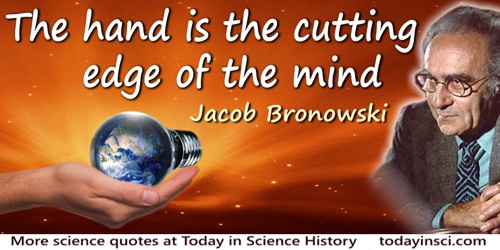
We have to understand that the world can only be grasped by action, not by contemplation. The hand is more important than the eye ... The hand is the cutting edge of the mind.
— Jacob Bronowski
The Ascent of Man (1973), 115-6.
We receive experience from nature in a series of messages. From these messages we extract a content of information: that is, we decode the messages in some way. And from this code of information we then make a basic vocabulary of concepts and a basic grammar of laws, which jointly describe the inner organization that nature translates into the happenings and the appearances we meet.
— Jacob Bronowski
The Identity of Man. Quoted in Richard Dawkins, The Oxford Book of Modern Science Writing (2008), 176-7.
What a scientist does is compounded of two interests: the interest of his time and his own interest. … The need of the age gives its shape to scientific progress as a whole. But it is not the need of the age which gives the individual scientist his sense of pleasure and of adventure, and that excitement which keeps him working late into the night…
— Jacob Bronowski
In 'The Creative Mind', Science and Human Values (1956, 1972), 8.
When Da Vinci wanted an effect, he willed, he planned the means to make it happen: that was the purpose of his machines. But the machines of Newton … are means not for doing but for observing. He saw an effect, and he looked for its cause.
— Jacob Bronowski
From The Common Sense of Science (1951), 25.
When Hitler arrived in 1933, the tradition of scholarship in Germany was destroyed, almost overnight. … Europe was no longer hospitable to the imagination—and not just the scientific imagination. A whole conception of culture was in retreat…. Silence fell, as after the trial of Galileo. The great men went out into a threatened world. Max Born. Erwin Schrödinger. Albert Einstein. Sigmund Freud. Thomas Mann. Bertolt Brecht. Arturo Toscanini. Bruno Walter. Marc Chagall. Enrico Fermi. Leo Szilard….
— Jacob Bronowski
In Ch. 11, 'Knowledge or Certainty', The Ascent of Man, (1973), 367.
William Blake said that “to be an Error & to be Cast out is a part of God’s design.” It is certainly part of the design of science.
— Jacob Bronowski
In Science and Human Values (1956), 64.
You will die but the carbon will not; its career does not end with you. It will return to the soil, and there a plant may take it up again in time, sending it once more on a cycle of plant and animal life.
— Jacob Bronowski
…...
See also:
- 18 Jan - short biography, births, deaths and events on date of Bronowski's birth.
- The Ascent of Man, by Jacob Bronowski. - book suggestion.
 In science it often happens that scientists say, 'You know that's a really good argument; my position is mistaken,' and then they would actually change their minds and you never hear that old view from them again. They really do it. It doesn't happen as often as it should, because scientists are human and change is sometimes painful. But it happens every day. I cannot recall the last time something like that happened in politics or religion.
(1987) --
In science it often happens that scientists say, 'You know that's a really good argument; my position is mistaken,' and then they would actually change their minds and you never hear that old view from them again. They really do it. It doesn't happen as often as it should, because scientists are human and change is sometimes painful. But it happens every day. I cannot recall the last time something like that happened in politics or religion.
(1987) -- 





