 (source)
|
George Brayton
(3 Oct 1830 - 17 Dec 1892)
American engineer who invented the first commercial gas internal combustion engine. Its principle of continuous ignition later became the basis for the turbine engine.
|
George Brayton's Engine
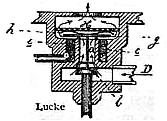
George B. Brayton in 1872 proposed and built an engine that was very complete and fairly successful. Fig. 97 is a general view and Fig. 98 his oil burner.
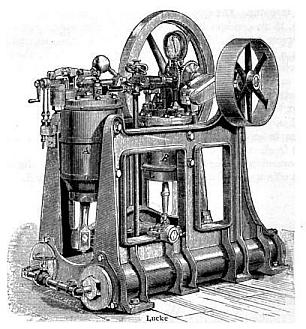
Air is compressed in the single-acting pump, which has a volume one-half that of the power cylinder. The compressed air passes from the constant-pressure receiver through pipe D and over the absorbent material e, through which the fuel is fed by a pump. Here it takes up vapor and the mixture passes the wire-guage grating and into the cylinder, where it burns. Means are provided to prevent entirely shutting off the air from the power cylinder, and thus there is kept constantly burning a small flame which increases for the power stroke. Governing is effected by a variable cut-off to the power cylinder.
The power cylinder is water-jacketed, and no trouble is experienced through over-heating. A safety valve is placed in the reservoir.
- 3 Oct - short biography, births, deaths and events on date of Brayton's birth.
- George Brayton's Engine in Boat Trial - Experimental use of a Brayton engine to power watercraft, described in a letter in Manufacturer and Builder (1880)
- George Brayton - Obituary from Cassier's Magazine (1912).
- George Brayton's Engine - A description originally written in 1875, and updated in Johnson's (revised) Universal Cyclopaedia.
- The Brayton Engine and Cycle and Use of the Brayton Engine - from The Automobile Book: A Practical Treatise (1916), by Charles E. Duryea, James Edward Homans.
- Internal Fire: The Internal-Combustion Engine 1673-1900, by C. Lyle Cummins, Jr. - book suggestion.





