 (source)
|
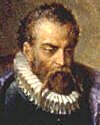
Tycho Brahe
(14 Dec 1546 - 24 Oct 1601)
Danish astronomer who was on his way home on 11 Nov 1572, when his attention was attracted by a star in Cassiopeia which was shining at about the brightness of Jupiter and which had not been seen in this place before. Tycho was so impressed by this event that he devoted the rest of his professional life to astronomy.
|
Science Quotes by Tycho Brahe (16 quotes)
[On the 11th day of November 1572], in the evening, after sunset, when, according to my habit, I was contemplating the stars in a clear sky, I noticed that a new and unusual star, surpassing all others in brilliancy, was shining almost directly over my head; and since I had, almost from boyhood, known all the stars of the heavens perfectly (there is no great difficulty in gaining that knowledge), it was quite evident to me that there had never before been any star in that place in the sky, even the smallest, to say nothing of a star so conspicuously bright as this. I was so astonished at this sight that I was not ashamed to doubt the trustworthiness of my own eyes. But when I observed that others, too, on having the place pointed out to them, could see that there was a star there, I had no further doubts. A miracle indeed, either the greatest of all that have occurred in the whole range of nature since the beginning of the world, or one certainly that is to be classed with those attested by the Holy Oracles.
— Tycho Brahe
De Stello. Nova (On the New Star) (1573). Quoted in H. Shapley and A. E. Howarth (eds.), Source Book in Astronomy (1929), 13.
Simplicibus itaque verbis gaudet Mathematica Veritas, cum etiam per se simplex sit Veritatis oratio. (So Mathematical Truth prefers simple words since the language of Truth is itself simple.)
— Tycho Brahe
Epistolarum astronomicarum liber primus (1596)
And when statesmen or others worry him [the scientist] too much, then he should leave with his possessions. With a firm and steadfast mind one should hold under all conditions, that everywhere the earth is below and the sky above and to the energetic man, every region is his fatherland.
— Tycho Brahe
Attributed (1597). As quoted, without citation, in Morris Herbert Goran, Science and Anti-science, (1974), 13.
At the entrance to the observatory Stjerneborg located underground, Tycho Brahe built a Ionic portal. On top of this were three sculptured lions. On both sides were inscriptions and on the backside was a longer inscription in gold letters on a porfyr stone: Consecrated to the all-good, great God and Posterity. Tycho Brahe, Son of Otto, who realized that Astronomy, the oldest and most distinguished of all sciences, had indeed been studied for a long time and to a great extent, but still had not obtained sufficient firmness or had been purified of errors, in order to reform it and raise it to perfection, invented and with incredible labour, industry, and expenditure constructed various exact instruments suitable for all kinds of observations of the celestial bodies, and placed them partly in the neighbouring castle of Uraniborg, which was built for the same purpose, partly in these subterranean rooms for a more constant and useful application, and recommending, hallowing, and consecrating this very rare and costly treasure to you, you glorious Posterity, who will live for ever and ever, he, who has both begun and finished everything on this island, after erecting this monument, beseeches and adjures you that in honour of the eternal God, creator of the wonderful clockwork of the heavens, and for the propagation of the divine science and for the celebrity of the fatherland, you will constantly preserve it and not let it decay with old age or any other injury or be removed to any other place or in any way be molested, if for no other reason, at any rate out of reverence to the creator’s eye, which watches over the universe. Greetings to you who read this and act accordingly. Farewell!
— Tycho Brahe
(Translated from the original in Latin)
Because the region of the Celestial World is of so great and such incredible magnitude as aforesaid, and since in what has gone before it was at least generally demonstrated that this comet continued within the limits of the space of the Aether, it seems that the complete explanation of the whole matter is not given unless we are also informed within narrower limits in what part of the widest Aether, and next to which orbs of the Planets [the comet] traces its path, and by what course it accomplishes this.
— Tycho Brahe
De Mundi Aetherei Recentioribus Phaenomenis (On Recent Phenomena in the Aetherial World) (1588). Quoted in M. Boas Hall, The Scientific Renaissance 1450-1630 (1962), 115.
For those [observations] that I made in Leipzig in my youth and up to my 21st year, I usually call childish and of doubtful value. Those that I took later until my 28th year [i.e., until 1574] I call juvenile and fairly serviceable. The third group, however, which I made at Uraniborg during approximately the last 21 years with the greatest care and with very accurate instruments at a more mature age, until I was fifty years of age, those I call the observations of my manhood, completely valid and absolutely certain, and this is my opinion of them.
— Tycho Brahe
In H. Raeder, E. and B. Stromgren (eds. and trans.), Tycho Brahe’s Description of his Instruments and Scientific Work: as given in Astronomiae Instauratae Mechanica, Wandesburgi 1598 (1946), 110.
I conclude therefore that this star [Tycho’s supernova] is not some kind of comet or a fiery meteor, whether these be generated beneath the Moon or above the Moon, but that it is a star shining in the firmament itself—one that has never previously been seen before our time, in any age since the beginning of the world.
— Tycho Brahe
In De Stella Nova, as translated in Dagobert D. Runes, A Treasury of World Science (1962), 108.
If Nicolaus Copernicus, the distinguished and incomparable master, in this work had not been deprived of exquisite and faultless instruments, he would have left us this science far more well-established. For he, if anybody, was outstanding and had the most perfect understanding of the geometrical and arithmetical requisites for building up this discipline. Nor was he in any respect inferior to Ptolemy; on the contrary, he surpassed him greatly in certain fields, particularly as far as the device of fitness and compendious harmony in hypotheses is concerned. And his apparently absurd opinion that the Earth revolves does not obstruct this estimate, because a circular motion designed to go on uniformly about another point than the very center of the circle, as actually found in the Ptolemaic hypotheses of all the planets except that of the Sun, offends against the very basic principles of our discipline in a far more absurd and intolerable way than does the attributing to the Earth one motion or another which, being a natural motion, turns out to be imperceptible. There does not at all arise from this assumption so many unsuitable consequences as most people think.
— Tycho Brahe
From Letter (20 Jan 1587) to Christopher Rothman, chief astronomer of the Landgrave of Hesse. Webmaster seeks more information to better cite this source — please contact if you can furnish more. Webmaster originally found this quote introduced by an uncredited anonymous commentary explaining the context: “It was not just the Church that resisted the heliocentrism of Copernicus. Many prominent figures, in the decades following the 1543 publication of De Revolutionibus, regarded the Copernican model of the universe as a mathematical artifice which, though it yielded astronomical predictions of superior accuracy, could not be considered a true representation of physical reality.”
Let me not seem to have lived in vain.
— Tycho Brahe
Reputed to be his last words.
On consideration and by the advice of learned men, I thought it improper to unfold the secrets of the art (alchemy) to the vulgar, as few persons are capable of using its mysteries to advantage and without detriment.
— Tycho Brahe
That the machine of Heaven is not a hard and impervious body full of various real spheres, as up to now has been believed by most people. It will be proved that it extends everywhere, most fluid and simple, and nowhere presents obstacles as was formerly held, the circuits of the Planets being wholly free and without the labour and whirling round of any real spheres at all, being divinely governed under a given law.
— Tycho Brahe
De Mundi Aetherei Recentioribus Phaenomenis (On Recent Phenomena in the Aetherial World) (1588). Quoted in M. Boas Hall, The Scientific Renaissance 1450-1630 (1962), 117.
The body of the Earth, large, sluggish and inapt for motion, is not to be disturbed by movement (especially three movements), any more than the Aetherial Lights [stars] are to be shifted, so that such ideas are opposed both to physical principles and to the authority of the Holy Writ which many time: confirms the stability of the Earth (as we shall discuss more fully elsewhere).
— Tycho Brahe
De Mundi Aetherei Recentioribus Phaenomenis (On Recent Phenomena in the Aetherial World) (1588). Quoted in M. Boas Hall, The Scientific Renaissance 1450-1630 (1962), 115.
The star [Tycho’s supernova] was at first like Venus and Jupiter, giving pleasing effects; but as it then became like Mars, there will next come a period of wars, seditions, captivity and death of princes, and destruction of cities, together with dryness and fiery meteors in the air, pestilence, and venomous snakes. Lastly, the star became like Saturn, and there will finally come a time of want, death, imprisonment and all sorts of sad things.
— Tycho Brahe
There really are not any spheres in the heavens ... Those which have been devised by the experts to save the appearances exist only in the imagination, for the purpose of enabling the mind to conceive the motion which the heavenly bodies trace in their course and, by the aid of geometry, to determine the motion numerically through the use of arithmetic.
— Tycho Brahe
J. L. E. Dreyer (ed.), Opera Omnia (1913-29), Vol. 4, 222. Trans. Edward Rosen, 'Nicholas Copernicus', in Charles C. Gillispie (ed.), Dictionary of Scientific Biography (1971), Vol. 3, 409.
Those who study the stars have God for a teacher.
— Tycho Brahe
When I had satisfied myself that no star of that kind had ever shone before, I was led into such perplexity by the unbelievability of the thing that I began to doubt the faith of my own eyes.
— Tycho Brahe
Quotes by others about Tycho Brahe (8)
And from this such small difference of eight minutes [of arc] it is clear why Ptolemy, since he was working with bisection [of the linear eccentricity], accepted a fixed equant point… . For Ptolemy set out that he actually did not get below ten minutes [of arc], that is a sixth of a degree, in making observations. To us, on whom Divine benevolence has bestowed the most diligent of observers, Tycho Brahe, from whose observations this eight-minute error of Ptolemy’s in regard to Mars is deduced, it is fitting that we accept with grateful minds this gift from God, and both acknowledge and build upon it. So let us work upon it so as to at last track down the real form of celestial motions (these arguments giving support to our belief that the assumptions are incorrect). This is the path I shall, in my own way, strike out in what follows. For if I thought the eight minutes in [ecliptic] longitude were unimportant, I could make a sufficient correction (by bisecting the [linear] eccentricity) to the hypothesis found in Chapter 16. Now, because they could not be disregarded, these eight minutes alone will lead us along a path to the reform of the whole of Astronomy, and they are the matter for a great part of this work.
Astronomia Nova, New Astronomy (1609), ch. 19, 113-4, Johannes Kepler Gesammelte Werke (1937-), Vol. 3, 177-8.
Yet in this my stars were not Mercury as morning star in the angle of the seventh house, in quartile with Mars, but they were Copernicus, they were Tycho Brahe, without whose books of observations everything which has now been brought by me into the brightest daylight would lie buried in darkness.
Harmonice Mundi, The Harmony of the World (1619), book IV, Epilogue on Sublunary Nature. Trans. E. J. Aiton, A. M. Duncan and J. V. Field (1997), 377.
And if you want the exact moment in time, it was conceived mentally on 8th March in this year one thousand six hundred and eighteen, but submitted to calculation in an unlucky way, and therefore rejected as false, and finally returning on the 15th of May and adopting a new line of attack, stormed the darkness of my mind. So strong was the support from the combination of my labour of seventeen years on the observations of Brahe and the present study, which conspired together, that at first I believed I was dreaming, and assuming my conclusion among my basic premises. But it is absolutely certain and exact that the proportion between the periodic times of any two planets is precisely the sesquialterate proportion of their mean distances.
Harmonice Mundi, The Harmony of the World (1619), book V, ch. 3. Trans. E. J. Aiton, A. M. Duncan and J. V. Field (1997), 411.
I conclude therefore that this star [Tycho’s supernova] is not some kind of comet or a fiery meteor, whether these be generated beneath the Moon or above the Moon, but that it is a star shining in the firmament itself—one that has never previously been seen before our time, in any age since the beginning of the world.
In De Stella Nova, as translated in Dagobert D. Runes, A Treasury of World Science (1962), 108.
The star [Tycho’s supernova] was at first like Venus and Jupiter, giving pleasing effects; but as it then became like Mars, there will next come a period of wars, seditions, captivity and death of princes, and destruction of cities, together with dryness and fiery meteors in the air, pestilence, and venomous snakes. Lastly, the star became like Saturn, and there will finally come a time of want, death, imprisonment and all sorts of sad things.
I can certainly wish for new, large, and properly constructed instruments, and enough of them, but to state where and by what means they are to be procured, this I cannot do. Tycho Brahe has given Mastlin an instrument of metal as a present, which would be very useful if Mastlin could afford the cost of transporting it from the Baltic, and if he could hope that it would travel such a long way undamaged… . One can really ask for nothing better for the observation of the sun than an opening in a tower and a protected place underneath.
As quoted in James Bruce Ross and Mary Martin McLaughlin, The Portable Renaissance Reader (1968), 605.
Tycho [Brahe] is a man with whom no one can live without exposing himself to the greatest indignities. The pay is splendid, but one can only extract the half of it. I have thought of turning to medicine.
As quoted in Willy Ley, Watchers of the Skies (1969) 92.
Long ago it was said: If Tycho had had instruments ten times as precise, we would never have had a Kepler, or a Newton, or Astronomy.
In La Science et l’Hypothèse (1901, 1908), 211, as translated in Henri Poincaré and William John Greenstreet (trans.), Science and Hypothesis (1902, 1905), 181. From the original French, “Il y a longtemps qu’on l’a dit: Si Tycho avait eu des instruments dix fois plus précis, il n’y aurait jamais eu ni Képler, ni Newton, ni Astronomie.”
See also:
- 14 Dec - short biography, births, deaths and events on date of Brahe's birth.
- Tycho & Kepler, by Kitty Ferguson. - book suggestion.
- Booklist for Tycho Brahe.
 In science it often happens that scientists say, 'You know that's a really good argument; my position is mistaken,' and then they would actually change their minds and you never hear that old view from them again. They really do it. It doesn't happen as often as it should, because scientists are human and change is sometimes painful. But it happens every day. I cannot recall the last time something like that happened in politics or religion.
(1987) --
In science it often happens that scientists say, 'You know that's a really good argument; my position is mistaken,' and then they would actually change their minds and you never hear that old view from them again. They really do it. It doesn't happen as often as it should, because scientists are human and change is sometimes painful. But it happens every day. I cannot recall the last time something like that happened in politics or religion.
(1987) -- 




