 (source)
|
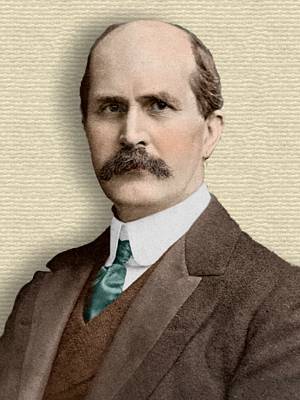
Sir William Bragg
(2 Jul 1862 - 12 Mar 1942)
English physicist who was the father of Lawrence Bragg, with whom he shared the 1915 Nobel Prize for Physics. Both researched crystal structure using X-ray diffraction methods.
|
Science Quotes by Sir William Bragg (8 quotes)

But in its [the corpuscular theory of radiation] relation to the wave theory there is one extraordinary and, at present, insoluble problem. It is not known how the energy of the electron in the X-ray bulb is transferred by a wave motion to an electron in the photographic plate or in any other substance on which the X-rays fall. It is as if one dropped a plank into the sea from the height of 100 ft. and found that the spreading ripple was able, after travelling 1000 miles and becoming infinitesimal in comparison with its original amount, to act upon a wooden ship in such a way that a plank of that ship flew out of its place to a height of 100 ft. How does the energy get from one place to the other?
— Sir William Bragg
'Aether Waves and Electrons' (Summary of the Robert Boyle Lecture), Nature, 1921, 107, 374.
From religion comes a man's purpose; from science, his power to achieve it. Sometimes people ask if religion and science are not opposed to one another. They are: in the sense that the thumb and fingers of my hands are opposed to one another. It is an opposition by means of which anything can be grasped.
— Sir William Bragg
In Sir Kerr Grant, The Life and Work of Sir William Bragg (1952), 43.
It is strange that the immense variety in nature can be resolved into a series of numbers.
— Sir William Bragg
Lecture (Christmas 1923), 'The Atoms of Which Things Are Made'. Collected in Concerning the Nature of Things: Six Lectures Delivered at the Royal Institution (1925, 1954), 37.
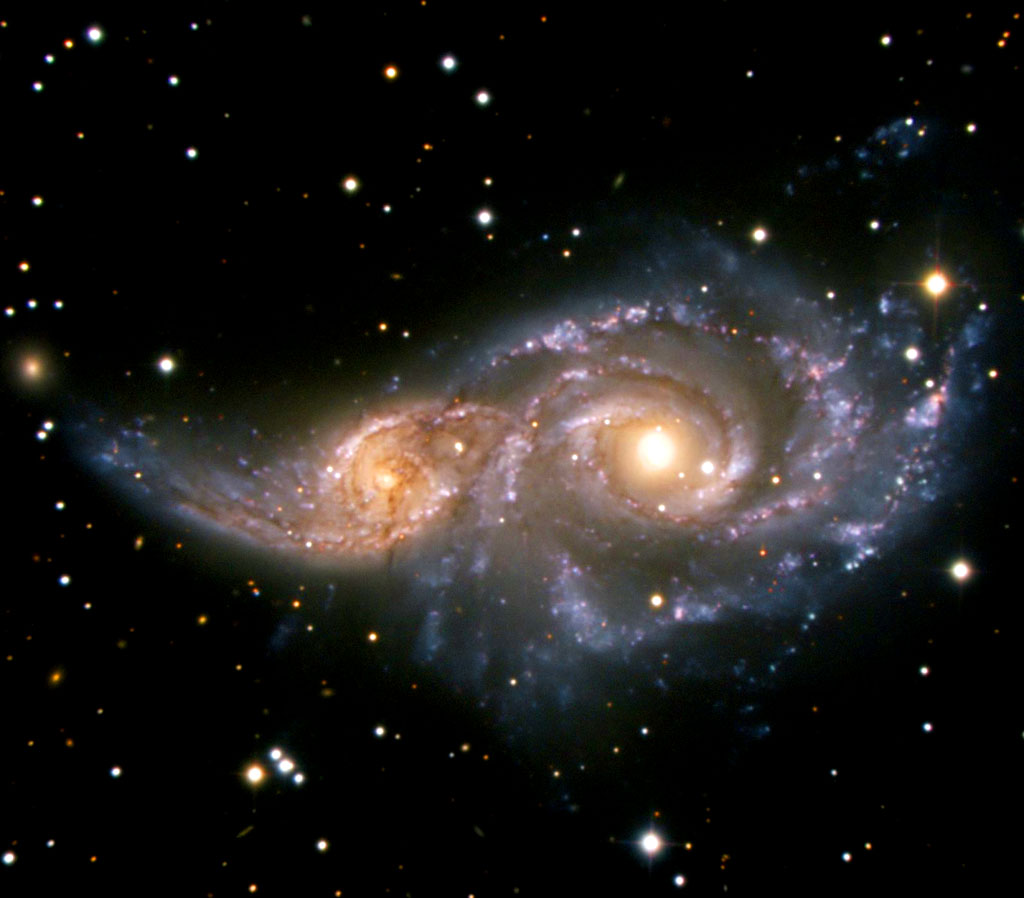
Light brings us the news of the Universe.
— Sir William Bragg
The Universe of Light (1933), 1.
No known theory can be distorted so as to provide even an approximate explanation [of wave-particle duality]. There must be some fact of which we are entirely ignorant and whose discovery may revolutionize our views of the relations between waves and ether and matter. For the present we have to work on both theories. On Mondays, Wednesdays, and Fridays we use the wave theory; on Tuesdays, Thursdays, and Saturdays we think in streams of flying energy quanta or corpuscles.
— Sir William Bragg
'Electrons and Ether Waves', The Robert Boyle Lecture 1921, Scientific Monthly, 1922, 14, 158.
Sound … cannot travel across what we call a vacuum. … Light and our eyes that see it deal with the doings of the whole universe; sound belongs to the world only. I may talk of the universe of light, but I can only talk of the world of sound.
— Sir William Bragg
In The World of Sound (1921), 10.
The dividing line between the wave or particle nature of matter and radiation is the moment “Now.” As this moment steadily advances through time it coagulates a wavy future into a particle past.
— Sir William Bragg
Attributed.
The light is a messenger, carrying a story about the form of the object.
— Sir William Bragg
From Mackenzie Davidson Memorial Lecture (14 Nov 1928), as quoted and cited in Graeme K. Hunter, Light is a Messenger: The Life of William Lawrence Bragg (2004), epigraph in front matter.
Quotes by others about Sir William Bragg (2)
[Professor W.L. Bragg asserts that] In sodium chloride there appear to be no molecules represented by NaCl. The equality in number of sodium and chlorine atoms is arrived at by a chess-board pattern of these atoms; it is a result of geometry and not of a pairing-off of the atoms.
In Henry E. Armstrong, 'Poor Common Salt!', Nature (1927), 120, 478.
When I saw the alpha-helix and saw what a beautiful, elegant structure it was, I was thunderstruck and was furious with myself for not having built this, but on the other hand, I wondered, was it really right?
So I cycled home for lunch and was so preoccupied with the turmoil in my mind that didn’t respond to anything. Then I had an idea, so I cycled back to the lab. I realized that I had a horse hair in a drawer. I set it up on the X-ray camera and gave it a two hour exposure, then took the film to the dark room with my heart in my mouth, wondering what it showed, and when I developed it, there was the 1.5 angstrom reflection which I had predicted and which excluded all structures other than the alpha-helix.
So on Monday morning I stormed into my professor’s office, into Bragg’s office and showed him this, and Bragg said, 'Whatever made you think of that?' And I said, 'Because I was so furious with myself for having missed that beautiful structure.' To which Bragg replied coldly, 'I wish I had made you angry earlier.'
So I cycled home for lunch and was so preoccupied with the turmoil in my mind that didn’t respond to anything. Then I had an idea, so I cycled back to the lab. I realized that I had a horse hair in a drawer. I set it up on the X-ray camera and gave it a two hour exposure, then took the film to the dark room with my heart in my mouth, wondering what it showed, and when I developed it, there was the 1.5 angstrom reflection which I had predicted and which excluded all structures other than the alpha-helix.
So on Monday morning I stormed into my professor’s office, into Bragg’s office and showed him this, and Bragg said, 'Whatever made you think of that?' And I said, 'Because I was so furious with myself for having missed that beautiful structure.' To which Bragg replied coldly, 'I wish I had made you angry earlier.'
From transcript of audio of Max Perutz in BBC programme, 'Lifestory: Linus Pauling' (1997). On 'Linus Pauling and the Race for DNA' webpage 'I Wish I Had Made You Angry Earlier.'

See also:
- 2 Jul - short biography, births, deaths and events on date of Bragg's birth.
- William Bragg - context of quote “Light brings us the news of the Universe” - Medium image (500 x 250 px)
- William Bragg - context of quote “Light brings us the news of the Universe” - Large image (800 x 400 px)
 In science it often happens that scientists say, 'You know that's a really good argument; my position is mistaken,' and then they would actually change their minds and you never hear that old view from them again. They really do it. It doesn't happen as often as it should, because scientists are human and change is sometimes painful. But it happens every day. I cannot recall the last time something like that happened in politics or religion.
(1987) --
In science it often happens that scientists say, 'You know that's a really good argument; my position is mistaken,' and then they would actually change their minds and you never hear that old view from them again. They really do it. It doesn't happen as often as it should, because scientists are human and change is sometimes painful. But it happens every day. I cannot recall the last time something like that happened in politics or religion.
(1987) --