 (source)
|
Zabdiel Boylston
(9 Mar 1676 - 1 Mar 1766)
American physician who introduced smallpox inoculation into the American colonies, though he had no medical degree. His only education was from his father.
|
Innoculation in Boston
Zabdiel Boylston
From: The History of the United States of America, by Richard Hildreth (1874)
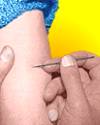
[p.300] Nov 1721: An adjourned session was interrupted by the small-pox, which, after an interval of twenty years, had broken out in Boston, and occasioned the greatest alarm. In the published transactions of the Royal Society, of which he was a member, Cotton Mather had been seen some letters from Turkey, giving an account of the practice there of communicating the small-pox by inoculation, thus enabling the patient to prepare for the disorder, and to go through it more safely than when taken in the natural way. With characteristic zeal and enthusiasm, Mather took hold of this idea; and having applied in vain to the three or four other medical practitioners of Boston, he at last prevailed on Zabdiel Boylston to try the experiment. A native of the colony, a man of skill and reputation in his profession, humane and courageous, Dr. Boylston commenced upon his own son. The first trials were successful; yet it required no little courage to go on. Inoculation was violently opposed by the other practitioners, [p.301] headed by Dr. Douglas, a pragmatical Scotchman. Several pamphlets published on the subject prove, by the virulence of their style, the excitement of the disputants. The new practice was denounced as an infusion of malignity into the blood; a species of poisoning; an interference with the prerogatives of Jehovah, whose right it was to wound and to heal; an attempt to thwart God, who sent the small-pox as a punishment for sins, and whose vengeance would thus be only provoked the more. Many “sober, pious people” thought that, if any of Boylston’s patients should die, he ought to be treated as a murderer. An exasperated mob paraded the streets with halters in their hands, threatening to hang the inoculators. A lighted grenade, filled with combustibles, was thrown into Cotton Mather’s house, into the very sick chamber of an inoculated patient.
Against superstition and prejudices thus inflamed by the members of a learned profession, which ought to take the lead in natural science, Cotton Mather made a noble stand, hardly to have been expected from one so active thirty years before in the witchcraft delusion. His venerable father, now very old, and the other ministers of Boston, sustained him; but their united influence could hardly stem the popular torrent. The selectmen took strong ground against inoculation: at the late session of the General Court, a bill had passed the House to prohibit the practice; but it was thrown out by the council. In the end the inoculators completely triumphed. The very same month in which Boylston and Mather commenced their experiments in Boston, inoculation was introduced into England by the witty and accomplished Lady Mary Wortley Montague, lately returned from a residence at Constantinople. The success of this practice soon silenced all opposition; and it continued in [p.302] extensive use until superseded by the more brilliant discovery of Jenner. When Boylston visited England a few years after, he was received with distinguished attention, and elected a member of the Royal Society.
- Science Quotes by Zabdiel Boylston.
- 9 Mar - short biography, births, deaths and events on date of Boylston's birth.
- Zabdiel Boylston - Biography - his difficulties and eventual success when he introduced smallpox inoculation.
- An Infectious Disease of Historical Importance: an extensive article on the smallpox disease.
- Smallpox on Death Row: transcript of a BBC Horizon program.
- The Speckled Monster: A Historical Tale of Battling the Smallpox Epidemic, by Jennifer Lee Carrell. - book suggestion.
- Booklist for Smallpox.





