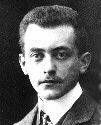
 (source)
|
Max Born
(11 Dec 1882 - 5 Jan 1970)
German-British physicist.
|
Science Quotes by Max Born (14 quotes)
All attempts to adapt our ethical code to our situation in the technological age have failed.
— Max Born
My Life & My Views (1968), 52.
But I believe that there is no philosophical high-road in science, with epistemological signposts. No, we are in a jungle and find our way by trial and error, building our road behind us as we proceed. We do not find signposts at cross-roads, but our own scouts erect them, to help the rest.
— Max Born
In Experiment and Theory in Physics (1943), 44.
But in practical affairs, particularly in politics, men are needed who combine human experience and interest in human relations with a knowledge of science and technology. Moreover, they must be men of action and not contemplation. I have the impression that no method of education can produce people with all the qualities required. I am haunted by the idea that this break in human civilization, caused by the discovery of the scientific method, may be irreparable.
— Max Born
My Life & My Views (1968), 57-8.
During my span of life science has become a matter of public concern and the l'art pour l'art standpoint of my youth is now obsolete. Science has become an integral and most important part of our civilization, and scientific work means contributing to its development. Science in our technical age has social, economic, and political functions, and however remote one's own work is from technical application it is a link in the chain of actions and decisions which determine the fate of the human race. I realized this aspect of science in its full impact only after Hiroshima.
— Max Born
My Life & My Views (1968), 49.
His [Erwin Schrödinger's] private life seemed strange to bourgeois people like ourselves. But all this does not matter. He was a most lovable person, independent, amusing, temperamental, kind and generous, and he had a most perfect and efficient brain.
— Max Born
In My Life, Recollections of a Nobel Laureate (1978), 270. Quoted by Walter Moore, Schrödinger: Life and Thought (1992), 6.
I have tried to read philosophers of all ages and have found many illuminating ideas but no steady progress toward deeper knowledge and understanding. Science, however, gives me the feeling of steady progress: I am convinced that theoretical physics is actual philosophy. It has revolutionized fundamental concepts, e.g., about space and time (relativity), about causality (quantum theory), and about substance and matter (atomistics), and it has taught us new methods of thinking (complementarity) which are applicable far beyond physics.
— Max Born
My Life & My Views (1968), 48.
It is odd to think that there is a word for something which, strictly speaking, does not exist, namely, “rest.” We distinguish between living and dead matter; between moving bodies and bodies at rest. This is a primitive point of view. What seems dead, a stone or the proverbial “door-nail,” say, is actually forever in motion. We have merely become accustomed to judge by outward appearances; by the deceptive impressions we get through our senses.
— Max Born
The Restless Universe (1935), I.
No language which lends itself to visualizability can describe the quantum jumps.
— Max Born
As quoted in epigraph, without citation, in Nick Herbert, '“And Then A Miracle Occurs”: The Quantum Measurement Problem', Quantum Reality: Beyond the New Physics (1985), Chap 8, 131.
One would have to have been brought up in the “spirit of militarism” to understand the difference between Hiroshima and Nagasaki on the one hand, and Auschwitz and Belsen on the other. The usual reasoning is the following: the former case is one of warfare, the latter of cold-blooded slaughter. But the plain truth is that the people involved are in both instances nonparticipants, defenseless old people, women, and children, whose annihilation is supposed to achieve some political or military objective.… I am certain that the human race is doomed, unless its instinctive detestation of atrocities gains the upper hand over the artificially constructed judgment of reason.
— Max Born
In The Born-Einstein Letters: Correspondence Between Albert Einstein and Max Born (1971), 205. Born’s commentary (at age 86) added for the book, printed after letter to Albert Einstein, 8 Nov 1953.
Physics, as we know it, will be over in six months.
— Max Born
As quoted in Stephen Hawking, Black Holes and Baby Universes and Other Essays (1993), 50. The context given with the quote was that in the late 1920s Max Born told made this remark to a group of scientists visiting Gottingen. This was shortly after the discovery by Paul Dirac, of the Dirac equation, which governs the behavior of the electron. (It seemed a comprehensive theory was imminent to unify the theories of physics.)
The ultimate origin of the difficulty lies in the fact (or philosophical principle) that we are compelled to use the words of common language when we wish to describe a phenomenon, not by logical or mathematical analysis, but by a picture appealing to the imagination. Common language has grown by everyday experience and can never surpass these limits. Classical physics has restricted itself to the use of concepts of this kind; by analysing visible motions it has developed two ways of representing them by elementary processes; moving particles and waves. There is no other way of giving a pictorial description of motions—we have to apply it even in the region of atomic processes, where classical physics breaks down.
— Max Born
Atomic Physics (1957), 97.
There are two objectionable types of believers: those who believe the incredible and those who believe that 'belief' must be discarded and replaced by 'the scientific method'.
— Max Born
Natural Philosophy of Cause and Chance (1964), 209.
To present a scientific subject in an attractive and stimulating manner is an artistic task, similar to that of a novelist or even a dramatic writer. The same holds for writing textbooks.
— Max Born
My Life & My Views (1968), 48.
We have reached the end of our journey into the depths of matter. We have sought for firm ground and found none. The deeper we penetrate, the more restless becomes the universe…: all is rushing about and vibrating in a wild dance.
— Max Born
In The Restless Universe (2013), Chap. 5, 277.
Quotes by others about Max Born (2)
I found out at an early age that science is a haven for the timid, the freaks, the misfits. That is more true perhaps for the past than now. If you were a student in Göttingen in the 1920s and went to the seminar “Structure of Matter” which was under the joint auspices of David Hilbert and Max Born, you could well imagine that you were in a madhouse as you walked in. Every one of the persons there was obviously some kind of a severe case. The least you could do was put on some kind of a stutter. Robert Oppenheimer as a graduate student found it expedient to develop a very elegant kind of stutter, the "njum-njum-njum" technique. Thus, if you were an oddball you felt at home.
Answering the question, “Why did you choose science as your life’s work?” In 'Homo Scientificus According to Beckett," collected in William Beranek, Jr. (ed.)Science, Scientists, and Society, (1972), 135. Excerpted in Ann E. Kammer, Science, Sex, and Society (1979), 278.
When Hitler arrived in 1933, the tradition of scholarship in Germany was destroyed, almost overnight. … Europe was no longer hospitable to the imagination—and not just the scientific imagination. A whole conception of culture was in retreat…. Silence fell, as after the trial of Galileo. The great men went out into a threatened world. Max Born. Erwin Schrödinger. Albert Einstein. Sigmund Freud. Thomas Mann. Bertolt Brecht. Arturo Toscanini. Bruno Walter. Marc Chagall. Enrico Fermi. Leo Szilard….
In Ch. 11, 'Knowledge or Certainty', The Ascent of Man, (1973), 367.
See also:
- 11 Dec - short biography, births, deaths and events on date of Born's birth.
- My Life and Views, by Max Born. - book suggestion.
 In science it often happens that scientists say, 'You know that's a really good argument; my position is mistaken,' and then they would actually change their minds and you never hear that old view from them again. They really do it. It doesn't happen as often as it should, because scientists are human and change is sometimes painful. But it happens every day. I cannot recall the last time something like that happened in politics or religion.
(1987) --
In science it often happens that scientists say, 'You know that's a really good argument; my position is mistaken,' and then they would actually change their minds and you never hear that old view from them again. They really do it. It doesn't happen as often as it should, because scientists are human and change is sometimes painful. But it happens every day. I cannot recall the last time something like that happened in politics or religion.
(1987) -- 




