 (source)
|
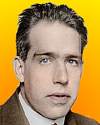
Niels Bohr
(7 Oct 1885 - 18 Nov 1962)
Danish physicist.
|
Science Quotes by Niels Bohr (34 quotes)
>> Click for Niels Bohr Quotes on | Atom | Language | Understanding |
>> Click for Niels Bohr Quotes on | Atom | Language | Understanding |
[About describing atomic models in the language of classical physics:] We must be clear that when it comes to atoms, language can be used only as in poetry. The poet, too, is not nearly so concerned with describing facts as with creating images and establishing mental connections.
— Niels Bohr
As quoted by Werner Heisenberg, as translated by Arnold J. Pomerans, in Physics and Beyond: Encounters and Conversations (1971), 41. The words are not verbatim, but as later recollected by Werner Heisenberg describing his early encounter with Bohr in 1920.
Contraria sunt complementa.
Opposites are complementary.
Opposites are complementary.
— Niels Bohr
Motif on Niels Bohr's coat of arms.
~~[Doubtful attribution]~~ Today’s common sense is yesterday’s science.
— Niels Bohr
Found stated without source, in Marcia Stubbs and Sylvan Barnet The Little, Brown Reader (1989), 806. [Webmaster, so far, has found no source, lacks additional examples, and doubts its attribution. (Can you help?) Meanwhile, as an aphorism it is interesting enough to find it a place here—and to add the caution to regard it as anonymous unless authenticated.]
~~[Misattributed?]~~ Prediction is difficult, especially the future.
— Niels Bohr
Seen variously attributed, including to Yogi Berra or Mark Twain. The association with Bohr is unverified, and is, for example, given as a quote without citation, in Alan G. Mencher, 'On the Social Deployment of Science', Bulletin of the Atomic Scientists (1971), 27, No. 10, 37. Bohr may perhaps have uttered these words, but probably did not originate them. Bohr was Danish, and the quote is known as a Danish saying. It appears in Danish as “Det er vanskeligt at spaa, især naar det gælder Fremtiden,” in Karl Kristian Steincke, 'Og saa til Slut et Par parlamentariske Sprogblomster' (Parliamentary Howlers), Farvel Og Tak (1948), Vol. 4, 227. Background in depth is on the quoteinvestigator.com website.
A visitor to Niels Bohr's country cottage, noticing a horseshoe hanging on the wall, teasing the eminent scientist about this ancient superstition. “Can it be true that you, of all people, believe it will bring you luck?'
'Of course not,' replied Bohr, 'but I understand it brings you luck whether you believe it or not.'”
'Of course not,' replied Bohr, 'but I understand it brings you luck whether you believe it or not.'”
— Niels Bohr
As described in Clifton Fadiman (ed.), André Bernard (ed.), Bartlett's Book of Anecdotes (2000), 68.
An expert is a man who has made all the mistakes, which can be made, in a very narrow field.
— Niels Bohr
recalled on his death, November 18, 1962.
An expert is a person who has made all the mistakes that can be made in a very narrow field.
— Niels Bohr
As quoted by Edward Teller, in Robert Coughlan, 'Dr. Edward Teller’s Magnificent Obsession', Life (6 Sep 1954), 62.
Anyone who is not shocked by the quantum theory has not understood it. [Attributed.]
— Niels Bohr
Webmaster is not alone in failing to find a primary source. Regardless of how widely quoted, the few citations to be found merely reference other books in which it is stated without a valid citation. For example, this quote is an epigraph in Eric Middleton, The New Flatlanders (2007), 19, with a note (p.151) citing Niels Bohr, Atomic Physics and Human Knowledge (1958), but Webmaster’s search of that text does not find it. If you know the primary source, or an early citation, please contact Webmaster.
As regards the co-ordination of all ordinary properties of matter, Rutherford’s model of the atom puts before us a task reminiscent of the old dream of philosophers: to reduce the interpretation of the laws of nature to the consideration of pure numbers.
— Niels Bohr
In Faraday Lecture (1930), Journal of the Chemical Society (Feb 1932), 349. As quoted and cited in Chen Ning Yang, Elementary Particles (1961), 7.
But, but, but … if anybody says he can think about quantum theory without getting giddy it merely shows that he hasn’t understood the first thing about it!
— Niels Bohr
Quoted in Otto R. Frisch, What Little I Remember (1979), 95.
Causality may be considered as a mode of perception by which we reduce our sense impressions to order.
— Niels Bohr
In Atomic Theory and the Description of Nature (1929, 1961), 116-117.
Every sentence I utter must be understood not as an affirmation but as a question.
[A caution he gives his students, to be wary of dogmatism.]
[A caution he gives his students, to be wary of dogmatism.]
— Niels Bohr
In Bill Becker, 'Pioneer of the Atom', New York Times Sunday Magazine (20 Oct 1957), 52.
How wonderful that we have met this paradox. Now we have some hope of making progress.
— Niels Bohr
Comment to observers when an experiment took an unexpected turn. In Bill Becker, 'Pioneer of the Atom', New York Times Sunday Magazine (20 Oct 1957), 52. Also in quoted in Ruth Moore Niels Bohr: the Man, His Science, & The World They Changed (1966), 140.
If we couldn’t laugh at ourselves, that would be the end of everything.
— Niels Bohr
Comment made to Professor Erik Riidinger, 1962. Quotation supplied and translated by Professor Erik Rüdinger, Niels Bohr Archive.
In physics we deal with states of affairs much simpler than those of psychology and yet we again and again learn that our task is not to investigate the essence of things—we do not at all know what this would mean&mash;but to develop those concepts that allow us to speak with each other about the events of nature in a fruitful manner.
— Niels Bohr
Letter to H.P.E. Hansen (20 Jul 1935), Niels Bohr Archive. In Jan Faye, Henry J. Folse, Niels Bohr and Contemporary Philosophy (1994), 83.
One thought [spectra are] marvellous, but it is not possible to make progress there. Just as if you have the wing of a butterfly then certainly it is very regular with the colors and so on, but nobody thought one could get the basis of biology from the coloring of the wing of a butterfly.
— Niels Bohr
Quoted from Interviews (I, 7) in 'The Genesis of the Bohr Atom', J.L. Heilbron and T.S. Kuhn, Historical Studies in the Physical Sciences (1969), 257, reprinted in J. L. Heilbron, Historical Studies in the Theory of Atomic Structure (1981), 195.
Predictions can be very difficult—especially about the future.
— Niels Bohr
Quoted in H. Rosovsky, The University: An Owners Manual (1991), 147. It is said that Bohr used to quote this saying to illustrate the differences between Danish and Swedish humour. Bohr always attributed the saying to Robert Storm Petersen (1882-1949), a well-known Danish artist and writer. However, the saying did NOT originate from Petersen. It may have been said in the Danish Parliament between 1935 and 1939 [Information supplied courtesy of Professor Erik Rüdinger, Niels Bohr Archive, Copenhagen].
Quantum provides us with a striking illustration of the fact that though we can fully understand a connection … we can only speak of it in images and parables. We must be clear that when it comes to atoms, language can be used only as in poetry. The poet, too, is not nearly so concerned with describing facts as with creating images and establishing mental connections.
— Niels Bohr
In conversation during first meeting with Werner Heisenberg (summer 1920), as quoted in Werner Heisenberg and Arnold J. Pomerans (trans.), Physics and Beyond: Encounters and Conversations (1971), 41. As cited in Philip Kuberski, The Forgèd Feature: Toward a Poetics of Uncertainty: New and Selected Essays (1995), 177-178.
Science only advances by renouncing its past.
— Niels Bohr
Webmaster is suspicious of the authenticity of this quote. An epigraph, without citation, in Chandler Burr, Separate Creation: The Search for the Biological Origins of Sexual Orientation (1997), 309. Seen in only a few recent places. It does not seem to appear in earlier decades, as might be expected for such a snappy quote. Perhaps it is a restatement of another quote. Please contact if you know the primary source.
The existence of life must be considered as an elementary fact that can not be explained, but must be taken as a starting point in biology, in a similar way as the quantum of action, which appears as an irrational element from the point of view of classical mechanical physics, taken together with the existence of elementary particles, forms the foundation of atomic physics. The asserted impossibility of a physical or chemical explanation of the function peculiar to life would in this sense be analogous to the insufficiency of the mechanical analysis for the understanding of the stability of atoms.
— Niels Bohr
'Light and Life', Nature, 1933, 131, 458.
The old saying of the two kinds of truth. To the one kind belongs statements so simple and clear that the opposite assertion obviously could not be defended. The other kind, the so-called “deep truths”, are statements in which the opposite also contains deep truth.
— Niels Bohr
Niels Bohr, 'Discussion with Einstein on Epistemological Problems in Atomic Physics', in P. A. Schilpp (ed.), Albert Einstein: Philosopher-Scientist (1949), 240.
The opposite of a correct statement is a false statement. But the opposite of a profound truth may well be another profound truth.
— Niels Bohr
Webmaster has not yet found a primary source for this quote verbatim. However, it is very widely seen quoted in this wording, and seemingly always without a citation to the original source. Hans Bohr, the son of Niels Bohr, gives his first-hand knowledge that: “One of the favorite maxims of my father was the distinction between the two sorts of truth, profound truths recognized by the fact that the opposite is also a profound truth, in contrast to trivialities where opposites are obviously absurd.” (Webmaster has not been able to verify a source for that which cited it as Hans Bohr, My Father: His Life and Work (1967), 328. In any case, notice that the son’s narrative does not give his father’s words in quotation marks.
The present state of atomic theory is characterized by the fact that we not only believe the existence of atoms to be proved beyond a doubt, but also we even believe that we have an intimate knowledge of the constituents of the individual atoms.
— Niels Bohr
'The structure of the atom', Nobel Lecture, 11 December 1922. In Nobel Lectures: Physics 1922-1941 (1998), 5.
The task of science is both to extend the range of our experience and to reduce it to order.
— Niels Bohr
From Introductory Survey (1929) in Atomic Theory and the Description of Nature (1934), 1.
This interpretation of the atomic number [as the number of orbital electrons] may be said to signify an important step toward the solution of the boldest dreams of natural science, namely to build up an understanding of the regularities of nature upon the consideration of pure number.
— Niels Bohr
Atomic Theory and the Description of Nature (1934), 103-104Cited in Gerald James Holton, Thematic Origins of Scientific Thought: Kepler to Einstein (1985), 74.
Those who are not shocked when they first come across quantum theory cannot possibly have understood it.
— Niels Bohr
As recollected, though not verbatim, by Werner Heisenberg from a personal conversation he had with Bohr (and Wolfgang Pauli) in 1952. In Werner Heisenberg and Arnold J. Pomerans (trans.), 'Positivism, Metaphysics and Religion' (1952), collected in Physics and Beyond: Encounters and Conversations (1971), 206. Translated from the German book, Der Teil und das Ganze. In the Preface, the author states that in his book, he was reconstructing discussions from decades earlier, so the wording should not be taken to be literally verbatim.
Truth is something that we can attempt to doubt, and then perhaps, after much exertion, discover that part of the doubt is not justified.
— Niels Bohr
Quoted in Bill Becker, 'Pioneer of the Atom', New York Times Sunday Magazine (20 Oct 1957), 52.
We all agreed that your theory is crazy. The question which divides us is whether it is crazy enough to have a chance of being correct.
— Niels Bohr
In The Ambidextrous Universe by Martin Gardner (1964).
We intend to say something about the structure of the atom but lack a language in which we can make ourselves understood. We are in much the same position as a sailor, marooned on a remote island where conditions differ radically from anything he has ever known and where, to make things worse, the natives speak a completely alien tongue.
— Niels Bohr
In conversation during first meeting with Werner Heisenberg (summer 1920), as quoted in William H. Cropper, Great Physicists: The Life and Times of Leading Physicists from Galileo to Hawking (2001), 249-250.
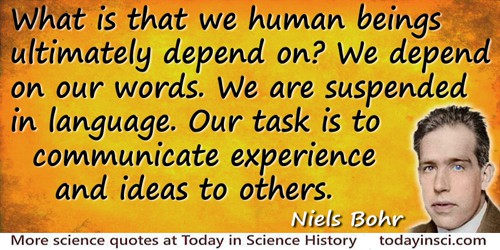
What is that we human beings ultimately depend on? We depend on our words. We are suspended in language. Our task is to communicate experience and ideas to others.
— Niels Bohr
Quoted in Aage Petersen, 'The Philosophy of Niels Bohr', Bulletin of the Atomic Scientists, 1963, 19, 10.
When asked … [about] an underlying quantum world, Bohr would answer, “There is no quantum world. There is only an abstract quantum physical description. It is wrong to think that the task of physics is to find out how nature is. Physics concerns what we can say about Nature.”
— Niels Bohr
As quoted in Aage Petersen, 'The Philosophy of Niels Bohr', Bulletin of the Atomic Scientists, 1963, 19, 12. Note: Bohr's remark, although in quotation marks, should not be regarded as a direct quote in these exact words. It is a generalised statement in Petersen’s words to represent Bohr’s viewpoint. This is explained in a footnote in Michael Frayn, The Human Touch (2007), 431 based on an article by N. David Mermin in Physics Today (Feb 2004).
When searching for harmony in life one must never forget that in the drama of existence we are ourselves both actors and spectators.
— Niels Bohr
Niels Bohr, 'Discussion with Einstein on Epistemological Problems in Atomic Physics', in P. A. Schilpp (ed.), Albert Einstein: Philosopher-Scientist (1949), 236.
You must come to Copenhagen to work with us. We like people who can actually perform thought experiments!
— Niels Bohr
Said to Otto Frisch. Quoted in Otto R. Frisch, What Little I Remember (1979), 76.
Your theory is crazy...but it’s not crazy enough to be true.
— Niels Bohr
Restatement of the longer quote: “We all agreed that your theory is crazy. The question which divides us is whether it is crazy enough to have a chance of being correct.”
Quotes by others about Niels Bohr (22)
When Bohr is about everything is somehow different. Even the dullest gets a fit of brilliancy.
Isidor I. Rabi in Daniel J. Kevles, The Physicists (1978), 201.
But it is necessary to insist more strongly than usual that what I am putting before you is a model—the Bohr model atom—because later I shall take you to a profounder level of representation in which the electron instead of being confined to a particular locality is distributed in a sort of probability haze all over the atom.
Messenger Lectures (1934), New Pathways in Science (1935), 34.
At the beginning of this debate Stephen [Hawking] said that he thinks that he is a positivist, whereas I am a Platonist. I am happy with him being a positivist, but I think that the crucial point here is, rather, that I am a realist. Also, if one compares this debate with the famous debate of Bohr and Einstein, some seventy years ago, I should think that Stephen plays the role of Bohr, whereas I play Einstein's role! For Einstein argued that there should exist something like a real world, not necessarily represented by a wave function, whereas Bohr stressed that the wave function doesn't describe a 'real' microworld but only 'knowledge' that is useful for making predictions.
Debate at the Isaac Newton Institute of the Mathematical Sciences, Cambridge University (1994), transcribed in Stephen Hawking and Roger Penrose, The Nature of Space and Time (1996), 134-135.
We [Frisch and Lise Meitner] walked up and down in the snow, I on skis and she on foot (she said and proved that she could get along just as fast that way), and gradually the idea took shape that this was no chipping or cracking of the nucleus but rather a process to be explained by Bohr’s idea that the nucleus was like a liquid drop; such a drop might elongate and divide itself.
Otto Frisch and John A. Wheeler, 'The Discovery of Fission', Physics Today, Nov 1967, 20, 47.
You can talk about people like Buddha, Jesus, Moses, Confucius, but the thing that convinced me that such people existed were the conversations with Bohr.
About his time working with Niels Bohr in Copenhagen.
About his time working with Niels Bohr in Copenhagen.
Quoted in Dennis Overbye, 'John A. Wheeler, Physicist Who Coined the Term Black Hole, Is Dead at 96', New York Times (14 Apr 2008).
People were pretty well spellbound by what Bohr said… While I was very much impressed by [him], his arguments were mainly of a qualitative nature, and I was not able to really pinpoint the facts behind them. What I wanted was statements which could be expressed in terms of equations, and Bohr's work very seldom provided such statements. I am really not sure how much later my work was influenced by these lectures of Bohr's... He certainly did not have a direct influence because he did not stimulate one to think of new equations.
Recalling the occasion in May 1925 (a year before receiving his Ph.D.) when he met Niels Bohr who was in Cambridge to give a talk on the fundamental difficulties of the quantum theory.
Recalling the occasion in May 1925 (a year before receiving his Ph.D.) when he met Niels Bohr who was in Cambridge to give a talk on the fundamental difficulties of the quantum theory.
In History of Twentieth Century Physics (1977), 109. In A. Pais, 'Playing With Equations, the Dirac Way'. Behram N. Kursunoglu (Ed.) and Eugene Paul Wigner (Ed.), Paul Adrien Maurice Dirac: Reminiscences about a Great Physicist (1990), 94.
I admired Bohr very much. We had long talks together, long talks in which Bohr did practically all the talking.
Recalling his Sep 1926-Feb 1927 stay in Copenhagen.
Recalling his Sep 1926-Feb 1927 stay in Copenhagen.
In History of Twentieth Century Physics (1977), 109. In A. Pais, 'Playing With Equations, the Dirac Way'. Behram N. Kursunoglu (Ed.) and Eugene Paul Wigner (Ed.), Paul Adrien Maurice Dirac: Reminiscences about a Great Physicist (1990), 94.
Our scientific work in physics consists in asking questions about nature in the language that we possess and trying to get an answer from experiment by the means at our disposal. In this way quantum theory reminds us, as Bohr has put it, of the old wisdom that when searching for harmony in life one must never forget that in the drama of existence we are ourselves both players and spectators. It is understandable that in our scientific relation to nature our own activity becomes very important when we have to deal with parts of nature into which we can penetrate only by using the most elaborate tools.
The Copenhagen Interpretation of Quantum Theory (1958). In Steve Adams, Frontiers (2000), 13.
Physicists speak of the particle representation or the wave representation. Bohr's principle of complementarity asserts that there exist complementary properties of the same object of knowledge, one of which if known will exclude knowledge of the other. We may therefore describe an object like an electron in ways which are mutually exclusive—e.g., as wave or particle—without logical contradiction provided we also realize that the experimental arrangements that determine these descriptions are similarly mutually exclusive. Which experiment—and hence which description one chooses—is purely a matter of human choice.
The Cosmic Code: Quantum Physics as the Language of Nature (1982), 94.
Bohr’s standpoint, that a space-time description is impossible, I reject a limine. Physics does not consist only of atomic research, science does not consist only of physics, and life does not consist only of science. The aim of atomic research is to fit our empirical knowledge concerning it into our other thinking. All of this other thinking, so far as it concerns the outer world, is active in space and time. If it cannot be fitted into space and time, then it fails in its whole aim and one does not know what purpose it really serves.
Letter to Willy Wien (25 Aug 1926). Quoted in Walter Moore, Schrödinger: Life and Thought (1989), 226.
After the discovery of spectral analysis no one trained in physics could doubt the problem of the atom would be solved when physicists had learned to understand the language of spectra. So manifold was the enormous amount of material that has been accumulated in sixty years of spectroscopic research that it seemed at first beyond the possibility of disentanglement. An almost greater enlightenment has resulted from the seven years of Röntgen spectroscopy, inasmuch as it has attacked the problem of the atom at its very root, and illuminates the interior. What we are nowadays hearing of the language of spectra is a true 'music of the spheres' in order and harmony that becomes ever more perfect in spite of the manifold variety. The theory of spectral lines will bear the name of Bohr for all time. But yet another name will be permanently associated with it, that of Planck. All integral laws of spectral lines and of atomic theory spring originally from the quantum theory. It is the mysterious organon on which Nature plays her music of the spectra, and according to the rhythm of which she regulates the structure of the atoms and nuclei.
Atombau und Spektrallinien (1919), viii, Atomic Structure and Spectral Lines, trans. Henry L. Brose (1923), viii.
Nobody knows how the stand of our knowledge about the atom would be without him. Personally, [Niels] Bohr is one of the amiable colleagues I have met. He utters his opinions like one perpetually groping and never like one who believes himself to be in possession of the truth.
Quoted in Bill Becker, 'Pioneer of the Atom', New York Times Sunday Magazine (20 Oct 1957), 52.
[Niels Bohr] is a national pride to his fellow Danes. In Denmark, Bohr’s standing is only slightly less than that of the royal family and Hans Christian Anderson. When the wife of an American physicist casually told a gentleman seated next to her on a Copenhagen streetcar that her husband was studying under Professor Bohr, the old man jumped to his feet, swept off his hat with a flourish and bowed deeply.
Quoted in Bill Becker, 'Pioneer of the Atom', New York Times Sunday Magazine (20 Oct 1957), 52.
[Student describing Niels Bohr's main gift, the ability to synthesize:] Like Socrates, he wages a fight to bring harmony out of chaos and diversity.
Quoted in Bill Becker, 'Pioneer of the Atom', New York Times Sunday Magazine (20 Oct 1957), 52.
[About the great synthesis of atomic physics in the 1920s:] It was a heroic time. It was not the doing of any one man; it involved the collaboration of scores of scientists from many different lands. But from the first to last the deeply creative, subtle and critical spirit of Niels Bohr guided, restrained, deepened and finally transmuted the enterprise.
Quoted in Bill Becker, 'Pioneer of the Atom', New York Times Sunday Magazine (20 Oct 1957), 54.
Relations between authors and referees are, of course, almost always strained. Authors are convinced that the malicious stupidity of the referee is alone preventing them from laying their discoveries before an admiring world. Referees are convinced that authors are too arrogant and obtuse to recognize blatant fallacies in their own reasoning, even when these have been called to their attention with crystalline lucidity. All physicists know this, because all physicists are both authors and referees, but it does no good. The ability of one person to hold both views is an example of what Bohr called complementarity.
In Boojums All the Way Through: Communicating Science in a Prosaic Age (1990), 19-20.
It might interest you that when we made the experiments that we did not read the literature well enough—and you know how that happens. On the other hand, one would think that other people would have told us about it. For instance, we had a colloquium at the time in Berlin at which all the important papers were discussed. Nobody discussed Bohr’s paper. Why not? The reason is that fifty years ago one was so convinced that nobody would, with the state of knowledge we had at that time, understand spectral line emission, so that if somebody published a paper about it, one assumed “probably it is not right.” So we did not know it.
Explaining how his experiment with Gustav Hertz produced results, without them knowing that it proved Niels Bohr’s theory of the atom and its energy levels. From an interview quoted by Gerald Holton in 'On the Recent Past of Physics', American Journal of Physics (1961), 29, 805. As cited in William H. Cropper, Great Physicists: The Life and Times of Leading Physicists from Galileo to Hawking (2001), 251.
The Bohr atom was introduced to us by Bohr himself. I still have the notes I took during his lectures … His discourse was rendered almost incomprehensible by his accent; there were endless references to what I recorded as “soup groups”, only later emended to “sub-groups”.
In Cecilia Payne-Gaposchkin: An Autobiography and Other Recollections (1996), 116-117.
Two years ago 1 tried to appeal to Rockefeller’s conscience about the absurd method of allocating grants, unfortunately without success. Bohr has now gone to see him, in an attempt to persuade him to take some action on behalf of the exiled German scientists.
I remember discussions with Bohr which went through many hours till very late at night and ended almost in despair; and when at the end of the discussion I went alone for a walk in the neighboring park I repeated to myself again and again the question: Can nature possibly be as absurd as it seemed to us in these atomic experiments?
In Physics and Philosophy: The Revolution in Modern Science (1958, 1962), 42.
The ingenious but nevertheless somewhat artificial assumptions of [Bohr’s model of the atom], …
are replaced by a much more natural assumption in de Broglie’s wave phenomena. The wave phenomenon forms the real “body” of the atom. It replaces the individual punctiform electrons, which in Bohr’s model swarm around the nucleus.
From 'Our Image of Matter', collected in Werner Heisenberg, Max Born, Erwin Schrödinger, Pierre Auger, On Modern Physics (1961), 50. Webmaster note: “punctiform” means composed of points.
Only persistence leads to the goal,
Only fullness leads to clarity,
And truth dwells in the abyss.
Only fullness leads to clarity,
And truth dwells in the abyss.
Last stanza of poem, 'Spruch des Konfucius' ('Sayings of Confucius', 1796), translated using DeepL from the original German: “Nur Beharrung führt zum Ziel,/Nur die Fülle führt zur Klarheit,/Und im Abgrund wohnt die Wahrheit.” From Musen-Almanach für das Jahr 1800 (1800), 209-210. Said to be a favorite aphorism of Niels Bohr.
Nur die Fülle führt zur Klarheit, Und im Abgrund wohnt die Wahrheit.”
See also:
- 7 Oct - short biography, births, deaths and events on date of Bohr's birth.
- Suspended In Language: Niels Bohr's Life, Discoveries, And The Century He Shaped, by Jim Ottaviani. - book suggestion.
- Booklist for Niels Bohr.
 In science it often happens that scientists say, 'You know that's a really good argument; my position is mistaken,' and then they would actually change their minds and you never hear that old view from them again. They really do it. It doesn't happen as often as it should, because scientists are human and change is sometimes painful. But it happens every day. I cannot recall the last time something like that happened in politics or religion.
(1987) --
In science it often happens that scientists say, 'You know that's a really good argument; my position is mistaken,' and then they would actually change their minds and you never hear that old view from them again. They really do it. It doesn't happen as often as it should, because scientists are human and change is sometimes painful. But it happens every day. I cannot recall the last time something like that happened in politics or religion.
(1987) -- 




