 (source)
|
Bible
( - )
.
|
Science Quotes by Bible (69 quotes)
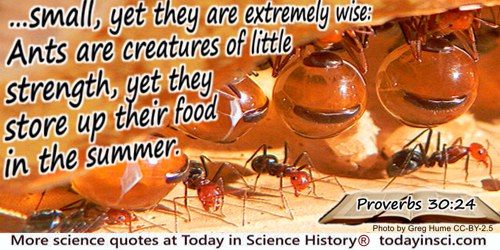
…small, yet they are extremely wise: Ants are creatures of little strength, yet they store up their food in the summer…
— Bible
In Proverbs, 'Sayings of Agur', Ch. 30, v.24-25 in The Bible: New International Version (2001), 364.
A faithful friend is the medicine of life; and they that fear the Lord shall find him.
— Bible
King James version, Ecclesiasticus 6:16.
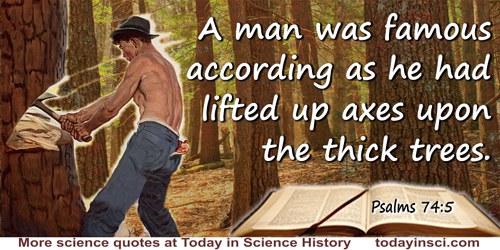
A man was famous according as he had lifted up axes upon the thick trees.
— Bible
Psalms 74:5 in Church of Scotland, The Book of Common-Prayer, and Administration of the Sacraments; and Other Parts of Divine Service For the Use of the Church of Scotland. With A Praphrase of the Psalms in Metre by King James the VI (1637), 250.
A merry heart doeth good like a medicine: but a broken spirit drieth the bones.
— Bible
King James Bible, Old Testament, Proverbs 17:22.
A wise person is hungry for knowledge, while the fool feeds on trash.
— Bible
Proverbs 15:14, as given in The Swindoll Study Bible NLT (New Living Translation), 760. In the King James Version, this is given as: “The heart of him that hath understanding seeketh knowledge: But the mouth of fools feedeth on foolishness.”
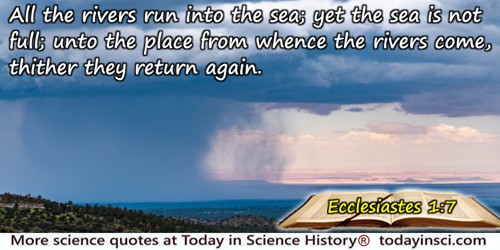
All the rivers run into the sea; yet the sea is not full; unto the place from whence the rivers come, thither they return again.
— Bible
King James Version, Ecclesiastes 1:7.
And God said, “Let the earth put forth vegetation, plants yielding seed, and fruit trees bearing fruit in which is their seed, each according to its kind.” And God saw that it was good. And there was evening and there was morning, a third day.
— Bible
(circa 725 B.C.)
And God said, Let the earth bring forth the living creature after his kind, cattle, and creeping thing, and beast of the earth after his kind: and it was so.
— Bible
From Genesis, I, 24, in The Holy Bible (1756), 2.
And God said, Let there be lights in the firmament of the heavens to separate the day from the night; and let them be for signs and for seasons and for days and years, and let them be lights in the firmament of the heavens to give light upon the earth.” And it was so. And God made the two great lights, the greater light to rule the day, and the lesser light to rule the night; he made the stars also.
— Bible
(circa 725 B.C.)
And God saw everything that He had made, and, behold, it was very good.
— Bible
From Genesis, I, 31, in The Holy Bible (1756), 2.
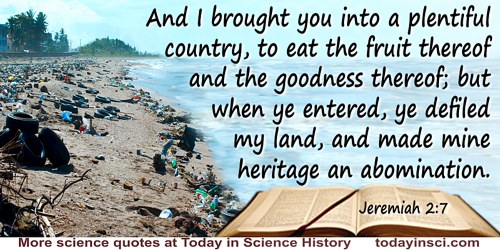
And I brought you into a plentiful country, to eat the fruit thereof and the goodness thereof; but when ye entered, ye defiled my land, and made mine heritage an abomination.
— Bible
Jeremiah 2:7, King James Bible.
And it shall come to pass in that day, saith the Lord God, that I will cause the sun to go down at noon, and I will darken the earth in the clear day.
— Bible
Amos 8:9. As in The Holy Bible, Or Divine Treasury (1804), 75.
And of every living thing of all flesh, you shall bring two of every sort into the ark, to keep them alive with you; they shall be male and female. Of the birds according to their kinds, and of the animals according to their kinds, of every creeping thing of the ground according to its kind.
— Bible
(circa 725 B.C.)
And the light shineth in the darkness; and the darkness comprehendeth it not.
— Bible
(circa 325 A.D.)
As for the earth, out of it comes bread, but underneath it is turned up as by fire. Its stones are the place of sapphires, and it has dust of gold.
— Bible
Bible: English Standard Version, Job Chap 28, verses 5-6.
Babylon the great is fallen, is fallen.
— Bible
(circa 325 A.D.)
Be fruitful and multiply, and then fill the earth and subdue it.
— Bible
(circa 725 B.C.)
But let your communication be Yea, yea; Nay, nay: for whatsoever is more than these cometh of evil.
— Bible
[Reminiscent of binary code!] Matthew 5:37. In Gary William Flake, The Computational Beauty of Nature (2000), 23.
But, beloved, do not forget this one thing, that with the Lord one day is as a thousand years, and a thousand years as one day.
— Bible
2 Peter 3:8
Consider the lilies of the field, how they grow; they toil not, neither do they spin.
— Bible
(circa 325 A.D.)
Every man should eat and drink and enjoy the fruit of all his labor; it is the gift of God.
— Bible
(circa 725 B.C.)
For in much wisdom is much grief and he that increaseth knowledge, increaseth sorrow.
— Bible
From 'Ecclesiastes', 1:18. In King James Version, The Bible: Containing the Old and New Testaments Translated Out Of the Original Tongues (circa 725 B.C., 1834)
https://books.google.com/books?id=qbaVYV0QiPMC
1834
For now we see through a glass, darkly; but then face to face: now I know in part; but then shall I know…
— Bible
In The Bible, King James Version, 1 Corinthians 13:12.
For the life of the flesh is in the blood.
— Bible
Leviticus 17:11.
For the Lord your God is bringing you into a good land—a land with brooks, streams, and deep springs gushing out into the valleys and hills; a land with wheat and barley, vines and fig trees, pomegranates, olive oil and honey; 9 a land where bread will not be scarce and you will lack nothing; a land where the rocks are iron and you can dig copper out of the hills.
— Bible
New International Version, Bible, Deuteronomy 8, 7-9.
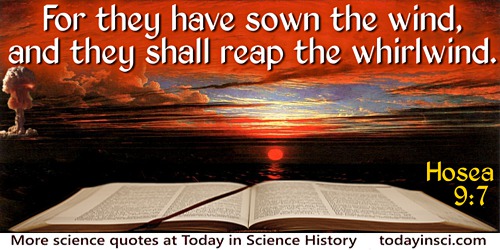
For they have sown the wind, and they shall reap the whirlwind.
— Bible
Hosea, 9:7. In Robert Andrews Famous Lines: a Columbia Dictionary of Familiar Quotations (1997), 340.
For what shall it profit a man, if he shall gain the whole world, and lose his own soul?
— Bible
Mark 8:36. Quoted in Kim Lim (ed.), 1,001 Pearls of Spiritual Wisdom: Words to Enrich, Inspire, and Guide Your Life (2014), 17
Give instruction to a wise man and he will be yet wiser.
— Bible
Proverbs 9:9 KJV
Go to the ant, thou sluggard; consider her ways, and be wise.
— Bible
Proverbs 6:6. In Gary William Flake, The Computational Beauty of Nature (2000), 261.
God said, “Let the earth produce vegetation… . Let the earth produce every kind of living creature. …” God said, “Let us make man in our image, in the likeness of ourselves, and let them be masters of the fish of the sea, the birds of heaven, the cattle, all the wild beasts, and all the reptiles that crawl upon the earth. “
— Bible
(circa 725 B.C.)
He telleth the number of stars; he calleth them all by their names.
— Bible
Psalms 147:4 in The Holy Bible (1746), 549.
I give waters in the wilderness and rivers in the desert, to give drink to my people.
— Bible
Isaiah 43:20
I returned and saw under the sun that the race is not to the swift, nor the battle to the strong, neither yet bread to the wise, nor yet riches to men of understanding, nor yet favour to men of skill; but time and chance happeneth to them all.
— Bible
Ecclesiastes 9:11. As given in the King James Version.
In the beginning God created the heaven and earth. And the earth was waste and void; and darkness was upon the face of the deep: and the spirit of God moved upon the face of the waters. … God said, “Let there be a vault in the waters to divide the waters in two.” And so it was. God made the vault, and it divided the waters above the vault from the waters under the vault. God called the vault “heaven.”
— Bible
Genesis 1:1 in The Holy Bible Containing the Old and New Testaments Translated Out of the Original Tongues. Printed for the Universities of Oxford and Cambridge (1895), 1.
It is the glory of God to conceal a thing, but the glory of a king to search it out.
— Bible
Prov. c. xxv. v. 2. As quoted by Francis Bacon and Basil Montagu (ed.) in The Works of Francis Bacon, (1834), Vol. 13, 89.
Let thy speech be short, comprehending much in few words.
— Bible
(circa 725 B.C.)
Now the serpent was more subtle than any beast of the field.
— Bible
(circa 725 B.C.)
Now the whole earth had one language and few words… . Then they said, Come, let us build ourselves a city, and a tower with its top in the heavens, and let us make a name for ourselves, lest we be scattered abroad upon the face of the whole earth.” And the Lord came down to see the city and the tower, which the sons of men had built. And the Lord said, “Behold, they are one people, and they have all one language; and this is only the beginning of what they will do; and nothing that they propose to do will now be impossible for them. Come, let us go down, and there confuse their language, that they may not understand one another’s speech.” So the Lord scattered them abroad from there over the face of all the earth, and they left off building the city. Therefore its name was called Babel, because there the Lord confused the language of all the earth… .
— Bible
(circa 725 B.C.)
O Timothy, keep that which is committed to thy trust, avoiding profane and vain babblings, and oppositions of science falsely so called; Which some professing have erred concerning faith. Grace be with thee. Amen.
— Bible
I Timothy 6:20-21, in The Holy Bible (1756).
Oh that I had wings like a dove! for then would I fly away, and be at rest.
— Bible
Psalm 55:6, The Holy Bible (1815), 475.
Oh, that my words were now written! Oh, that they were printed in a book! That with an graven with an iron pen and lead, in the rock for ever!
— Bible
Reference to the antiquity of iron and lead, from Job 19:23-24, in The Holy Bible (1746), 473.
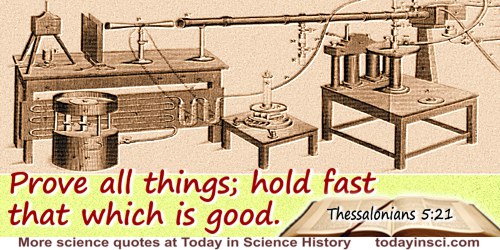
Prove all things; hold fast that which is good.
— Bible
In Thessalonians 5:21, King James Version, Bible. For example, in Robert Carroll and Stephen Prickett, eds., The Bible: Authorized King James Version (2008), 255.
So God created the great sea monsters and every living creature that moves, with which the waters swarm, according to their kinds.
— Bible
(circa 725 B.C.)
So out of the ground the Lord God formed every beast of the field and every bird of the air, and brought them to the man to see what he would call them; and whatever the man called every living creature, that was its name. The man gave names to all cattle, and to the birds of the air, and to every beast of the field… .
— Bible
(circa 725 B.C.)
So the Lord God caused a deep sleep to fall upon the man, and while he slept took one of his ribs and closed up its place with flesh; and the rib which the Lord God had taken from the man he made into a woman and brought her to the man.
— Bible
(circa 725 B.C.)
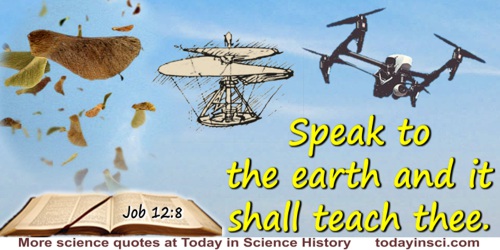
Speak to the earth and it shall teach thee.
— Bible
Book of Job (12:8), The Holy Bible: containing the Old and New Testaments, in the Common Version (1833), 409.
Tarshish was thy merchant by reason of the multitude of all kind of riches; with silver, iron, tin and lead, they traded in thy fairs.
— Bible
Reference to an early use of metals, from Ezekiel 27:12, in Holy Bible (1769).
The earth lies polluted under its inhabitants; for they have transgressed laws, violated the statutes, broken the everlasting covenant. Therefore a curse devours the earth, and its inhabitants suffer for their guilt.
— Bible
Isaiah 24:5-6 in Holy Bible: New Revised Standard Version (2011), 504.
The fear of the Lord is the beginning of knowledge: but fools despise wisdom and instruction.
— Bible
King James Version, Proverbs 1:7.
The fear of the Lord is the beginning of knowledge: but fools despise wisdom and instruction.
— Bible
King James Version, Proverbs 1:7.
The heart of the prudent getteth knowledge; and the ear of the wise seeketh knowledge.
— Bible
King James Version, Proverbs 18:15.
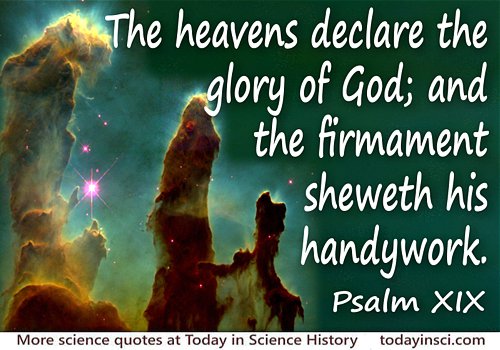
The heavens declare the glory of God; and the firmament sheweth his handy work. … In them hath he set a tabernacle for the sun, which is as a bridegroom coming out of his chamber, and rejoiceth as a strong man to run a race. His going forth is from the end of the heaven, and his circuit unto the ends of it: and there is nothing his from the heat thereof.
— Bible
Psalm 19, verse 1 from the King James Bible (translated 1611), as in The Holy Bible Containing the Old and New Testaments (1709), 347.
The light of the body is the eye.
— Bible
(circa 325 A.D.)
The Lord demands accurate scales and balances; He set the standards for fairness.
— Bible
Proverbs 16:11, as given in The Swindoll Study Bible NLT (New Living Translation), 760. In the King James Version, this is given as: “A just weight and balance are the Lord’s: all the weights of the bag are his work.”
The man is not of the woman; but the woman of the man. Neither was the man created for the woman; but the woman for the man.
— Bible
(circa 325 A.D.)
The mountains and hills will burst into song before you, and all the trees of the field will clap their hands. Instead of the thornbush will grow the pine tree, and instead of briers the myrtle will grow.
— Bible
Bible: New International Version (1984), Isaiah 55:12-13.
The wind goeth toward the south, and turneth about unto the north; it whirleth about continually, and the wind returneth again according to his circuits.
— Bible
King James Version, Ecclesiastes 1:6.
The wise man’s eyes are in his head; but the fool walketh in darkness.
— Bible
Ecclesiastes 2:14. Quoted as his reason to become a scientist, by Rudolf Arnheim, Professor Emeritus, Psychology of Art, Harvard University. In 'Seventy-Five Reasons to Become a Scientist', American Scientist (Sep-Oct 1988), 76, No. 5, 450.
Thou shalt not have in thy bag divers weights, a great and a small. Thou shalt not have in thine house divers measures, a great and a small. But thou shalt have a perfect and just weight, a perfect and just measure shalt thou have.
— Bible
Book of Deuteronomy.
Thou shalt not let thy cattle gender with a diverse kind; thou shalt not sow thy field with mingled seed.
An early injunction against genetic modification.
An early injunction against genetic modification.
— Bible
Leviticus 19:19. In 'Shaping Life in the Lab', Time (9 Mar 1981).
Train up a child in the way he should go: and when he is old, he will not depart from it.
— Bible
Proverbs 22:6, King James Version.
When a believing person prays, great things happen.
— Bible
James 5:13-16. Quoted in Kim Lim (ed.), 1,001 Pearls of Spiritual Wisdom: Words to Enrich, Inspire, and Guide Your Life (2014), 177
When I consider Thy heavens, the work of Thy fingers, the moon and the stars, which Thou hast ordained; What is man, that Thou art mindful of him? and the son of man, that Thou visitest him?
— Bible
Psalms VIII, verses 3-4, in The Book of Psalms: Containing the Prayer Book Version, The Authorized Version and The Revised Version: in Parallel Columns (1899), 8, Authorized Version column.
When I consider Thy heavens, the work of thy fingers, the moon and the stars, which thou hast ordained; What is man, that Thou art mindful of him? and the son of man, that thou visitest him?
— Bible
Psalm VIII, 3-4. In George D'Oyly and Richard Mant (eds.), The Holy Bible According to the Authorized Version (1839).
When I was a child, I spake as a child, I understood as a child, I thought as a child: but when I became a man, I put away childish things.
— Bible
(circa 325 A.D.) From King James Version, Bible, 1 Corinthians 13:11.
Where there is no vision the people perish.
— Bible
(circa 725 B.C.)
Who gathers knowledge gathers pain.
— Bible
In Ecclesiastes 1:18. A condensed version of the verse, “For in much wisdom is much grief and he that increaseth knowledge, increaseth sorrow.”
Ye are like unto whited sepulchres, which indeed appear beautiful outward, but are within full of dead men’s bones, and of all uncleanness.
— Bible
(circa 325 A.D.)
Your own soul is nourished when you are kind, but you destroy yourself when you are cruel.
— Bible
Proverbs 11:17. Proverbs 11:17
Quotes by others about Bible (40)
Nisi credideritis, non intelligitis.
Unless you believe, you will not understand.
Unless you believe, you will not understand.
De Ubero Arbitrio (On Free Choice of the Will) [386], Book I, chapter 2, section 4 (Augustine quoting from Isaiah 7:9).
The believer has the whole world of wealth (Prov. 17: 6 LXX) and “possesses all things as if he had nothing” (2 Cor. 6: 10) by virtue of his attachment to you whom all things serve; yet he may know nothing about the circuits of the Great Bear. It is stupid to doubt that he is better than the person who measures the heaven and counts the stars and weighs the elements, but neglects you who have disposed everything “by measure and number and weight” (Wisd. 11: 21).
Confessions [c.397], Book V, chapter 4 (7), trans. H. Chadwick (1991), 76.
To this I may add another form of temptation, manifold in its dangers … There exists in the soul … a cupidity which does not take delight in the carnal pleasure but in perceptions acquired through the flesh. It is a vain inquisitiveness dignified with the title of knowledge and science. As this is rooted in the appetite for knowing, and as among the senses the eyes play a leading role in acquiring knowledge, the divine word calls it “the lust of the eyes” (I John, 2: 16) … To satisfy this diseased craving … people study the operations of nature, which lie beyond our grasp when there is no advantage in knowing and the investigators simply desire knowledge for its own sake. This motive is again at work if, using a perverted science for the same end, people try to achieve things by magical arts.
From Confessions (c.397), Book X, Chap. 35 (54-55), as given in Henry Chadwick, Confessions: A New Translation by Henry Chadwick (1991), 210-212.
Well, it [evolution] is a theory, it is a scientific theory only, and it has in recent years been challenged in the world of science and is not yet believed in the scientific community to be as infallible as it once was believed. But if it was going to be taught in the schools, then I think that also the biblical theory of creation, which is not a theory but the biblical story of creation, should also be taught.
Responding to a question, during his 1980 Presidential Campaign, whether he agreed with the teaching of evolution in schools. Quoted in New Scientist (9 Oct 1980), 136.
In this age of space flight, when we use the modern tools of science to advance into new regions of human activity, the Bible ... this grandiose, stirring history of the gradual revelation and unfolding of the moral law ... remains in every way an up-to-date book. Our knowledge and use of the laws of nature that enable us to fly to the Moon also enable us to destroy our home planet with the atom bomb. Science itself does not address the question whether we should use the power at our disposal for good or for evil. The guidelines of what we ought to do are furnished in the moral law of God. It is no longer enough that we pray that God may be with us on our side. We must learn again that we may be on God's side.
Quoted in Bob Phillips, Phillips' Book of Great Thoughts & Funny Sayings (1993), 42.
I gleaned more practical psychology and psychiatry from the Bible, than from all other books!
Quoted in Bob Phillips, Phillips' Book of Great Thoughts & Funny Sayings (1993), 42.
The Biblical value of pi, by comparison, is exactly three, as is clear from a verse in 1 Kings vii 23: 'and he made a molten sea, ten cubits from brim to brim, and his height was five cubit; and a line of thirty cubits did encompass him round about.'
— Eli Maor
From To Infinity and Beyond (1991), 4.
Evolution has encountered no intellectual trouble; no new arguments have been offered. Creationism is a home-grown phenomenon of American sociocultural history—a splinter movement … who believe that every word in the Bible must be literally true, whatever such a claim might mean.
Leonardo's Mountain of Clams and the Diet of Worms: Essays on Natural History (1998), 270.
Science is uncertain. Theories are subject to revision; observations are open to a variety of interpretations, and scientists quarrel amongst themselves. This is disillusioning for those untrained in the scientific method, who thus turn to the rigid certainty of the Bible instead. There is something comfortable about a view that allows for no deviation and that spares you the painful necessity of having to think.
The 'Threat' of Creationism. In Ashley Montagu (ed.), Science and Creationism (1984), 192.
As far as I see, such a theory [of the primeval atom] remains entirely outside any metaphysical or religious question. It leaves the materialist free to deny any transcendental Being. He may keep, for the bottom of space-time, the same attitude of mind he has been able to adopt for events occurring in non-singular places in space-time. For the believer, it removes any attempt to familiarity with God, as were Laplace’s chiquenaude or Jeans’ finger. It is consonant with the wording of Isaiah speaking of the “Hidden God” hidden even in the beginning of the universe … Science has not to surrender in face of the Universe and when Pascal tries to infer the existence of God from the supposed infinitude of Nature, we may think that he is looking in the wrong direction.
From 'The Primeval Atom Hypothesis and the Problem of Clusters of Galaxies', in R. Stoops (ed.), La Structure et l'Evolution de l'Univers (1958), 1-32. As translated in Helge Kragh, Cosmology and Controversy: The Historical Development of Two Theories of the Universe (1996), 60.
Imagine the people who believe such things and who are not ashamed to ignore, totally, all the patient findings of thinking minds through all the centuries since the Bible was written. And it is these ignorant people, the most uneducated, the most unimaginative, the most unthinking among us, who would make themselves the guides and leaders of us all; who would force their feeble and childish beliefs on us; who would invade our schools and libraries and homes. I personally resent it bitterly.
In The Roving Mind (1983), 26.
But I should be very sorry if an interpretation founded on a most conjectural scientific hypothesis were to get fastened to the text in Genesis... The rate of change of scientific hypothesis is naturally much more rapid than that of Biblical interpretations, so that if an interpretation is founded on such an hypothesis, it may help to keep the hypothesis above ground long after it ought to be buried and forgotten.
Letter to Rev. C. J. Ellicott, Bishop of Gloucester and Bristol (22 Nov 1876). Quoted in Lewis Campbell and William Garnett, The Life of James Clerk Maxwell (1882), 394.
Why, these men would destroy the Bible on evidence that would not convict a habitual criminal of a misdemeanor. They found a tooth in a sand pit in Nebraska with no other bones about it, and from that one tooth decided that it was the remains of the missing link. They have queer ideas about age too. They find a fossil and when they are asked how old it is they say they can't tell without knowing what rock it was in, and when they are asked how old the rock is they say they can't tell unless they know how old the fossil is.
In Henry Fairfield Osborn, 'Osborn States the Case For Evolution', New York Times (12 Jul 1925), XX1. In fact, the tooth was misidentified as anthropoid by Osborn, who over-zealously proposed Nebraska Man in 1922. This tooth was shortly thereafter found to be that of a peccary (a Pliocene pig) when further bones were found. A retraction was made in 1927, correcting the scientific blunder.
The only part of evolution in which any considerable interest is felt is evolution applied to man. A hypothesis in regard to the rocks and plant life does not affect the philosophy upon which one's life is built. Evolution applied to fish, birds and beasts would not materially affect man's view of his own responsibilities except as the acceptance of an unsupported hypothesis as to these would be used to support a similar hypothesis as to man. The evolution that is harmful—distinctly so—is the evolution that destroys man’s family tree as taught by the Bible and makes him a descendant of the lower forms of life. This … is a very vital matter.
'God and Evolution', New York Times (26 Feb 1922), 84. Rebuttals were printed a few days later from Henry Fairfield Osborn and Edwin Grant Conklin.
Paris ... On this side of the ocean it is difficult to understand the susceptibility of American citizens on the subject and precisely why they should so stubbornly cling to the biblical version. It is said in Genesis the first man came from mud and mud is not anything very clean. In any case if the Darwinian hypothesis should irritate any one it should only be the monkey. The monkey is an innocent animal—a vegetarian by birth. He never placed God on a cross, knows nothing of the art of war, does not practice lynch law and never dreams of assassinating his fellow beings. The day when science definitely recognizes him as the father of the human race the monkey will have no occasion to be proud of his descendants. That is why it must be concluded that the American Association which is prosecuting the teacher of evolution can be no other than the Society for Prevention of Cruelty to Animals.
[A cynical article in the French press on the Scopes Monkey Trial, whether it will decide “a monkey or Adam was the grandfather of Uncle Sam.”]
[A cynical article in the French press on the Scopes Monkey Trial, whether it will decide “a monkey or Adam was the grandfather of Uncle Sam.”]
Article from a French daily newspaper on the day hearings at the Scopes Monkey Trial began, Paris Soir (13 Jul 1925), quoted in 'French Satirize the Case', New York Times (14 Jul 1925), 3.
If only the Geologists would let me alone, I could do very well, but those dreadful Hammers! I hear the clink of them at the end of every cadence of the Bible verses.
Letter to Henry Acland (24 May 1851).
I am putting together a secular bible. My Genesis is when the apple falls on Newton's head.
Quoted in interview by Tim Adams, 'This much I know: A.C. Grayling', The Observer (4 Jul 2009).
[The Book of Genesis is] [p]rofoundly interesting and indeed pathetic to me are those attempts of the opening mind of man to appease its hunger for a Cause. But the Book of Genesis has no voice in scientific questions. It is a poem, not a scientific treatise. In the former aspect it is for ever beautiful; in the latter it has been, and it will continue to be, purely obstructive and hurtful.'
In 'Professor Virchow and Evolution', Fragments of Science (1879), Vol. 2, 377. Tyndall is quoting himself from “four years ago”&mdashthus c.1875.
Once early in the morning, at two or three in the morning, when the master was asleep, the books in the library began to quarrel with each other as to which was the king of the library. The dictionary contended quite angrily that he was the master of the library because without words there would be no communication at all. The book of science argued stridently that he was the master of the library for without science there would have been no printing press or any of the other wonders of the world. The book of poetry claimed that he was the king, the master of the library, because he gave surcease and calm to his master when he was troubled. The books of philosophy, the economic books, all put in their claims, and the clamor was great and the noise at its height when a small low voice was heard from an old brown book lying in the center of the table and the voice said, “The Lord is my shepherd, I shall not want.” And all of the noise and the clamor in the library ceased, and there was a hush in the library, for all of the books knew who the real master of the library was.
'Ministers of Justice', address delivered to the Eighty-Second Annual Convention of the Tennessee Bar Association at Gatlinburg (5 Jun 1963). In Tennessee Law Review (Fall 1963), 31, No. 1, 19.
There’s a lot of scientific data that I found out as a scientist that actually show that this is really a young Earth. I believe that the Earth is about 9,000 years old. I believe that it was created in six days as we know them. That’s what the Bible says. And what I’ve come to learn is that it’s the manufacturer’s handbook, is what I call it. It ... teaches us how to run all our public policy.
[Demonstrating the uncompromising substitution of his religious ideology for centuries of scientific facts while he is responsible for setting important public policy on matters of science.]
[Demonstrating the uncompromising substitution of his religious ideology for centuries of scientific facts while he is responsible for setting important public policy on matters of science.]
From speech (27 Sep 2012) to a sportman's banquet at Liberty Baptist Church, Hartwell, Georgia, as quoted in Matt Pearce, 'U.S. Rep. Paul Broun: Evolution a lie ‘from the pit of hell’', Los Angeles Times (7 Oct 2012).
One can often recognize herd animals by their tendency to carry bibles.
From 'The Signal', a short story in Illusionless Man: Fantasies and Meditations (1971).
There can be no real conflict between the two Books of the Great Author. Both are revelations made by Him to man,—the earlier telling of God-made harmonies coming up from the deep past, and rising to their height when man appeared, the later teaching man's relations to his Maker, and speaking of loftier harmonies in the eternal future.
Conclusion of 'Cosmogony', the last chapter in Manual of Geology, Treating of the Principles of the Science (1863), 746.
The Bible is like a telescope. If a man looks through his telescope, then he sees worlds beyond; but, if he looks at his telescope, then he does not see anything but that.
In Proverbs from Plymouth Pulpit (1887), 136.
I find more sure marks of the authenticity of the Bible than in any profane history whatever.
As written by Bishop Richard Watson, this anecdote was relayed to him by his former teacher, Dr. Robert Smith, late Master of Trinity College, who was told by Newton, while he was writing his Observations on Daniel and the Apocalypse of St. John. Quoted in Richard Watson, 'An Apology For Christianity', Bishop of Landaff’s Sermons on Public Occasions, and Tracts on Religious Subjects (1788), 286. At the time of publication, the author was Lord Bishop of Landaff and Regius Professor of Divinity, University of Cambridge. 'Apology' was one in a series of Letters addressed to Ed. Gibbon, Esq (author of the History of the Decline and Fall of the Roman Empire first printed in 1776). Dr. Robert Smith (1689-2 Feb 1768) was a mathematician who helped to spread Isaac Newton’s ideas in Europe.
God created man in his own image, says the Bible; the philosophers do the exact opposite, they create God in theirs.
Aphorism 48 in Notebook D (1773-1775), as translated by R.J. Hollingdale in Aphorisms (1990). Reprinted as The Waste Books (2000), 51.
Properly read, the Bible is the most potent force for atheism ever conceived.
…...
You should look at the entire Bible as a whole rather then narrowly, if you can, under close scrutiny and with juxtaposition of passages
…...
False interpretation of the Bible has often clashed with science, as false science has with true interpretation; but true science is the natural ally of religion, for both are from God.
…...
A conflict arises when a religious community insists on the absolute truthfulness of all statements recorded in the Bible. This means an intervention on the part of religion into the sphere of science; this is where the struggle of the Church against the doctrines of Galileo and Darwin belongs. On the other hand, representatives of science have often made an attempt to arrive at fundamental judgments with respect to values and ends on the basis of scientific method, and in this way have set themselves in opposition to religion. These conflicts have all sprung from fatal errors.
From an Address (19 May 1939) at Princeton Theological Seminary, 'Science and Religion', collected in Ideas And Opinions (1954, 2010), 45.
As a child, I received instruction both in the Bible and in the Talmud. I am a Jew, but I am enthralled by the luminous figure of the Nazarene.
From 'What Life Means to Einstein', The Saturday Evening Post (26 Oct 1929), 117.
Through the reading of popular scientific books I soon reached the conviction that much in the stories of the Bible could not be true. The consequence was a positively fanatic [orgy of] freethinking coupled with the impression that youth is intentionally being deceived by the state through lies; it was a crushing impression. Mistrust of every kind of authority grew out of this experience, a skeptical attitude toward the convictions that were alive in any specific social environment–an attitude that has never again left me, even though, later on, it has been tempered by a better insight into the causal connections.
In P. A. Schilpp, (ed.), Part I, 'Autobiographical Notes', Albert Einstein: Philosopher-Scientist (1949, 1959), Vol. 1, 5. Translated by the P.A. Schilpp, from Einstein’s original German manuscript, written at age 67, (p.2, 4): “Durch Lesen populärwissenschaftlicher Bücher kam ich bald zu der Ueberzeugung, dass vieles in den Erzählungen der Bibel nicht wahr sein konnte. Die Folge war eine geradezu fanatische Freigeisterei, verbunden mit dem Eindruck, dass die Jugend vom Staate mit Vorbedacht belogen wird; es war ein niederschmetternder Eindruck. Das Misstrauen gegen jede Art Autorität erwuchs aus diesem Erlebnis, eine skeptische Einstellung gegen die Ueberzeugungen, welche in der jeweiligen sozialen Umwelt lebendig waren—eine Einstellung, die mich nicht wieder verlassen hat, wenn sie auch später durch bessere Einsicht in die kausalen Zusammenhänge ihre ursprünglische Schärfe verloren haben.”.
Feeling weightless… it’s so many things together. A feeling of pride, of healthy solitude, of dignified freedom from everything that’s dirty, sticky. You feel exquisitely comfortable . . . and you feel you have so much energy, such an urge to do things, such an ability to do things. And you work well, yes, you think well, without sweat, without difficulty as if the biblical curse in the sweat of thy face and in sorrow no longer exists, As if you’ve been born again.
…...
We have one of his [Newton’s] college memorandum-books, which is highly interesting. The following are some of the entries: “Drills, gravers, a hone, a hammer, and a mandril, 5s.;” “a magnet, 16s.;” “compasses, 2s.;” “glass bubbles, 4s.;” “at the tavern several other times, £1;” “spent on my cousin, 12s.;” “on other acquaintances, 10s.;” “Philosophical Intelligences, 9s. 6d.;” “lost at cards twice, 15s.;” “at the tavern twice, 3s. 6d.;” “to three prisms, £3;” “four ounces of putty, 1s. 4d.;” “Bacon’s Miscellanies, 1s. 6d.;” “a bible binding, 3s.;” “for oranges to my sister, 4s. 2d.;” “for aquafortis, sublimate, oyle pink, fine silver, antimony, vinegar, spirit of wine, white lead, salt of tartar, £2;” “Theatrum chemicum, £1 8s.”
In 'Sir Isaac Newton', People’s Book of Biography: Or, Short Lives of the Most Interesting Persons of All Ages and Countries (1868), 255.
One day the zoo-keeper noticed that the orangutan was reading two books—the Bible and Darwin’s Origin of Species. In surprise, he asked the ape,“Why are you reading both those books?”
“Well,” said the orangutan, “I just wanted to know if I was my brother’s keeper, or my keeper’s brother.”
“Well,” said the orangutan, “I just wanted to know if I was my brother’s keeper, or my keeper’s brother.”
In Jon Fripp, Michael Fripp and Deborah Fripp, Speaking of Science (2000), 27.
It is some systematised exhibition of the whale in his broad genera, that I would now fain put before you. Yet is it no easy task. The classification of the constituents of a chaos, nothing less is here essayed. Listen to what the best and latest authorities have laid down.
“No branch of Zoology is so much involved as that which is entitled Cetology,” says Captain Scoresby, A.D. 1820.
“It is not my intention, were it in my power, to enter into the inquiry as to the true method of dividing the cetacea into groups and families. * * * Utter confusion exists among the historians of this animal” (sperm whale), says Surgeon Beale. A. D. 1839.
“Unfitness to pursue our research in the unfathomable waters.” “Impenetrable veil covering our knowledge of the cetacea.” “A field strewn with thorns.” “All these incomplete indications but serve to torture us naturalists.”
Thus speak of the whale, the great Cuvier, and John Hunter, and Lesson, those lights of zoology and anatomy. Nevertheless, though of real knowledges there be little, yet of books there are plenty; and so in some small degree, with cetology, or the science of whales. Many are the men, small and great, old and new, landsmen and seamen, who have at large or in little, written of the whale. Run over a few:— The Authors of the Bible; Aristotle; Pliny; Aldrovandi; Sir Thomas Browne; Gesner; Ray; Linnæus; Rondeletius; Willoughby; Green; Artedi; Sibbald; Brisson; Marten; Lacépède; Bonneterre; Desmarest; Baron Cuvier; Frederick Cuvier; John Hunter; Owen; Scoresby; Beale; Bennett; J. Ross Browne; the Author of Miriam Coffin; Olmstead; and the Rev. T. Cheever. But to what ultimate generalising purpose all these have written, the above cited extracts will show.
Of the names in this list of whale authors, only those following Owen ever saw living whales; and but one of them was a real professional harpooner and whaleman. I mean Captain Scoresby.
“No branch of Zoology is so much involved as that which is entitled Cetology,” says Captain Scoresby, A.D. 1820.
“It is not my intention, were it in my power, to enter into the inquiry as to the true method of dividing the cetacea into groups and families. * * * Utter confusion exists among the historians of this animal” (sperm whale), says Surgeon Beale. A. D. 1839.
“Unfitness to pursue our research in the unfathomable waters.” “Impenetrable veil covering our knowledge of the cetacea.” “A field strewn with thorns.” “All these incomplete indications but serve to torture us naturalists.”
Thus speak of the whale, the great Cuvier, and John Hunter, and Lesson, those lights of zoology and anatomy. Nevertheless, though of real knowledges there be little, yet of books there are plenty; and so in some small degree, with cetology, or the science of whales. Many are the men, small and great, old and new, landsmen and seamen, who have at large or in little, written of the whale. Run over a few:— The Authors of the Bible; Aristotle; Pliny; Aldrovandi; Sir Thomas Browne; Gesner; Ray; Linnæus; Rondeletius; Willoughby; Green; Artedi; Sibbald; Brisson; Marten; Lacépède; Bonneterre; Desmarest; Baron Cuvier; Frederick Cuvier; John Hunter; Owen; Scoresby; Beale; Bennett; J. Ross Browne; the Author of Miriam Coffin; Olmstead; and the Rev. T. Cheever. But to what ultimate generalising purpose all these have written, the above cited extracts will show.
Of the names in this list of whale authors, only those following Owen ever saw living whales; and but one of them was a real professional harpooner and whaleman. I mean Captain Scoresby.
Opening of Chap. 32, 'Cetology', in Moby Dick (1851, 1892), 126-127.
Newton[’s] Principia…is more biblical than just a text. It is the equivalent of Euclid’s elements. … These principles talk of the philosophy that is…exonerated by the success of application.
From review by an unnamed reader of Ernst Mach and Thomas J. McCormack (trans.), The Science of Mechanics: A Critical and Historical Exposition of Its Principles (1893), Google Books id=4OE2AAAAMAAJ.
Hogwash! … On our way to the moon, and on the moon, I worked as hard as John Young and it took me another six years before I found out the truth about God. In the days of Apollo and long afterwards I still believed in the theory of evolution and rejected the Biblical creation story. [Commenting on an American reporter’s printed intimation that Lunar Module pilots “had less things to do and had time to look out the spaceship’s window, or to explore the surroundings. Afterwards they could not cope with what they had seen, felt and experienced.”]
As quoted in Colin Burgess, Footprints in the Dust: The Epic Voyages of Apollo, 1969-1975 (2010), 422. Burgess introduced the quote with: “Charles Moss Duke Jr. has always been wrongly labeled as the astronaut who found God during his Apollo 16 mission, but even though he did eventually become a born-again Christian, this life-altering epiphany came some years after the event.” Burgess explained that Duke dislikes “misinformed characterizations of himself and his Apollo colleagues and of the religious impact of his own lunar mission.” [The ellipsis in the subject quote spans from one paragraph to the next in Burgess’ book. The ellipsis was added by Webmaster, on the assumption that the word “Hogwash!” belongs with the statement in the following paragraph.]
A few years ago, Science endeavored to show that it was not inconsistent with the bible. The tables have been turned, and now, Religion is endeavoring to prove that the bible is not inconsistent with Science.
In Some Mistakes of Moses (1879), 242.
A liberal education may be had at a very slight cost of time …[with] ten books which you may make close friends.
I. Old and New Testament.
II. Shakespeare.
III. Montaigne.
IV. Plutarch’s Lives.
V. Marcus Aurelius.
VI. Epictetus.
VII. Religio Medici.
VIII. Don Quixote.
IX. Emerson
X. Oliver Wendell Holmes—Breakfast-Table Series.
I. Old and New Testament.
II. Shakespeare.
III. Montaigne.
IV. Plutarch’s Lives.
V. Marcus Aurelius.
VI. Epictetus.
VII. Religio Medici.
VIII. Don Quixote.
IX. Emerson
X. Oliver Wendell Holmes—Breakfast-Table Series.
From 'Bed-Side Reading List For Medical Students', final page of Aequanimitas and Other Addresses (1904, 1906), 475.
That John Thomas Scopes, heretofore on the 24th day of April, 1925, in the county aforesaid, then and there unlawfully did wilfully teach in the public schools of Rhea County, Tennessee, which said public schools are supported in part, or in whole by the public school fund of the State, a certain theory or theories that denied the story of the divine creation of man as taught in the Bible, but did teach instead thereof, that man is descended from a lower order of animals, he, the said John Thomas Scopes, being at the time, and prior thereto, a teacher in the public schools of Rhea County, Tennessee, as foresaid, against the peace and dignity of the State.
Text of the indictment of John Scopes for teaching evolution. As given in John Scopes and James Presley, Center of the Storm: Memoirs of John T. Scopes (1967),

See also:
 In science it often happens that scientists say, 'You know that's a really good argument; my position is mistaken,' and then they would actually change their minds and you never hear that old view from them again. They really do it. It doesn't happen as often as it should, because scientists are human and change is sometimes painful. But it happens every day. I cannot recall the last time something like that happened in politics or religion.
(1987) --
In science it often happens that scientists say, 'You know that's a really good argument; my position is mistaken,' and then they would actually change their minds and you never hear that old view from them again. They really do it. It doesn't happen as often as it should, because scientists are human and change is sometimes painful. But it happens every day. I cannot recall the last time something like that happened in politics or religion.
(1987) -- 





