 (source)
|
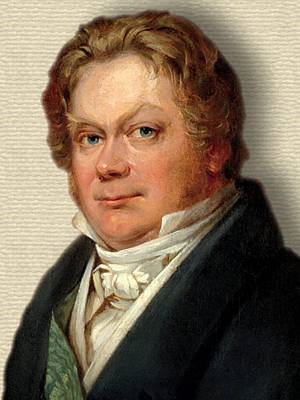
Jöns Jacob Berzelius
(20 Aug 1779 - 7 Aug 1848)
Swedish chemist who was one of the founders of modern chemistry. He is especially noted for his determination of atomic weights, the development of modern chemical symbols.
|
Science Quotes by Jöns Jacob Berzelius (10 quotes)
... every chemical combination is wholly and solely dependent on two opposing forces, positive and negative electricity, and every chemical compound must be composed of two parts combined by the agency of their electrochemical reaction, since there is no third force. Hence it follows that every compound body, whatever the number of its constituents, can be divided into two parts, one of which is positively and the other negatively electrical.
— Jöns Jacob Berzelius
Essai sur la théorie des proportions chemiques (1819), 98. Quoted by Henry M. Leicester in article on Bessel in Charles Coulston Gillespie (editor), Dictionary of Scientific Biography (1981), Vol. 2, 94.
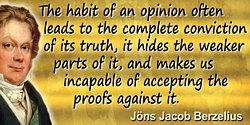
Die Gewohnheit einer Meinung erzeugt oft völlige Ueberzeugung von ihrer Richtigkeit, sie verbirgt die schwächeren Theile davon, und macht uns unfähig, die Beweise dagegen anzunehmen.
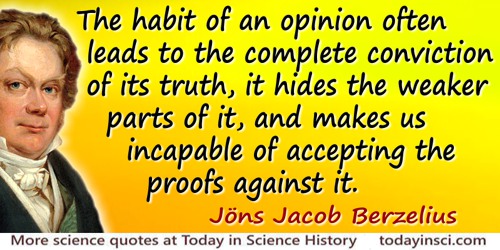
The habit of an opinion often leads to the complete conviction of its truth, it hides the weaker parts of it, and makes us incapable of accepting the proofs against it.
The habit of an opinion often leads to the complete conviction of its truth, it hides the weaker parts of it, and makes us incapable of accepting the proofs against it.
— Jöns Jacob Berzelius
(1827). German text in Ira Freund, The Study of Chemical Composition (1904), 31. Translated form in Carl Schorlemmer, The Rise and Development of Organic Chemistry (1894), 49.
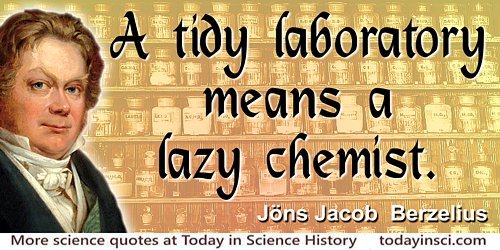
A tidy laboratory means a lazy chemist.
— Jöns Jacob Berzelius
Berzelius to Nils Sefstrom, 8th July 1812. In C. G. Bernard, 'Berzelius as a European Traveller', in E. M. Melhardo and T. Frängsmyr (eds.), Enlightenment Science in the Romantic Era (1992), 225.
As mineralogy constitutes a part of chemistry, it is clear that this arrangement [of minerals] must derive its principles from chemistry. The most perfect mode of arrangement would certainly be to allow bodies to follow each other according to the order of their electro-chemical properties, from the most electro-negative, oxygen, to the most electro-positive, potassium; and to place every compound body according to its most electro-positive ingredient.
— Jöns Jacob Berzelius
An Attempt to Establish a Pure Scientific System of Mineralogy (1814), trans. J. Black, 48.
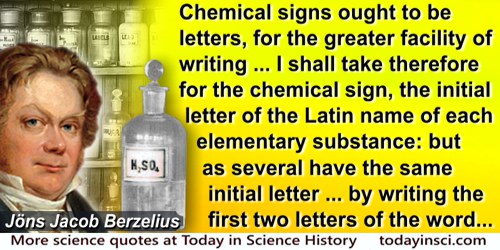
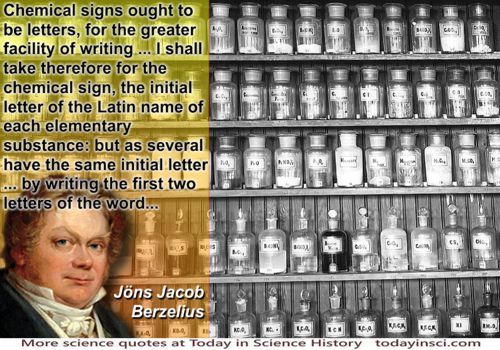
Chemical signs ought to be letters, for the greater facility of writing, and not to disfigure a printed book ... I shall take therefore for the chemical sign, the initial letter of the Latin name of each elementary substance: but as several have the same initial letter, I shall distinguish them in the following manner:— 1. In the class which I shall call metalloids, I shall employ the initial letter only, even when this letter is common to the metalloid and to some metal. 2. In the class of metals, I shall distinguish those that have the same initials with another metal, or a metalloid, by writing the first two letters of the word. 3. If the first two letters be common to two metals, I shall, in that case, add to the initial letter the first consonant which they have not in common: for example, S = sulphur, Si = silicium, St = stibium (antimony), Sn = stannum (tin), C = carbonicum, Co = colbaltum (colbalt), Cu = cuprum (copper), O = oxygen, Os = osmium, &c.
— Jöns Jacob Berzelius
'Essay on the Cause of Chemical Proportions, and on some circumstances relating to them: together with a short and easy method of expressing them', Annals of Philosophy, 1814, 3,51-2.
In arranging the bodies in order of their electrical nature, there is formed an electro-chemical system which, in my opinion, is more fit than any other to give an idea of chemistry.
— Jöns Jacob Berzelius
Essai sur le théorie des proportions chimiques (1819). Translated in Henry M. Leicester and Herbert S. Klickstein, A Source Book in Chemistry 1400-1900 (1952), 260.
Since it is necessary for specific ideas to have definite and consequently as far as possible selected terms, I have proposed to call substances of similar composition and dissimilar properties isomeric, from the Greek ίσομερης (composed of equal parts).
— Jöns Jacob Berzelius
Jahrebericht (1832). As translated in Henry M. Leicester and Herbert S. Klickstein, A Source Book in Chemistry 1400-1900 (1952), 265.
The experiments made on the mutual electrical relations of bodies have taught us that they can be divided into two classes: electropositive and electronegative. The simple bodies which belong to the first class, as well as their oxides, always take up positive electricity when they meet simple bodies or oxides belonging to the second class; and the oxides of the first class always behave with the oxides of the other like salifiable bases with acids.
— Jöns Jacob Berzelius
Essai sur le théorie des proportions chimiques (1819). Translated in Henry M. Leicester and Herbert S. Klickstein, A Source Book in Chemistry 1400-1900 (1952), 260.
This new force, which was unknown until now, is common to organic and inorganic nature. I do not believe that this is a force entirely independent of the electrochemical affinities of matter; I believe, on the contrary, that it is only a new manifestation, but since we cannot see their connection and mutual dependence, it will be easier to designate it by a separate name. I will call this force catalytic force. Similarly, I will call the decomposition of bodies by this force catalysis, as one designates the decomposition of bodies by chemical affinity analysis.
— Jöns Jacob Berzelius
In'Some Ideas on a New Force which Acts in Organic Compounds', Annales chimie physiques, 1836, 61, 146. Translated in Henry M. Leicester and Herbert S. Klickstein, A Source Book in Chemistry 1400-1900 (1952), 267.
This work [an essay by Thomson, ‘On the method of analysing sulphate of zinc’] belongs to those few productions from which science will derive no advantage whatever. Much of the experimental part, even of the fundamental experiments, appears to have been made at the writing-desk; and the greatest civility which his contemporaries can show its author, is to forget it was ever published. … love of science makes it imperative to detect quackery, and expose it to the judgement of every one as it merits
— Jöns Jacob Berzelius
In Jahresbericht (1827), 6, 77 and 181. Woehler's translation quoted in 'Attack of Berzelius on Dr. Thomson's Attempt to Establish the First Principles of Chemistry by Experiment', Philosophical Magazine (Dec 1828), 4, No. 24, 451. The latter article comments, “It well becomes Berzelius to expose fallacy in argument, or detect error in analysis; but let him not pass beyond the limits of fair criticism: let him not arraign the character of the individual., who may be actuated by motives and principles as pure as his own. Intemperate attacks, such as this, reflect back upon their author, and indicate a mind inflamed by pique, jealousy, or some unworthy passion.”
Quotes by others about Jöns Jacob Berzelius (3)
Atoms are round balls of wood invented by Dr. Dalton.
Answer given by a pupil to a question on atomic theory, as reported by Sir Henry Enfield Roscoe.
Answer given by a pupil to a question on atomic theory, as reported by Sir Henry Enfield Roscoe.
Reports of the British Association for the Advancement of Science, 57th report, 1887, 7.
Those who are unacquainted with the details of scientific investigation have no idea of the amount of labour expended in the determination of those numbers on which important calculations or inferences depend. They have no idea of the patience shown by a Berzelius in determining atomic weights; by a Regnault in determining coefficients of expansion; or by a Joule in determining the mechanical equivalent of heat.
In Sound: A Course of Eight Lectures Delivered at the Royal Institution of Great Britain (1867), 26.
I am an organic chemist, albeit one who adheres to the definition of organic chemistry given by the great Swedish chemist Berzelius, namely, the chemistry of substances found in living matter, and my science is one of the more abstruse insofar as it rests on concepts and employs a jargon neither of which is a part of everyday experience. Nevertheless, organic chemistry deals with matters of truly vital Importance and in some of its aspects with which I myself have been particularly concerned it may prove to hold the keys to Life itself.
In 'Synthesis in the Study of Nucleotides', Nobel Lecture, 11 December 1957. In Nobel Lectures: Chemistry 1942-1962 (1964), 522.
See also:
- 20 Aug - short biography, births, deaths and events on date of Berzelius's birth.
- Jöns Jacob Berzelius - context of quote Jons Berzelius quote on chemical symbols - with background of bottles of chemicals - Medium image (500 x 350 px)
- Jöns Jacob Berzelius - context of quote Jons Berzelius quote on chemical symbols - with background of bottles of chemicals - Large image (800 x 600 px)
- Jöns Jacob Berzelius: Autobiographical Notes, by H.G.Soderbaum and Olof Larsell (trans). - book suggestion.
 In science it often happens that scientists say, 'You know that's a really good argument; my position is mistaken,' and then they would actually change their minds and you never hear that old view from them again. They really do it. It doesn't happen as often as it should, because scientists are human and change is sometimes painful. But it happens every day. I cannot recall the last time something like that happened in politics or religion.
(1987) --
In science it often happens that scientists say, 'You know that's a really good argument; my position is mistaken,' and then they would actually change their minds and you never hear that old view from them again. They really do it. It doesn't happen as often as it should, because scientists are human and change is sometimes painful. But it happens every day. I cannot recall the last time something like that happened in politics or religion.
(1987) -- 





.jpg)