 (source)
|
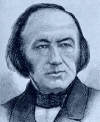
Claude Bernard
(12 Jul 1813 - 10 Feb 1878)
French physiologist who helped establish the principles of experimentation in the life sciences. His Introduction to the Study of Experimental Medicine (1865) is a scientific classic.
|
Science Quotes by Claude Bernard (90 quotes)
>> Click for Claude Bernard Quotes on | Belief | Cause | Discovery | Experiment | Fact | Find | Great | Hypothesis | Idea | Knowledge | Life | Men Of Science | Mind | New | Observation | Phenomenon | Reasoning | Research | Science | Seeking | Statistics | Theory | Truth | Understanding |
>> Click for Claude Bernard Quotes on | Belief | Cause | Discovery | Experiment | Fact | Find | Great | Hypothesis | Idea | Knowledge | Life | Men Of Science | Mind | New | Observation | Phenomenon | Reasoning | Research | Science | Seeking | Statistics | Theory | Truth | Understanding |
A l’aide de ces sciences expérimentales actives, l’homme devient un inventeur de phénomènes, un véritable contremaître de la création; et l'on ne saurait, sous ce rapport, assigner de limites à la puissance qu’il peut acquérir sur la nature, par les progrès futurs des sciences expérimentales
With the aid of these active experimental sciences man becomes an inventor of phenomena, a real foreman of creation; and under this head we cannot set limits to the power that he may gain over nature through future progress of the experimental sciences.
With the aid of these active experimental sciences man becomes an inventor of phenomena, a real foreman of creation; and under this head we cannot set limits to the power that he may gain over nature through future progress of the experimental sciences.
— Claude Bernard
Original French text in Introduction à l'Étude de la Médecine Expérimentale (1898), 32. English version from An Introduction to the Study of Experimental Medicine (1865), as translated by Henry Copley Greene (1957), 18.
À mesure que la science rabaisse ainsi notre orgueil, elle augmente notre puissance.
Science increases our power in proportion as it lowers our pride.
Science increases our power in proportion as it lowers our pride.
— Claude Bernard
Original French quote from Introduction à l’étude de la médecine expérimentale (1865), 141. As translated in Fielding H. Garrison, 'Medical Proverbs, Aphorisms and Epigrams', Bulletin of New York Academy of Medicine (Oct 1928), 4, No. 10, 997. The translation above is literal. For a clearer interpretation, see another version on this web page: “But by a marvellous compensation, science, in humbling our pride, proportionately increases our power.”
Il ne fallait jamais faire des expériences pour confirmer ses idées, mais simplement pour les contrôler.
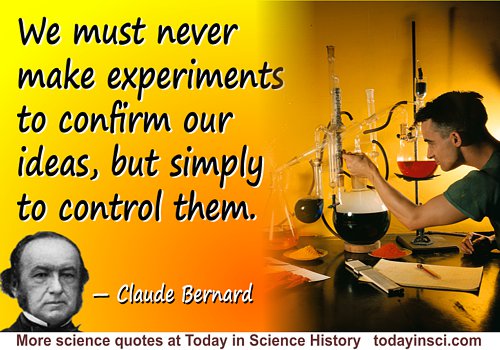
We must never make experiments to confirm our ideas, but simply to control them.
We must never make experiments to confirm our ideas, but simply to control them.
— Claude Bernard
From Introduction à l'étude de la médecine expérimentale (1865), 67-68. Translation from Henry Copley Green, An Introduction to the Study of Experimental Medicine (1957), 38. Bernard footnoted that he had expressed this idea earlier in Leçons sur les propriétés et les altérations des liquides de l’organisme (1859), Première leçon.
La théorie est l’hypothèse vérifiée, après qu’elle a été soumise au contrôle du raisonnement et de la critique expérimentale. La meilleure théorie est celle qui a été vérifiée par le plus grand nombre de faits. Mais une théorie, pour rester bonne, doit toujours se modifier avec les progrès de la science et demeurer constamment soumise à la vérification et à la critique des faits nouveaux qui apparaissent.
A theory is a verified hypothesis, after it has been submitted to the control of reason and experimental criticism. The soundest theory is one that has been verified by the greatest number of facts. But to remain valid, a theory must be continually altered to keep pace with the progress of science and must be constantly resubmitted to verification and criticism as new facts appear.
A theory is a verified hypothesis, after it has been submitted to the control of reason and experimental criticism. The soundest theory is one that has been verified by the greatest number of facts. But to remain valid, a theory must be continually altered to keep pace with the progress of science and must be constantly resubmitted to verification and criticism as new facts appear.
— Claude Bernard
Original work in French, Introduction à l'Étude de la Médecine Expérimentale (1865), 385. English translation by Henry Copley Green in An Introduction to the Study of Experimental Medicine (1927, 1957), 220.
La théorie n’est que l’idée scientifique contrôlée par l’expérience.
A theory is merely a scientific idea controlled by experiment.
A theory is merely a scientific idea controlled by experiment.
— Claude Bernard
Original work in French, Introduction à l'Étude de la Médecine Expérimentale (1865), 40. English translation by Henry Copley Green in An Introduction to the Study of Experimental Medicine (1927, 1957), 26.
Mais, par une merveilleuse compensation, à mesure que la science rabaisse ainsi notre orgueil, elle augmente notre puissance.
But by a marvellous compensation, science, in humbling our pride, proportionately increases our power.
But by a marvellous compensation, science, in humbling our pride, proportionately increases our power.
— Claude Bernard
Original French quote from Introduction à l’étude de la médecine expérimentale (1865), 141. As translated by H.C. Greene in An Introduction to the Study of Experimental Medicine (1927, 1949), 82. Most often seen quoted in a shorter, more literal translation as “Science increases our power in proportion as it lowers our pride” (detailed elsewhere on this web page).
The constancy of the internal environment is the condition for free and independent life: the mechanism that makes it possible is that which assured the maintenance, with the internal environment, of all the conditions necessary for the life of the elements.
— Claude Bernard
Lectures on the Phenomena of Life Common to Animals and Plants (1878), trans. Hebbel E. Hoff, Roger Guillemin and Lucienne Guillemin (1974), 84.
Une idée anticipée ou une hypothèse est donc le point de départ nécessaire de tout raisonnement expérimental. Sans cela on ne saurait faire aucune investigation ni s’instruire ; on ne pourrait qu’entasser des observations stériles. Si l’on expérimentait sans idée préconçue, on irait à l’aventure; mais d’un autre côté, ainsi que nous l’avons dit ailleurs, si l’on observait avec des idées préconçues, on ferait de mauvaises observations.
An anticipative idea or an hypothesis is, then, the necessary starting point for all experimental reasoning. Without it, we could not make any investigation at all nor learn anything; we could only pile up sterile observations. If we experimented without a preconceived idea, we should move at random.
[Also seen translated as:] A hypothesis is … the obligatory starting point of all experimental reasoning. Without it no investigation would be possible, and one would learn nothing: one could only pile up barren observations. To experiment without a preconceived idea is to wander aimlessly.
An anticipative idea or an hypothesis is, then, the necessary starting point for all experimental reasoning. Without it, we could not make any investigation at all nor learn anything; we could only pile up sterile observations. If we experimented without a preconceived idea, we should move at random.
[Also seen translated as:] A hypothesis is … the obligatory starting point of all experimental reasoning. Without it no investigation would be possible, and one would learn nothing: one could only pile up barren observations. To experiment without a preconceived idea is to wander aimlessly.
— Claude Bernard
Original work in French, Introduction à l'Étude de la Médecine Expérimentale (1865). English translation by Henry Copley Green in An Introduction to the Study of Experimental Medicine (1927, 1957), 32. Alternate translation in Peter Medawar, 'Hypothesis and Imagination', collected in The Strange Case of the Spotted Mice and Other Classic Essays on Science (1974), 30.
A contemporary poet has characterized this sense of the personality of art and of the impersonality of science in these words,—“Art is myself; science is ourselves.”
— Claude Bernard
From An Introduction to the Study of Experimental Medicine (1865), as translated by Henry Copley Greene (1957), 43. The poet referred to was Victor Hugo, writing in William Shakespeare (1864).
A discovery is generally an unforeseen relation not included in theory.
— Claude Bernard
From An Introduction to the Study of Experimental Medicine (1865), as translated by Henry Copley Greene (1957), 38.
A fact is nothing in itself. It has value only for the idea connected with it or through the proof that it furnishes.
— Claude Bernard
In An Introduction to the Study of Experimental Medicine (1927, 1957), 53, as translated by Henry Copley Greene. From the original French by Claude Bernard: “Un fait n’est rien par lui-même, il ne vaut que par l’idée qui s’y rattache ou par la preuve qu’il fournit.” (1865), 93.
A great surgeon performs operations for stone by a single method; later he makes a statistical summary of deaths and recoveries, and he concludes from these statistics that the mortality law for this operation is two out of five. Well, I say that this ratio means literally nothing scientifically and gives us no certainty in performing the next operation; for we do not know whether the next case will be among the recoveries or the deaths. What really should be done, instead of gathering facts empirically, is to study them more accurately, each in its special determinism. We must study cases of death with great care and try to discover in them the cause of mortal accidents so as to master the cause and avoid the accidents.
— Claude Bernard
From An Introduction to the Study of Experimental Medicine (1865), as translated by Henry Copley Greene (1957), 137-138. (Note that Bernard overlooks how the statistical method can be useful: a surgeon announcing a mortality rate of 40% invites comparison. A surgeon with worse outcomes should adopt this method. If a surgeon has a better results, that method should be adopted.)
A man of science rises ever, in seeking truth; and if he never finds it in its wholeness, he discovers nevertheless very significant fragments; and these fragments of universal truth are precisely what constitutes science.
— Claude Bernard
From An Introduction to the Study of Experimental Medicine (1927, 1957), as translated by Henry Copley Greene (1927, 1957), 222. From the original French by Claude Bernard: “le savant monte toujours en cherchant la vérité, et s'il ne la trouve jamais tout entière, il en découvre néanmoins des fragments très-importants, et ce sont précisément ces fragments de la vérité générale qui constituent la science.” (1865), 389. A Google translation gives: “The scientist always rises by seeking the truth, and if he never finds it entirely, he nevertheless discovers very important fragments of it, and it is precisely these fragments of the general truth which constitute science.”
A physician’s subject of study is necessarily the patient, and his first field for observation is the hospital. But if clinical observation teaches him to know the form and course of diseases, it cannot suffice to make him understand their nature; to this end he must penetrate into the body to find which of the internal parts are injured in their functions. That is why dissection of cadavers and microscopic study of diseases were soon added to clinical observation. But to-day these various methods no longer suffice; we must push investigation further and, in analyzing the elementary phenomena of organic bodies, must compare normal with abnormal states. We showed elsewhere how incapable is anatomy alone to take account of vital phenenoma, and we saw that we must add study of all physico-chemical conditions which contribute necessary elements to normal or pathological manifestations of life. This simple suggestion already makes us feel that the laboratory of a physiologist-physician must be the most complicated of all laboratories, because he has to experiment with phenomena of life which are the most complex of all natural phenomena.
— Claude Bernard
From An Introduction to the Study of Experimental Medicine (1865), as translated by Henry Copley Greene (1957), 140-141.
Ardent desire for knowledge, in fact, is the one motive attracting and supporting investigators in their efforts; and just this knowledge, really grasped and yet always flying before them, becomes at once their sole torment and their sole happiness. Those who do not know the torment of the unknown cannot have the joy of discovery which is certainly the liveliest that the mind of man can ever feel.
— Claude Bernard
From An Introduction to the Study of Experimental Medicine (1927, 1957), 221-222, as translated by Henry Copley Greene. From the original French by Claude Bernard: “Le désir ardent de la connaissance est l’unique mobile qui attire et soutient l’investigateur dans ses efforts; et c’est précisément cette connaissance qu’il saisit réellement et qui fuit cependant toujours devant lui, qui devient à la fois son seul tourment et son seul bonheur. Celui qui ne connaît pas les tourments de l’inconnu doit ignorer les joies de la découverte qui sont certainement les plus vives que l’esprit de l’homme puisse jamais ressentir.” (1865), 388. A Google translation gives: “The ardent desire for knowledge is the only motive which attracts and sustains the inquirer in his efforts; and it is precisely this knowledge which he really grasps and which nevertheless always flees before him, which becomes at the same time his only torment and his only happiness. He who does not know the torments of the unknown must ignore the joys of discovery which are certainly the most vivid that the mind of man can ever experience.”
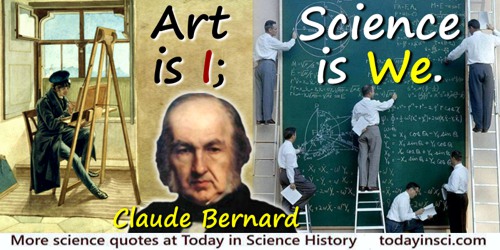
Art is I; science is we.
— Claude Bernard
In Lily Splane, Quantum Consciousness (2004),307
As soon as the circumstances of an experiment are well known, we stop gathering statistics. … The effect will occur always without exception, because the cause of the phenomena is accurately defined. Only when a phenomenon includes conditions as yet undefined,Only when a phenomenon includes conditions as yet undefined, can we compile statistics. … we must learn therefore that we compile statistics only when we cannot possibly help it; for in my opinion, statistics can never yield scientific truth.
— Claude Bernard
From An Introduction to the Study of Experimental Medicine (1865), as translated by Henry Copley Greene (1957), 134-137.
But while I accept specialization in the practice, I reject it utterly in the theory of science.
— Claude Bernard
From An Introduction to the Study of Experimental Medicine (1865), as translated by Henry Copley Greene (1957), 25.
By destroying the biological character of phenomena, the use of averages in physiology and medicine usually gives only apparent accuracy to the results. From our point of view, we may distinguish between several kinds of averages: physical averages, chemical averages and physiological and pathological averages. If, for instance, we observe the number of pulsations and the degree of blood pressure by means of the oscillations of a manometer throughout one day, and if we take the average of all our figures to get the true or average blood pressure and to learn the true or average number of pulsations, we shall simply have wrong numbers. In fact, the pulse decreases in number and intensity when we are fasting and increases during digestion or under different influences of movement and rest; all the biological characteristics of the phenomenon disappear in the average. Chemical averages are also often used. If we collect a man's urine during twenty-four hours and mix all this urine to analyze the average, we get an analysis of a urine which simply does not exist; for urine, when fasting, is different from urine during digestion. A startling instance of this kind was invented by a physiologist who took urine from a railroad station urinal where people of all nations passed, and who believed he could thus present an analysis of average European urine! Aside from physical and chemical, there are physiological averages, or what we might call average descriptions of phenomena, which are even more false. Let me assume that a physician collects a great many individual observations of a disease and that he makes an average description of symptoms observed in the individual cases; he will thus have a description that will never be matched in nature. So in physiology, we must never make average descriptions of experiments, because the true relations of phenomena disappear in the average; when dealing with complex and variable experiments, we must study their various circumstances, and then present our most perfect experiment as a type, which, however, still stands for true facts. In the cases just considered, averages must therefore be rejected, because they confuse, while aiming to unify, and distort while aiming to simplify. Averages are applicable only to reducing very slightly varying numerical data about clearly defined and absolutely simple cases.
— Claude Bernard
From An Introduction to the Study of Experimental Medicine (1865), as translated by Henry Copley Greene (1957), 134-135.
Constant, or free, life is the third form of life; it belongs to the most highly organized animals. In it, life is not suspended in any circumstance, it unrolls along a constant course, apparently indifferent to the variations in the cosmic environment, or to the changes in the material conditions that surround the animal. Organs, apparatus, and tissues function in an apparently uniform manner, without their activity undergoing those considerable variations exhibited by animals with an oscillating life. This because in reality the internal environment that envelops the organs, the tissues, and the elements of the tissues does not change; the variations in the atmosphere stop there, so that it is true to say that physical conditions of the environment are constant in the higher animals; it is enveloped in an invariable medium, which acts as an atmosphere of its own in the constantly changing cosmic environment. It is an organism that has placed itself in a hot-house. Thus the perpetual changes in the cosmic environment do not touch it; it is not chained to them, it is free and independent.
— Claude Bernard
Lectures on the Phenomena of Life Common to Animals and Plants (1878), trans. Hebbel E. Hoff, Roger Guillemin and Lucienne Guillemin (1974), 83.
Descriptive anatomy is to physiology what geography is to history, and just as it is not enough to know the typography of a country to understand its history, so also it is not enough to know the anatomy of organs to understand their functions.
— Claude Bernard
Lectures on the Phenomena of Life Common to Animals and Plants (1878), trans. Hebbel E. Hoff, Roger Guillemin and Lucienne Guillemin (1974), 7.
Effects vary with the conditions which bring them to pass, but laws do not vary. Physiological and pathological states are ruled by the same forces; they differ only because of the special conditions under which the vital laws manifest themselves.
— Claude Bernard
From An Introduction to the Study of Experimental Medicine (1865), as translated by Henry Copley Greene (1957),10.
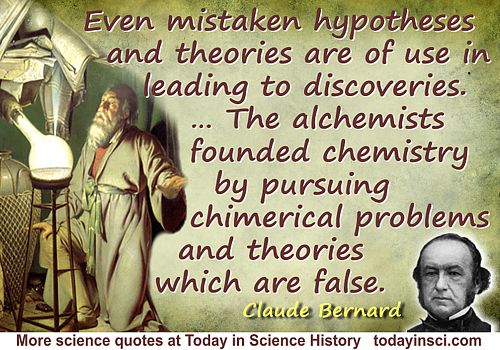
Even mistaken hypotheses and theories are of use in leading to discoveries. This remark is true in all the sciences. The alchemists founded chemistry by pursuing chimerical problems and theories which are false. In physical science, which is more advanced than biology, we might still cite men of science who make great discoveries by relying on false theories. It seems, indeed, a necessary weakness of our mind to be able to reach truth only across a multitude of errors and obstacles.
— Claude Bernard
An Introduction to the Study of Experimental Medicine (1865, translation 1927, 1957), 170.
Everything is poisonous, nothing is poisonous, it is all a matter of dose.
— Claude Bernard
In Pathologie expérimenta1e (1872), 72. From the original French, “Tout est poison, rien n’est poison, tout est une question de dose.”
Experiment is fundamentally only induced observation.
— Claude Bernard
Section title in An Introduction to the Study of Experimental Medicine (1865), as translated by Henry Copley Greene (1957), 19.
First causes are outside the realm of science.
— Claude Bernard
From An Introduction to the Study of Experimental Medicine (1865), as translated by Henry Copley Greene (1957), 66.
Good methods can teach us to develop and use to better purpose the faculties with which nature has endowed us, while poor methods may prevent us from turning them to good account. Thus the genius of inventiveness, so precious in the sciences, may be diminished or even smothered by a poor method, while a good method may increase and develop it.
— Claude Bernard
I do not … reject the use of statistics in medicine, but I condemn not trying to get beyond them and believing in statistics as the foundation of medical science. … Statistics … apply only to cases in which the cause of the facts observed is still [uncertain or] indeterminate. … There will always be some indeterminism … in all the sciences, and more in medicine than in any other. But man’s intellectual conquest consists in lessening and driving back indeterminism in proportion as he gains ground for determinism by the help of the experimental method..
— Claude Bernard
From An Introduction to the Study of Experimental Medicine (1865), as translated by Henry Copley Greene (1957), 138-140.
If an idea presents itself to us, we must not reject it simply because it does not agree with the logical deductions of a reigning theory.
— Claude Bernard
If I had to define life in a single phrase, I should clearly express my thought of throwing into relief one characteristic which, in my opinion, sharply differentiates biological science. I should say: life is creation.
— Claude Bernard
From An Introduction to the Study of Experimental Medicine (1865), as translated by Henry Copley Greene (1957), 93.
If needed to give a comparison expressing my feelings about the science of life, I would say that it is a magnificent reception room, resplendent with light, which one can only reach by passing through a long and dreadful kitchen.
— Claude Bernard
In Introduction à l'Étude de la Médecine Expérimentale (1865), 23. From the original French, “S’il fallait donner une comparaison qui exprimât mon sentiment sur la science de la vie, je dirais que c’est un salon superbe tout resplendissant de lumière, dans lequel on ne peut parvenir qu’en passant par une longue et affreuse cuisine.” English version by Webmaster using Google Translate. This version has additional context than the customary translation, elsewhere on this web page, that begins, “The science of life is a superb….”
In a word, I consider hospitals only as the entrance to scientific medicine; they are the first field of observation which a physician enters; but the true sanctuary of medical science is a laboratory; only there can he seek explanations of life in the normal and pathological states by means of experimental analysis.
— Claude Bernard
From An Introduction to the Study of Experimental Medicine (1865), as translated by Henry Copley Greene (1957), 146.
In every enterprise … the mind is always reasoning, and, even when we seem to act without a motive, an instinctive logic still directs the mind. Only we are not aware of it, because we begin by reasoning before we know or say that we are reasoning, just as we begin by speaking before we observe that we are speaking, and just as we begin by seeing and hearing before we know what we see or what we hear.
— Claude Bernard
From An Introduction to the Study of Experimental Medicine (1865), as translated by Henry Copley Greene (1957), 146.
In science the important thing is to modify and change one's ideas as science advances.
— Claude Bernard
As given by in Bertha McCool, 'The Development of Embryology', Bios (Oct 1935), 6, No. 3, 303. Also in Rudolf Franz Flesch, The Art of Clear Thinking (1951), 122. Webmaster has also seen this attributed to Herbert Spencer, but has yet found such examples date only after 1997. If you know the primary source from Bernard, please contact Webmaster.
In sciences of observation, man observes and reasons experimentally, but he does not experiment; and in this sense we might say that a science of observation is a passive science. In sciences of experimentation, man observes, but in addition he acts on matter, analyzes its properties and to his own advantage brings about the appearance of phenomena which doubtless always occur according to natural laws, but in conditions which nature often has not yet achieved. With the help of these active experimental sciences, man becomes an inventor of phenomena, a real foreman of creation; and under this head we cannot set limits to the power that he may gain over nature through future progress in the experimental sciences.
— Claude Bernard
From Introduction à l'Étude de la Médecine Expérimentale (1865); as translated by Henry Copley Greene, in An Introduction to the Study of Experimental Medicine (1927, 1957), 18. As given, for example, in Fielding Hudson Garrison, An Introduction to the History of Medicine (1929), 15. Compare the (apparent?) summary of this quote, expressed as, “Observation is a passive science, experimentation is an active science.” The shorter quote is seen for example, in Fielding Hudson Garrison, An Introduction to the History of Medicine (1929), 15. However, Webmaster has not yet found these few words verbatim in a primary source, and believes although the shortened quote is a summary, in very few words, of the idea expressed in the longer passage above, that it was not written verbatim by Bernard himself.
In teaching man, experimental science results in lessening his pride more and more by proving to him every day that primary causes, like the objective reality of things, will be hidden from him forever and that he can only know relations.
— Claude Bernard
…...
In the patient who succumbed, the cause of death was evidently something which was not found in the patient who recovered; this something we must determine, and then we can act on the phenomena or recognize and foresee them accurately. But not by statistics shall we succeed in this; never have statistics taught anything, and never can they teach anything about the nature of the phenomenon.
— Claude Bernard
From An Introduction to the Study of Experimental Medicine (1865), as translated by Henry Copley Greene (1957), 138.
In the philosophic sense, observation shows and experiment teaches.
— Claude Bernard
From An Introduction to the Study of Experimental Medicine (1865), as translated by Henry Copley Greene (1957), 5.
In these researches I followed the principles of the experimental method that we have established, i.e., that, in presence of a well-noted, new fact which contradicts a theory, instead of keeping the theory and abandoning the fact, I should keep and study the fact, and I hastened to give up the theory.
— Claude Bernard
From An Introduction to the Study of Experimental Medicine (1865), as translated by Henry Copley Greene (1957), 164.
It has often been said that, to make discoveries, one must be ignorant. This opinion, mistaken in itself, nevertheless conceals a truth. It means that it is better to know nothing than to keep in mind fixed ideas based on theories whose confirmation we constantly seek, neglecting meanwhile everything that fails to agree with them.
— Claude Bernard
From An Introduction to the Study of Experimental Medicine (1865), as translated by Henry Copley Greene (1957), 37.
It is impossible to devise an experiment without a preconceived idea; devising an experiment, we said, is putting a question; we never conceive a question without an idea which invites an answer. I consider it, therefore, an absolute principle that experiments must always be devised in view of a preconceived idea, no matter if the idea be not very clear nor very well defined.
— Claude Bernard
An Introduction to the Study of Experimental Medicine (1865, translation 1927, 1957), 23.
It is that which we do know which is the great hindrance to our learning not that which we do
not know.
— Claude Bernard
Remark to his friend Gambetta, as quoted in Sir Michael Foster, Claude Bernard (1899), 206
It is what we know already that often prevents us from learning.
— Claude Bernard
As yet, Webmaster has not found a primary source for the wording in the subject quote. (Can you help?) It may be a restatement of: “An uneducated man, knowing nothing of theory, … would not prevent him from seeing new facts unperceived by a man preoccupied with an exclusive theory.” As translated from the original French: “Un homme ignorant, qui ne connaîtrait pas la théorie … ne l'empêcherait pas de voir des faits nouveaux que n'aperçoit pas celui qui est préoccupé d'une théorie exclusive.” As translated by Henry Copley Greene in An Introduction to the Study of Experimental Medicine (1927, 1957), 38, from Introduction à l'étude de la médecine expérimentale (1865), 67.
Laplace considers astronomy a science of observation, because we can only observe the movements of the planets; we cannot reach them, indeed, to alter their course and to experiment with them. “On earth,” said Laplace, “we make phenomena vary by experiments; in the sky, we carefully define all the phenomena presented to us by celestial motion.” Certain physicians call medicine a science of observations, because they wrongly think that experimentation is inapplicable to it.
— Claude Bernard
From An Introduction to the Study of Experimental Medicine (1865), as translated by Henry Copley Greene (1957), 18. A footnote cites Laplace, Système du monde, Chap. 2.
Man can learn nothing except by going from the known to the unknown.
— Claude Bernard
In An Introduction to the Study of Experimental Medicine (1927, 1957), 45, as translated by Henry Copley Greene. From the original French by Claude Bernard: “L'homme ne peut rien apprendre qu’en allant duconnu à l'inconnu.” From Introduction à l'étude de la médecine expérimentale (1865), 78.
Man does not limit himself to seeing; he thinks and insists on learning the meaning of phenomena whose existence has been revealed to him by observation. So he reasons, compares facts, puts questions to them, and by the answers which he extracts, tests one by another. This sort of control, by means of reasoning and facts, is what constitutes experiment, properly speaking; and it is the only process that we have for teaching ourselves about the nature of things outside us.
— Claude Bernard
In Claude Bernard and Henry Copley Greene (trans.), An Introduction to the Study of Experimental Medicine (1927, 1957), 5.
Man is naturally metaphysical and arrogant, and is thus capable of believing that the ideal creations of his mind, which express his feelings, are identical with reality. From this it follows that the experimental method is not really natural to him.
— Claude Bernard
Mediocre men often have the most acquired knowledge. It is in the darker. It is in the darker regions of science that great men are recognized; they are marked by ideas which light up phenomena hitherto obscure and carry science forward.
— Claude Bernard
From An Introduction to the Study of Experimental Medicine (1865), as translated by Henry Copley Greene (reprint 1999), 42.
Men who believe too firmly in their theories, do not believe enough in the theories of others. So … these despisers of their fellows … make experiments only to destroy a theory, instead of to seek the truth.
— Claude Bernard
From An Introduction to the Study of Experimental Medicine (1927, 1957), as translated by Henry Copley Greene (1957), 38. From the original French by Claude Bernard: “Ceux qui croient trop à leurs théories ne croient pas assez à celles des autres. Alors … ces contempteurs d'autrui … font des expériences que pour détruire une théorie, au lieu de les faire pour chercher la vérité.” (1865), 68. A Google translation gives: “Those who believe too much in their theories do not believe enough in those of others. So … these despisers of others … do experiments only to destroy a theory, instead of doing them to seek the truth.”
Men who have excessive faith in their theories … make poor observations, because they choose among the results of their experiments only what suits their object, neglecting whatever is unrelated to it and carefully setting aside everything which might tend toward the idea they wish to combat.
— Claude Bernard
From An Introduction to the Study of Experimental Medicine (1927, 1957), as translated by Henry Copley Greene (1957), 38. Note: the ellipsis condenses the quote from two paragraphs, beginning with the same clause as another quote on this web page, beginning, “Men who have excessive faith….” From the original French by Claude Bernard: “Les hommes qui ont une foi excessive dans leurs théories … font de mauvaises observations parce qu'ils ne prennent dans les résultats de leurs expériences que ce qui convient à leur but en négligeant ce qui ne s'y rapporte pas, et en écartant bien soigneusement tout ce qui pourrait aller dans le sens de l'idée qu'ils veulent combattre.” (1865), 67-68. A Google translation gives: “Men who have excessive faith in their theories … make bad observations because they only take from the results of their experiments what suits their purpose, neglecting what does not relate to it, and carefully discarding everything that could go in the direction of the idea they want to fight.”
Men who have excessive faith in their theories or ideas are not only ill prepared for making discoveries; they also make very poor observations. Of necessity, they observe with a preconceived idea, and when they devise an experiment, they can see, in its results,only a confirmation of their theory. In this way they distort observation and often neglect very important facts because they do not further their aim.
— Claude Bernard
From An Introduction to the Study of Experimental Medicine (1927, 1957), as translated by Henry Copley Greene (1957), 38. From the original French by Claude Bernard: “Les hommes qui ont une foi excessive dans leurs théories ou dans leurs idées sont non-seulement mal disposés pour faire des découvertes, mais ils font aussi de très-mauvaises observations. Ils observent nécessairement avec une idée préconçue, et quand ils ont institué une expérience, ils ne veulent voir dans ses résultats qu'une confirmation de leur théorie. Ils défigurent ainsi l'observation et négligent souvent des faits très-importants, parce qu’ils ne concourent pas à leur but.” (1865), 68. A Google translation gives: “Men who have excessive faith in their theories or in their ideas are not only ill disposed to make discoveries, but they also make very bad observations. They necessarily observe with a preconceived idea, and when they have instituted an experiment, they only want to see in its results a confirmation of their theory. They thus disfigure observation and often neglect very important facts, because they do not contribute to their end.”
Negative facts when considered alone never teach us anything.
— Claude Bernard
Now, a living organism is nothing but a wonderful machine endowed with the most marvellous properties and set going by means of the most complex and delicate mechanism.
— Claude Bernard
From An Introduction to the Study of Experimental Medicine (1865), as translated by Henry Copley Greene (1957), 63.
Observation is a passive science, experimentation is an active science.
— Claude Bernard
As given, for example, in Fielding Hudson Garrison, An Introduction to the History of Medicine (1929), 15. Webmaster has not found these words verbatim in a primary source, and believes there are summary of an idea expressed in a longer passage. See the quotation beginning “In sciences of observation,” elsewhere on this web page. From Introduction à l'Étude de la Médecine Expérimentale (1865); as translated by Henry Copley Greene, in An Introduction to the Study of Experimental Medicine (1927), 18.
One must accept the results of experiments as they come, with all their unexpectedness and irregularity.
— Claude Bernard
In An Introduction to the Study of Experimental Medicine (1927, 1957), 38, as translated by Henry Copley Greene. From the original French by Claude Bernard: “il faut accepter les résultats de l'expérience tels qu'ils se présentent, avec tout leur imprévu et leurs accidents.” (1865), 68. A Google translation gives: “One must accept the results of the experiment as they present themselves, with all their unforeseen and their accidents.”
Our ideas are only intellectual instruments which we use to break into phenomena; we must change them when they have served their purpose, as we change a blunt lancet that we have used long enough.
— Claude Bernard
In An Introduction to the Study of Experimental Medicine (1865).
Priestley [said] that each discovery we make shows us many others that should be made.
— Claude Bernard
From An Introduction to the Study of Experimental Medicine (1865), as translated by Henry Copley Greene (1957), 222.
Progress is achieved by exchanging our theories for new ones which go further than the old, until we find one based on a larger number of facts. … Theories are only hypotheses, verified by more or less numerous facts. Those verified by the most facts are the best, but even then they are never final, never to be absolutely believed.
— Claude Bernard
From An Introduction to the Study of Experimental Medicine (1865), as translated by Henry Copley Greene (1957), 165.
Proof that a given condition always precedes or accompanies a phenomenon does not warrant concluding with certainty that a given condition is the immediate cause of that phenomenon. It must still be established that when this condition is removed, the phenomen will no longer appear.
— Claude Bernard
From An Introduction to the Study of Experimental Medicine (1865), as translated by Henry Copley Greene (1957), 55.
Put off your imagination, as you put off your overcoat, when you enter the laboratory. But put it on again, as you put on your overcoat, when you leave.
— Claude Bernard
Attributed.
Real science exists, then, only from the moment when a phenomenon is accurately defined as to its nature and rigorously determined in relation to its material conditions, that is, when its law is known. Before that, we have only groping and empiricism.
— Claude Bernard
From An Introduction to the Study of Experimental Medicine (1865), as translated by Henry Copley Greene (reprint 1999), 74.
Science allows no exceptions; without this there would be no determinism in science or rather, there would be no science at all.
— Claude Bernard
In Leçons de Pathologie Experimental (1871).
Science rejects the indeterminate.
— Claude Bernard
In An Introduction to the Study of Experimental Medicine (1927, 1957), 55, as translated by Henry Copley Greene. From the original French by Claude Bernard: “La science repousse l’indeterminé.” (1865), 96. Also seen in alternate translation as: “Science repulses the indefinite.”
Speaking concretely, when we say “making experiments or making observations,” we mean that we devote ourselves to investigation and to research, that we make attempts and trials in order to gain facts from which the mind, through reasoning, may draw knowledge or instruction.
Speaking in the abstract, when we say “relying on observation and gaining experience,” we mean that observation is the mind's support in reasoning, and experience the mind's support in deciding, or still better, the fruit of exact reasoning applied to the interpretation of facts. It follows from this that we can gain experience without making experiments, solely by reasoning appropriately about well-established facts, just as we can make experiments and observations without gaining experience, if we limit ourselves to noting facts.
Observation, then, is what shows facts; experiment is what teaches about facts and gives experience in relation to anything.
Speaking in the abstract, when we say “relying on observation and gaining experience,” we mean that observation is the mind's support in reasoning, and experience the mind's support in deciding, or still better, the fruit of exact reasoning applied to the interpretation of facts. It follows from this that we can gain experience without making experiments, solely by reasoning appropriately about well-established facts, just as we can make experiments and observations without gaining experience, if we limit ourselves to noting facts.
Observation, then, is what shows facts; experiment is what teaches about facts and gives experience in relation to anything.
— Claude Bernard
From An Introduction to the Study of Experimental Medicine (1865), as translated by Henry Copley Greene (1957), 11.
The better educated we are and the more acquired information we have, the better prepared shall we find our minds for making great and fruitful discoveries.
— Claude Bernard
In An Introduction to the Study of Experimental Medicine (1927, 1957), 38, as translated by Henry Copley Greene. From the original French by Claude Bernard: “Plus on est instruit, plus on possède de connaissances antérieures, mieux on aura l’esprit disposé pour faire des découvertes grandes et fécondes.” (1865), 67. A Google translation gives: “The more educated one is, the more prior knowledge one possesses, the better disposed one’s mind will be to make great and fruitful discoveries.”
The doubter is a true man of science: he doubts only himself and his interpretations, but he believes in science.
— Claude Bernard
In Fielding Hudson Garrison, An Introduction to the History of Medicine (1929), 14.
The essence of the simplest mineral phenomenon is as completely unknown to chemists and physicists today as is the essence of intellectual phenomenon to physiologists.
— Claude Bernard
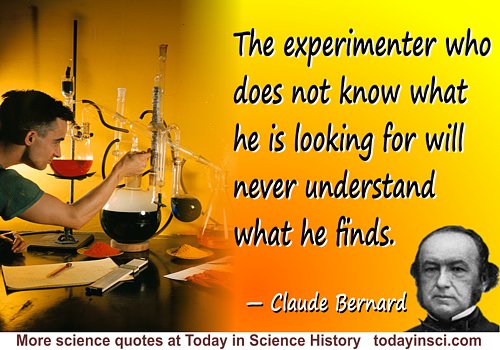
The experimenter who does not know what he is looking for will never understand what he finds.
— Claude Bernard
Attributed. Also seen as, “He who does not know what he is looking for will not lay hold of what he has found when he gets it.” If you know a primary source, perhaps in the original French, please contact Webmaster.
The first entirely vital action, so termed because it is not effected outside the influence of life, consists in the creation of the glycogenic material in the living hepatic tissue. The second entirely chemical action, which can be effected outside the influence of life, consists in the transformation of the glycogenic material into sugar by means of a ferment.
— Claude Bernard
Sur le Méchanisme de la Fonction du Sucre dans Ie Foie (1857), 583. Translated in Joseph S. Fruton, Proteins, Enzymes, Genes: The Interplay of Chemistry and Biology (1999), 340.
The first requirement in using statistics is that the facts treated shall be reduced to comparable units.
— Claude Bernard
From An Introduction to the Study of Experimental Medicine (1865), as translated by Henry Copley Greene (1957), 136.
The goal of scientific physicians in their own science … is to reduce the indeterminate. Statistics therefore apply only to cases in which the cause of the facts observed is still indeterminate.
— Claude Bernard
From An Introduction to the Study of Experimental Medicine (1865), as translated by Henry Copley Greene (1957), 139.
The great experimental principle, then, is doubt, that philosophic doubt which leaves to the mind its freedom and initiative, and from which the virtues most valuable to investigators in physiology and medicine are derived.
— Claude Bernard
From An Introduction to the Study of Experimental Medicine (1865), as translated by Henry Copley Greene (1957), 37.
The minds that rise and become really great are never self-satisfied, but still continue to strive.
— Claude Bernard
From An Introduction to the Study of Experimental Medicine (1865), as translated by Henry Copley Greene (1957), 222.
The organism, as we have long been saying, is a little world (microcosm) in the great universe (macrocosm).
— Claude Bernard
The science of life is a superb and dazzlingly lighted hall which may be reached only by passing through a long and ghastly kitchen.
— Claude Bernard
From Introduction à l'Étude de la Médecine Expérimentale (1865), translated by Henry Copley Greene, in An Introduction to the Study of Experimental Medicine (1927, 1957), 15. As extracted in John Bartlett and Emily Morison Beck (ed.), Familiar Quotations (1980, 15th ed.), 551.
The true worth of an experimenter consists in his pursuing not only what he seeks in his experiment, but also what he did not seek.
— Claude Bernard
Unverified in these exact words. Contact webmaster if you know the primary source. Perhaps the quote is a summary of a longer passage. Claude lays out his experimental philosophy in An Introduction to the Study of Experimental Medicine (1865).
Theories are like a stairway; by climbing, science widens its horizon more and more, because theories embody and necessarily include proportionately more facts as they advance.
— Claude Bernard
From An Introduction to the Study of Experimental Medicine (1865), as translated by Henry Copley Greene (1957), 165.
To be worthy of the name, an experimenter must be at once theorist and practitioner. While he must completely master the art of establishing experimental facts, which are the materials of science, he must also clearly understand the scientific principles which guide his reasoning through the varied experimental study of natural phenomena. We cannot separate these two things: head and hand. An able hand, without a head to direct it, is a blind tool; the head is powerless without its executive hand.
— Claude Bernard
In Claude Bernard and Henry Copley Greene (trans.), An Introduction to the Study of Experimental Medicine (1927, 1957), 3.
True science teaches us to doubt and, in ignorance, to refrain.
— Claude Bernard
…...
We achieve more than we know. We know more than we understand. We understand more than we can explain.
— Claude Bernard
In AI: The Tumultuous History of the Search for Artificial Intelligence (1999), 159, but without citation. If you know a primary source, please contact Webmaster.
We must alter theory to adapt it to nature, but not nature to adapt it to theory.
— Claude Bernard
An Introduction to the Study of Experimental Medicine (1865, translation 1927, 1957), 39.
We must keep our freedom of mind, … and must believe that in nature what is absurd, according to our theories, is not always impossible.
— Claude Bernard
In An Introduction to the Study of Experimental Medicine (1927, 1957), 38, as translated by Henry Copley Greene. From the original French by Claude Bernard: “Il faut garder sa liberté d'esprit, et croire que dans la nature l'absurde suivant nos théories n'est pas toujours impossible.” (1865), 67. A Google translation gives: “You have to keep your freedom of mind, … and believe that in nature the absurd according to our theories is not always impossible.”
We must remain, in a word, in an intellectual disposition which seems paradoxical, but which, in my opinion, represents the true mind of the investigator. We must have a robust faith and yet not believe.
[Often seen summarized as: The investigator should have a robust faith—and yet not believe.]
[Often seen summarized as: The investigator should have a robust faith—and yet not believe.]
— Claude Bernard
Introduction to the Study of Experimental Medicine (1865). In Alan S. Weber, Nineteenth Century Science: a Selection of Original Texts (2000), 333.
We must trust our observations or our theories only after experimental verification. If we trust too much, the mind becomes bound and cramped by the results of its own reasoning; it no longer has freedom of action, and so lacks the power to break away from that blind faith in theories which is only scientific superstition.
— Claude Bernard
From An Introduction to the Study of Experimental Medicine (1865), as translated by Henry Copley Greene (1957), 37.
We must…never be too much absorbed by the thought we are pursuing, nor deceive ourselves about the value of our ideas or scientific theories.
— Claude Bernard
In An Introduction to the Study of Experimental Medicine (1927, 1957), 167, as translated by Henry Copley Greene. From the original French by Claude Bernard: “On ne doit donc jamais être trop absorbé par la pensée qu’on poursuit, ni s’illusionner sur la valeur de ses idées ou de ses théories scientifiques.” (1865), 294.
We see, then, that the elements of the scientific method are interrelated. Facts are necessary materials; but their working up by experimental reasoning, i.e., by theory, is what establishes and really builds up science. Ideas, given form by facts, embody science. A scientific hypothesis is merely a scientific idea, preconceived or previsioned. A theory is merely a scientific idea controlled by experiment. Reasoning merely gives a form to our ideas, so that everything, first and last, leads back to an idea. The idea is what establishes, as we shall see, the starting point or the primum movens of all scientific reasoning, and it is also the goal in the mind's aspiration toward the unknown.
— Claude Bernard
From An Introduction to the Study of Experimental Medicine (1865), as translated by Henry Copley Greene (1957), 26.
Well-observed facts, though brought to light by passing theories, will never die; they are the material on which alone the house of science will at last be built.
— Claude Bernard
From An Introduction to the Study of Experimental Medicine (1865), as translated by Henry Copley Greene (1957), 165.
When a physician is called to a patient, he should decide on the diagnosis, then the prognosis, and then the treatment. … Physicians must know the evolution of the disease, its duration and gravity in order to predict its course and outcome. Here statistics intervene to guide physicians, by teaching them the proportion of mortal cases, and if observation has also shown that the successful and unsuccessful cases can be recognized by certain signs, then the prognosis is more certain.
— Claude Bernard
From An Introduction to the Study of Experimental Medicine (1865), as translated by Henry Copley Greene (1957), 213.
When entering on new ground we must not be afraid to express even risky ideas so as to stimulate research in all directions. As Priestley put it, we must not remain inactive through false modesty based on fear of being mistaken.
— Claude Bernard
From An Introduction to the Study of Experimental Medicine (1865), as translated by Henry Copley Greene (1957), 164-165.
When we meet a fact which contradicts a prevailing theory, we must accept the fact and abandon the theory, even when the theory is supported by great names and generally accepted.
— Claude Bernard
From An Introduction to the Study of Experimental Medicine (1927, 1957), 164, as translated by Henry Copley Greene. From the original French by Claude Bernard: “Quand le fait qu’on rencontre est en opposition avec une théorie régnante, il faut accepter le fait et abandonner la théorie, lors même que celle-ci, soutenue par de grands noms, est généralement adoptée.” (1865), 287-288. A Google translation gives: “When the fact one encounters is in opposition to a reigning theory, one must accept the fact and abandon the theory, even when the latter, supported by great names, is generally adopted.”
See also:
- 12 Jul - short biography, births, deaths and events on date of Bernard's birth.
- Claude Bernard - context of quote The alchemists founded chemistry - Medium image (500 x 350 px)
- Claude Bernard - context of quote “The alchemists founded chemistry” - Large image (800 x 600 px)
- Claude Bernard - context of quote The experimenter - Medium image (500 x 350 px)
- Claude Bernard - context of quote The experimenter - Large image (800 x 600 px)
- Claude Bernard - context of quote Make experiments to … control our ideas - Medium image (500 x 350 px)
- Claude Bernard - context of quote Make experiments to … control our ideas - Large image (800 x 600 px)
 In science it often happens that scientists say, 'You know that's a really good argument; my position is mistaken,' and then they would actually change their minds and you never hear that old view from them again. They really do it. It doesn't happen as often as it should, because scientists are human and change is sometimes painful. But it happens every day. I cannot recall the last time something like that happened in politics or religion.
(1987) --
In science it often happens that scientists say, 'You know that's a really good argument; my position is mistaken,' and then they would actually change their minds and you never hear that old view from them again. They really do it. It doesn't happen as often as it should, because scientists are human and change is sometimes painful. But it happens every day. I cannot recall the last time something like that happened in politics or religion.
(1987) -- 





