 (source)
|
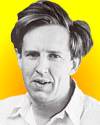
John Desmond Bernal
(10 May 1901 - 15 Sep 1971)
Irish physicist and X-ray crystallographer whose contributions to X-ray crystallography enabled determining the atomic structures of solid compounds. He also engaged in research in molecular biology and the origin of life. He also investigated the structure and composition of the Earth’s crust.
|
Science Quotes by John Desmond Bernal (23 quotes)
[In 18th-century Britain] engineers for the most began as simple workmen, skilful and ambitious but usually illiterate and self-taught. They were either millwrights like Bramah, mechanics like Murdoch and George Stephenson, or smiths like Newcomen and Maudslay.
— John Desmond Bernal
In Science in History (1969), Vol. 2, 591.

All that glisters may not be gold, but at least it contains free electrons.
— John Desmond Bernal
From Lecture at Birkbeck College, University of London (1960). As quoted and cited in Alan L. Mackay and Maurice Ebison (ed.), The Harvest of a Quiet Eye (1977, 1981), 7. Below the quote, a comment is added in brackets: “[But consider the Golden Scarab Beetle which has a metallic lustre without metal.]” [Webmaster’s note: In this book, the comment is shown in a much smaller type size, in a different font, and is therefore presumably an editorial remark, and not part of Bernal’s own words. Both Bernal and Mackay were crystallographers at Birkbeck College, where the lecture was given. Webmaster speculates that Mackay attended the lecture, and the quote is made from his own recollection, since no print source is included with the citation. In general, metals are lustrous because of the free electrons they have, which interact with incident light.]
As a scientist Miss [Rosalind] Franklin was distinguished by extreme clarity and perfection in everything she undertook. Her photographs are among the most beautiful X-ray photographs of any substance ever taken.
— John Desmond Bernal
In his Obituary for Rosalind Franklin, Nature, 1958, 182, 154. As given in Andrew Brown, J.D. Bernal: The Sage of Science (2005), 359.
But if capitalism had built up science as a productive force, the very character of the new mode of production was serving to make capitalism itself unnecessary.
— John Desmond Bernal
Marx and Science (1952), 39.
Her [Rosalind Franklin] devotion to research showed itself at its finest in the last months of
her life. Although stricken with an illness which she knew would be fatal, she continued to work right up to the end.
— John Desmond Bernal
In his obituary for Rosalind Franklin, Nature, 1958, 182, 154. As given in Andrew Brown, J.D. Bernal: The Sage of Science (2005), 359.
In England, more than in any other country, science is felt rather than thought. … A defect of the English is their almost complete lack of systematic thinking. Science to them consists of a number of successful raids into the unknown.
— John Desmond Bernal
The Social Function of Science (1939), 197.
In fact, we will have to give up taking things for granted, even the apparently simple things. We have to learn to understand nature and not merely to observe it and endure what it imposes on us. Stupidity, from being an amiable individual defect, has become a social crime.
— John Desmond Bernal
The Origin of Life (1967), 163.
In my own field, x-ray crystallography, we used to work out the structure of minerals by various dodges which we never bothered to write down, we just used them. Then Linus Pauling came along to the laboratory, saw what we were doing and wrote out what we now call Pauling's Rules. We had all been using Pauling's Rules for about three or four years before Pauling told us what the rules were.
— John Desmond Bernal
In The Extension of Man (1972), 116.
It is characteristic of science that the full explanations are often seized in their essence by the percipient scientist long in advance of any possible proof.
— John Desmond Bernal
The Origin of Life, 1967
Life is a partial, continuous, progressive, multiform and conditionally interactive, self-realization of the potentialities of atomic electron states.
— John Desmond Bernal
In The Origin of Life (1967), 251.
Man is occupied and has been persistently occupied since his separate evolution, with three kinds of struggle: first with the massive unintelligent forces of nature, heat and cold, winds, rivers, matter and energy; secondly, with the things closer to him, animals and plants, his own body, its health and disease; and lastly, with his desires and fears, his imaginations and stupidities.
— John Desmond Bernal
In The World, the Flesh and the Devil (1929).
Men will not be content to manufacture life: they will want to improve on it.
— John Desmond Bernal
The World, The Flesh and The Devil: An Enquiry into the Future of the Three Enemies of the Rational Soul (1929), 56.
Pauling was shocked by the freedom with which the X-ray crystallographers of the time, including particularly Astbury, played with the intimate chemical structure of their models. They seemed to think that if the atoms were arranged in the right order and about the right distance apart, that was all that mattered, that no further restrictions need to be put on them.
— John Desmond Bernal
Quoted by John Law in 'The Case of X-ray Protein Crystallography', collected in Gerard Lemaine (ed.), Perspectives on the Emergence of Scientific Disciplines, 1976, 140.
Published papers may omit important steps and the memory of men of science, even the greatest, is sadly fallible.
— John Desmond Bernal
Science and Industry in the Nineteenth Century (1953), 199.
She [Rosalind Franklin] discovered in a series of beautifully executed researches the fundamental distinction between carbons that turned on heating into graphite and those that did not. Further she related this difference to the chemical constitution of the molecules from which carbon was made. She was already a recognized authority in industrial physico-chemistry when she chose to abandon this work in favour of the far more difficult and more exciting fields of biophysics.
— John Desmond Bernal
Comment in The Times, 19 Apr 1958, shortly after Franklin's death. In Jenifer Glynn, 'Rosalind Franklin', in E. Shils and C. Blacker (eds.), Cambridge Women: Twelve Portraits (1996), 206.
So many of the chemical reactions occurring in living systems have been shown to be catalytic processes occurring isothermally on the surface of specific proteins, referred to as enzymes, that it seems fairly safe to assume that all are of this nature and that the proteins are the necessary basis for carrying out the processes that we call life.
— John Desmond Bernal
In 'The Physical Basis of Life', (1951), 39. As given in Andrew Brown, J.D. Bernal: The Sage of Science (2005), 359.
The beauty of life is, therefore, geometrical beauty of a type that Plato would have much appreciated.
— John Desmond Bernal
The Origin of Life (1967), xiii.
The events of the past few years have led to a critical examination of the function of science in society. It used to be believed that the results of scientific investigation would lead to continuous progressive improvements in conditions of life; but first the War and then the economic crisis have shown that science can be used as easily for destructive and wasteful purposes, and voices have been raised demanding the cessation of scientific research as the only means of preserving a tolerable civilization. Scientists themselves, faced with these criticisms, have been forced to consider, effectively for the first time, how the work they are doing is connected around them. This book is an attempt to analyse this connection; to investigate how far scientists, individually and collectively, are responsible for this state of affairs, and to suggest what possible steps could be taken which would lead to a fruitful and not to a destructive utilization of science.
— John Desmond Bernal
The Social Function of Science (1939), xlii.
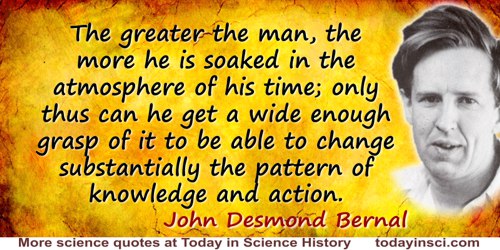
The greater the man, the more he is soaked in the atmosphere of his time; only thus can he get a wide enough grasp of it to be able to change substantially the pattern of knowledge and action.
— John Desmond Bernal
Science in History (1954), 22.
The question of the origin of life is essentially speculative. We have to construct, by straightforward thinking on the basis of very few factual observations, a plausible and self-consistent picture of a process which must have occurred before any of the forms which are known to us in the fossil record could have existed.
— John Desmond Bernal
The Origin of Life (1967), 2.
The very bulk of scientific publications is itself delusive. It is of very unequal value; a large proportion of it, possibly as much as three-quarters, does not deserve to be published at all, and is only published for economic considerations which have nothing to do with the real interests of science.
— John Desmond Bernal
The Social Function of Science (1939), 118.
We academic scientists move within a certain sphere, we can go on being useless up to a point, in the confidence that sooner or later some use will be found for our studies. The mathematician, of course, prides himself on being totally useless, but usually turns out to be the most useful of the lot. He finds the solution but he is not interested in what the problem is: sooner or later, someone will find the problem to which his solution is the answer.
— John Desmond Bernal
'Concluding Remarks', Proceedings of the Royal Society of London, Series A, A Discussion of New Materials, 1964, 282, 152-3.
We should admit in theory what is already very largely a case in practice, that the main currency of scientific information is the secondary sources in the forms of abstracts, reports, tables, &c., and that the primary sources are only for detailed reference by very few people. It is possible that the fate of most scientific papers will be not to be read by anyone who uses them, but with luck they will furnish an item, a number, some facts or data to such reports which may, but usually will not, lead to the original paper being consulted. This is very sad but it is the inevitable consequence of the growth of science. The number of papers that can be consulted is absolutely limited, no more time can be spent in looking up papers, by and large, than in the past. As the number of papers increase the chance of any one paper being looked at is correspondingly diminished. This of course is only an average, some papers may be looked at by thousands of people and may become a regular and fixed part of science but most will perish unseen.
— John Desmond Bernal
'The Supply of Information to the Scientist: Some Problems of the Present Day', The Journal of Documentation, 1957, 13, 195.

See also:
- 10 May - short biography, births, deaths and events on date of Bernal's birth.
- J. D. Bernal: The Sage of Science, by Andrew Brown. - book suggestion.
- Booklist for J.D. Bernal.
 In science it often happens that scientists say, 'You know that's a really good argument; my position is mistaken,' and then they would actually change their minds and you never hear that old view from them again. They really do it. It doesn't happen as often as it should, because scientists are human and change is sometimes painful. But it happens every day. I cannot recall the last time something like that happened in politics or religion.
(1987) --
In science it often happens that scientists say, 'You know that's a really good argument; my position is mistaken,' and then they would actually change their minds and you never hear that old view from them again. They really do it. It doesn't happen as often as it should, because scientists are human and change is sometimes painful. But it happens every day. I cannot recall the last time something like that happened in politics or religion.
(1987) -- 




