 (source)
|
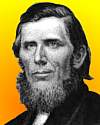
Ephraim Ball
(12 Aug 1812 - 1 Jan 1872)
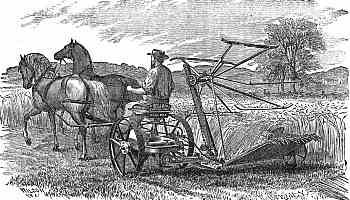
American inventor and manufacturer whose “Ball's Ohio Mower and Reaper” was widely successful (1854). This machine was a leader in the change to double driving wheels. His factories annually produced up to 10,000 of this and later models.
|
Ephraim Ball
From A History of American Manufactures from 1608 to 1860 (1866)
Ephraim Ball and Cornelius Aultman of Canton, Ohio, belong to a class of the world's benefactors who have made two blades of grass grow where but one grew before. Both are self-made men, and by their invention of machines adapted to the wants of agriculturists have built up manufacturing establishments that are among the largest and most important in the West.
Ephraim Ball, the inventor of the famous Ohio Reaper and Mower, was born in Stark county, Ohio, in 1812, and passed his youth amid hardships and privations, without the advantages of even an ordinary common school education. Compelled, when not more than fourteen years of age, to seek his own subsistence, he attained the age of manhood with only a knowledge of the ruder parts of the art of the house-carpenter.
Having married early in life, he became surrounded by the cares of a family, for whose support, in 1840, he directed all his mental and physical energies to the starting of a foundry for making Plough castings, and a shop for Stocking Ploughs. "Should he now contemplate," says a brief memoir furnished us by one familiar with the facts, "an establishment for casting ocean steamers in one piece the work would look scarcely more formidable." With no previous knowledge of the business—having never seen liquid iron but once in his life—yet obliged not only to plan but to execute all the work himself, be became in turn carpenter, stone cutter mason, pattern maker, plough stocker, painter, salesman, purchaser, financier, and bookkeeper to the establishment.
With hands and brain earnestly employed, and all his hopes centered on success, difficulties, competition, and opposition only solidified his resolution. No wonder that in such a mental gymnasium mind grew rapidly, manners improved, intelligence, skill, judgment, and influence increased. It was a success. Ploughs were made and sold known as 'Ball's Blue Ploughs.'
A partnership was now formed which has made a name and influence the world over. Cornelius Aultman and Lewis Miller, names well-known on the Patent Office records and throughout the West, became the partners of Mr. Ball and in 1851 the little shop at Greentown was abandoned, and the (afterward) great firm of Ball, Aultman & Co. appeared at Canton, Ohio, on the Pittsburgh, Fort Wayne, and Chicago Railroad. Here genius had a wider range, and here, in 1854, the West was first cheered by the sight of "The Ohio Mower," a machine with double driving wheels and a flexible finger-bar.
The loss of all their shops and tools in the same year by fire deferred the full, practical development of the machine until 1856, when Mr. Ball took out Letters patent for his improvement. From that time forward business increased rapidly and improvements followed in quick succession. The "Buckeye" machine was brought out in 1858, after the dissolution of the firm, which look place early in that year. In the hands of his former partners, C. Aultman &. Co., this, which also belongs to the family of two wheeled machines, has attained a wonderful success, probably equal to that of the parent machine, as many as seven thousand having been made by them in 1865.
In 1856, Ball, Aultman & Co., made five hundred Ohio Mowers, and it is not known that any other machines with double drivers were made, but for the sake of comparison, the whole number made may be put at six hundred. The number of machines with single driving wheels made in that year was not far from twelve thousand, or in the proportion of twenty to one. In 1865, of one hundred and twenty thousand machines made, considerably over one half are believed to have been double drivers. That all, or even a majority of these, were Balls' machines, is not claimed, yet there is little doubt that the success and popularity of his machine contributed greatly to the change in the relative numbers of each class, and to the preponderance of the double drivers.
In 1858, the firm of Ball, Aultman & Co. was dissolved, and each of the original partners proceeded to erect or fit up establishments which are now among the largest of their class in the West...
Ephraim Ball ... has also an extensive establishment in Canton [Ohio] for the manufacture of what is now known as "Ball's New American Harvester." The buildings are mostly of brick, very substantially constructed, and have an aggregate area of nearly sixty thousand square feet. The rooms, of which there are some seventeen in number, are equipped with machines and tools of the best description, with capacity for turning out six thousand machines per annum. The most careful supervision is exercised in all parts of the work; skilful mechanics and the best materials only are employed, and the result is a finely finished machine, which has attained extraordinary popularity.
As Ball's Harvester is manufactured in several other places in the "United States under license from the inventor, whose patent revenue amounts to a large sum annually, it is believed that fully ten thousand were made in the United States in 1865.
- 12 Aug - short biography, births, deaths and events on date of Ball's birth.





