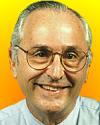
 (source)
|
John N. Bahcall
(30 Dec 1934 - 17 Aug 2005)
American astrophysicist who pioneered the development of neutrino astrophysics in the early 1960s. He theorized that neutrinos (subatomic particles that have no charge and exceedingly weak interaction with matter) can be used to understanding how stars shine.
|
Science Quotes by John N. Bahcall (10 quotes)
Every time we get slapped down, we can say, “Thank you Mother Nature,” because it means we’re about to learn something important.
— John N. Bahcall
Quoted at end of article of Michael D. Lemonick and J. Madeleine Nash, 'Unraveling Universe', Time (6 Mar 1995), 145, 84.
I do not personally want to believe that we already know the equations that determine the evolution and fate of the universe; it would make life too dull for me as a scientist. … I hope, and believe, that the Space Telescope might make the Big Bang cosmology appear incorrect to future generations, perhaps somewhat analogous to the way that Galileo’s telescope showed that the earth-centered, Ptolemaic system was inadequate.
— John N. Bahcall
From 'The Space Telescope (the Hubble Space Telescope): Out Where the Stars Do Not Twinkle', in NASA Authorization for Fiscal Year 1978: Hearings before the Committee on Commerce, Science and Transportation, United States Senate, 95th Congress, first session on S.365 (1977), 124. This was testimony to support of authorization for NASA beginning the construction of the Space Telescope, which later became known as the Hubble Space Telescope.
I know all about neutrinos, and my friend here knows about everything else in astrophysics.
His standard phrase when introducing himself and a colleague to a new acquaintance.
His standard phrase when introducing himself and a colleague to a new acquaintance.
— John N. Bahcall
Sky and Telescope (Jan 1990)
In my personal view, a failure to discover unimagined objects and answer unasked questions, once HST functions properly, would indicate a lack of imagination in stocking the Universe on the part of the Deity.
— John N. Bahcall
In Hubble Space Telescope flaw: hearing before the Committee on Science, Space, and Technology, U.S. House of Representatives, One Hundred First Congress, second session, July 13, 1990 (1990), 105.
No one has ever found a problem for which Hans [Bethe] did not have an unfair advantage. He could just calculate better than other people.
— John N. Bahcall
As quoted in 'Hans Bethe Still Spends Time on His Passion', The New York Times (16 Feb 1997), E9.
The earth’s atmosphere is an imperfect window on the universe. Electromagnetic waves in the optical part of the spectrum (that is, waves longer than X rays and shorter than radio waves) penetrate to the surface of the earth only in a few narrow spectral bands. The widest of the transmitted bands corresponds roughly to the colors of visible light; waves in the flanking ultraviolet and infrared regions of the optical spectrum are almost totally absorbed by the atmosphere. In addition, atmospheric turbulence blurs the images of celestial objects, even when they are viewed through the most powerful ground-based telescopes.
in an article promoting the construction of the Hubble Space Telescope
in an article promoting the construction of the Hubble Space Telescope
— John N. Bahcall
Scientific American (July 1977)
The most important discoveries will provide answers to questions that we do not yet know how to ask and will concern objects that we can not yet imagine.
— John N. Bahcall
In Hubble Space Telescope flaw: hearing before the Committee on Science, Space, and Technology, U.S. House of Representatives, One Hundred First Congress, second session, July 13, 1990 (1990), 105.
These neutrino observations are so exciting and significant that I think we're about to see the birth of an entirely new branch of astronomy: neutrino astronomy. Supernova explosions that are invisible to us because of dust clouds may occur in our galaxy as often as once every 10 years, and neutrino bursts could give us a way to study them.
— John N. Bahcall
New York Times (3 Apr 1987)
We often frame our understanding of what the [Hubble] space telescope will do in terms of what we expect to find, and actually it would be terribly anticlimactic if in fact we find what we expect to find. … The most important discoveries will provide answers to questions that we do not yet know how to ask and will concern objects we have not yet imagined.
— John N. Bahcall
As quoted in Timothy Ferris, 'The Space Telescope: A Sign of Intelligent Life', New York Times (29 Apr 1990), A1.
We should do astronomy because it is beautiful and because it is fun. We should do it because people want to know. We want to know our place in the universe and how things happen.
— John N. Bahcall
From interview in 'A New Decade Dawns for Astronomy', Sky and Telescope (Jan 1990), 79, No. 1, 19. The quote is cited in Current Biography Yearbook (2000), 30.
Quotes by others about John N. Bahcall (1)
John Bahcall, an astronomer on the Institute of Advanced Study faculty since 1970 likes to tell the story of his first faculty dinner, when he found himself seated across from Kurt Gödel, … a man dedicated to logic and the clean certainties of mathematical abstraction. Bahcall introduced himself and mentioned that he was a physicist. Gödel replied, “I don’t believe in natural science.”
As stated in Adam Begley, 'The Lonely Genius Club', New York Magazine (30 Jan 1995), 63.
See also:
- 30 Dec - short biography, births, deaths and events on date of Bahcall's birth.
- John N. Bahcall - context of quote “We're about to learn something important” - Medium image (500 x 250 px)
- John N. Bahcall - context of quote “We're about to learn something important” - Large image (800 x 400 px)
- John N. Bahcall - context of quote “We should do astronomy because it is beautiful” - Medium image (500 x 250 px)
- John N. Bahcall - context of quote “We should do astronomy because it is beautiful” - Large image (800 x 400 px)
- John N. Bahcall - context of quote “The most important discoveries” - Medium image (500 x 250 px)
- John N. Bahcall - context of quote “The most important discoveries” - Large image (800 x 400 px)
- John Bahcall - Statement to House Subcommittee concerning Hubble Space Telescope flaw (13 Jul 1990).
- Neutrino Astrophysics, by John N. Bahcall. - book suggestion.
 In science it often happens that scientists say, 'You know that's a really good argument; my position is mistaken,' and then they would actually change their minds and you never hear that old view from them again. They really do it. It doesn't happen as often as it should, because scientists are human and change is sometimes painful. But it happens every day. I cannot recall the last time something like that happened in politics or religion.
(1987) --
In science it often happens that scientists say, 'You know that's a really good argument; my position is mistaken,' and then they would actually change their minds and you never hear that old view from them again. They really do it. It doesn't happen as often as it should, because scientists are human and change is sometimes painful. But it happens every day. I cannot recall the last time something like that happened in politics or religion.
(1987) -- 




