 (source)
|
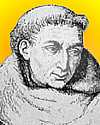
Roger Bacon
(c. 1220 - 11 Jun 1292)
English scholar who was one of the first to propose mathematics and experimentation as appropriate methods of science. He even speculated about flying machines and mechanically propelled carriages.
|
Science Quotes by Roger Bacon (19 quotes)
[I]f in other sciences we should arrive at certainty without doubt and truth without error, it behooves us to place the foundations of knowledge in mathematics, in so far as disposed through it we are able to reach certainty in other sciences and truth by the exclusion of error. (c.1267)
— Roger Bacon
Translation by Robert Burke, Opus Majus of Roger Bacon (1928), vol 1, 124. In Fred R. Shapiro, The Yale Book of Quotations (2006), 39.
Omnes scientiae sunt connexae et fovent auxiliis sicut partes ejusdem totius, quarum quaelibet opus suum peragit non propter se sed pro aliis.
All sciences are connected; they lend each other material aid as parts of one great whole, each doing its own work, not for itself alone, but for the other parts; as the eye guides the body and the foot sustains it and leads it from place to place.
All sciences are connected; they lend each other material aid as parts of one great whole, each doing its own work, not for itself alone, but for the other parts; as the eye guides the body and the foot sustains it and leads it from place to place.
— Roger Bacon
Opus Tertium [1266- 1268], chapter 4, Latin text quoted in J. B. Bury, The Idea of Progress (1920), 355 (footnote to page 25). In J. S. Brewer (ed.), Fr. Rogeri Bacon Opera ... inedita (1859), 18.
Sed tamen salis petrae. VI. Part V. NOV. CORVLI. ET V. sulphuris, et sic facies toniitrum et coruscationem: sic facies artificium.
But, however, of saltpetre take six parts, live of young willow (charcoal), and five of sulphur, and so you will make thunder and lightning, and so you will turn the trick.
Bacon’s recipe for Gunpowder, partly expressed as an anagram in the original Latin.
But, however, of saltpetre take six parts, live of young willow (charcoal), and five of sulphur, and so you will make thunder and lightning, and so you will turn the trick.
Bacon’s recipe for Gunpowder, partly expressed as an anagram in the original Latin.
— Roger Bacon
Roger Bacon's Letter Concerning the Marvelous Power of Art and of Nature and Concerning the Nullity of Magic, trans. T. L. Davis (1922), 48.
All science requires mathematics.
[Editors' summary of Bacon's idea, not Bacon's wording.]
[Editors' summary of Bacon's idea, not Bacon's wording.]
— Roger Bacon
These are not the exact words of Roger Bacon, but are from an editor's sub-heading, giving a summary for the topic of Chapter 2, for example, in Roger Bacon and Robert Belle Burke (ed.), Opus Maius (reproduction 2002), Vol. 1, Part 4, 117. Part 4 is devoted to a discourse on Mathematics. In its Chapter 1, as translated, Bacon states that 'There are four great sciences, without which the other sciences cannot be known nor a knowledge of things secured. ... Of these sciences the gate and key is mathematics.'
And this is a miracle of nature in part known, namely, that iron follows the part of a magnet that touches it, and flies from the other part of the same magnet. And the iron turns itself after moving to the part of the heavens conformed to the part of the magnet which it touched.
— Roger Bacon
As regards authority I so proceed. Boetius says in the second prologue to his Arithmetic, “If an inquirer lacks the four parts of mathematics, he has very little ability to discover truth.” And again, “Without this theory no one can have a correct insight into truth.” And he says also, “I warn the man who spurns these paths of knowledge that he cannot philosophize correctly.” And Again, “It is clear that whosoever passes these by, has lost the knowledge of all learning.”
— Roger Bacon
Opus Majus [1266-1268], Part IV, distinction I, chapter I, trans. R. B. Burke, The Opus Majus of Roger Bacon (1928), Vol. I, 117.
But concerning vision alone is a separate science formed among philosophers, namely, optics, and not concerning any other sense ... It is possible that some other science may be more useful, but no other science has so much sweetness and beauty of utility. Therefore it is the flower of the whole of philosophy and through it, and not without it, can the other sciences be known.
— Roger Bacon
Opus Majus [1266-1268], Part V, distinction I, chapter I, trans. R. B. Burke, The Opus Maius of Roger Bacon (1928), Vol. 2, 420.
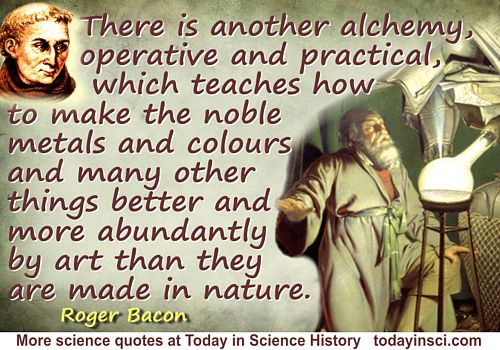
But there is another alchemy, operative and practical, which teaches how to make the noble metals and colours and many other things better and more abundantly by art than they are made in nature. And science of this kind is greater than all those preceding because it produces greater utilities. For not only can it yield wealth and very many other things for the public welfare, but it also teaches how to discover such things as are capable of prolonging human life for much longer periods than can be accomplished by nature … Therefore this science has special utilities of that nature, while nevertheless it confirms theoretical alchemy through its works.
— Roger Bacon
Opus Tertium [1266-1268], chapter 12, quoted in A. C. Crombie, Augustine to Galileo (1959), Vol. I, 69.
But we must here state that we should not see anything if there were a vacuum. But this would not be due to some nature hindering species, and resisting it, but because of the lack of a nature suitable for the multiplication of species; for species is a natural thing, and therefore needs a natural medium; but in a vacuum nature does not exist.
— Roger Bacon
Opus Majus [1266-1268], Part V, distinction 9, chapter 2, trans. R. B. Burke, The Opus Majus of Roger Bacon (1928), Vol. 2, 485.
For he who knows not mathematics cannot know any other science; what is more, he cannot discover his own ignorance, or find its proper remedy.
— Roger Bacon
For the things of this world cannot be made known without a knowledge of mathematics.
— Roger Bacon
(Sent to the Pope in 1267). As translated in Opus Majus (1928), Vol. 1, 128.
For there are two modes of acquiring knowledge, namely, by reasoning and experience. Reasoning draws a conclusion and makes us grant the conclusion, but does not make the conclusion certain, nor does it remove doubt so that the mind may rest on the intuition of truth, unless the mind discovers it by the path of experience; since many have the arguments relating to what can be known, but because they lack experience they neglect the arguments, and neither avoid what is harmful nor follow what is good. For if a man who has never seen fire should prove by adequate reasoning that fire burns and injures things and destroys them, his mind would not be satisfied thereby, nor would he avoid fire, until he placed his hand or some combustible substance in the fire, so that he might prove by experience that which reasoning taught. But when he has had actual experience of combustion his mind is made certain and rests in the full light of truth. Therefore reasoning does not suffice, but experience does.
— Roger Bacon
Opus Majus [1266-1268], Part VI, chapter I, trans. R. B. Burke, The Opus Majus of Roger Bacon (1928), Vol. 2, 583.
In the mathematics I can report no deficience, except that it be that men do not sufficiently understand the excellent use of the pure mathematics, in that they do remedy and cure many defects in the wit and faculties intellectual. For if the wit be too dull, they sharpen it; if too wandering, they fix it; if too inherent in the sense, they abstract it. So that as tennis is a game of no use in itself, but of great use in respect it maketh a quick eye and a body ready to put itself into all postures; so in the mathematics, that use which is collateral and intervenient is no less worthy than that which is principal and intended.
— Roger Bacon
As translated in John Fauvel and Jeremy Gray (eds.) A History of Mathematics: A Reader (1987), 290-291. From De Augmentis, Book 3, The Advancement of Learning (1605), Book 2. Reprinted in The Two Books of Francis Bacon: Of the Proficience and Advancement of Learning, Divine and Human (2009), 97.
Mathematics is both the door and the key to the sciences.
— Roger Bacon
In Opus Majus (1267).
Mathematics is the gate and key of the sciences. ... Neglect of mathematics works injury to all knowledge, since he who is ignorant of it cannot know the other sciences or the things of this world. And what is worse, men who are thus ignorant are unable to perceive their own ignorance and so do not seek a remedy.
— Roger Bacon
In Opus Majus, Part 4, Distinctia Prima, cap. 1.
The strongest arguments prove nothing so long as the conclusions are not verified by experience. Experimental science is the queen of sciences and the goal of all speculation.
— Roger Bacon
Opus Tertium. Translation as stated in Popular Science (Aug 1901), 337.
There are four great sciences, without which the other sciences cannot be known nor a knowledge of things secured … Of these sciences the gate and key is mathematics … He who is ignorant of this [mathematics] cannot know the other sciences nor the affairs of this world.
— Roger Bacon
Opus Majus [1266-1268], Part IV, distinction I, chapter I, trans. R. B. Burke, The Opus Majus of Roger Bacon (1928), Vol. I, 116.
This science [experimental science] alone, therefore, knows how to test perfectly what can be done by nature, what by the effort of art, what by trickery, what the incantations, conjurations, invocations, deprecations, sacrifices that belong to magic mean and dream of, and what is in them, so that all falsity may be removed and the truth alone of art and nature may be retained. This science alone teaches us how to view the mad acts of magicians, that they may be not ratified but shunned, just as logic considers sophistical reasoning.
— Roger Bacon
In Opus Majus (1267).
What others strive to see dimly and blindly, like bats in twilight, he [Petrus Peregrinus] gazes at in the full light of day, because he is a master of experiment. Through experiment he gains knowledge of natural things, medical, chemical, and indeed of everything in the heavens or earth. … He has even taken note of the remedies, lot casting, and charms used by old women and by wizards and magicians, and of the deceptions and devices of conjurors, so that nothing which deserves inquiry should escape him, and that he may be able to expose the falsehoods of magicians.
— Roger Bacon
Quotes by others about Roger Bacon (1)
In modern Europe, the Middle Ages were called the Dark Ages. Who dares to call them so now? … Their Dante and Alfred and Wickliffe and Abelard and Bacon; their Magna Charta, decimal numbers, mariner’s compass, gunpowder, glass, paper, and clocks; chemistry, algebra, astronomy; their Gothic architecture, their painting,—are the delight and tuition of ours. Six hundred years ago Roger Bacon explained the precession of the equinoxes, and the necessity of reform in the calendar; looking over how many horizons as far as into Liverpool and New York, he announced that machines can be constructed to drive ships more rapidly than a whole galley of rowers could do, nor would they need anything but a pilot to steer; carriages, to move with incredible speed, without aid of animals; and machines to fly into the air like birds.
In 'Progress of Culture', an address read to the Phi Beta Kappa Society at Cambridge, 18 July 1867. Collected in Works of Ralph Waldo Emerson (1883), 475.
See also:
- 11 Jun - short biography, births, deaths and events on date of Bacon's death.
- Roger Bacon - context of quote there is another alchemy - Medium image (500 x 350 px)
- Roger Bacon - context of quote “There is another alchemy” - Large image (800 x 600 px)
 In science it often happens that scientists say, 'You know that's a really good argument; my position is mistaken,' and then they would actually change their minds and you never hear that old view from them again. They really do it. It doesn't happen as often as it should, because scientists are human and change is sometimes painful. But it happens every day. I cannot recall the last time something like that happened in politics or religion.
(1987) --
In science it often happens that scientists say, 'You know that's a really good argument; my position is mistaken,' and then they would actually change their minds and you never hear that old view from them again. They really do it. It doesn't happen as often as it should, because scientists are human and change is sometimes painful. But it happens every day. I cannot recall the last time something like that happened in politics or religion.
(1987) -- 





