 (source)
|
Sir Francis Bacon
(22 Jan 1561 - 9 Apr 1626)
English philosopher remembered for his influence promoting a scientific method. He held that the aim of scientific investigation is practical application of the understanding of nature to improve man’s condition.
|
Science Quotes by Sir Francis Bacon (170 quotes)
>> Click for Sir Francis Bacon Quotes on | Death | Difference | Discovery | Error | Experiment | Invention | Knowledge | Logic | Man | Mathematics | Mind | Nature | Observation | Physician | Science | Study | Thinking | Truth | Understanding | Work |
>> Click for Sir Francis Bacon Quotes on | Death | Difference | Discovery | Error | Experiment | Invention | Knowledge | Logic | Man | Mathematics | Mind | Nature | Observation | Physician | Science | Study | Thinking | Truth | Understanding | Work |

… for it is very probable, that the motion of gravity worketh weakly, both far from the earth, and also within the earth: the former because the appetite of union of dense bodies with the earth, in respect of the distance, is more dull: the latter, because the body hath in part attained its nature when it is some depth in the earth.
[Foreshadowing Newton's Universal Law of Gravitation (1687)]
[Foreshadowing Newton's Universal Law of Gravitation (1687)]
— Sir Francis Bacon
Sylva Sylvarum; or a Natural History in Ten Centuries (1627), Century 1, Experiment 33. Collected in The Works of Francis Bacon (1826), Vol 1, 255.
...neither is it possible to discover the more remote and deeper parts of any science, if you stand but upon the level of the same science, and ascend not to a higher science.
— Sir Francis Bacon
Francis Bacon, Basil Montagu (Ed.), The Works of Francis Bacon (1852), Vol. 1, 173.
…the Form or true definition of heat … is in few words as follows: Heat is a motion; expansive, restrained, and acting in its strife upon the smaller particles of bodies. But the expansion is thus modified; while it expands all ways, it has at the same time an inclination upward. And the struggle in the particles is modified also; it is not sluggish, but hurried and with violence.
— Sir Francis Bacon
Novum Organum (1620), Book 2, Aphorism 20. Translated as 'First Vintage Concerning the Form of Heat', The New Organon: Aphorisms Concerning the Interpretation of Nature and the Kingdom of Man), collected in James Spedding, Robert Ellis and Douglas Heath (eds.), The Works of Francis Bacon (1857), Vol. 4, 154-5.
...those experiments be not only esteemed which have an immediate and present use, but those principally which are of most universal consequence for invention of other experiments, and those which give more light to the invention of causes; for the invention of the mariner's needle, which giveth the direction, is of no less benefit for navigation than the invention of the sails, which give the motion.
— Sir Francis Bacon
The Second Book of Francis Bacon of the Proficience and Advancement of Learning (1605). In Francis Bacon and Basil Montagu, The Works of Francis Bacon, Lord Chancellor of England (1852), 200
...to invent is to discover that we know not, and not to recover or resummon that which we already know.
— Sir Francis Bacon
The Second Book of Francis Bacon of the Proficience and Advancement of Learning (1605). In Francis Bacon and Basil Montagu, The Works of Francis Bacon, Lord Chancellor of England (1852), 209

…truth will sooner come out of error than from confusion.
— Sir Francis Bacon
From Novum Organum (1620), Book 2, Aphorism 20. Translated as The New Organon: Aphorisms Concerning the Interpretation of Nature and the Kingdom of Man), collected in James Spedding, Robert Ellis and Douglas Heath (eds.), The Works of Francis Bacon (1857), Vol. 4, 149.
'...no pleasure is comparable to the standing upon the vantage ground of truth … and to see the errors … in the vale below:' so always that this prospect be with pity, and not with swelling or pride.
Quoting an unnamed poet and adding a comment.
Quoting an unnamed poet and adding a comment.
— Sir Francis Bacon
I. Of Truth,' Essays (1597). In Francis Bacon and Basil Montagu, The Works of Francis Bacon, Lord Chancellor of England (1852), 11
Deliberare utilia, mora est tutissima.
To deliberate about useful things, is the safest delay.
To deliberate about useful things, is the safest delay.
— Sir Francis Bacon
In 'Ornamenta Rationalia, or, Elegant Sentences' (1625). As given in Essays, Moral, Economical, and Political: A New Edition, With the Latin Quotations Translated (1813), No. 6, 362.
Demonstratio longe optima est experientia.
By far the best proof is experience.
By far the best proof is experience.
— Sir Francis Bacon
Novum Organum, I., 70. In Thomas Benfield Harbottle, Dictionary of Quotations (Classical) (1906), 42.
Etiam capillus unus habet umbram suam.
The smallest hair casts a shadow.
The smallest hair casts a shadow.
— Sir Francis Bacon
In 'Ornamenta Rationalia, or, Elegant Sentences' (1625). As given in Essays, Moral, Economical, and Political: A New Edition, With the Latin Quotations Translated (1813), No. 10, 362.
In artibus et scientiis, tanquam in metalli fodinis, omnia novis operibus et ulterioribus progressibus circumstrepere debent
But arts and sciences should be like mines, where the noise of new works and further advances is heard on every side.
But arts and sciences should be like mines, where the noise of new works and further advances is heard on every side.
— Sir Francis Bacon
Original Latin as in Novum Organum, Book 1, XC, collected in The Works of Francis Bacon (1826), Vol. 8, 50-51. As translated by James Spedding and Robert Leslie Ellis in The Works of Francis Bacon (1863), 127.
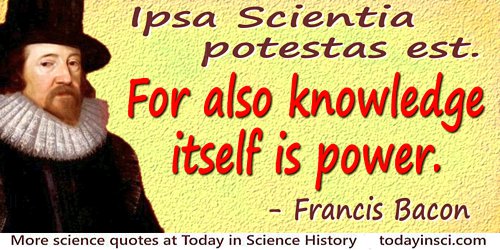
Ipsa Scientia potestas est.
For also knowledge itself is power.
For also knowledge itself is power.
— Sir Francis Bacon
'Meditationes Sacrae' (1597), in James Spedding, Robert Ellis and Douglas Heath (eds.), The Works of Francis Bacon (1887-1901), Vol. 7, 253.
Male secum agit æger, medicum qui hæredem ficit.Br>That sick man does ill for himself, who makes his physician his heir.
— Sir Francis Bacon
In 'Ornamenta Rationalia, or, Elegant Sentences' (1625). As given in Essays, Moral, Economical, and Political: A New Edition, With the Latin Quotations Translated (1813), No. 31, 364. A century later, Benjamin Franklin included this in his Poor Richard’s Almanac as “He’s a Fool that makes his Doctor his Heir.”
Natura enim non nisi parendo vincitur
Nature to be commanded must be obeyed.
Nature to be commanded must be obeyed.
— Sir Francis Bacon
From Novum Organum (1620), Book 1, Aphorism 3. Translated as The New Organon: Aphorisms Concerning the Interpretation of Nature and the Kingdom of Man), collected in James Spedding, Robert Ellis and Douglas Heath (eds.), The Works of Francis Bacon (1857), Vol. 4, 47.
Primo enim paranda est Historia Naturalis et Experimentalis, suffidens et bona; quod fundamentum rei est: neque enim fingendum, aut excogitandum, sed inveniendum, quid natura faciat aut ferat.
For first of all we must prepare a Natural and Experimental History, sufficient and good; and this is the foundation of all; for we are not to imagine or suppose, but to discover, what nature does or may be made to do.
For first of all we must prepare a Natural and Experimental History, sufficient and good; and this is the foundation of all; for we are not to imagine or suppose, but to discover, what nature does or may be made to do.
— Sir Francis Bacon
In Novum Organum, Book 2, Aphorism 10. As translated in Francis Bacon and James Spedding with Robert Leslie Ellis (eds.), 'The New Organon', The Works of Francis Bacon: Translations of the Philosophical Works (1858), Vol. 4, 127. Also seen in epigraphs as a shorter quote, “Non fingendum, aut excogitandum, sed inveniendum, quid natura faciat aut ferat,” which can also be translated as “We have not to imagine or to think out, but to find out what Nature does or produces.”
Prudens interrogatio quasi dimidium sapientiae.
A prudent question is, as it were, one half of wisdom.
A prudent question is, as it were, one half of wisdom.
— Sir Francis Bacon
In The Works of Francis Bacon: Philosophical Works (1857), 635. Also in Henry Thomas Riley, Dictionary of Latin Quotations, Proverbs, Maxims, and Mottos (1866), 349.
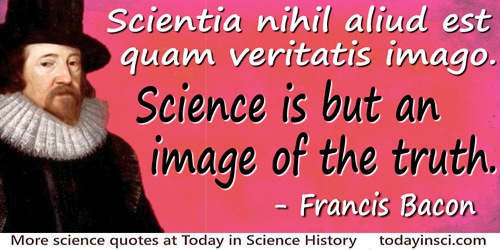
Scientia nihil aliud est quam veritatis imago
Science is but an image of the truth.
Science is but an image of the truth.
— Sir Francis Bacon
In James Wood, Dictionary of Quotations from Ancient and Modern, English and Foreign Sources (1893), 383:3.
~~[Attributed]~~ Prudens quaestio dimidium scientiae.
Half of science is asking the right questions.
Half of science is asking the right questions.
— Sir Francis Bacon
Also translated as, “To ask the proper question is half of knowing.” Also seen translated as “Half of science is putting forth the right questions,” in Jon R. Stone, The Routledge Dictionary of Latin Quotations (2005), 92. This quote, or a variant, is widely found widely in quote collections and books, but seemingly always without explicit primary source citation. It may have been derived from “Prudens interrogatio quasi dimidium sapientiae.” (A prudent question is, as it were, one half of wisdom), as printed in The Works of Francis Bacon: Philosophical Works (1857), 635. Webmaster has not, as yet, identified a verbatim primary source for the subject quote in Latin. Meanwhile, note the the sense of “scientiae” in Bacon’s time meant “a corpus of human knowledge” rather than the more specific use of the word “science” today. (Sometimes the quote is found attributed to Roger Bacon, which Webmaster, for lack of evidence, currently believes is likely not correct.) [Please contact Webmaster if you can help.]
~~[Attributed]~~ Prudens quaestio dimidium scientiae.
Half of science is putting forth the right questions.
Half of science is putting forth the right questions.
— Sir Francis Bacon
In Jon R. Stone, The Routledge Dictionary of Latin Quotations (2005), 92.
A healthy body is a guest-chamber for the soul; a sick body is a prison.
— Sir Francis Bacon
As quoted in a book review in The Royal Society of Health Journal (1955), 225.
A man that is young in years may be old in hours, if he has lost no time.
— Sir Francis Bacon
‘Of Youth and Age’, Essays.
A physician advised his patient that had sore eyes, that he should abstain from wine; but the patient said, “I think rather, sir, from wine and water; for I have often marked it in blue eyes, and I have seen water come forth, but never wine.”
— Sir Francis Bacon
In 'A Collection of Apophthegms, New and Old' (1625). As given in Essays, Moral, Economical, and Political: A New Edition, With the Latin Quotations Translated (1813), No. 52, 279.
Above all things, good policy is to be used that the treasure and moneys in a state be not gathered into few hands. For otherwise a state may have a great stock, and yet starve. And money is like muck, not good except it be spread.
— Sir Francis Bacon
'Of Seditions and Troubles' (1625) in James Spedding, Robert Ellis and Douglas Heath (eds.), The Works of Francis Bacon (1887-1901), Vol. 6, 410.
Again there is another great and powerful cause why the sciences have made but little progress; which is this. It is not possible to run a course aright when the goal itself has not been rightly placed.
— Sir Francis Bacon
Translation of Novum Organum, LXXXI. In Francis Bacon, James Spedding, The Works of Francis Bacon (1864), Vol. 8, 113.
All depends on keeping the eye steadily fixed on the facts of nature and so receiving their images simply as they are.
— Sir Francis Bacon
In Francis Bacon, James Spedding (ed.), Robert Leslie Ellis (ed.), 'The Plan of the Work: The Great Instauration', The Works of Francis Bacon: Translations of the Philosophical Works (1858), Vol. 4, 32.
All good moral philosophy is ... but the handmaid to religion.
— Sir Francis Bacon
In The Advancement of Learning, book 2, xxii, 14. In Francis Bacon and Basil Montagu, The Works of Francis Bacon (1825), 252.
And as for Mixed Mathematics, I may only make this prediction, that there cannot fail to be more kinds of them, as nature grows further disclosed.
— Sir Francis Bacon
In Advancement of Learning (1605), Book 2. Collected in The Works of Francis Bacon (1765), Vol. 1, 61.
And yet surely to alchemy this right is due, that it may be compared to the husbandman whereof Æsop makes the fable, that when he died he told his sons that he had left unto them gold buried under the ground in his vineyard: and they digged over the ground, gold they found none, but by reason of their stirring and digging the mould about the roots of their vines, they had a great vintage the year following: so assuredly the search and stir to make gold hath brought to light a great number of good and fruitful inventions and experiments, as well for the disclosing of nature as for the use of man's life.
— Sir Francis Bacon
The Advancement of Learning (1605, 1712), Vol. 1, 15.
Another argument of hope may be drawn from this–that some of the inventions already known are such as before they were discovered it could hardly have entered any man's head to think of; they would have been simply set aside as impossible. For in conjecturing what may be men set before them the example of what has been, and divine of the new with an imagination preoccupied and colored by the old; which way of forming opinions is very fallacious, for streams that are drawn from the springheads of nature do not always run in the old channels.
— Sir Francis Bacon
Translation of Novum Organum, XCII. In Francis Bacon, James Spedding, The Works of Francis Bacon (1864), Vol. 8, 128.
Another diversity of Methods is according to the subject or matter which is handled; for there is a great difference in delivery of the Mathematics, which are the most abstracted of knowledges, and Policy, which is the most immersed…, yet we see how that opinion, besides the weakness of it, hath been of ill desert towards learning, as that which taketh the way to reduce learning to certain empty and barren generalities; being but the very husks and shells of sciences, all the kernel being forced out and expulsed with the torture and press of the method.
— Sir Francis Bacon
Advancement of Learning, Book 2. In James Spedding, The Works of Francis Bacon (1863), Vol. 6, 292-293. Peter Pešić, explains that 'By Mathematics, he had in mind a sterile and rigid scheme of logical classifications, called dichotomies in his time,' inLabyrinth: A Search for the Hidden Meaning of Science (2001), 73.
Another error is a conceit that … the best has still prevailed and suppressed the rest: so as, if a man should begin the labor of a new search, he were but like to light upon somewhat formerly rejected, and by rejection brought into oblivion; as if the multitude, or the wisest for the multitude’s sake, were not ready to give passage rather to that which is popular and superficial, than to that which is substantial and profound: for the truth is, that time seemeth to be of the nature of a river or stream, which carrieth down to us that which is light and blown up, and sinketh and drowneth that which is weighty and solid.
— Sir Francis Bacon
Advancement of Learning, Book 1. Collected in The Works of Francis Bacon (1826), Vol 1, 36.
Aristippus said; “That those that studied particular sciences, and neglected philosophy, were like Penelope’s wooers, that made love to the waiting women.”
— Sir Francis Bacon
In 'A Collection of Apophthegms, New and Old' (1625). As given in Essays, Moral, Economical, and Political: A New Edition, With the Latin Quotations Translated (1813), No. 271, 341.
Aristotle... a mere bond-servant to his logic, thereby rendering it contentious and well nigh useless.
— Sir Francis Bacon
Rerum Novarum (1605)
As the birth of living creatures are ill shapen; so are all innovations, which are the births of time.
— Sir Francis Bacon
From essay, 'Of Innovations'. As collected and translated in The Works of Francis Bacon (1765), Vol. 1, 479.
As the births of living creatures are ill-shapen, so are all innovations, which are the births of time.
— Sir Francis Bacon
XXIV. On Innovation,' Essays (1597). In Francis Bacon and Basil Montagu, The Works of Francis Bacon, Lord Chancellor of England (1852), 32
Books must follow sciences, and not sciences books.
— Sir Francis Bacon
In 'A Proposal for Amending the Laws of England' (1616). Collected in The Works, with Several Additional Pieces Never Before Printed (1740), Vol. 4, 5.
Brutes by their natural instinct have produced many discoveries, whereas men by discussion and the conclusions of reason have given birth to few or none.
— Sir Francis Bacon
Novum Organum, LXXIII
But by far the greatest hindrance and aberration of the human understanding proceeds from the dullness, incompetency, and deceptions of the senses; in that things which strike the sense outweigh things which do not immediately strike it, though they be more important. Hence it is that speculation commonly ceases where sight ceases; insomuch that of things invisible there is little or no observation.
— Sir Francis Bacon
From Aphorism 50, Novum Organum, Book I (1620). Collected in James Spedding (ed.), The Works of Francis Bacon (1858), Vol. 4, 58.
But by far the greatest obstacle to the progress of science and to the undertaking of new tasks and provinces therein is found in this—that men despair and think things impossible.
— Sir Francis Bacon
Translation of Novum Organum, CIX. In Francis Bacon, James Spedding, The Works of Francis Bacon (1864), Vol. 8, 140-141.
But if any skillful minister of nature shall apply force to matter, and by design torture and vex it, in order to [effect] its annihilation, it, on the contrary being brought under this necessity, changes and transforms itself into a strange variety of shapes and appearances; for nothing but the power of the Creator can annihilate, or truly destroy it.
— Sir Francis Bacon
As quoted in M.J. Gorton, 'The Weather', Popular Science News (1889), 23, No. 8, 115.
But the best demonstration by far is experience, if it go not beyond the actual experiment.
— Sir Francis Bacon
From Aphorism 70, Novum Organum, Book I (1620). Collected in James Spedding (ed.), The Works of Francis Bacon (1858), Vol. 4, 70.
But the greatest error of all the rest is the mistaking or misplacing of the last or farthest end of knowledge: for men have entered into a desire of learning and knowledge, sometimes upon a natural curiosity and inquisitive appetite; sometimes to entertain their minds with variety and delight; sometimes for ornament and reputation; and sometimes to enable them to victory of wit and contradiction; and most times for lucre and profession; and seldom sincerely to give a true account of their gift of reason, to the benefit and use of men...
— Sir Francis Bacon
The First Book of Francis Bacon of the Proficience and Advancement of Learning (1605). In Francis Bacon and Basil Montagu, The Works of Francis Bacon, Lord Chancellor of England (1852), 174
Certainly, it is heaven upon earth, to have a man's mind move in charity, rest in providence, and turn upon the poles of truth.
— Sir Francis Bacon
'Essays or Counsels: Civil and Moral. I. Of Truth'. In Francis Bacon, James Spedding, The Works of Francis Bacon (1864), Vol. 6, 378.
Cure the disease and kill the patient.
— Sir Francis Bacon
‘Of Friendship’, Essays.
Deformed persons commonly take revenge on nature.
— Sir Francis Bacon
The Advancement of Learning, Bk VI, Ch. 3.
Democritus said; “That truth did lie in profound pits, and when it was got it need much refining.”
— Sir Francis Bacon
In 'A Collection of Apophthegms, New and Old' (1625). As given in Essays, Moral, Economical, and Political: A New Edition, With the Latin Quotations Translated (1813), 'Contained in the original edition in octavo but omitted in later copies', No. 263, 353.
Doctor Johnson said, that in sickness there were three things that were material; the physician, the disease, and the patient: and if any two of these joined, then they get the victory; for, Ne Hercules quidem contra duos [Not even Hercules himself is a match for two]. If the physician and the patient join, then down goes the disease; for then the patient recovers: if the physician and the disease join, that is a strong disease; and the physician mistaking the cure, then down goes the patient: if the patient and the disease join, then down goes the physician; for he is discredited.
— Sir Francis Bacon
In 'A Collection of Apophthegms, New and Old' (1625). As given in Essays, Moral, Economical, and Political: A New Edition, With the Latin Quotations Translated (1813), No. 147, 308. The doctor is identified Ben Johnson by Forbes Winslow in his notes appended to Physic and Physicians (1842). Notes section, 39. Perhaps he means poet and playwright of stage comedy, Ben Jonson (1572-1637), also referred to in the book as “Benjamin Johnson” and once as “Dr. Johnson.” Note that Francis Bacon (1561-1626) died well before the life of writer Dr. Samuel Johnson (1709-1784).
For all knowledge and wonder (which is the seed of knowledge) is an impression of pleasure in itself.
— Sir Francis Bacon
The First Book of Francis Bacon of the Proficience and Advancement of Learning (1605). In Francis Bacon and Basil Montagu, The Works of Francis Bacon, Lord Chancellor of England (1852), 163
For behavior, men learn it, as they take diseases, one of another.
— Sir Francis Bacon
As quoted in 'Solitude and Society', The Atlantic Monthly (Dec 1857), Vol. 1, 228.
For it being the nature of the mind of man (to the extreme prejudice of knowledge) to delight in the spacious liberty of generalities, as in a champion region, and not in the enclosures of particularity; the Mathematics were the goodliest fields to satisfy that appetite.
— Sir Francis Bacon
In De Augmentis, Bk. 8; Advancement of Learning, Bk. 2.
For man being the minister and interpreter of nature, acts and understands so far as he has observed of the order, the works and mind of nature, and can proceed no further; for no power is able to loose or break the chain of causes, nor is nature to be conquered but by submission: whence those twin intentions, human knowledge and human power, are really coincident; and the greatest hindrance to works is the ignorance of causes.
— Sir Francis Bacon
In The Great lnstauration.
For many parts of Nature can neither be invented with sufficient subtlety, nor demonstrated with sufficient perspicuity, nor accommodated to use with sufficient dexterity, without the aid and intervention of Mathematic: of which sort are Perspective, Music, Astronomy, cosmography, Architecture, Machinery, and some others.
— Sir Francis Bacon
In De Augmentis, Bk. 3; The Advancement of Learning (1605), Book 3. As translated in Francis Bacon, James Spedding and Robert Leslie Ellis, 'Of the great Appendix of Natural Philosophy, both Speculative and Operative, namely Mathematic; and that it ought rather
to be placed among Appendices than among Substantive Sciences. Division of Mathematic into Pure and Mixed', The Works of Francis Bacon (1858), Vol. 4, Chap. 6, 371.
For myself, I found that I was fitted for nothing so well as for the study of Truth; as having a mind nimble and versatile enough to catch the resemblances of things (which is the chief point) , and at the same time steady enough to fix and distinguish their subtler differences; as being gifted by nature with desire to seek, patience to doubt, fondness to meditate, slowness to assert, readiness to reconsider, carefulness to dispose and set in order; and as being a man that neither affects what is new nor admires what is old, and that hates every kind of imposture. So I thought my nature had a kind of familiarity and relationship with Truth.
— Sir Francis Bacon
From 'Progress of philosophical speculations. Preface to intended treatise De Interpretatione Naturæ (1603), in Francis Bacon and James Spedding (ed.), Works of Francis Bacon (1868), Vol. 3, 85.
Further, it will not be amiss to distinguish the three kinds and, as it were, grades of ambition in mankind. The first is of those who desire to extend their own power in their native country, a vulgar and degenerate kind. The second is of those who labor to extend the power and dominion of their country among men. This certainly has more dignity, though not less covetousness. But if a man endeavor to establish and extend the power and dominion of the human race itself over the universe, his ambition (if ambition it can be called) is without doubt both a more wholesome and a more noble thing than the other two. Now the empire of man over things depends wholly on the arts and sciences. For we cannot command nature except by obeying her.
— Sir Francis Bacon
From Novum Organum (1620), Book 1, Aphorism 129. Translated as The New Organon: Aphorisms Concerning the Interpretation of Nature and the Kingdom of Man), collected in James Spedding, Robert Ellis and Douglas Heath (eds.), The Works of Francis Bacon (1857), Vol. 4, 114.
Histories make men wise; poets, witty; the mathematics, subtle; natural philosophy, deep; moral, grave; logic and rhetoric, able to contend.
— Sir Francis Bacon
'L. Of Studies,' Essays (1597). In Francis Bacon and Basil Montagu, The Works of Francis Bacon, Lord Chancellor of England (1852), 55.
Hope is a good breakfast, but it is a bad supper.
— Sir Francis Bacon
'Apophthegms From the Resuscitatio' (1661). In Francis Bacon, James Spedding, The Works of Francis Bacon (1860), Vol. 13, 391.
Human knowledge and human power meet in one; for where the cause is not known the effect cannot be produced. Nature to be commanded must be obeyed; and that which in contemplation is as the cause is in operation as the rule.
— Sir Francis Bacon
From Novum Organum (1620), Book 1, Aphorism 3. Translated as The New Organon: Aphorisms Concerning the Interpretation of Nature and the Kingdom of Man), collected in James Spedding, Robert Ellis and Douglas Heath (eds.), The Works of Francis Bacon (1857), Vol. 4, 47.
I confess that I have as vast contemplative ends, as I have moderate civil ends: for I have taken all knowledge to be my province.
— Sir Francis Bacon
Letter (age 31) to his uncle Lord Burleigh. In Francis Bacon, James Spedding (ed.) et al., Works of Francis Bacon (1862) Vol. 6, 109.
I had rather believe all the Fables in the Legend, and the Talmud, and the Alcoran, then that this universall Frame, is without a Minde. And therefore, God never wrought Miracle, to convince Atheisme, because his Ordinary Works Convince it. It is true, that a little Philosophy inclineth Mans Minde to Atheisme; But depth in Philosophy, bringeth Mens Mindes about to Religion.
— Sir Francis Bacon
'Of Atheisme' (1625) in James Spedding, Robert Ellis and Douglas Heath (eds.), The Works of Francis Bacon (1887-1901), Vol. 6, 413.
I hold every man a debtor to his profession; from the which as men of course do seek to receive countenance and profit, so ought they of duty to endeavour themselves, by way of amends, to be a help and ornament thereunto. This is performed, in some degree, by the honest and liberal practice of a profession; where men shall carry a respect not to descend into any course that is corrupt and unworthy thereof, and preserve themselves free from the abuses wherewith the same profession is noted to be infected: but much more is this performed, if a man be able to visit and strengthen the roots and foundation of the science itself; thereby not only gracing it in reputation and dignity, but also amplifying it in profession and substance.
— Sir Francis Bacon
Opening sentences of Preface, Maxims of Law (1596), in The Works of Francis Bacon: Law tracts. Maxims of the Law (1803), Vol. 4, 10.
I was ever of the opinion that the philosopher’s stone, and an holy war, were but the rendezvous of cracked brains, that wore their feather in their heads.
— Sir Francis Bacon
From essay, An Advertisement Touching a Holy War (1622). As collected and translated in Francis Bacon and Basil Montagu, The Works of Francis Bacon (1844), Vol. 2, 439. As quoted in Samuel Austin Allibone, Prose Quotations From Socrates to Macaulay (1876), 28. [Note: In Bacon’s time, the 17th century, the meaning of “advertise” was to give knowledge, advice or counsel. An “advertisement” meant the same in the form of a written statement. —Webmaster]
I would by all means have men beware, lest Æsop’s pretty fable of the fly that sate [sic] on the pole of a chariot at the Olympic races and said, “What a dust do I raise,” be verified in them. For so it is that some small observation, and that disturbed sometimes by the instrument, sometimes by the eye, sometimes by the calculation, and which may be owing to some real change in the heaven, raises new heavens and new spheres and circles.
— Sir Francis Bacon
'Of Vain Glory' (1625) in James Spedding, Robert Ellis and Douglas Heath (eds.), The Works of Francis Bacon (1887-1901), Vol. 6, 503.
If [a man's] wit be not apt to distinguish or find differences, let him study the schoolmen; for they are cymini sectores, [splitters of hairs,]
— Sir Francis Bacon
Translation in Francis Bacon, James Spedding (ed.) et al., Works of Francis Bacon (1858) Vol. 6, 498. (Note: The translation of cymini sectores, 'splitters of hairs,' is provided in the translated work cited. 'If [a man's]' has been added to clarify context of this quote from that work.)
If a man will begin with certainties, he shall end in doubts; but if he will be content to begin with doubts, he shall end in certainties.
— Sir Francis Bacon
The Advancement of Learning (1605) in James Spedding, Robert Ellis and Douglas Heath (eds.), The Works of Francis Bacon (1887-1901), Vol. 3, 293.
If a man's wit be wandering, let him study the mathematics; for in demonstrations, if his wit be called away never so little, he must begin again.
— Sir Francis Bacon
Translation in Francis Bacon, James Spedding (ed.) et al., Works of Francis Bacon (1858) Vol. 6, 498.
If any human being earnestly desire to push on to new discoveries instead of just retaining and using the old; to win victories over Nature as a worker rather than over hostile critics as a disputant; to attain, in fact, clear and demonstrative knowlegde instead of attractive and probable theory; we invite him as a true son of Science to join our ranks.
— Sir Francis Bacon
Novum Organum (1620), 34, Preface.
If one be bird-witted, that is easily distracted and unable to keep his attention as long as he should, mathematics provides a remedy; for in them if the mind be caught away but a moment, the demonstration has to be commenced anew.
— Sir Francis Bacon
In De Augmentis, Bk. 6; Advancement of Learning, Bk. 2.
If the just cure of a disease be full of peril, let the physician resort to palliation.
— Sir Francis Bacon
Nat. Hist. As quoted in entry for 'Palliation', Samuel Johnson, A Dictionary of the English Language; in which the Words are Deduced from their Originals (1818), Vol. 3 (unpaginated).
If we are to achieve results never before accomplished, we must employ methods never before attempted.
— Sir Francis Bacon
…...
In nature things move violently to their place, and calmly in their place.
— Sir Francis Bacon
Translation in Francis Bacon, James Spedding (ed.) et al., Works of Francis Bacon (1858) Vol. 6, 401.
It cannot be that axioms established by argumentation should avail for the discovery of new works, since the subtlety of nature is greater many times over than the subtlety of argument. But axioms duly and orderly formed from particulars easily discover the way to new particulars, and thus render sciences active.
— Sir Francis Bacon
From Novum Organum (1620), Book 1, Aphorism 24. Translated as The New Organon: Aphorisms Concerning the Interpretation of Nature and the Kingdom of Man), collected in James Spedding, Robert Ellis and Douglas Heath (eds.), The Works of Francis Bacon (1857), Vol. 4, 51.
It has come to pass, I know not how, that Mathematics and Logic, which ought to be but the handmaids of Physic, nevertheless presume on the strength of the certainty which they possess to exercise dominion over it.
— Sir Francis Bacon
From De Augmentis Scientiaurum as translated in Francis Guy Selby, The Advancement of Learning (1893), Vol. 2, 73.
It is as natural to die as to be born; and to a little infant, perhaps, the one is as painful as the other.
— Sir Francis Bacon
‘Of Death’, Essays.
It is as natural to man to die as to be born; and to a little infant, perhaps, the one is as painful as the other.
— Sir Francis Bacon
Of Death. In Carl Sagan, Broca’s Brain: Reflections on the Romance of Science (1979, 1986), 206.
It is idle to expect any great advancement in science from the superinducing and engrafting of new things upon old. We must begin anew from the very foundations, unless we would revolve for ever in a circle with mean and contemptible progress.
— Sir Francis Bacon
From Novum Organum (1620), Book 1, Aphorism 31. Translated as The New Organon: Aphorisms Concerning the Interpretation of Nature and the Kingdom of Man), collected in James Spedding, Robert Ellis and Douglas Heath (eds.), The Works of Francis Bacon (1857), Vol. 4, 52.
It is madness and a contradiction to expect that things which were never yet performed should be effected, except by means hitherto untried.
— Sir Francis Bacon
Novum Organum (1620), Part 1, Sec. 1, Aphorism 6. In The Works of Franics Bacon (1815), Vol. 4, 4.
It is most true that a natural and secret hatred and aversation towards society, in any man, hath somewhat of the savage beast.
— Sir Francis Bacon
In 'Of Friendship', Mary Augusta Scott (ed.), Essays of Francis Bacon (1908), 117. A footnote indicates “aversation towards” used in the translation means “aversion to”.
It is not the lie that passeth through the mind, but the lie that sinketh in and settleth in it, that doth the hurt.
— Sir Francis Bacon
'Essays or Counsels: Civil and Moral. I. Of Truth'. In Francis Bacon, James Spedding, The Works of Francis Bacon (1864), Vol. 6, 378.
It is the wisdom of rats, that will be sure to leave a house somewhat before it fall.
— Sir Francis Bacon
From essay, 'Of Wisdom for a Man’s Self'. As collected and translated in The Works of Francis Bacon (1765), Vol. 1, 479.
It is the wisdom of the crocodiles, that shed tears when they devour.
— Sir Francis Bacon
From essay, 'Of Wisdom for a Man’s Self'. As collected and translated in The Works of Francis Bacon (1765), Vol. 1, 479.
It is true, that what is settled by custom, though it not be good, yet at least it is fit.
— Sir Francis Bacon
From essay, 'Of Innovations' (1625). As collected and translated in The Works of Francis Bacon (1765), Vol. 1, 479.
It is well to observe the force and virtue and consequence of discoveries, and these are to be seen nowhere more conspicuously than in those three which were unknown to the ancients, and of which the origins, although recent, are obscure and inglorious; namely, printing, gunpowder, and the magnet. For these three have changed the whole face and state of things throughout the world; the first in literature, the second in warfare, the third in navigation; whence have followed innumerable changes, insomuch that no empire, no sect, no star seems to have exerted greater power and influence in human affairs than these mechanical discoveries.
— Sir Francis Bacon
From Novum Organum (1620), Book 1, Aphorism 129. Translated as The New Organon: Aphorisms Concerning the Interpretation of Nature and the Kingdom of Man), collected in James Spedding, Robert Ellis and Douglas Heath (eds.), The Works of Francis Bacon (1857), Vol. 4, 114.
It is worthy the observing, that there is no passion in the mind of man, so weak, but it mates, and masters, the fear of death; and therefore, death is no such terrible enemy, when a man hath so many attendants about him, that can win the combat of him. Revenge triumphs over death; love slights it; honor aspireth to it; grief flieth to it; fear preoccupieth it.
— Sir Francis Bacon
In 'Of Death', Essays (1625, 1883), 10.
It would be an unsound fancy and self-contradictory to expect that things which have never yet been done can be done except by means which have never yet been tried.
— Sir Francis Bacon
From Novum Organum (1620), Book 1, Aphorism 6. Translated as The New Organon: Aphorisms Concerning the Interpretation of Nature and the Kingdom of Man), collected in James Spedding, Robert Ellis and Douglas Heath (eds.), The Works of Francis Bacon (1857), Vol. 4, 48.
It would be the height of folly—and self-defeating—to think that things never heretofore done can be accomplished without means never heretofore tried.
— Sir Francis Bacon
In Novum Organum (1620).
Knowledge is power.
[Editors' summary of Bacon's idea, not Bacon's wording.]
[Editors' summary of Bacon's idea, not Bacon's wording.]
— Sir Francis Bacon
Bacon's original text is in Latin, so any quote seen in English is an interpretation by the translator. The dictum, expressed in three words as 'Knowledge is Power,' is only seen in notes to the texts made by translators or editors, and is not a direct translation of Bacon's written words. See, for example, the commentary by F. G. Selby (ed.) in The Advancement of Learning, Book 1, by Francis Bacon (1905), 140; or, the introductory notes by E. A. Abbott (ed.) in Bacon's Essays (1876), cxxxvii. For the best match in Bacon's original words, see Novum Organum Aphorism 3: Scientia et potentia humana in idem coincidunt,... or 'Human knowledge and human power meet in one;...'. The Latin form is in Thomas Fowler (ed.), Bacon's Novum Organum (2nd Ed., 1878), 188; and this translated form is in Francis Bacon and James Spedding (trans.), The Works of Francis Bacon (1864), Vol. 8, 67.
Let every student of nature take this as his rule, that whatever the mind seizes upon with particular satisfaction is to be held in suspicion.
— Sir Francis Bacon
Novum Organum (1620). In Jerome Kagan, Three Seductive Ideas (1998).
Man, as the minister and interpreter of nature, is limited in act and understanding by his observation of the order of nature; neither his understanding nor his power extends further.
— Sir Francis Bacon
Novum Organum, Aphor I. Quoted in Robert Routledge, Discoveries and Inventions of the 19th Century (1890), 696
Man, being the servant and interpreter of Nature, can do and understand so much and so much only as he has observed in fact or thought of the course of nature; beyond this he neither knows anything nor can do anything.
— Sir Francis Bacon
From Novum Organum (1620), Book 1, Aphorism 1. As translated from the original Latin, “Homo enim naturae minister et interpres tantum facit et intelligit, quantum de naturae ordine, opere vel mente, observaverit: nec amplius scit, aut potest.” in The New Organon: Aphorisms Concerning the Interpretation of Nature and the Kingdom of Man), collected in James Spedding, Robert Ellis and Douglas Heath (eds.), The Works of Francis Bacon (1857), Vol. 4, 47. Also seen translated as “Man, as the minister and interpreter of nature, is limited in act and understanding by his observation of the order of nature; neither his understanding nor his power extends farther,” in Robert Routledge, Discoveries and Inventions of the 19th Century (1891), 697.
Mathematic is either Pure or Mixed: To Pure Mathematic belong those sciences which handle Quantity entirely severed from matter and from axioms of natural philosophy. These are two, Geometry and Arithmetic; the one handling quantity continued, the other dissevered. … Mixed Mathematic has for its subject some axioms and parts of natural philosophy, and considers quantity in so far as it assists to explain, demonstrate and actuate these.
— Sir Francis Bacon
In De Augmentis, Bk. 3; Advancement of Learning, Bk. 2.
Medical men do not know the drugs they use, nor their prices.
— Sir Francis Bacon
De Erroribus Medicorum.
Medicine is a science which hath been (as we have said) more professed than laboured, and yet more laboured than advanced: the labour having been, in my judgment, rather in circle than in progression. For I find much iteration, but small addition. It considereth causes of diseases, with the occasions or impulsions; the diseases themselves, with the accidents; and the cures, with the preservation.
— Sir Francis Bacon
The Advancement of Learning (1605) in James Spedding, Robert Ellis and Douglas Heath (eds.), The Works of Francis Bacon (1887-1901), Vol. 3, 373.
Men are rather beholden ... generally to chance or anything else, than to logic, for the invention of arts and sciences.
— Sir Francis Bacon
The Advancement of Learning (1605) in James Spedding, Robert Ellis and Douglas Heath (eds.), The Works of Francis Bacon (1887-1901), Vol. 3, 386.
Men fear death as children fear to go in the dark; and as that natural fear in children is increased with tales, so is the other.
— Sir Francis Bacon
From 'Of Truth', Essays or Counsels Civil and Moral (1625). As translated in James Spedding, Robert Ellis and Douglas Heath (eds.), The Works of Francis Bacon (1857), Vol. 6, 379.
Men fear Death, as children fear to go in the dark; and as that natural fear in children is increased with tales, so is the other.
— Sir Francis Bacon
Essays.
Moreover, the works already known are due to chance and experiment rather than to sciences; for the sciences we now possess are merely systems for the nice ordering and setting forth of things already invented; not methods of invention or directions for new works.
— Sir Francis Bacon
From Novum Organum (1620), Book 1, Aphorism 8. Translated as The New Organon: Aphorisms Concerning the Interpretation of Nature and the Kingdom of Man), collected in James Spedding, Robert Ellis and Douglas Heath (eds.), The Works of Francis Bacon (1857), Vol. 4, 48.
Natural abilities are like natural plants; they need pruning by study.
— Sir Francis Bacon
'L. Of Studies,' Essays (1597). In Francis Bacon and Basil Montagu, The Works of Francis Bacon, Lord Chancellor of England (1852), 55.
Nature is often hidden, sometimes overcome, seldom extinguished.
— Sir Francis Bacon
'Of Nature in Men' (1625) In James Spedding, Robert Ellis and Douglas Heath (eds.), The Works of Francis Bacon (1887-190I), Vol. 6, 469.
Neither the naked hand nor the understanding left to itself can effect much. It is by instruments and helps that the work is done, which are as much wanted for the understanding as for the hand. And as the instruments of the hand either give motion or guide it, so the instruments of the mind supply either suggestions for the understanding or cautions.
— Sir Francis Bacon
From Novum Organum (1620), Book 1, Aphorism 2. Translated as The New Organon: Aphorisms Concerning the Interpretation of Nature and the Kingdom of Man), collected in James Spedding, Robert Ellis and Douglas Heath (eds.), The Works of Francis Bacon (1857), Vol. 4, 47.
Never any knowledge was delivered in the same order it was invented.
— Sir Francis Bacon
'Of the Interpretation of Nature' (c.1603) in James Spedding, Robert Ellis and Douglas Heath (eds.), The Works of Francis Bacon (1887-1901), Vol. 3, 248.
Nevertheless if any skillful Servant of Nature shall bring force to bear on matter, and shall vex it and drive it to extremities as if with the purpose of reducing it to nothing, then will matter (since annihilation or true destruction is not possible except by the omnipotence of God) finding itself in these straits, turn and transform itself into strange shapes, passing from one change to another till it has gone through the whole circle and finished the period.
— Sir Francis Bacon
From 'Proteus; or Matter', De Sapientia Veterum (1609), Sec. 13. As translated in James Spedding, Robert Ellis and Douglas Heath (eds.), The Works of Francis Bacon (1857), Vol. 6, 726.
No one has yet been found so firm of mind and purpose as resolutely to compel himself to sweep away all theories and common notions, and to apply the understanding, thus made fair and even, to a fresh examination of particulars. Thus it happens that human knowledge, as we have it, is a mere medley and ill-digested mass, made up of much credulity and much accident, and also of the childish notions which we at first imbibed.
— Sir Francis Bacon
In Novum Organum (1620), Book 2, Aphorism 20.
Observation and experiment for gathering material, induction and deduction for elaborating it: these are are only good intellectual tools.
— Sir Francis Bacon
In Claude Bernard, Henry C. Greene and L. J. Henderson, An Introduction to the Study of Experimental Medicine (1957), 6.
Physic is of little use to a temperate person, for a man's own observation on what he finds does him good or what hurts him, is the best physic to preserve health.
— Sir Francis Bacon
In James Wood, Dictionary of Quotations from Ancient and Modern, English and Foreign Sources (1893), 348:17.
Physicians are some of them so pleasing and conformable to the humour of the patient, as they press not the true cure of the disease : and some other are so regular in proceeding according to art for the disease, as they respect not sufficiently the condition of the patient.
— Sir Francis Bacon
XXX. Of Regimen of Health,' Essays (1597). In Francis Bacon and Basil Montagu, The Works of Francis Bacon, Lord Chancellor of England (1852), 39.
Read not to contradict and confute, not to believe and take for granted, not to find talk and discourse, but to weigh and consider.
— Sir Francis Bacon
'Of Studies.' Translation in Francis Bacon, James Spedding (ed.) et al., Works of Francis Bacon (1858) Vol. 6, 497.
Revenge is a kind of wild justice; which the more man’s nature runs to, the more ought law to weed it out.
— Sir Francis Bacon
…...
Science is the labor and handicraft of the mind; poetry can only be considered its recreation.
— Sir Francis Bacon
As quoted in Nathaniel Holmes, The Authorship of Shakespeare (1867), 198. Footnoted as Int. Globe, Works (Mont.), XV. 150.
Sciences distinguished have a dependence upon universal knowledge, to be augmented, and rectified by the superior light thereof; as well as the parts and members of a science have upon the maxims of the same science, and the mutual light and consent which one part receiveth of another.
— Sir Francis Bacon
From 'Interpretatio Naturæ' ('Of The Interpretation of Nature'), collected in The Works Of Francis Bacon (1803), Vol. 2, 140.
Since my logic aims to teach and instruct the understanding, not that it may with the slender tendrils of the mind snatch at and lay hold of abstract notions (as the common logic does), but that it may in very truth dissect nature, and discover the virtues and actions of bodies, with their laws as determined in matter; so that this science flows not merely from the nature of the mind, but also from the nature of things.
— Sir Francis Bacon
In Novum Organum (1620), Book 2, Aphorism 42.
So highly did the ancients esteem the power of figures and numbers, that Democritus ascribed to the figures of atoms the first principles of the variety of things; and Pythagoras asserted that the nature of things consisted of numbers.
— Sir Francis Bacon
In De Augmentis, Bk. 3; Advancement of Learning, Bk. 2.
Some books are to be tasted, others to be swallowed, and some few to be chewed and digested; that is, some books are to be read only in parts; other to be read, but not curiously; and some few to be read wholly, and with diligence and attention. Some books also may be read by deputy, and extracts made of them by others; but that would be only in the less important arguments, and the meaner sort of books; else distilled books are like common distilled waters, flashy things. Reading maketh a full man; conference a ready man; and writing an exact man. And therefore, if a man write little, he had need have a great memory; if he confer little, he had need have a present wit: and if he read little, he had need have much cunning, to seem to know that he doth not. Histories make men wise; poets witty; the mathematics subtile; natural philosophy deep; moral grave; logic and rhetoric able to contend. Abeunt studia in mores. [The studies pass into the manners.]
— Sir Francis Bacon
'Of Studies' (1625) in James Spedding, Robert Ellis and Douglas Heath (eds.), The Works of Francis Bacon (1887-1901), Vol. 6, 498.
Such philosophy as shall not vanish in the fume of subtile, sublime, or delectable speculation but shall be operative to the endowment and betterment of man’s life.
— Sir Francis Bacon
As quoted on title page of Lancelot Hogben, Science for the Citizen (1938).
Surely every medicine is an innovation, and he that will not apply new remedies must expect new evils for time is the greatest innovator.
— Sir Francis Bacon
From essay, 'Of Innovations' (1625). As collected and translated in The Works of Francis Bacon (1765), Vol. 1, 479.
Take an arrow, and hold it in flame for the space of ten pulses, and when it cometh forth you shall find those parts of the arrow which were on the outsides of the flame more burned, blacked, and turned almost to coal, whereas the midst of the flame will be as if the fire had scarce touched it. This is an instance of great consequence for the discovery of the nature of flame; and sheweth manifestly, that flame burneth more violently towards the sides than in the midst.
— Sir Francis Bacon
Observing, but not with the knowledge, that a flame burns at its outside in contact with air, and there is no combustion within the flame which is not mixed with air. In Sylva Sylvarum; or a Natural History in Ten Centuries (1627), Century 1, Experiment 32. Collected in The Works of Francis Bacon (1740), Vol 3, 9.
The alchemists call in many varieties out of astrology, auricular traditions, and feigned testimonies.
— Sir Francis Bacon
As quoted, without source, in Samuel Austin Allibone, Prose Quotations From Socrates to Macaulay (1876), 28. Although two other quotes by Bacon under the heading 'Alchemy' do have sources indicated, the subject quote appears without source—which leaves the authenticity of the subject quote in question. As yet, Webmaster has found no primary source. Can you help?
[Note: auricular means received by the sense of hearing. -Webmaster]
The art of invention grows young with the things invented.
— Sir Francis Bacon
Quoted by Bacon as a Maxim. As given in Gurney Benham, A Book of Quotations, Proverbs and Household Words (1907), 494.
The cause and root of nearly all evils in the sciences is this—that while we falsely admire and extol the powers of the human mind we neglect to seek for its true helps.
— Sir Francis Bacon
From Novum Organum (1620), Book 1, Aphorism 9. Translated as The New Organon: Aphorisms Concerning the Interpretation of Nature and the Kingdom of Man), collected in James Spedding, Robert Ellis and Douglas Heath (eds.), The Works of Francis Bacon (1857), Vol. 4, 48.
The commissioners of the treasury moved the king, for the relief of his estate, to disafforest some forests of his, explaining themselves of such forests as lay out of the way, not near any of the king’s houses, nor in the course of his progress; whereof he should never have use nor pleasure. “Why,” saith the king, “do you think that Solomon had use and pleasure of all his three hundred concubines?”
— Sir Francis Bacon
In 'A Collection of Apophthegms, New and Old' (1625). As given in Essays, Moral, Economical, and Political: A New Edition, With the Latin Quotations Translated (1813), No. 9, 262. King James I was named in the preceding Apophthegm No. 3.
The confirmation of theories relies on the compact adaption of their parts, by which, like those of an arch or dome, they mutually sustain each other, and form a coherent whole.
— Sir Francis Bacon
As quoted in J.F.W. Herschel, A Treatise on Astronomy (1833), 4. With the original Latin, “Theoriarum vires, arcta et quasi se mutuo sustinente partium adaptatione, quâ, quasi in orbem cohaerent, firmantur.”
The dignity of this end of endowment of man's life with new commodity appeareth by the estimation that antiquity made of such as guided thereunto ; for whereas founders of states, lawgivers, extirpators of tyrants, fathers of the people, were honoured but with the titles of demigods, inventors ere ever consecrated among the gods themselves.
— Sir Francis Bacon
Bacon and Basil Montagu (Ed.), 'Fragments of Valerius Terminus, on the Interpretation of Nature', Works of Bacon (1825), vol. 1., 266. Quoted in The Origin and Progress of the Mechanical Inventions of James Watt (1854), Vol.1, 2.
The divisions of science are not like different lines that meet in one angle, but rather like the branches of trees that join in one trunk.
— Sir Francis Bacon
The Works of Francis Bacon (1815), Vol. 6, 68.
The end of our foundation [Salomon's House in the New Atlantis] is the knowledge of Causes and the secret motions of things; and the enlarging of the bounds of Human Empire, to the effecting of all things possible.
— Sir Francis Bacon
In Francis Bacon and William Rawle (ed.), The Works of Francis Bacon: Philosophical Works (1887), 156.
The End of our Foundation is the knowledge of Causes; and secret motions of things; and the enlarging of the bounds of Human Empire, to the effecting of all things possible.
— Sir Francis Bacon
'New Atlantis' (1626) in James Spedding, Robert Ellis and Douglas Heath (eds.), The Works of Francis Bacon (1887-1901), Vol. 3, 156.
The general root of superstition [is that] men observe when things hit, and not when they miss, and commit to memory the one, and pass over the other.
— Sir Francis Bacon
In The Works of Francis Bacon (1819), Vol. 2, 73.
The human understanding is moved by those things most which strike and enter the mind simultaneously and suddenly, and so fill the imagination; and then it feigns and supposes all other things to be somehow, though it cannot see how, similar to those few things by which it is surrounded.
— Sir Francis Bacon
Translation of Novum Organum, XLVII. In Francis Bacon, James Spedding, The Works of Francis Bacon (1864), Vol. 8, 80.
The human understanding is of its own nature prone to suppose the existence of more order and regularity in the world than it finds. And though there be many things in nature which are singular and unmatched, yet it devises for them parallels and conjugates and relatives which do not exist. Hence the fiction that all celestial bodies move in perfect circles, spirals and dragons being (except in name) utterly rejected.
— Sir Francis Bacon
From Aphorism 45, Novum Organum, Book I (1620). Collected in James Spedding (ed.), The Works of Francis Bacon (1858), Vol. 4, 55.
The human understanding is unquiet; it cannot stop or rest, and still presses onward, but in vain. Therefore it is that we cannot conceive of any end or limit to the world, but always as of necessity it occurs to us that there is something beyond... But he is no less an unskilled and shallow philosopher who seeks causes of that which is most general, than he who in things subordinate and subaltern omits to do so
— Sir Francis Bacon
From Aphorism 48, Novum Organum, Book I (1620). Collected in James Spedding (ed.), The Works of Francis Bacon (1858), Vol. 4, 57.
The human understanding when it has once adopted an opinion (either as being the received opinion or as being agreeable to itself) draws all things else to support and agree with it. And though there be a greater number and weight of instances to be found on the other side, yet these it either neglects and despises, or else by some distinction sets aside and rejects, in order that by this great and pernicious predetermination the authority of its former conclusions may remain inviolate.
— Sir Francis Bacon
From Aphorism 46, Novum Organum, Book I (1620). Collected in James Spedding (ed.), The Works of Francis Bacon (1858), Vol. 4, 56.
The ill and unfit choice of words wonderfully obstructs the understanding.
— Sir Francis Bacon
From Novum Organum (1620), Book 1, Aphorisms 39, 41-44. Translated as The New Organon: Aphorisms Concerning the Interpretation of Nature and the Kingdom of Man), collected in James Spedding, Robert Ellis and Douglas Heath (eds.), The Works of Francis Bacon (1857), Vol. 4, 55.
The industry of artificers maketh some small improvement of things invented; and chance sometimes in experimenting maketh us to stumble upon somewhat which is new; but all the disputation of the learned never brought to light one effect of nature before unknown.
— Sir Francis Bacon
In The Works of Francis Bacon (1740), Vol. 1, 69.
The job of the artist is always to deepen the mystery
— Sir Francis Bacon
John Mitchinson and John Lloyd, If Ignorance Is Bliss, Why Aren't There More Happy People?: Smart Quotes for Dumb Times (2009), 217.
The lame … in the path outstrip the swift who wander from it.
— Sir Francis Bacon
In Novum Organum, as collected and translated in The Works of Francis Bacon: Lord Chancellor of England (1831), 43.
The lame (as they say) in the path outstrip the swift who wander from it, and it is clear that the very skill and swiftness of him who runs not in the right direction must increase his aberration.
— Sir Francis Bacon
From Novum Organum, Book 1, as translated in Francis Bacon, The Works of Francis Bacon (1857), Vol. 3, 350.
The logic now in use serves rather to fix and give stability to the errors which have their foundation in commonly received notions than to help the search for truth. So it does more harm than good.
— Sir Francis Bacon
From Novum Organum (1620), Book 1, Aphorism 12. Translated as The New Organon: Aphorisms Concerning the Interpretation of Nature and the Kingdom of Man), collected in James Spedding, Robert Ellis and Douglas Heath (eds.), The Works of Francis Bacon (1857), Vol. 4, 48-49.
The monuments of wit survive the monuments of power.
— Sir Francis Bacon
The Works of Francis Bacon (1824), Vol. 6, 24.
The nature of things betrays itself more readily under the vexations of art than in its natural freedom.
— Sir Francis Bacon
The Great Instauration. In James Spedding, The Works of Francis Bacon: Translations of the Philosophical Works (1869), 48.
The only hope [of science] ... is in genuine induction.
— Sir Francis Bacon
Aphorism 14. In Francis Bacon and Basil Montagu, The Works of Francis Bacon (1831), Vol. 14, 32.
The only hope of science is genuine induction.
— Sir Francis Bacon
In Maturin Murray Ballou, Edge-Tools of Speech (1899), 440.
The partitions of knowledge are not like several lines that meet in one angle, and so touch not in a point; but are like branches of a tree, that meet in a stem, which hath a dimension and quantity of entireness and continuance, before it come to discontinue and break itself into arms and boughs.
— Sir Francis Bacon
Francis Bacon, Basil Montagu (Ed.), The Works of Francis Bacon (1852), Vol. 1, 193.
The poets did well to conjoin music and medicine, in Apollo, because the office of medicine is but to tune the curious harp of man's body and reduce it to harmony.
— Sir Francis Bacon
The Advancement of Learning (1605), Book 2. Reprinted in The Two Books of Francis Bacon: Of the Proficience and Advancement of Learning, Divine and Human (2009), 106.
The remedy is worse than the disease.
— Sir Francis Bacon
‘Of Seditions and Troubles’, Essays.
The strength of all sciences is, as the strength of the old man’s faggot, in the band. For the harmony of a science, supporting each part the other, is and ought to be the true and brief confutation and suppression of all the smaller sort of objections; but, on the other side, if you take out every axiom, as the sticks of the faggot, one by one, you may quarrel with them and bend them and break them at your pleasure: so that, as was said of Seneca, Verborum minutiis rerum frangit pondera [that he broke up the weight and mass of the matter by verbal points and niceties], so a man may truly say of the schoolmen, Quaestionum minutiis scientiarum frangunt soliditatem [they broke up the solidarity and coherency of the sciences by the minuteness and nicety of their questions]. For were it not better for a man in fair room to set up one great light, or branching candlestick of lights, than to go about with a small watch-candle into every corner?
— Sir Francis Bacon
The Works of Francis Bacon (1864), Vol. 6, 123
The study of nature with a view to works is engaged in by the mechanic, the mathematician, the physician, the alchemist, and the magician; but by all (as things now are) with slight endeavour and scanty success.
— Sir Francis Bacon
From Novum Organum (1620), Book 1, Aphorism 5. Translated as The New Organon: Aphorisms Concerning the Interpretation of Nature and the Kingdom of Man), collected in James Spedding, Robert Ellis and Douglas Heath (eds.), The Works of Francis Bacon (1857), Vol. 4, 47-48.
The Syllogism consists of propositions, propositions consist of words, words are symbols of notions. Therefore if the notions themselves (which is the root of the matter) are confused and over-hastily abstracted from the facts, there can be no firmness in the superstructure. Our only hope therefore lies in a true induction.
— Sir Francis Bacon
From Novum Organum (1620), Book 1, Aphorism 14. Translated as The New Organon: Aphorisms Concerning the Interpretation of Nature and the Kingdom of Man), collected in James Spedding, Robert Ellis and Douglas Heath (eds.), The Works of Francis Bacon (1857), Vol. 4, 49.
The understanding must not however be allowed to jump and fly from particulars to axioms remote and of almost the highest generality (such as the first principles, as they are called, of arts and things), and taking stand upon them as truths that cannot be shaken, proceed to prove and frame the middle axioms by reference to them; which has been the practice hitherto, the understanding being not only carried that way by a natural impulse, but also by the use of syllogistic demonstration trained and inured to it. But then, and then only, may we hope well of the sciences when in a just scale of ascent, and by successive steps not interrupted or broken, we rise from particulars to lesser axioms; and then to middle axioms, one above the other; and last of all to the most general. For the lowest axioms differ but slightly from bare experience, while the highest and most general (which we now have) are notional and abstract and without solidity. But the middle are the true and solid and living axioms, on which depend the affairs and fortunes of men; and above them again, last of all, those which are indeed the most general; such, I mean, as are not abstract, but of which those intermediate axioms are really limitations.
The understanding must not therefore be supplied with wings, but rather hung with weights, to keep it from leaping and flying. Now this has never yet been done; when it is done, we may entertain better hopes of science.
The understanding must not therefore be supplied with wings, but rather hung with weights, to keep it from leaping and flying. Now this has never yet been done; when it is done, we may entertain better hopes of science.
— Sir Francis Bacon
From Novum Organum (1620), Book 1, Aphorism 104. Translated as The New Organon: Aphorisms Concerning the Interpretation of Nature and the Kingdom of Man), collected in James Spedding, Robert Ellis and Douglas Heath (eds.), The Works of Francis Bacon (1857), Vol. 4, 97.
The webs of spiders are not better just because they produce their threads from themselves, nor is our work inferior because, like bees, we gather from others.
— Sir Francis Bacon
Aphorism 95, from Novum Organum (), Book 1. Translatedby AI from the original Latin: Nec aranearum sane textus ideo melior quia ex se fila gignunt, nec noster vilior quia ex alienis libamus ut apes. Bacon is championing empirical inquiry and collaborative knowledge, by arguing that intellectual work—like the work of scholars and philosophers—is not less valuable because it draws on the ideas of others. Much like bees gather nectar to produce honey, scholars collect knowledge to create something new and valuable.
The world hath been much abused by the opinion of making gold; the work itself I judge to be possible; but the means, hitherto propounded, to effect it are, in the practice, full of error and imposture; and in the theory, full of unfound imaginations.
— Sir Francis Bacon
From 'Experiment Solitary Touching the Making of Gold', Sylva Sylvarum: Or, a Natural History (1627), published posthumously by William Rawley. As collected and translated in The Works of Francis Bacon (1765), Vol. 1, 204. As quoted in Samuel Austin Allibone, Prose Quotations From Socrates to Macaulay (1876), 28.
There are and can be only two ways of searching into and discovering truth. The one flies from the senses and particulars to the most general axioms, and from these principles, the truth of which it takes for settled and immovable, proceeds to judgment and to the discovery of middle axioms. And this way is now in fashion. The other derives axioms from the senses and particulars, rising by a gradual and unbroken ascent, so that it arrives at the most general axioms last of all. This is the true way, but as yet untried.
— Sir Francis Bacon
From Novum Organum (1620), Book 1, Aphorism 20. Translated as The New Organon: Aphorisms Concerning the Interpretation of Nature and the Kingdom of Man), collected in James Spedding, Robert Ellis and Douglas Heath (eds.), The Works of Francis Bacon (1857), Vol. 4, 50.
There are four classes of Idols which beset men’s minds. To these for distinction’s sake I have assigned names,—calling the first class Idols of the Tribe; the second, Idols of the Cave; the third, Idols of the Market Place; the fourth, Idols of the Theatre …
The Idols of the Tribe have their foundation in human nature itself, and in the tribe or race of men. For it is a false assertion that the sense of man is the measure of things. On the contrary, all perceptions as well of the sense as of the mind are according to the measure of the individual and not according to the measure of the universe. And the human understanding is like a false mirror, which, receiving rays irregularly, distorts and discolours the nature of things by mingling its own nature with it.
The Idols of the Cave are the idols of the individual man. For every one (besides the errors common to human nature in general) has a cave or den of his own, which refracts and discolours the light of nature; owing either to his own proper and peculiar nature; or to his education and conversation with others; or to the reading of books, and the authority of those whom he esteems and admires; or to the differences of impressions, accordingly as they take place in a mind preoccupied and predisposed or in a mind indifferent and settled; or the like.
There are also Idols formed by the intercourse and association of men with each other, which I call Idols of the Market-place, on account of the commerce and consort of men there. For it is by discourse that men associate; and words are imposed according to the apprehension of the vulgar, and therefore the ill and unfit choice of words wonderfully obstructs the understanding. Nor do the definitions or explanations where with in some things learned men are wont to guard and defend themselves, by any means set the matter right. But words plainly force and overrule the understanding, and throw all into confusion, and lead men away into numberless empty controversies and idle fancies.
Lastly, there are Idols which have immigrated into men’s minds from the various dogmas of philosophies, and also from wrong laws of demonstration. These I call Idols of the Theatre; because in my judgment all the received systems are but so many stage-plays, representing worlds of their own creation after an unreal and scenic fashion.
The Idols of the Tribe have their foundation in human nature itself, and in the tribe or race of men. For it is a false assertion that the sense of man is the measure of things. On the contrary, all perceptions as well of the sense as of the mind are according to the measure of the individual and not according to the measure of the universe. And the human understanding is like a false mirror, which, receiving rays irregularly, distorts and discolours the nature of things by mingling its own nature with it.
The Idols of the Cave are the idols of the individual man. For every one (besides the errors common to human nature in general) has a cave or den of his own, which refracts and discolours the light of nature; owing either to his own proper and peculiar nature; or to his education and conversation with others; or to the reading of books, and the authority of those whom he esteems and admires; or to the differences of impressions, accordingly as they take place in a mind preoccupied and predisposed or in a mind indifferent and settled; or the like.
There are also Idols formed by the intercourse and association of men with each other, which I call Idols of the Market-place, on account of the commerce and consort of men there. For it is by discourse that men associate; and words are imposed according to the apprehension of the vulgar, and therefore the ill and unfit choice of words wonderfully obstructs the understanding. Nor do the definitions or explanations where with in some things learned men are wont to guard and defend themselves, by any means set the matter right. But words plainly force and overrule the understanding, and throw all into confusion, and lead men away into numberless empty controversies and idle fancies.
Lastly, there are Idols which have immigrated into men’s minds from the various dogmas of philosophies, and also from wrong laws of demonstration. These I call Idols of the Theatre; because in my judgment all the received systems are but so many stage-plays, representing worlds of their own creation after an unreal and scenic fashion.
— Sir Francis Bacon
From Novum Organum (1620), Book 1, Aphorisms 39, 41-44. Translated as The New Organon: Aphorisms Concerning the Interpretation of Nature and the Kingdom of Man), collected in James Spedding, Robert Ellis and Douglas Heath (eds.), The Works of Francis Bacon (1857), Vol. 4, 53-55.
There are, and can be, but these two ways of seeking truth; the former, the anticipatory, is the one now in use; the latter is the true but yet untried path.
— Sir Francis Bacon
Cited as Aphorism 19 in book review 'A Preliminary Discourse on the Study of Natural Philosophy' in The Quarterly Review (Jul 1831), 45, No. 90, 399. This appears to be an abridged version of Aphorism 20 shown on this web page.
There is another ground of hope that must not be omitted. Let men but think over their infinite expenditure of understanding, time, and means on matters and pursuits of far less use and value; whereof, if but a small part were directed to sound and solid studies, there is no difficulty that might not be overcome.
— Sir Francis Bacon
Translation of Novum Organum, CXI. In Francis Bacon, James Spedding, The Works of Francis Bacon (1864), Vol. 8, 144.
There is no consumption, unless that which is lost by one body passes into another. Explanation. In nature there is no annihilation; and therefore the thing which is consumed either passes into the air, or is received into some adjacent body.
— Sir Francis Bacon
"Provisional Rules. Concerning the Duration of Life and the Form of Death. Rule 1.' Historia Vitæ et Mortis. Translation in Francis Bacon, James Spedding (ed.) et al., Philosophical Works of Francis Bacon (1861) Vol. 2, 320."
There is no doubt but men of genius and leisure may carry our method to greater perfection, but, having had long experience, we have found none equal to it for the commodiousness it affords in working with the Understanding.
— Sir Francis Bacon
In 'Scala Intellectus', The Works of Francis Bacon (1815), Vol. 11, 13.
There is no excellent beauty that hath not some strangeness in the proportions.
— Sir Francis Bacon
'Of Beauty.' Bacon's Essays (1880), Essay 43, 433.
There is no vice that doth so cover a man with shame as to be found false and perfidious.
— Sir Francis Bacon
…...
There is nothing more certain in nature than that it is impossible for any body to be utterly annihilated.
[Stating the conservation of matter.]
[Stating the conservation of matter.]
— Sir Francis Bacon
Sylva Sylvarum; or a Natural History in Ten Centuries (1627), Century 1, Experiment 100. Collected in The Works of Francis Bacon (1826), Vol 1, 285.
There was a painter became a physician: whereupon one said to him; “You have done well; for before the faults of your work were seen; but now they are unseen.”
— Sir Francis Bacon
In 'A Collection of Apophthegms, New and Old' (1625). As given in Essays, Moral, Economical, and Political: A New Edition, With the Latin Quotations Translated (1813), No. 149, 308.
There were taken apples, and … closed up in wax. … After a month's space, the apple inclosed in was was as green and fresh as the first putting in, and the kernals continued white. The cause is, for that all exclusion of open air, which is ever predatory, maintaineth the body in its first freshness and moisture.
[In the U.S., since the 1920s, (to replace the fruit's original wax coating that is lost in the cleaning process after harvesting), natural waxes, such as carnauba wax, are applied in an extremely thin coating, to reduce loss of moisture and maintain crispness and appearance.]
[In the U.S., since the 1920s, (to replace the fruit's original wax coating that is lost in the cleaning process after harvesting), natural waxes, such as carnauba wax, are applied in an extremely thin coating, to reduce loss of moisture and maintain crispness and appearance.]
— Sir Francis Bacon
Sylva Sylvarum; or a Natural History in Ten Centuries (1627), Century 4, Experiment 350-317. Collected in The Works of Francis Bacon (1826), Vol 1, 350-351.
They are ill discoverers that think there is no land, when they can see nothing but sea.
— Sir Francis Bacon
The Advancement of Learning (1605) in James Spedding, Robert Ellis and Douglas Heath (eds.), The Works of Francis Bacon (1887-1901), Vol. 3, 355.
They are the best physicians, who being great in learning most incline to the traditions of experience, or being distinguished in practice do not reflect the methods and generalities of art.
— Sir Francis Bacon
The Advancement of Learning, Bk IV, Ch. II.
Those who have handled sciences have been either men of experiment or men of dogmas. The men of experiment are like the ant; they only collect and use; the reasoners resemble spiders, who make cobwebs out of their own substance. But the bee takes a middle course; it gathers its material from the flowers of the garden and of the field, but transforms and digests it by a power of its own. Not unlike this is the true business of philosophy; for it neither relies solely or chiefly on the powers of the mind, nor does it take the matter which it gathers from natural history and mechanical experiments and lay it up in the memory whole, as it finds it; but lays it up in the understanding altered and digested. Therefore from a closer and purer league between these two faculties, the experimental and the rational (such as has never yet been made), much may be hoped.
— Sir Francis Bacon
From Novum Organum (1620), Book 1, Aphorism 95. Translated as The New Organon: Aphorisms Concerning the Interpretation of Nature and the Kingdom of Man), collected in James Spedding, Robert Ellis and Douglas Heath (eds.), The Works of Francis Bacon (1857), Vol. 4, 92-3.
Those who have taken upon them to lay down the law of nature as a thing already searched out and understood, whether they have spoken in simple assurance or professional affectation, have therein done philosophy and the sciences great injury. For as they have been successful in inducing belief, so they have been effective in quenching and stopping inquiry; and have done more harm by spoiling and putting an end to other men's efforts than good by their own. Those on the other hand who have taken a contrary course, and asserted that absolutely nothing can be known — whether it were from hatred of the ancient sophists, or from uncertainty and fluctuation of mind, or even from a kind of fullness of learning, that they fell upon this opinion — have certainly advanced reasons for it that are not to be despised; but yet they have neither started from true principles nor rested in the just conclusion, zeal and affectation having carried them much too far...
Now my method, though hard to practice, is easy to explain; and it is this. I propose to establish progressive stages of certainty. The evidence of the sense, helped and guarded by a certain process of correction, I retain. But the mental operation which follows the act of sense I for the most part reject; and instead of it I open and lay out a new and certain path for the mind to proceed in, starting directly from the simple sensuous perception.
Now my method, though hard to practice, is easy to explain; and it is this. I propose to establish progressive stages of certainty. The evidence of the sense, helped and guarded by a certain process of correction, I retain. But the mental operation which follows the act of sense I for the most part reject; and instead of it I open and lay out a new and certain path for the mind to proceed in, starting directly from the simple sensuous perception.
— Sir Francis Bacon
Novum Organum (1620)

Time is the greatest innovator.
— Sir Francis Bacon
From essay, 'Of Innovations' (1625). As collected and translated in The Works of Francis Bacon (1765), Vol. 1, 479.
To conclude, therefore, let no man out of a weak conceit of sobriety, or an ill-apply'd moderation, think or maintain, that a man can search too far or be too well studied in the book of God’s word, or in the book of God’s works; divinity or philosophy; but rather let men endeavour an endless progress or proficience in both.
— Sir Francis Bacon
In Of Proficience and Advancement of Learning Divine and Human (1605), collected in The Works of Francis Bacon (1711), Vol. 2, 417. Charles Darwin placed this quote on the title page of his On the Origin of Species.
Truth comes out of error more readily than out of confusion.
— Sir Francis Bacon
In Novum Organum (1620).
Truth is a naked and open daylight, that doth not shew the masks and mummeries and triumphs of the world, half so stately and daintily as candlelights.
— Sir Francis Bacon
Essays Civil and Moral,' I, 'Of Truth'. In The Works of Francis Bacon (1824), Vol. 2, 253.
Truth more easily comes out of error than out of confusion.
— Sir Francis Bacon
As quoted by Thomas Huxley, Address delivered to the Working Men's Club and Institute, 'Technical Education' (1 Dec 1877), in Nineteenth Century (1878), 65-85. Collected in Science and Culture, and Other Essays (1881), 66.
We come therefore now to that knowledge whereunto the ancient oracle directeth us, which is the knowledge of ourselves; which deserveth the more accurate handling, by how much it toucheth us more nearly. This knowledge, as it is the end and term of natural philosophy in the intention of man, so notwithstanding it is but a portion of natural philosophy in the continent of nature. And generally let this be a rule, that all partitions of knowledges be accepted rather for lines and veins, than for sections and separations; and that the continuance and entireness of knowledge be preserved. For the contrary hereof hath made particular sciences to become barren, shallow, and erroneous; while they have not been nourished and maintained from the common fountain. So we see Cicero the orator complained of Socrates and his school, that he was the first that separated philosophy and rhetoric; whereupon rhetoric became an empty and verbal art. So we may see that the opinion of Copernicus touching the rotation of the earth, which astronomy itself cannot correct because it is not repugnant to any of the phenomena, yet natural philosophy may correct. So we see also that the science of medicine, if it be destituted and forsaken by natural philosophy, it is not much better than an empirical practice. With this reservation therefore we proceed to Human Philosophy or Humanity, which hath two parts: the one considereth man segregate, or distributively; the other congregate, or in society. So as Human Philosophy is either Simple and Particular, or Conjugate and Civil. Humanity Particular consisteth of the same parts whereof man consisteth; that is, of knowledges that respect the Body, and of knowledges that respect the Mind. But before we distribute so far, it is good to constitute. For I do take the consideration in general and at large of Human Nature to be fit to be emancipate and made a knowledge by itself; not so much in regard of those delightful and elegant discourses which have been made of the dignity of man, of his miseries, of his state and life, and the like adjuncts of his common and undivided nature; but chiefly in regard of the knowledge concerning the sympathies and concordances between the mind and body, which, being mixed, cannot be properly assigned to the sciences of either.
— Sir Francis Bacon
The Advancement of Learning (1605) in James Spedding, Robert Ellis and Douglas Heath (eds.), The Works of Francis Bacon (1887-1901), Vol. 3, 366-7.
Whence we see spiders, flies, or ants entombed and preserved forever in amber, a more than royal tomb.
— Sir Francis Bacon
Historia Vitæ et Mortis. Translation in Francis Bacon, James Spedding (ed.) et al., Philosophical Works of Francis Bacon (1861) Vol. 2, 320.
Quotes by others about Sir Francis Bacon (19)
But, as Bacon has well pointed out, truth is more likely to come out of error, if this is clear and definite, than out of confusion, and my experience teaches me that it is better to hold a well-understood and intelligible opinion, even if it should turn out to be wrong, than to be content with a muddle-headed mixture of conflicting views, sometimes miscalled impartiality, and often no better than no opinion at all.
Principles of General Physiology (1915), x.
I worked on true Baconian principles, and without any theory collected facts.
cit. Gavin de Beer in Autobiographies: Charles Darwin, Thomas Henry Huxley, 1974
I have said that science is impossible without faith. … Inductive logic, the logic of Bacon, is rather something on which we can act than something which we can prove, and to act on it is a supreme assertion of faith … Science is a way of life which can only fluorish when men are free to have faith.
In Calyampudi Radhakrishna Rao, Statistics and Truth (1997), 31.
Mr. Hobbes told me that the cause of his Lordship's [Francis Bacon's] death was trying an Experiment: viz. as he was taking the aire in a Coach with Dr. Witherborne (a Scotchman, Physitian to the King) towards High-gate, snow lay on the ground, and it came into my Lord's thoughts, why flesh might not be preserved in snow, as in Salt. They were resolved they would try the Experiment presently. They alighted out of the Coach and went into a poore woman's house at the bottom of Highgate hill, and bought a Hen, and made the woman exenterate it, and then stuffed the body with Snow, and my Lord did help to doe it himselfe. The Snow so chilled him that he immediately fell so extremely ill, that he could not return to his Lodging.
John Aubrey, Brief Lives (1680), edited by Oliver Lawson Dick (1949), 16.
To this day, we see all around us the Promethean drive to omnipotence through technology and to omniscience through science. The effecting of all things possible and the knowledge of all causes are the respective primary imperatives of technology and of science. But the motivating imperative of society continues to be the very different one of its physical and spiritual survival. It is now far less obvious than it was in Francis Bacon's world how to bring the three imperatives into harmony, and how to bring all three together to bear on problems where they superpose.
In 'Science, Technology and the Fourth Discontinuity' (1982). Reprinted in The Advancement of Science, and its Burdens (1986), 183.
Bacon first taught the world the true method of the study of nature, and rescued science from that barbarism in which the followers of Aristotle, by a too servile imitation of their master, had involved it.
A Course of Lectures on Natural Philosophy and the Mechanical Arts (1845), 5.
Ask a follower of Bacon what [science] the new philosophy, as it was called in the time of Charles the Second, has effected for mankind, and his answer is ready; “It has lengthened life; it has mitigated pain; it has extinguished diseases; it has increased the fertility of the soil; it has given new securities to the mariner; it has furnished new arms to the warrior; it has spanned great rivers and estuaries with bridges of form unknown to our fathers; it has guided the thunderbolt innocuously from heaven to earth; it has lighted up the night with the splendour of the day; it has extended the range of the human vision; it has multiplied the power of the human muscles; it has accelerated motion; it has annihilated distance; it has facilitated intercourse, correspondence, all friendly offices, all dispatch of business; it has enabled man to descend to the depths of the sea, to soar into the air, to penetrate securely into the noxious recesses of the earth, to traverse the land in cars which whirl along without horses, to cross the ocean in ships which run ten knots an hour against the wind. These are but a part of its fruits, and of its first-fruits; for it is a philosophy which never rests, which has never attained, which is never perfect. Its law is progress. A point which yesterday was invisible is its goal to-day, and will be its starting-point to-morrow.”
From essay (Jul 1837) on 'Francis Bacon' in Edinburgh Review. In Baron Thomas Babington Macaulay and Lady Trevelyan (ed.) The Works of Lord Macaulay Complete (1871), Vol. 6, 222.
This boulder seemed like a curious volume, regularly paged, with a few extracts from older works. Bacon tells us that “some books are to be tasted, others to be swallowed, and some few to be chewed and digested.” Of the last honour I think the boulder fully worthy.
In The Story of a Boulder: or, Gleanings from the Note-book of a Field Geologist (1858), 4.
History without the history of science, to alter slightly an apothegm of Lord Bacon, resembles a statue of Polyphemus without his eye—that very feature being left out which most marks the spirit and life of the person. My own thesis is complementary: science taught ... without a sense of history is robbed of those very qualities that make it worth teaching to the student of the humanities and the social sciences.
'The History of Science and the Teaching of Science', in I. Bernard Cohen and Fletcher G. Watson (eds.), General Education in Science (1952), 71.
Not only such Actions as were at first Indifferent to us, but even such as were Painful, will by Custom and Practice become Pleasant. Sir Francis Bacon observes in his Natural Philosophy, that our Taste is never pleased better, than with those things which at first created a Disgust in it. He gives particular Instances of Claret, Coffee, and other Liquors, which the Palate seldom approves upon the first Taste; but when it has once got a Relish of them, generally retains it for Life.
In The Spectator (2 Aug 1712), No. 447, collected in The Spectator (9th ed., 1728), Vol. 6, 225-226.
In the main, Bacon prophesied the direction of subsequent progress. But he “anticipated” the advance. He did not see that the new science was for a long time to be worked in the interest of old ends of human exploitation. He thought that it would rapidly give man new ends. Instead, it put at the disposal of a class the means to secure their old ends of aggrandizement at the expense of another class. The industrial revolution followed, as he foresaw, upon a revolution in scientific method. But it is taking the revolution many centuries to produce a new mind.
In Democracy and Education: An Introduction to the Philosophy of Education (1916), 330-331.
Mr. Hobbes told me that the cause of his Lordship’s [Francis Bacon s] death was trying an experiment: viz., as he was taking the air in a coach with Dr. Witherborne, a Scotchman, physician to the King, towards Highgate, snow lay on the ground, and it came into my Lord’s thoughts, why flesh might not be preserved in snow as in salt. They were resolved they would try the experiment presently. They alighted out of the coach and went into a poor woman s house at the bottom of Highgate Hill and bought a hen and made the woman exenterate it, and then stuffed the body with snow, and my Lord did help to do it himself The snow so chilled him that he immediately fell so extremely ill that he could not return to his lodgings.
In Brief Lives (late 17th century), as excerpted in The Retrospective Review (1821), 292.
One of the greatest experimental scientists of the time who was really doing something, William Harvey, said that what Bacon said science was, was the science that a lord-chancellor would do. He [Bacon] spoke of making observations, but omitted the vital factor of judgment about what to observe and what to pay attention to.
From address (1966) at the 14th Annual Convention of the National Science Teachers Association, New York City, printed in 'What is science?', The Physics Teacher (1969), 7, No. 6, 321.
The mechanical world view is a testimonial to three men: Francis Bacon, Rene Descartes, and Isaac Newton. After 300 years we are still living off their ideas.
In Jeremy Rifkin and Ted Howard, Entropy: Into the Greenhouse World (1980), 19.
We all pay an involuntary homage to antiquity – a “blind homage,” as Bacon calls it in his “Novum Organum,” which tends greatly to the obstruction of truth. To the great majority of mortal eyes, Time sanctifies everything that he does not destroy. The mere fact of anything being spared by the great foe makes it a favourite with us, who are sure to fall his victims.
From Memoirs of Extraordinary Popular Delusions (1841), Vol. 1, 314.
Bacon himself was very ignorant of all that had been done by mathematics; and, strange to say, he especially objected to astronomy being handed over to the mathematicians. Leverrier and Adams, calculating an unknown planet into a visible existence by enormous heaps of algebra, furnish the last comment of note on this specimen of the goodness of Bacon’s view… . Mathematics was beginning to be the great instrument of exact inquiry: Bacon threw the science aside, from ignorance, just at the time when his enormous sagacity, applied to knowledge, would have made him see the part it was to play. If Newton had taken Bacon for his master, not he, but somebody else, would have been Newton.
In Budget of Paradoxes (1872), 53-54.
If Bacon erred here [in valuing mathematics only for its uses], we must acknowledge that we greatly prefer his error to the opposite error of Plato. We have no patience with a philosophy which, like those Roman matrons who swallowed abortives in order to preserve their shapes, takes pains to be barren for fear of being homely.
In 'Lord Bacon', Edinburgh Review (Jul 1837). Collected in Critical and Miscellaneous Essays: Contributed to the Edinburgh Review (1857), Vol. 1, 396.
He [Lord Bacon] appears to have been utterly ignorant of the discoveries which had just been made by Kepler’s calculations … he does not say a word about Napier’s Logarithms, which had been published only nine years before and reprinted more than once in the interval. He complained that no considerable advance had been made in Geometry beyond Euclid, without taking any notice of what had been done by Archimedes and Apollonius. He saw the importance of determining accurately the specific gravities of different substances, and himself attempted to form a table of them by a rude process of his own, without knowing of the more scientific though still imperfect methods previously employed by Archimedes, Ghetaldus and Porta. He speaks of the εὕρηκα of Archimedes in a manner which implies that he did not clearly appreciate either the problem to be solved or the principles upon which the solution depended. In reviewing the progress of Mechanics, he makes no mention either of Archimedes, or Stevinus, Galileo, Guldinus, or Ghetaldus. He makes no allusion to the theory of Equilibrium. He observes that a ball of one pound weight will fall nearly as fast through the air as a ball of two, without alluding to the theory of acceleration of falling bodies, which had been made known by Galileo more than thirty years before. He proposed an inquiry with regard to the lever,—namely, whether in a balance with arms of different length but equal weight the distance from the fulcrum has any effect upon the inclination—though the theory of the lever was as well understood in his own time as it is now. … He speaks of the poles of the earth as fixed, in a manner which seems to imply that he was not acquainted with the precession of the equinoxes; and in another place, of the north pole being above and the south pole below, as a reason why in our hemisphere the north winds predominate over the south.
From Spedding’s 'Preface' to De Interpretations Naturae Proœmium, in The Works of Francis Bacon (1857), Vol. 3, 511-512. [Note: the Greek word “εὕρηκα” is “Eureka” —Webmaster.]
The barrenness of doubt had to make itself felt before it could be supplanted by knowledge. It was not until Hume, by carrying scepticism to its uttermost extent, had shown its unsatisfactory character and vain results, that the germs of scientific method, implanted by Bacon and Descartes, could develop and bear fruit in the positive philosophy of Comte.
In 'Mr. Buckle’s Fallacies', Darwinism and Other Essays (1893), 190.
See also:
- 22 Jan - short biography, births, deaths and events on date of Bacon's birth.
- Lord Bacon Did Not Write Shakespeare's Works - as expressed by Robert G. Ingersoll
- The Relation Of Bacon To Modern Science And Civilization - Letter to the Editor Of The Index (1878)
- Novum Organum: With Other Parts of the Great Instauration by Francis Bacon, by Peter Urbach. (Ed.) and John Gibson (Ed.). - book suggestion.
 In science it often happens that scientists say, 'You know that's a really good argument; my position is mistaken,' and then they would actually change their minds and you never hear that old view from them again. They really do it. It doesn't happen as often as it should, because scientists are human and change is sometimes painful. But it happens every day. I cannot recall the last time something like that happened in politics or religion.
(1987) --
In science it often happens that scientists say, 'You know that's a really good argument; my position is mistaken,' and then they would actually change their minds and you never hear that old view from them again. They really do it. It doesn't happen as often as it should, because scientists are human and change is sometimes painful. But it happens every day. I cannot recall the last time something like that happened in politics or religion.
(1987) -- 





.jpg)