 (source)
|
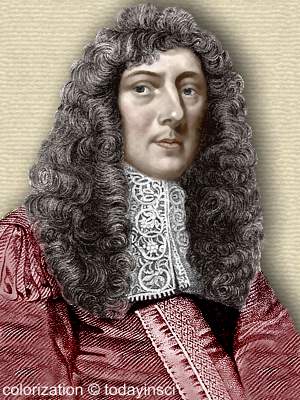
John Aubrey
(12 Mar 1626 - 7 Jun 1697)
English natural philosopher, author and biographer who is noted for discovering the Aubrey Holes encircling Stone Henge, and a prehistoric monument at Avebury. He was a founding memner of the Royal Society.
|
Science Quotes by John Aubrey (9 quotes)
He [Robert Boyle] is very tall (about six foot high) and straight, very temperate, and vertuouse, and frugall: a batcheler; keepes a Coach; sojournes with his sister, the Lady Ranulagh. His greatest delight is Chymistrey. He has at his sister’s a noble laboratory, and severall servants (Prentices to him) to look to it. He is charitable to ingeniose men that are in want, and foreigne Chymists have had large proofe of his bountie, for he will not spare for cost to get any rare Secret.
— John Aubrey
John Aubrey, Brief Lives (1680), edited by Oliver Lawson Dick (1949), 37.
He [Robert Hooke] is but of midling stature, something crooked, pale faced, and his face but little belowe, but his head is lardge; his eie full and popping, and not quick; a grey eie. He haz a delicate head of haire, browne, and of an excellent moist curle. He is and ever was very temperate, and moderate in dyet, etc. As he is of prodigious inventive head, so is a person of great vertue and goodnes. Now when I have sayd his Inventive faculty is so great, you cannot imagine his Memory to be excellent, for they are like two Bucketts, as one goes up, the other goes downe. He is certainly the greatest Mechanick this day in the World.
— John Aubrey
Brief Lives (1680), edited by Oliver Lawson Dick (1949), 165.
He [William Harvey] bid me to goe to the Fountain-head, and read Aristotle, Cicero, Avicenna, and did call the Neoteriques shitt-breeches.
— John Aubrey
Brief Lives (1680), edited by Oliver Lawson Dick (1949), 129.
He [William Harvey] did not care for chymistrey, and was wont to speake against them with an undervalue.
— John Aubrey
Brief Lives (1680), edited by Oliver Lawson Dick (1949), 132.
He had read much, if one considers his long life; but his contemplation was much more than his reading. He was wont to say that if he had read as much as other men he should have known no more than other men.
— John Aubrey
From 'Thomas Hobbes', in Andrew Clark (ed.) Brief Lives (1898), Vol. 1, 349.
He was 40 yeares old before he looked on Geometry; which happened accidentally. Being in a Gentleman's Library, Euclid's Elements lay open, and 'twas the 47 El. Libri 1 [Pythagoras' Theorem]. He read the proposition. By G-, sayd he (he would now and then sweare an emphaticall Oath by way of emphasis) this is impossible! So he reads the Demonstration of it, which referred him back to such a Proposition; which proposition he read. That referred him back to another, which he also read. Et sic deinceps [and so on] that at last he was demonstratively convinced of that trueth. This made him in love with Geometry .
Of Thomas Hobbes, in 1629.
Of Thomas Hobbes, in 1629.
— John Aubrey
Brief Lives (1680), edited by Oliver Lawson Dick (1949), 150.
I have heard him [William Harvey] say, that after his Booke of the Circulation of the Blood came-out, that he fell mightily in his Practize, and that 'twas beleeved by the vulgar that he was crack-brained.
— John Aubrey
Brief Lives (1680), edited by Oliver Lawson Dick (1949), 131.
Mr Hooke sent, in his next letter [to Sir Isaac Newton] the whole of his Hypothesis, scil that the gravitation was reciprocall to the square of the distance: ... This is the greatest Discovery in Nature that ever was since the World's Creation. It was never so much as hinted by any man before. I wish he had writt plainer, and afforded a little more paper.
— John Aubrey
Brief Lives (1680), edited by Oliver Lawson Dick (1949), 166-7.
Mr. Hobbes told me that the cause of his Lordship’s [Francis Bacon s] death was trying an experiment: viz., as he was taking the air in a coach with Dr. Witherborne, a Scotchman, physician to the King, towards Highgate, snow lay on the ground, and it came into my Lord’s thoughts, why flesh might not be preserved in snow as in salt. They were resolved they would try the experiment presently. They alighted out of the coach and went into a poor woman s house at the bottom of Highgate Hill and bought a hen and made the woman exenterate it, and then stuffed the body with snow, and my Lord did help to do it himself The snow so chilled him that he immediately fell so extremely ill that he could not return to his lodgings.
— John Aubrey
In Brief Lives (late 17th century), as excerpted in The Retrospective Review (1821), 292.
See also:
- 12 Mar - short biography, births, deaths and events on date of Aubrey's birth.
- John Aubrey and the Advancement of Learning, by William Poole. - book suggestion.
 In science it often happens that scientists say, 'You know that's a really good argument; my position is mistaken,' and then they would actually change their minds and you never hear that old view from them again. They really do it. It doesn't happen as often as it should, because scientists are human and change is sometimes painful. But it happens every day. I cannot recall the last time something like that happened in politics or religion.
(1987) --
In science it often happens that scientists say, 'You know that's a really good argument; my position is mistaken,' and then they would actually change their minds and you never hear that old view from them again. They really do it. It doesn't happen as often as it should, because scientists are human and change is sometimes painful. But it happens every day. I cannot recall the last time something like that happened in politics or religion.
(1987) -- 




