|
Aristotle
(384 B.C. - c. 322 B.C.)
Greek philosopher who presented his thoughts on weather in a book, Meteorologica, which while often wrong, did establish meteorolgy as a distinct discipline for study.
|
Science Quotes by Aristotle (111 quotes)
>> Click for Aristotle Quotes on | Earth | Nature | Physician | Truth |
>> Click for Aristotle Quotes on | Earth | Nature | Physician | Truth |
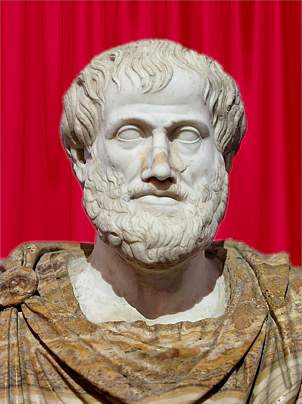
Bust of Aristotle at the Palazzo Altemps, Rome. It is a copy made from the sculpture by Lysippus. Roman copy in marble after a Greek bronze original (330 BC). Alabaster mantle is a modern addition.
… if the consequences are the same it is always better to assume the more limited antecedent, since in things of nature the limited, as being better, is sure to be found, wherever possible, rather than the unlimited.
— Aristotle
In Physics.
… while those whom devotion to abstract discussions has rendered unobservant of the facts are too ready to dogmatize on the basis of a few observations.
— Aristotle
In On Generation and Corruption.
…we are all inclined to ... direct our inquiry not by the matter itself, but by the views of our opponents; and, even when interrogating oneself, one pushes the inquiry only to the point at which one can no longer offer any opposition. Hence a good inquirer will be one who is ready in bringing forward the objections proper to the genus, and that he will be when he has gained an understanding of the differences.
— Aristotle
'On the Heavens', The Works of Aristotle editted by William David Ross and John Alexander Smith (1930), Vol. 2, 15.
ή γὰρ νοῡ ἐνέργεια ζωή
The energy or active exercise of the mind constitutes life.
The energy or active exercise of the mind constitutes life.
— Aristotle
From The Metaphysic, book Λ, 1072b, [25], as literally translated from the Greek by Rev. John H. M'Mahon in The Metaphysics of Aristotle (1857), 332. Also widely seen quoted as “The energy of the mind is the essence of life,” without citation, for example in Eve Herold, George Daley, Stem Cell Wars (2007), 119. Note that in the initial meaning, energeia (energy) for Aristotle is the act or the realization of something.
γῆς ἔντερα
[Literally] Earth’s entrails
[or, entrails of earth, or earth’s intestine, or earth’s guts: earthworm. Often seen out of context as “Earthworms are the intestines of the soil.”].
[Literally] Earth’s entrails
[or, entrails of earth, or earth’s intestine, or earth’s guts: earthworm. Often seen out of context as “Earthworms are the intestines of the soil.”].
— Aristotle
Contrary to the widespread quote, Webmaster has not yet found a complete sentence in the original Greek translating as “Earthworms are the intestines of the soil.” Webmaster believes Aristotle did not write such a sentence. As far as Webmaster can figure out, Aristotle had no other word for an earthworm than the descriptive two-word phrase above. The word γῆς translates directly as “earth” and ἔντερα as “intestine.” In the context, Aristotle wrote only this, without any other wording for “earthworm,” in De Generatione Animalium (On the Generation of Animals), Book III, 10, 762b. Identified in Arthur Platt, De Generatione Animalium (1910), unpaginated page 23, end of 762b, footnote 1. The Greek phrase is given in William Keith and Chambers Guthrie, A History of Greek Philosophy: Aristotle, an Encounter (1981), Vol. 4, 290, footnote 3. The context, from the Platt translation is: “For all of these [animals], though they have but little blood by nature, are nevertheless sanguinea, and have a heart with blood in it as the origin of the parts; and the so-called ‘entrails of earth’, in which comes into being the body of the eel, have the nature of a scolex.” The translator footnotes that: “These ‘entrails of earth’ are earthworms almost certainly. A. thinks they are spontaneously generated, and develop into eels.” An alternate interpretation is given by A.L. Peck in Generation of Animals, With an English Translation (1943), 361. “The ‘earth’s-guts’ as they are called have the nature of a larva; the body of the eels forms within them.” Peck footnotes: “The ‘earth’s-guts’ are apparently the round-worm Gordius. Webmaster note: These are hairlike, very long, and very thin, nematoid worms that are parasites—not earthworms. Webmaster concludes that gardeners saying “Earthworms are the intestines of the soil” are quoting something that Aristotle did not say, per se, and he did not specifically talk about earthworms as gardeners’ friends conditioning the soil.
Medicus curat, Natura sanat morbus.
The physician heals, Nature makes well.
The physician heals, Nature makes well.
— Aristotle
In Jehiel Keeler Hoyt and Kate Louise Roberts Hoyt's New Cyclopedia of Practical Quotations (1922), 502:1. (It is attributed therein to Aristotle as 'Idea in Nicomachean Ethics, Bk. VII. 15. 7. Oxford text.' However, a search by this webmaster found the specified reference did not match the quote.)
Natura nihil agit frustra.
Nature does nothing in vain.
Nature does nothing in vain.
— Aristotle
The idea that nature does nothing in vain can be found in many texts by Aristotle: De Caelo 271a 33, 291b 13-14; De Anima 432b 21, 434a 41; P.A. 661b 24, 691b 4-5, 694a 15, 695b 19-20; G.A. 739b 19, 741b 4, 744a 37-8. The original Greek over the centuries was repeatedly hand-copied and variously translated. The quote as shown above is none-the-less ascribed to “Anonymous” in James Wood, Dictionary of Quotations from Ancient and Modern, English and Foreign Sources (1893), 290:9. For comparison, in De Caelo translated by J.L.Stocks (1922), the last sentence of 291a is given as “But God and nature create nothing that has not its use,” and 291b as “Nature is no wanton or random creator.” In De Anima, 432b, J.A. Smith translates Aristotle’s words as “Nature never makes anything without a purpose,” whereas R.D. Hicks wrote a translation (1907), giving the same quote as “Nature does nothing in vain,” on p.149.
~~[Attributed]~~ It is not once nor twice but times without number that the same ideas make their appearance in the world.
— Aristotle
As quoted in Thomas L. Heath Manual of Greek Mathematics (1931, 2003), 205. Webmaster has so far found no primary source, and is dubious about authenticity. Can you help?
~~[Dubious]~~ To Thales the primary question was not what do we know, but how do we know it.
— Aristotle
So far, Webmaster cannot find any primary source. The statement is enclosed in quotation marks and introduced as “Aristotle observed," in The Classical World (1958), 122. However, John Burnet, in Early Greek Philosophy (1892), 41, writes “If Thales ever wrote anything, it soon was lost…. Aristotle professes to know something about the views of Thales; but he … himself simply gives them for what they are worth.” Burnet continues on page 43, “We are, perhaps, justified in holding that the greatness of Thales consisted just in this, that he was the first to ask, not what was the original form of matter, but what is the primary form of matter now.” Note that Burnet expresses this narrative form without attributing anything to Aristotle with quotation marks, and furthermore the latter statement seems to contradict the subject quote. Contact Webmaster if you can help source the subject quote.
A likely impossibility is always preferable to an unconvincing possibility.
— Aristotle
Poetics, 1460a, 26-7. In Jonathan Barnes (ed.), The Complete Works of Aristotle (1984), Vol. 2, 2337.
A line is not made up of points. … In the same way, time is not made up of parts considered as indivisible “nows.”
Part of Aristotle’s reply to Zeno's paradox concerning continuity.
Part of Aristotle’s reply to Zeno's paradox concerning continuity.
— Aristotle
A succinct summary, not a direct quotation of Aristotle's words. From Aristotle's Physics, Book VI. Sections 1 and 9 as given by Florian Cajori in part 2 of an article 'The History of Zeno's Arguments on Motion', in The American Mathematical Monthly (Feb 1915), 22:2, 41.
A nose which varies from the ideal of straightness to a hook or snub may still be of good shape and agreeable to the eye.
— Aristotle
In Politics.
Accordingly, the poet should prefer probable impossibilities to improbable possibilities.
— Aristotle
In Poetics.
All animals whatsoever, whether they fly or swim or walk upon dry land, whether they bring forth their young alive or in the egg, develop in the same way.
— Aristotle
In The Works of Aristotle: Historia Animalium (350 BC), (The History of Animals), Book VII, Part 7, 586a21 translated in William David Ross and John Alexander Smith (eds.), D’Arcy Wentworth Thompson (trans.), (1910), Vol. 4, 27.
All men by nature desire knowledge.
— Aristotle
…...
All men by nature desire to know.
— Aristotle
Metaphysics, 980a, 21. In Jonathan Barnes (ed.), The Complete Works of Aristotle (1984), Vol. 2, 1552.
Among natural bodies some have, and some have not, life; and by life we mean the faculties of self-nourishment, self-growth and self-decay. Thus every natural body partaking of life may be regarded as an essential existence; … but then it is an existence only in combination. … And since the organism is such a combination, being possessed of life, it cannot be the Vital Principle. Therefore it follows that the Vital Principle most be an essence, as being the form of a natural body, holding life in potentiality; but essence is a reality (entetechie). The Vital Principle is the original reality of a natural body endowed with potential life; this, however, is to be understood only of a body which may be organized. Thus the parts even of plants are organs, but they are organs that are altogether simple; as the leaf which is the covering of the pericarp, the pericarp of the fruit. If, then, there be any general formula for every kind of Vital Principle, it is—tthe primary reality of an organism.
— Aristotle
In George Henry Lewes, Aristotle (1864), 231.
Among the sea-fishes many stories are told about the dolphin, indicative of his gentle and kindly nature…. It appears to be the fleetest of all animals, marine and terrestrial, and it can leap over the masts of large vessels.
— Aristotle
In 'The History of Animals' (350 BC), Great Books of the Western World (1952), Vol. 9, 156.
Anaximenes and Anaxagoras and Democritus say that its [the earth’s] flatness is responsible for it staying still: for it does not cut the air beneath but covers it like a lid, which flat bodies evidently do: for they are hard to move even for the winds, on account of their resistance.
— Aristotle
Aristotle, On the Heavens, 294b, 13. In G. S. Kirk, J. E. Raven and M.Schofield (eds), The Presocratic Philosophers: A Critical History with a Selection of Texts (1983), p. 153.
Animals generally seem naturally disposed to … intercourse at about the same period of the year, and that is when winter is changing into summer…. In the human species, the male experiences more under sexual excitement in winter, and the female in summer.
— Aristotle
In The Works of Aristotle: Historia Animalium (350 BC), (The History of Animals), Book V, Part 8, 542a20 translated in William David Ross and John Alexander Smith (eds.), D’Arcy Wentworth Thompson (trans.), (1910), Vol. 4, 27-28
As to the position of the earth, then, this is the view which some advance, and the views advanced concerning its rest or motion are similar. For here too there is no general agreement. All who deny that the earth lies at the centre think that it revolves about the centre, and not the earth only but, as we said before, the counter-earth as well. Some of them even consider it possible that there are several bodies so moving, which are invisible to us owing to the interposition of the earth. This, they say, accounts for the fact that eclipses of the moon are more frequent than eclipses of the sun; for in addition to the earth each of these moving bodies can obstruct it.
— Aristotle
On the Heavens, 293b, 15-25. In Jonathan Barnes (ed.), The Complete Works of Aristotle (1984), Vol. 1, 483.
At first he who invented any art that went beyond the common perceptions of man was naturally admired by men, not only because there was something useful in the inventions, but because he was thought wise and superior to the rest. But as more arts were invented, and some were directed to the necessities of life, others to its recreation, the inventors of the latter were always regarded as wiser than the inventors of the former, because their branches of knowledge did not aim at utility.
— Aristotle
Metaphysics, 981b, 13-20. In Jonathan Barnes (ed.), The Complete Works of Aristotle (1984), Vol. 2, 1553.
At present we must confine ourselves to saying that soul is the source of these phenomena and is characterized by them, viz. by the powers of self-nutrition, sensation, thinking, and movement.
— Aristotle
On the Soul, 413b, II-3. In Jonathan Barnes (ed.), The Complete Works of Aristotle (1984), Vol. 1, 658.
But nature flies from the infinite; for the infinite is imperfect, and nature always seeks an end.
— Aristotle
Generation of Animals, 715b, 114-6. In Jonathan Barnes (ed.), The Complete Works of Aristotle (1984), Vol. I, 1112.
But the whole vital process of the earth takes place so gradually and in periods of time which are so immense compared with the length of our life, that these changes are not observed, and before their course can be recorded from beginning to end whole nations perish and are destroyed.
— Aristotle
Meteorology, 351b, 8-13. In Jonathan Barnes (ed.), The Complete Works of Aristotle (1984), Vol. I, 573.
Conscientious and careful physicians allocate causes of disease to natural laws, while the ablest scientists go back to medicine for their first principles.
— Aristotle
Attributed.
Courage is the first of human qualities because it is the quality which guarantees the others.
— Aristotle
…...
Dignity does not consist in possessing honors, but in deserving them.
— Aristotle
…...
Everything that depends on the action of nature is by nature as good as it can be.
— Aristotle
Nicomachean Ethics, 1099b, 21-22. In Jonathan Barnes (ed.), The Complete Works of Aristotle (1984), Vol. 2, 1738.
Everything which comes to be, comes to be out of, and everything which passes away passes away into, its opposite or something in between. And the things in between come out of the opposites—thus colors come out of pale and dark. So the things which come to be naturally all are or are out of opposites.
— Aristotle
In 'Physics', Book 1, Chapter 2, 188b22, as translated by William Charlton, Physics: Books I and II (1983), 12.
For any two portions of fire, small or great, will exhibit the same ratio of solid to void; but the upward movement of the greater is quicker than that of the less, just as the downward movement of a mass of gold or lead, or of any other body endowed with weight, is quicker in proportion to its size.
— Aristotle
On the Heavens, 309b, 11-5. In Jonathan Barnes (ed.), The Complete Works of Aristotle (1984), Vol. I, 505.
For even they who compose treatises of medicine or natural philosophy in verse are denominated Poets: yet Homer and Empedocles have nothing in common except their metre; the former, therefore, justly merits the name of the Poet; while the other should rather be called a Physiologist than a Poet.
— Aristotle
Aristotle’s Treatise on Poetry, I:2, trans. Thomas Twining (1957), 103
For it is owing to their wonder that men now both begin and at first began to philosophize; they wondered originally at the obvious difficulties, then advanced little by little and stated difficulties about the greater matters, e.g. about the phenomena of the moon and those of the sun and the stars, and about the genesis of the universe. And a man who is puzzled and wonders thinks himself ignorant (whence even the lover of myth is in a sense a lover of wisdom, for myth is composed of wonders); therefore since they philosophized in order to escape from ignorance, evidently they were pursuing science in order to know, and not for any utilitarian end. And this is confirmed by the facts; for it was when almost all the necessities of life and the things that make for comfort and recreation were present, that such knowledge began to be sought. Evidently then we do not seek it for the sake of any advantage; but as the man is free, we say, who exists for himself and not for another, so we pursue this as the only free science, for it alone exists for itself.
— Aristotle
Metaphysics, 982b, 12-27. In Jonathan Baines (ed.), The Complete Works of Aristotle (1984), Vol. 2, 1554.
For it is the nature of that which is the same and remains in the same state always to produce the same effects, so either there will always be coming to be or perishing.
— Aristotle
From 'On Generation and Corruption', Natural Philosophy, Book 2, Chap. 10, 336a27. As translated by Inna Kupreeva, Ancient Commentators on Aristotle: Philoponus: On Aristotle on Coming-to-be and Perishing 2.5-11 (2014), 84.
For nature by the same cause, provided it remain in the same condition, always produces the same effect, so that either coming-to-be or passing-away will always result.
— Aristotle
On Generation and Corruption, 336a, 27-9. In Jonathan Barnes (ed.), The Complete Works of Aristotle (1984), Vol. I, 551.
For ourselves, we may take as a basic assumption, clear from a survey of particular cases, that natural things are some or all of them subject to change.
— Aristotle
In 'Physics', Book 1, Chapter 2, 185a13, as translated by William Charlton, Physics: Books I and II (1983), 2.
He who sees things grow from the beginning will have the best view of them.
— Aristotle
Quoted in J. Lima-de-Faria (ed.), Historical Atlas of Crystallography (1990), vi.
He who thus considers things in their first growth and origin … will obtain the clearest view of them.
— Aristotle
In Politics, Book 1, Chap. 1, as translated by Benjamin Jowett (1885), Vol. 1, 2.
Here and elsewhere we shall not obtain the best insight into things until we actually see them growing from the beginning.
— Aristotle
In Politics as quoted in James R. Newman, The World of Mathematics (1957). Vol. 1, 170.
Hippocrates is an excellent geometer but a complete fool in everyday affairs.
— Aristotle
…...
Hope is a waking dream.
— Aristotle
In Benjamin F. Powell (ed.), 'Selections Fron the Moral Remarks of Aristotle', Bible of Reason; or, Scriptures of Ancient Moralists (1837), Vol. 1, 9.
If any person thinks the examination of the rest of the animal kingdom an unworthy task, he must hold in like disesteem the study of man. For no one can look at the primordia of the human frame—blood, flesh, bones, vessels, and the like—without much repugnance. Moreover, in every inquiry, the examination of material elements and instruments is not to be regarded as final, but as ancillary to the conception of the total form. Thus, the true object of architecture is not bricks, mortar or timber, but the house; and so the principal object of natural philosophy is not the material elements, but their composition, and the totality of the form to which they are subservient, and independently of which they have no existence.
— Aristotle
On Parts of Animals, Book 1, Chap 5, 645a, 26-36. In W. Ogle (trans.), Aristotle on the Parts of Animals (1882), 17. Alternate translations: “primodia” = “elements”; “Moreover ... Thus” = “Moreover, when anyone of the parts or structures, be it which it may, is under discussion, it must not be supposed that it is its material composition to which attention is being directed or which is the object of the discussion, but rather the total form. Similarly”; “form ... subservient, and” = “totality of the substance.” See alternate translation in Jonathan Barnes (ed.), The Complete Works of Aristotle (1984), Vol. 1, 1004.
If one way be better than another, that you may be sure is Nature’s way.
— Aristotle
In Nichomachean Ethics (4th century B.C.).
If there is any kind of animal which is female and has no male separate from it, it is possible that this may generate a young one from itself. No instance of this worthy of any credit has been observed up to the present at any rate, but one case in the class of fishes makes us hesitate. No male of the so-called erythrinus has ever yet been seen, but females, and specimens full of roe, have been seen. Of this, however, we have as yet no proof worthy of credit.
— Aristotle
Generation of Animals, 741a, 32-8. In Jonathan Barnes (ed.), The Complete Works of Aristotle (1984), Vol. I, 1150.
If this is a straight line [showing his audience a straight line drawn by a ruler], then it necessarily ensues that the sum of the angles of the triangle is equal to two right angles, and conversely, if the sum is not equal to two right angles, then neither is the triangle rectilinear.
— Aristotle
In Physica.
In all disciplines in which there is systematic knowledge of things with principles, causes, or elements, it arises from a grasp of those: we think we have knowledge of a thing when we have found its primary causes and principles, and followed it back to its elements. Clearly, then, systematic knowledge of nature must start with an attempt to settle questions about principles.
— Aristotle
In Physics Book 1, Chap 1, as translated in J.L. Ackrill, A New Aristotle Reader (1988), 81.
In all things which have a plurality of parts, and which are not a total aggregate but a whole of some sort distinct from the parts, there is some cause.
[Often paraphrased as: The whole is more than the sum of its parts.]
[Often paraphrased as: The whole is more than the sum of its parts.]
— Aristotle
Metaphysics, Book 8, 1045a, as translated by Hugh Tredennick. The subject quote is often seen misinterpreted as, “The whole is more than the sum of its parts,” but this is not a verbal quote by Aristotle; it is not found as a sentence like that in any of Aristotle's writings. For a discussion refuting that the wording of the shorter paraphrase was written by Aristotle, see Shelia Guberman and Gianfranco Minati, Dialogue about Systems (2007), section C.4, 181. An alternate translation, by W.D. Ross, is on p.182.
It is clear that the earth does not move, and that it does not lie elsewhere than at the center.
— Aristotle
On the Heavens (2004), 54.
It is clear that there is some difference between ends: some ends are energeia [energy], while others are products which are additional to the energeia.
[The first description of the concept of energy.]
[The first description of the concept of energy.]
— Aristotle
In Cutler J. Cleveland and Christopher G. Morris, Dictionary of Energy (2009), 572, with this added: Energeia has traditionally been translated as “activity” or “actuality” some modern texts render it more literally as “in work&rqduo; or “being at work”.
It is clear, then, that though there may be countless instances of the perishing of unmoved movers, and though many things that move themselves perish and are succeeded by others that come into being, and though one thing that is unmoved moves one thing while another moves another, nevertheless there is something that comprehends them all, and that as something apart from each one of them, and this it is that is the cause of the fact that some things are and others are not and of the continuous process of change; and this causes the motion of the other movers, while they are the causes of the motion of other things. Motion, then, being eternal, the first mover, if there is but one, will be eternal also; if there are more than one, there will be a plurality of such eternal movers.
— Aristotle
Physics, 258b, 32-259a, 8. In Jonathan Barnes (ed.), The Complete Works of Aristotle (1984), Vol. 1, 432.
It is evidently equally foolish to accept probable reasoning from a mathematician and to demand from a rhetorician demonstrative proofs.
— Aristotle
Nicomachean Ethics, 1094b, 25-7. In Jonathan Barnes (ed.), The Complete Works of Aristotle (1984), Vol. 2, 1730.
It is no part of a physician's business to use either persuasion or compulsion upon the patients.
— Aristotle
Politics, VII, ii.
It is not improbable that some of the presentations which come before the mind in sleep may even be causes of the actions cognate to each of them. For as when we are about to act [in waking hours], or are engaged in any course of action, or have already performed certain actions, we often find ourselves concerned with these actions, or performing them, in a vivid dream.
— Aristotle
In Mortimer Jerome Adler, Charles Lincoln Van Doren (eds.) Great Treasury of Western Thought: A Compendium of Important Statements on Man and His Institutions by the Great Thinkers in Western History (1977), 352
It is the mark of an educated mind to be able to entertain a thought without accepting it.
— Aristotle
…...
It is well to be up before daybreak, for such habits contribute to health, wealth and wisdom.
— Aristotle
Attributed.
Let us first understand the facts, and then we may seek the cause.
— Aristotle
Cited as De Part., I., l. 639 in George Henry Lewes, Aristotle: A Chapter from the History of Science including analyses of Aristotle's scientific writings (1864),
Let us follow the natural order and begin with the primary facts.
— Aristotle
In Ingram Bywater (trans.), Aristotle, On the Art of Poetry (1909), 3.
Man perfected by society is the best of all animals; he is the most terrible of all when he lives without law and without justice.
— Aristotle
In Politics, Book 1, 1253a. As given in Maturin Murray Ballou (ed.), Treasury of Thought: Forming an Encyclopædia of Quotations from Ancient and Modern Authors (1872), 323. As translated by Benjamin Jowett, The Politics of Aristotle (1899), 4: “For man, when perfected, is the best of animals, but, when separated from law and justice, he is the worst of all.” As translated by Harris Rackham in Aristotle: Politics, 13: “For as man is the best of the animals when perfected, so he is the worst of all when sundered from law and justice.”
Men in most cases continue to be sexually competent until they are sixty years old, and if that limit be overpassed then until seventy years; and men have been actually known to procreate children at seventy years of age.
— Aristotle
In The Works of Aristotle: Historia Animalium (350 BC), (The History of Animals), Book VII, Part 6, 585b5 translated in William David Ross and John Alexander Smith (eds.), D’Arcy Wentworth Thompson (trans.), (1910), Vol. 4, 4
More dependence must be placed on facts than on reasonings, which must agree with facts.
— Aristotle
Cited as De Gener. Animal., III., 10, 760. 639 in George Henry Lewes, Aristotle: A Chapter from the History of Science including analyses of Aristotle's scientific writings (1864),
Nature does nothing without a purpose. In children may be observed the traces and seeds of what will one day be settled psychological habits, though psychologically a child hardly differs for the time being from an animal.
— Aristotle
In D. W. Thompson (trans.), Historia Animalium, VIII, 1. Another translation of the first sentence is, “Nature does nothing uselessly.”
Nature proceeds little by little from things lifeless to animal life in such a way that it is impossible to determine the exact line of demarcation, nor on which side thereof an intermediate form should lie. Thus, next after lifeless things comes the plant, and of plants one will differ from another as to its amount of apparent vitality; and, in a word, the whole genus of plants, whilst it is devoid of life as compared with an animal, is endowed with life as compared with other corporeal entities. Indeed, as we just remarked, there is observed in plants a continuous scale of ascent towards the animal. So, in the sea, there are certain objects concerning which one would be at a loss to determine whether they be animal or vegetable. For instance, certain of these objects are fairly rooted, and in several cases perish if detached.
— Aristotle
History of Animals, 588b, 4-14. In Jonathan Barnes (ed.) The Complete Works of Aristotle (1984), Vol. 1, 922.
Nature produces those things which, being continually moved by a certain principle contained in themselves, arrive at a certain end.
— Aristotle
In 'Physics' as quoted by Henry Fairfield Osborn in Address (29 Dec 1925) for the Opening of the new Peabody Museum of Yale University, 'The Origin of Species 1859-1925', The Scientific Monthly (Mar 1926), Vol. 22, 190.
Now, the causes being four, it is the business of the student of nature to know about them all, and if he refers his problems back to all of them, he will assign the “why” in the way proper to his science—the matter, the form, the mover, that for the sake of which.
— Aristotle
Physics, 198a, 22-4. In Jonathan Barnes (ed.), The Complete Works of Aristotle (1984), Vol. I, 338.
One can do noble acts without ruling earth and sea: for even with moderate advantages, one can act virtuously.
— Aristotle
In Nicomachean Ethics, Book 10, Chap. 8. Great Books of the Western World (1952), Vol. 9, 433.
Our account does not rob mathematicians of their science, by disproving the actual existence of the infinite in the direction of increase, in the sense of the untraceable. In point of fact they do not need the infinite and do not use it. They postulate any that the finite straight line may be produced as far as they wish.
— Aristotle
In Physics.
Our treatment of this science will be adequate, if it achieves the amount of precision which belongs to its subject matter.
— Aristotle
In Nicomachean Ethics, Book 1, Chap 3. In Harris Rackham (trans.), Aristotle’s Ethics for English Readers (1943), 14.
Our view is that there is a matter of the perceptible bodies, but that this is not separable but is always together with a contrariety, from which the so-called “elements” come to be.
— Aristotle
As quoted in Christopher Shields, The Oxford Handbook of Aristotle (2012). 218.
Philosophy is the science which considers truth.
— Aristotle
In Tryon Edwards, A Dictionary of Thoughts (1908), 410.
Plainly, then, these are the causes, and this is how many they are. They are four, and the student of nature should know them all, and it will be his method, when stating on account of what, to get back to them all: the matter, the form, the thing which effects the change, and what the thing is for.
— Aristotle
From Physics, Book II, Part 7, 198a21-26. As quoted in Stephen Everson, 'Aristotle on the Foundations of the State', Political Studies (1988), 36, 89-101. Reprinted in Lloyd P. Gerson (ed.), Aristotle: Politics, Rhetoric and Aesthetics (1999), 74.
Plants, again, inasmuch as they are without locomotion, present no great variety in their heterogeneous pacts. For, when the functions are but few, few also are the organs required to effect them. ... Animals, however, that not only live but perceive, present a great multiformity of pacts, and this diversity is greater in some animals than in others, being most varied in those to whose share has fallen not mere life but life of high degree. Now such an animal is man.
— Aristotle
Parts of Animals, 655b, 37-656a, 7. In Jonathan Barnes (ed.), The Complete Works of Aristotle (1984), Vol. I, 1021-2.
Rising before daylight is also to be commended; it is a healthy habit, and gives more time for the management of the household as well as for liberal studies.
— Aristotle
Economics, I.
Salt water when it turns into vapour becomes sweet, and the vapour does not form salt water when it condenses again. This I know by experiment. The same thing is true in every case of the kind: wine and all fluids that evaporate and condense back into a liquid state become water. They all are water modified by a certain admixture, the nature of which determines their flavour.
[Aristotle describing his distillation experiment.]
[Aristotle describing his distillation experiment.]
— Aristotle
Meteorology (350 B.C.), Book II, translated by E. W. Webster. Internet Classics Archive, (classics.mit.edu).
Sea water is rendered potable by evaporation; wine and other liquids can be submitted to the same process, for, after having been converted into vapours, they can be condensed back into liquids.
— Aristotle
In Meteorology (c. 350 B.C.), Book 2, 2. Translation as shown in Joseph William Mellor, A Comprehensive Treatise on Inorganic and Theoretical Chemistry (1922), Vol. 1, 37.
Since we think we understand when we know the explanation, and there are four types of explanation (one, what it is to be a thing; one, that if certain things hold it is necessary that this does; another, what initiated the change; and fourth, the aim), all these are proved through the middle term.
— Aristotle
Posterior Analytics, 94a, 20-4. In Jonathan Barnes (ed.), The Complete Works of Aristotle (1984), Vol. I, 155.
So it is clear, since there will be no end to time and the world is eternal, that neither the Tanais nor the Nile has always been flowing, but that the region whence they flow was once dry; for their action has an end, but time does not. And this will be equally true of all other rivers. But if rivers come into existence and perish and the same parts of the earth were not always moist, the sea must needs change correspondingly. And if the sea is always advancing in one place and receding in another it is clear that the same parts of the whole earth are not always either sea or land, but that all this changes in the course of time.
— Aristotle
Meteorology, 353a, 14-24. In Jonathan Barnes (ed.), The Complete Works of Aristotle (1984), Vol. I, 575.
Speech is the representation of the mind, and writing is the representation of speech.
— Aristotle
In 'On Interpretation'. As quoted in New Encyclopedia Britannica (2003), Vol. 22, 567.
Speeches are like babies-easy to conceive but hard to deliver.
— Aristotle
Attributed.
Spoken words are the symbols of mental experience, and written words are the symbols of spoken words.
— Aristotle
In De Interpretatione, translated by E.M. Edghill in On Interpretation, Chap. 1, second sentence.
Such an event is probable in Agathon’s sense of the word: “it is probable,” he says, “that many things should happen contrary to probability.”
— Aristotle
In Poetics.
That which we must learn to do, we learn by doing.
— Aristotle
In Nicomachean Ethics.
The body is most fully developed from thirty to thirty-five years of age, the mind at about forty-nine.
— Aristotle
Rhetoric, II, xiv.
The chief forms of beauty are order and symmetry and definiteness, which the mathematical sciences demonstrate in a special degree.
— Aristotle
As translated in Book 13, 1078.a3, Aristotle’s Metaphysics, a Revised Text with Introduction and Commentary by W. D. Ross (1924), Vol. 2, 416.
The continuum is that which is divisible into indivisibles that are infinitely divisible.
— Aristotle
From Physics, as quoted in Eli Maor, To Infinity and Beyond (1991).
The dolphin ... [in air] ... has a voice (and can therefore utter vocal or vowel sounds), for it is furnished with a lung and a windpipe; but its tongue is not loose, nor has it lips, so as to give utterance to an articulate sound (or a sound of vowel and consonant in combination.)
Other translations vary. Sometimes seen quoted more briefly as: The voice of the dolphin in air is like that of the human in that they can pronounce vowels and combinations of vowels, but have difficulties with the consonants.
Other translations vary. Sometimes seen quoted more briefly as: The voice of the dolphin in air is like that of the human in that they can pronounce vowels and combinations of vowels, but have difficulties with the consonants.
— Aristotle
Historia Animalium (c.350 BC) as translated by D'Arcy Wentworth Thompson, The History of Animals (1910, reprint, 2004), Book IV, 110; also online etext. Brief form as quoted in Communication Between Man and Dolphin (1987), 11.
By John Cunningham Lilly
The energy of the mind is the essence of life.
— Aristotle
…...
The fire at Lipara, Xenophanes says, ceased once for sixteen years, and came back in the seventeenth. And he says that the lavastream from Aetna is neither of the nature of fire, nor is it continuous, but it appears at intervals of many years.
— Aristotle
De mirac. oscult. 38; 833 a 16. Quoted in Arthur Fairbanks (ed. And trans.), The First Philosophers of Greece (1898), 79.
The gods are too fond of a joke.
— Aristotle
…...
The heart in all animals has cavities inside it… . The largest of all the three chambers is on the right and highest up; the least is on the left; and the medium one lies in between the other two.
— Aristotle
In Historia Animalium, (The History of Animals), Book III, translated in William David Ross and John Alexander Smith (eds.), D’Arcy Wentwoth Thompson (trans.), Works Translated Into English (1910), Vol. 4, 512-513.
The investigation of the truth is in one way hard, in another easy. An indication of this is found in the fact that no one is able to attain the truth adequately, while, on the other hand, no one fails entirely, but every one says something true about the nature of things, and while individually they contribute little or nothing to the truth, by the union of all a considerable amount is amassed. Therefore, since the truth seems to be like the proverbial door, which no one can fail to hit, in this way it is easy, but the fact that we can have a whole truth and not the particular part we aim at shows the difficulty of it. Perhaps, as difficulties are of two kinds, the cause of the present difficulty is not in the facts but in us.
— Aristotle
Metaphysics, 993a, 30-993b, 9. In Jonathan Barnes (ed.), The Complete Works of Aristotle (1984), Vol. 2, 1569-70.
The main species of beauty are orderly arrangement, proportion, and definiteness; and these are especially manifested by the mathematical sciences.
— Aristotle
In Metaphysics, 13-1078a-b, as translated by Hugh Tredennick (1933). Also seen translated as, “The mathematical sciences particularly exhibit order, symmetry, and limitation; and these are the greatest forms of the beautiful.”
The mathematical sciences particularly exhibit order, symmetry, and limitation; and these are the greatest forms of the beautiful.
— Aristotle
In Metaphysica, 3-1078b.
The physician himself, if sick, actually calls in another physician, knowing that he cannot reason correctly if required to judge his own condition while suffering.
— Aristotle
De Republica, iii.16.
The same ideas, one must believe, recur in men’s minds not once or twice but again and again.
— Aristotle
On the Heavens, 270b, 19-20. In Jonathan Barnes (ed.), The Complete Works of Aristotle (1984), Vol. I, 451.
The same thing may have all the kinds of causes, e.g. the moving cause of a house is the art or the builder, the final cause is the function it fulfils, the matter is earth and stones, and the form is the definitory formula.
— Aristotle
Metaphysics, 996b, 5-8. In Jonathan Barnes (ed.), The Complete Works of Aristotle (1984), Vol. 2, 1574.
The saying of Protagoras is like the views we have mentioned; he said that man is the measure of all things, meaning simply that that which seems to each man assuredly is. If this is so, it follows that the same thing both is and is not, and is bad and good, and that the contents of all other opposite statements are true, because often a particular thing appears beautiful to some and ugly to others, and that which appears to each man is the measure
— Aristotle
Metaphysics, 1062b, 12- I 9. In Jonathan Barnes (ed.), The Complete Works of Aristotle (1984), Vol. 2, 1678.
The so-called Pythagoreans applied themselves to mathematics, and were the first to develop this science; and through studying it they came to believe that its principles are the principles of everything.
— Aristotle
In Metaphysics, 1-985b, as translated by Hugh Tredennick (1933). Also seen translated as, “The so-called Pythagoreans, who were the first to take up mathematics, not only advanced this subject, but saturated with it, they fancied that the principles of mathematics were the principles of all things.”
The sun, moving as it does, sets up processes of change and becoming and decay, and by its agency the finest and sweetest water is every day carried up and is dissolved into vapour and rises to the upper region, where it is condensed again by the cold and so returns to the earth. This, as we have said before, is the regular course of nature.
— Aristotle
Meteorology (350 B.C.), Book II, translated by E. W. Webster. Internet Classics Archive, (classics.mit.edu).
There is a science which investigates being as being and the attributes which belong to this in virtue of its own nature. Now this is not the same as any of the so-called special sciences; for none of these treats universally of being as being. They cut off a part of being and investigate the attribute of this part; this is what the mathematical sciences for instance do. Now since we are seeking the first principles and the highest causes, clearly there must be some thing to which these belong in virtue of its own nature. If then those who sought the elements of existing things were seeking these same principles, it is necessary that the elements must be elements of being not by accident but just because it is being. Therefore it is of being as being that we also must grasp the first causes.
— Aristotle
'Book Gamma (1003a17-1011b23' in Metaphysics, trans. W.D. Ross (1924). Excerpt 'Being Qua Being', in Joseph Margolis and Jacques Catudal, The Quarrel between Invariance and Flux (2001), 18-19.
There is more evidence to prove that saltiness [of the sea] is due to the admixture of some substance ... It is this stuff which makes salt water heavy (it weighs more than fresh water) and thick. The difference in consistency is such that ships with the same cargo very nearly sink in a river when they are quite fit to navigate in the sea. This circumstance has before now caused loss to shippers freighting their ships in a river. That the thicker consistency is due to an admixture of something is proved by the fact that if you make strong brine by the admixture of salt, eggs, even when they are full, float in it. It almost becomes like mud; such a quantity of earthy matter is there in the sea.
[Aristotle recognised the different density of fresh (river) or salty (sea) water. He describes an experiment using an egg (which sinks in fresh water) that floats in a strong brine solution.]
[Aristotle recognised the different density of fresh (river) or salty (sea) water. He describes an experiment using an egg (which sinks in fresh water) that floats in a strong brine solution.]
— Aristotle
Meteorology (350 B.C.), Book II, translated by E. W. Webster. Internet Classics Archive, (classics.mit.edu).
There is more evidence to prove that saltness [of the sea] is due to the admixture of some substance, besides that which we have adduced. Make a vessel of wax and put it in the sea, fastening its mouth in such a way as to prevent any water getting in. Then the water that percolates through the wax sides of the vessel is sweet, the earthy stuff, the admixture of which makes the water salt, being separated off as it were by a filter.
[This is an example of Aristotle giving proof by experiment, in this case, of desalination by osmosis.]
[This is an example of Aristotle giving proof by experiment, in this case, of desalination by osmosis.]
— Aristotle
Meteorology (350 B.C.), Book II, translated by E. W. Webster. Internet Classics Archive, (classics.mit.edu).
Those who assert that the mathematical sciences make no affirmation about what is fair or good make a false assertion; for they do speak of these and frame demonstrations of them in the most eminent sense of the word. For if they do not actually employ these names, they do not exhibit even the results and the reasons of these, and therefore can be hardly said to make any assertion about them. Of what is fair, however, the most important species are order and symmetry, and that which is definite, which the mathematical sciences make manifest in a most eminent degree. And since, at least, these appear to be the causes of many things—now, I mean, for example, order, and that which is a definite thing, it is evident that they would assert, also, the existence of a cause of this description, and its subsistence after the same manner as that which is fair subsists in.
— Aristotle
In Metaphysics [MacMahon] Bk. 12, chap. 3.
To be acceptable as scientific knowledge a truth must be a deduction from other truths.
— Aristotle
Unverified. Webmaster has not yet pinpointed the source in these words. In Astounding Science Fiction (1945), 35, No. 5, it appears as an epigraph, and cites 'Nichomachean Ethics'. This may only be a summary of a theme of Archimedes. Please contact Webmaster if you have a specific reference to the primary source.
Truth is a remarkable thing. We cannot miss knowing some of it. But we cannot know it entirely.
— Aristotle
Free translation of inscription on the building of the National Academy of Sciences, as given as epigraph in Frederick Seitz, The Science Matrix (1998), 1.
We cannot … prove geometrical truths by arithmetic.
— Aristotle
In Posterior Analytics.
We do not know a truth without knowing its cause.
— Aristotle
Nicomachean Ethics, bk. 1, ch. 1.
We maintain that there are two exhalations, one vaporous the other smoky, and these correspond to two kinds of bodies that originate in the earth, things quarried and things mined. The heat of the dry exhalation is the cause of all things quarried. Such are the kinds of stones that cannot be melted, and realgar, and ochre, and ruddle, and sulphur, and the other things of that kind, most things quarried being either coloured lye or, like cinnabar, a stone compounded of it. The vaporous exhalation is the cause of all things mined—things which are either fusible or malleable such as iron, copper, gold.
— Aristotle
Meteorology, 378a, 19-28. In Jonathan Barnes (ed.), The Complete Works of Aristotle (1984), Vol. I, 607.
We, on the other hand, must take for granted that the things that exist by nature are, either all or some of them, in motion.
— Aristotle
Physics, 185a, 12-3. In Jonathan Barnes (ed.), The Complete Works of Aristotle (1984), Vol. I, 316.
Whatever we are to do when we have learnt, these we learn by doing; as by building, men become builders.
— Aristotle
From Ethics, book 2, 1103a32-33. As translated in A New Translation of the Nichomachean Ethics (1819), 32, as “printed for R. Pearson.” Often seen quoted briefly as, “What we have to learn to do, we learn by doing.” There are a number of other translations. “We learn an art or craft by doing the things that we shall have to do when we have learnt it: for instance, men become builders by building houses, harpers by playing on the harp,” is given by Harris Rackham, The Nicomachean Ethics (1962), 73. Also “In the case of the arts, that which we have to be taught to do, that we learn to do by doing it. We become masons, for instance, by building; and harpers by playing upon the harp,” in Robert Williams (trans.), The Nicomachean Ethics of Aristotle (1869), 32. Notice the idea that "have to be taught" is in contrast with things that we do by nature.
When all the discoveries [relating to the necessities and some to the pastimes of life] were fully developed, the sciences which relate neither to pleasure nor yet to the necessities of life were invented, and first in those places where men had leisure. Thus the mathematical sciences originated in the neighborhood of Egypt, because there the priestly class was allowed leisure.
— Aristotle
In Metaphysics, 1-981b, as translated by Hugh Tredennick (1933). Also seen translated as “Now that practical skills have developed enough to provide adequately for material needs, one of these sciences which are not devoted to utilitarian ends [mathematics] has been able to arise in Egypt, the priestly caste there having the leisure necessary for disinterested research.”
While it is true that the suicide braves death, he does it not for some noble object but to escape some ill.
— Aristotle
Nicomachean Ethics, 3.
Quotes by others about Aristotle (69)
Neither is there a smallest part of what is small, but there is always a smaller (for it is impossible that what is should cease to be). Likewise there is always something larger than what is large.
Simplicius, Commentary on Aristotle’s Physics, 164, 17-9. In G. S. Kirk, J. E. Raven and M. Schofield (eds.), The Presocratic Philosophers: A Critical History with a Selection of Texts (1983), p. 360.
All other things have a portion of everything, but Mind is infinite and self-ruled, and is mixed with nothing but is all alone by itself.
Simplicius, Commentary on Aristotle’s Physics, 164, 24 - 5. In G. S. Kirk, J. E. Raven and M. Schofield (eds.), The Presocratic Philosophers: A Critical History with a Selection of Texts (1983), p. 363.
And since the portions of the great and the small are equal in number, so too all things would be in everything. Nor is it possible that they should exist apart, but all things have a portion of everything.
Simplicius, Commentary on Aristotle’s Physics, 164, 26-8. In G. S. Kirk, J. E. Raven and M. Schofield (eds.), The Presocratic Philosophers: A Critical History with a Selection of Texts (1983) , p. 365-6.
Albertus [Magnus] ... debased the doctrine of Aristotle with the itch of the chemists flowing with the bloody flux of quicksilver and the stench of sulphur.
De Orta et Causis Subterraneorum Lib. V (1546), 46, trans. John Howes.
And when with excellent Microscopes I discern in otherwise invisible Objects the Inimitable Subtlety of Nature’s Curious Workmanship; And when, in a word, by the help of Anatomicall Knives, and the light of Chymicall Furnaces, I study the Book of Nature, and consult the Glosses of Aristotle, Epicurus, Paracelsus, Harvey, Helmont, and other learn'd Expositors of that instructive Volumne; I find my self oftentimes reduc’d to exclaim with the Psalmist, How manifold are thy works, O Lord? In wisdom hast thou made them all.
Some Motives and Incentives to the Love of God (1659), 56-7.
The so-called “scientific revolution,” popularly associated with the sixteenth and seventeenth centuries, but reaching back in an unmistakably continuous line to a period much earlier still. Since that revolution overturned the authority in science not only of the middle ages but of the ancient world—since it ended not only in the eclipse of scholastic philosophy but in the destruction of Aristotelian physics—it outshines everything since the rise of Christianity and reduces the Renaissance and Reformation to the rank of mere episodes, mere internal displacements, within the system of medieval Christendom … It looms so large as the real origin of the modern world and of the modern mentality that our customary periodisation of European history has become an anachronism and an encumbrance.
The Origins of Modern Science (1949), viii.
Aristotle... a mere bond-servant to his logic, thereby rendering it contentious and well nigh useless.
Rerum Novarum (1605)
Il maestro di color che sanno.
The master of those who know.
Of Aristotle.
The master of those who know.
Of Aristotle.
InDivina Commedia 'Inferno' canto 4, line 80.
From the time of Aristotle it had been said that man is a social animal: that human beings naturally form communities. I couldn’t accept it. The whole of history and pre-history is against it. The two dreadful world wars we have recently been through, and the gearing of our entire economy today for defensive war belie it. Man's loathsome cruelty to man is his most outstanding characteristic; it is explicable only in terms of his carnivorous and cannibalistic origin. Robert Hartmann pointed out that both rude and civilised peoples show unspeakable cruelty to one another. We call it inhuman cruelty; but these dreadful things are unhappily truly human, because there is nothing like them in the animal world. A lion or tiger kills to eat, but the indiscriminate slaughter and calculated cruelty of human beings is quite unexampled in nature, especially among the apes. They display no hostility to man or other animals unless attacked. Even then their first reaction is to run away.
In Africa's Place In the Emergence of Civilisation (1959), 41.
The longest tyranny that ever sway’d
Was that wherein our ancestors betray’d
Their free-born reason to the Stagirite [Aristotle],
And made his torch their universal light.
So truth, while only one suppli'd the state,
Grew scarce, and dear, and yet sophisticate.
Was that wherein our ancestors betray’d
Their free-born reason to the Stagirite [Aristotle],
And made his torch their universal light.
So truth, while only one suppli'd the state,
Grew scarce, and dear, and yet sophisticate.
'To my Honour’d Friend, Dr Charleton' (1663), lines 1-6, in James Kinsley (ed.), The Poems and Fables of John Dryden (1962), 32.
Is it not evident, in these last hundred years (when the Study of Philosophy has been the business of all the Virtuosi in Christendome) that almost a new Nature has been revealed to us? that more errours of the School have been detected, more useful Experiments in Philosophy have been made, more Noble Secrets in Opticks, Medicine, Anatomy, Astronomy, discover'd, than in all those credulous and doting Ages from Aristotle to us? So true it is that nothing spreads more fast than Science, when rightly and generally cultivated.
Of Dramatic Poesie (1684 edition), lines 258-67, in James T. Boulton (ed.) (1964), 44
But notwithstanding these Arguments are so convictive and demonstrative, its marvellous to see how some Popish Authors (Jesuites especially) strain their wits to defend their Pagan Master Aristotle his Principles. Bullialdus speaks of a Florentine Physitian, that all the Friends he had could ever perswade him once to view the Heavens through a Telescope, and he gave that reason for his refusal, because he was afraid that then his Eyes would make him stagger concerning the truth of Aristotle’s Principles, which he was resolved he would not call into question. It were well, if these Men had as great veneration for the Scripture as they have, for Aristotles (if indeed they be his) absurd Books de cælo Sed de his satis.
(Indicating a belief that the Roman Catholic church impeded the development of modern science.)
(Indicating a belief that the Roman Catholic church impeded the development of modern science.)
Kometographia, Or a Discourse Concerning Comets (Boston 1684). Quoted in Michael Garibaldi Hall, The Last American Puritan: The Life of Increase Mather, 1639-1723 (1988), 167.
Aristotle maintained that women have fewer teeth than men; although he was twice married, it never occurred to him to verify this statement by examining his wives' mouths.
In The Impact of Science on Society (1951), 7.
In Aristotle the mind, regarded as the principle of life, divides into nutrition, sensation, and faculty of thought, corresponding to the inner most important stages in the succession of vital phenomena.
As to what Simplicius said last, that to contend whether the parts of the Sun, Moon, or other celestial body, separated from their whole, should naturally return to it, is a vanity, for that the case is impossible, it being clear by the demonstrations of Aristotle that the celestial bodies are impassible, impenetrable, unpartable, etc., I answer that none of the conditions whereby Aristotle distinguishes the celestial bodies from the elementary has any foundation other than what he deduces from the diversity of their natural motions; so that, if it is denied that the circular motion is peculiar to celestial bodies, and affirmed instead that it is agreeable to all naturally moveable bodies, one is led by necessary confidence to say either that the attributes of generated or ungenerated, alterable or unalterable, partable or unpartable, etc., equally and commonly apply to all bodies, as well to the celestial as to the elementary, or that Aristotle has badly and erroneously deduced those from the circular motion which he has assigned to celestial bodies.
Dialogue on the Great World Systems (1632). Revised and Annotated by Giorgio De Santillana (1953), 45.
Nor need you doubt that Pythagoras, a long time before he found the demonstration for the Hecatomb, had been certain that the square of the side subtending the right angle in a rectangular triangle was equal to the square of the other two sides; the certainty of the conclusion helped not a little in the search for a demonstration. But whatever was the method of Aristotle, and whether his arguing a priori preceded sense a posteriori, or the contrary, it is sufficient that the same Aristotle (as has often been said) put sensible experiences before all discourses. As to the arguments a priori, their force has already been examined.
Dialogue on the Great World Systems (1632). Revised and Annotated by Giorgio De Santillana (1953), 60.
[Simplicio] is much puzzled and perplexed. I think I hear him say, 'To whom then should we repair for the decision of our controversies if Aristotle were removed from the choir? What other author should we follow in the schools, academies, and studies? What philosopher has written all the divisions of Natural Philosophy, and so methodically, without omitting as much as a single conclusion? Shall we then overthrow the building under which so many voyagers find shelter? Shall we destroy that sanctuary, that Prytaneum, where so many students find commodious harbour; where without exposing himself to the injuries of the air, with only the turning over of a few leaves, one may learn all the secrets of Nature.'
Dialogue on the Great World Systems (1632). Revised and Annotated by Giorgio De Santillana (1953), 66.
Amicus Plato amicus Aristoteles magis amica verita.
Plato is my friend, Aristotle is my friend, but my greatest friend is truth.
Plato is my friend, Aristotle is my friend, but my greatest friend is truth.
Written in the margin of a notebook while a student at Cambridge. In Richard S. Westfall, Never at Rest (1980), 89.
Aristotle discovered all the half-truths which were necessary to the creation of science.
From Dialogue XLII in Alfred North Whitehead and Lucien Price (ed.), Dialogues of Alfred North Whitehead (1954, 1977), 344.
Everyone admits that the male is the primary efficient cause in generation, as being that in whom the species or form resides, and they further assert that his genitures emitted in coitus causes the egg both to exist and to be fertile. But how the semen of the cock produces the chick from the egg, neither the philosophers nor the physicians of yesterday or today have satisfactorily explained, or solved the problem formulated by Aristotle.
Disputations Touching the Generation of Animals (1651), trans. Gweneth Whitteridge (1981), Chapter 47, 214.
He [William Harvey] bid me to goe to the Fountain-head, and read Aristotle, Cicero, Avicenna, and did call the Neoteriques shitt-breeches.
Brief Lives (1680), edited by Oliver Lawson Dick (1949), 129.
Slavery in America was perpetuated not merely by human badness but also by human blindness. … Men convinced themselves that a system that was so economically profitable must be morally justifiable. … Science was commandeered to prove the biological inferiority of the Negro. Even philosophical logic was manipulated [exemplified by] an Aristotlian syllogism:
All men are made in the image of God;
God, as everyone knows, is not a Negro;
Therefore, the Negro is not a man.
All men are made in the image of God;
God, as everyone knows, is not a Negro;
Therefore, the Negro is not a man.
'Love in Action', Strength To Love (1963, 1981), 44.
For between true Science, and erroneous Doctrines, Ignorance is in the middle. Naturall sense and imagination, are not subject to absurdity. Nature it selfe cannot erre: and as men abound in copiousnesses of language; so they become more wise, or more mad than ordinary. Nor is it possible without Letters for any man to become either excellently wise, or (unless his memory be hurt by disease, or ill constitution of organs) excellently foolish. For words are wise men's counters, they do but reckon by them; but they are the money of fools that value them by the authority of an Aristotle, a Cicero, or a Thomas, or any other Doctor whatsoever, if but a man.
Leviathan (1651), ed. C. B. Macpherson (1968), Part 1, Chapter 4, 106.
The strangest thing of all is that our ulama these days have divided science into two parts. One they call Muslim science, and one European science. Because of this they forbid others to teach some of the useful sciences. They have not understood that science is that noble thing that has no connection with any nation, and is not distinguished by anything but itself. Rather, everything that is known is known by science, and every nation that becomes renowned becomes renowned through science. Men must be related to science, not science to men. How very strange it is that the Muslims study those sciences that are ascribed to Aristotle with the greatest delight, as if Aristotle were one of the pillars of the Muslims. However, if the discussion relates to Galileo, Newton, and Kepler, they consider them infidels. The father and mother of science is proof, and proof is neither Aristotle nor Galileo. The truth is where there is proof, and those who forbid science and knowledge in the belief that they are safeguarding the Islamic religion are really the enemies of that religion. Lecture on Teaching and Learning (1882).
In Nikki R. Keddie, An Islamic Response to Imperialism (1983), 107.
It is possible that the deepest meaning and aim of Newtonianism, or rather, of the whole scientific revolution of the seventeenth century, of which Newton is the heir and the highest expression, is just to abolish the world of the 'more or less', the world of qualities and sense perception, the world of appreciation of our daily life, and to replace it by the (Archimedean) universe of precision, of exact measures, of strict determination ... This revolution [is] one of the deepest, if not the deepest, mutations and transformations accomplished—or suffered—by the human mind since the invention of the cosmos by the Greeks, two thousand years before.
'The Significance of the Newtonian Synthesis' (1950). In Newtonian Studies (1965), 4-5.
But, indeed, the science of logic and the whole framework of philosophical thought men have kept since the days of Plato and Aristotle, has no more essential permanence as a final expression of the human mind, than the Scottish Longer Catechism.
A Modern Utopia (1904, 2006), 14.
The Chameleon’s face reminded Aristotle of a Baboon. Aristotle wasn’t much of a looker himself.
How to Become Extinct (1941), 120.
It is rigid dogma that destroys truth; and, please notice, my emphasis is not on the dogma, but on the rigidity. When men say of any question, “This is all there is to be known or said of the subject; investigation ends here,” that is death. It may be that the mischief comes not from the thinker but for the use made of his thinking by late-comers. Aristotle, for example, gave us our scientific technique … yet his logical propositions, his instruction in sound reasoning which was bequeathed to Europe, are valid only within the limited framework of formal logic, and, as used in Europe, they stultified the minds of whole generations of mediaeval Schoolmen. Aristotle invented science, but destroyed philosophy.
Dialogues of Alfred North Whitehead, as recorded by Lucien Price (1954, 2001), 165.
Aristotle ... imputed this symphony of the heavens ... this music of the spheres to Pythagorus. ... But Pythagoras alone of mortals is said to have heard this harmony ... If our hearts were as pure, as chaste, as snowy as Pythagoras' was, our ears would resound and be filled with that supremely lovely music of the wheeling stars.
'On the Music of the Spheres'. Second Prolusion. In John Milton and Merritt Yerkes Hughes (ed.), Complete Poems and Major Prose (1957, 2003), 603-604.
ZOOLOGY, n. The science and history of the animal kingdom, including its king, the House Fly (Musca maledicta.) The father of Zoology was Aristotle, as is universally conceded, but the name of its mother has not come down to us.
The Collected Works of Ambrose Bierce (1911), Vol. 7, The Devil's Dictionary, 376.
A men whose every word is nothing but the truth is not a human being but a god! Gods do not die, whereas Aristotle is lying in a grave now.
From the play Galileo Galilei (2001) .
[Thomas Henry] Huxley, I believe, was the greatest Englishman of the Nineteenth Century—perhaps the greatest Englishman of all time. When one thinks of him, one thinks inevitably of such men as Goethe and Aristotle. For in him there was that rich, incomparable blend of intelligence and character, of colossal knowledge and high adventurousness, of instinctive honesty and indomitable courage which appears in mankind only once in a blue moon. There have been far greater scientists, even in England, but there has never been a scientist who was a greater man.
'Thomas Henry Huxley.' In the Baltimore Evening Sun (4 May 1925). Reprinted in A Second Mencken Chrestomathy: A New Selection from the Writings of America's Legendary Editor, Critic, and Wit (2006), 157.
If the matter is one that can be settled by observation, make the observation yourself. Aristotle could have avoided the mistake of thinking that women have fewer teeth than men, by the simple device of asking Mrs. Aristotle to keep her mouth open while he counted.
In An Outline of Intellectual Rubbish (1943), 22.
Aristoteles quidem ait: 'Omnes ingeniosos melancholicos esse.'
Aristotle says that all men of genius are melancholy.
Aristotle says that all men of genius are melancholy.
From Tusculanae Disputationes, book 1, chap. 33, line 80. As quoted in Hannis Taylor and Mary Lillie Taylor Hunt, Cicero: a Sketch of His Life and Works (2nd Ed., 1918), 597.
...they have never affirm'd any thing, concerning the Cause, till the Trial was past: whereas, to do it before, is a most venomous thing in the making of Sciences; for whoever has fix'd on his Cause, before he experimented; can hardly avoid fitting his Experiment to his Observations, to his own Cause, which he had before imagin'd; rather than the Cause to the Truth of the Experiment itself.
Referring to experiments of the Aristotelian mode, whereby a preconceived truth would be illustrated merely to convince people of the validity of the original thought.
Referring to experiments of the Aristotelian mode, whereby a preconceived truth would be illustrated merely to convince people of the validity of the original thought.
Thomas Sprat, Abraham Cowley, History of the Royal Society (1667, 1734), 108.
Linnaeus and Cuvier have been my two gods, though in very different ways, but
they were mere schoolboys to old Aristotle.
Letter to W. Ogle (22 Feb 1882). In Charles Darwin and Francis Darwin (ed.), The Life and Letters of Charles Darwin (1896), 427.
Bernard: Oh, you’re going to zap me with penicillin and pesticides. Spare me that and I’ll spare you the bomb and aerosols. But don’t confuse progress with perfectibility. A great poet is always timely. A great philosopher is an urgent need. There’s no rush for Isaac Newton. We were quite happy with Aristotle’s cosmos. Personally, I preferred it. Fifty-five crystal spheres geared to God’s crankshaft is my idea of a satisfying universe. I can’t think of anything more trivial than the speed of light. Quarks, quasars—big bangs, black holes—who [cares]? How did you people con us out of all that status? All that money? And why are you so pleased with yourselves?
Chloe: Are you against penicillin, Bernard?
Bernard: Don’t feed the animals.
Chloe: Are you against penicillin, Bernard?
Bernard: Don’t feed the animals.
In the play, Acadia (1993), Act 2, Scene 5, 61.
Bacon first taught the world the true method of the study of nature, and rescued science from that barbarism in which the followers of Aristotle, by a too servile imitation of their master, had involved it.
A Course of Lectures on Natural Philosophy and the Mechanical Arts (1845), 5.
I finally saw that the blood, forced by the action of the left ventricle into the arteries, was distributed to the body at large, and its several parts, in the same manner as it is sent through the lungs, impelled by the right ventricle into the pulmonary artery, and that it then passed through the veins and along the vena cava, and so round to the left ventricle in the manner already indicated. Which motion we may be allowed to call circular, in the same way as Aristotle says that the air and the rain emulate the circular motion of the superior bodies; for the moist earth, warmed by the sun, evaporates; the vapours drawn upwards are condensed, and descending in the form of rain, moisten the earth again; and by this arrangement are generations of living things produced.
From William Harvey and Robert Willis (trans.), The Works of William Harvey, M.D. (1847), 46.
[Aristotle formal logic thus far (1787)] has not been able to advance a single step, and hence is to all appearances closed and completed.
In Preface to second edition (1787) of Critique Of Pure Reason (1781) as translated by Werner Pluhar (1996), 15. An earlier translation by N. Kemp-Smith (1933) is similar, but ends with “appearance a closed and completed body of doctrine.”
There is a reference in Aristotle to a gnat produced by larvae engendered in the slime of vinegar. This must have been Drosophila.
A History of Genetics (1965), 43. Used as an Epigraph in M. M. Green, James F. Crow and William F. Dove (eds.), 'It Really Is Not a Fruit Fly', Genetics (Sep 2002), 162, 1. The article points out that Drosphila melanogaster now called the “fruit fly” was historically known in general genetics texts as the “pomace fly” (e.g. Castle, 1911) or the “vinegar fly” (e.g. Morgan, Bridges and Sturtevant, 1925). The article footnotes the origin as a sentence in Aristotle’s History of Animals, book 5, section 19: “The conops comes from a grub engendered in the slime of vinegar.” Whereas that insect would seen to be the “vinegar fly,” from descriptions elsewhere in Aristotle's writing, he also used the word “conops” for an insect like a mosquito.
Man is a rational animal—so at least I have been told. … Aristotle, so far as I know, was the first man to proclaim explicitly that man is a rational animal. His reason for this view was … that some people can do sums. … It is in virtue of the intellect that man is a rational animal. The intellect is shown in various ways, but most emphatically by mastery of arithmetic. The Greek system of numerals was very bad, so that the multiplication table was quite difficult, and complicated calculations could only be made by very clever people.
From An Outline of Intellectual Rubbish (1937, 1943), 5. Collected in The Basic Writings of Bertrand Russell (2009), 45.
Aristotle, in spite of his reputation, is full of absurdities. He says that children should be conceived in the Winter, when the wind is in the North, and that if people marry too young the children will be female. He tells us that the blood of females is blacker then that of males; that the pig is the only animal liable to measles; that an elephant suffering from insomnia should have its shoulders rubbed with salt, olive-oil, and warm water; that women have fewer teeth than men, and so on. Nevertheless, he is considered by the great majority of philosophers a paragon of wisdom.
From An Outline of Intellectual Rubbish (1937, 1943), 19. Collected in The Basic Writings of Bertrand Russell (2009), 63.
We are as remote from adequate explanation of the nature and causes of mechanical evolution of the hard parts of animals as we were when Aristotle first speculated on this subject … I think it is possible that we may never fathom all the causes of mechanical evolution or of the origin of new mechanical characters, but shall have to remain content with observing the modes of mechanical evolution, just as embryologists and geneticists are observing the modes of development, from the fertilized ovum to the mature individual, without in the least understanding either the cause or the nature of the process of development which goes on under their eyes every day
From 'Orthogenesis as observed from paleontological evidence beginning in the year 1889', American Naturalist (1922) 56, 141-142. As quoted and cited in 'G.G. Simpson, Paleontology, and the Modern Synthesis', collected in Ernst Mayr, William B. Provine (eds.), The Evolutionary Synthesis: Perspectives on the Unification of Biology (1998), 171.
How far the main herd of metaphysicans are still lagging behind Plato; and how, for near two thousand years, they were almost all content to feed on the crumbs dropt from Aristotle’s table.
Co-author with his brother Augustus William Hare Guesses At Truth, By Two Brothers: Second Edition: With Large Additions (1848), Second Series, 13. (The volume is introduced as “more than three fourths new.” This quote is identified as by Julius; Augustus had died in 1833.)
Imagine Aristotle revivified and visiting Manhattan. Nothing in our social, political, economic, artistic, sexual or religious life would mystify him, but he would be staggered by our technology. Its products—skyscrapers, cars, airplanes, television, pocket calculators—would have been impossible without calculus.
In book review, 'Adventures Of a Mathematician: The Man Who Invented the H-Bomb', New York Times (9 May 1976), 201.
At this point, however, I have no intention whatever of criticizing the false teachings of Galen, who is easily first among the professors of dissection, for I certainly do not wish to start off by gaining a reputation for impiety toward him, the author of all good things, or by seeming insubordinate to his authority. For I am well aware how upset the practitioners (unlike the followers of Aristotle) invariably become nowadays, when they discover in the course of a single dissection that Galen has departed on two hundred or more occasions from the true description of the harmony, function, and action of the human parts, and how grimly they examine the dissected portions as they strive with all the zeal at their command to defend him. Yet even they, drawn by their love of truth, are gradually calming down and placing more faith in their own not ineffective eyes and reason than in Galen’s writings.
From De Humani Corporis Fabrica Libri Septem: (1543), Book I, iv, as translated by William Frank Richardson, in On The Fabric of the Human Body: Book I: The Bones and Cartilages (1998), Preface, liv.
For, however much we may clench our teeth in anger, we cannot but confess, in opposition to Galen’s teaching but in conformity with the might of Aristotle’s opinion, that the size of the orifice of the hollow vein at the right chamber of the heart is greater than that of the body of the hollow vein, no matter where you measure the latter. Then the following chapter will show the falsity of Galen’s view that the hollow vein is largest at the point where it joins the hump of the liver.
From De Humani Corporis Fabrica Libri Septem (1543), Book III, 275, as translated by William Frank Richardson and John Burd Carman, in 'The Arguments Advanced by Galen in Opposition to Aristotl’s Views about the Origin of the Hollow Vein Do Not Have Oracular Authority', On The Fabric of the Human Body: Book III: The Veins And Arteries; Book IV: The Nerves (1998), 45.
The source and origin of the nerves is the brain and spinal marrow, and hence some nerves originate from the brain and some from the spinal marrow. Some … experts set down the heart as the origin of the nerves and some the hard membrane that envelops the brain; none of them, however, thought it was the liver or any other viscus of that kind … Aristotle in particular, and quite a few others, thought that the nerves took origin from the heart.
From De Humani Corporis Fabrica Libri Septem (1543), Book IV, 315, as translated by William Frank Richardson and John Burd Carman, in 'The Nerves Originate From the Brain', On The Fabric of the Human Body: Book III: The Veins And Arteries; Book IV: The Nerves (1998), 160
If we look at the problems raised by Aristotle, we are astonished at his gift of observation. What wonderful eyes the Greeks had for many things! Only they committed the mistake of being overhasty, of passing straightway from the phenomenon to the explanation of it, and thereby produced certain theories that are quite inadequate. But this is the mistake of all times, and still made in our own day.
In The Maxims and Reflections of Goethe (1906), 195.
Although it be a known thing subscribed by all, that the foetus assumes its origin and birth from the male and female, and consequently that the egge is produced by the cock and henne, and the chicken out of the egge, yet neither the schools of physicians nor Aristotle’s discerning brain have disclosed the manner how the cock and its seed doth mint and coin the chicken out of the egge.
As quoted in John Arthur Thomson, The Science of Life: An Outline of the History of Biology and Its Recent Advances (1899), 126.
Napoleon and other great men were makers of empires, but these eight men whom I am about to mention were makers of universes and their hands were not stained with the blood of their fellow men. I go back 2,500 years and how many can I count in that period? I can count them on the fingers of my two hands. Pythagoras, Ptolemy, Kepler, Copernicus, Aristotle, Galileo, Newton and Einstein—and I still have two fingers left vacant.
Speech (28 Oct 1930) at the Savoy Hotel, London in Einstein’s honor sponsored by a committee to help needy Jews in Eastern Europe. In Albert Einstein, Cosmic Religion: With Other Opinions and Aphorisms (1931), 31.
In early times, when the knowledge of nature was small, little attempt was made to divide science into parts, and men of science did not specialize. Aristotle was a master of all science known in his day, and wrote indifferently treatises on physics or animals. As increasing knowledge made it impossible for any one man to grasp all scientific subjects, lines of division were drawn for convenience of study and of teaching. Besides the broad distinction into physical and biological science, minute subdivisions arose, and, at a certain stage of development, much attention was, given to methods of classification, and much emphasis laid on the results, which were thought to have a significance beyond that of the mere convenience of mankind.
But we have reached the stage when the different streams of knowledge, followed by the different sciences, are coalescing, and the artificial barriers raised by calling those sciences by different names are breaking down. Geology uses the methods and data of physics, chemistry and biology; no one can say whether the science of radioactivity is to be classed as chemistry or physics, or whether sociology is properly grouped with biology or economics. Indeed, it is often just where this coalescence of two subjects occurs, when some connecting channel between them is opened suddenly, that the most striking advances in knowledge take place. The accumulated experience of one department of science, and the special methods which have been developed to deal with its problems, become suddenly available in the domain of another department, and many questions insoluble before may find answers in the new light cast upon them. Such considerations show us that science is in reality one, though we may agree to look on it now from one side and now from another as we approach it from the standpoint of physics, physiology or psychology.
But we have reached the stage when the different streams of knowledge, followed by the different sciences, are coalescing, and the artificial barriers raised by calling those sciences by different names are breaking down. Geology uses the methods and data of physics, chemistry and biology; no one can say whether the science of radioactivity is to be classed as chemistry or physics, or whether sociology is properly grouped with biology or economics. Indeed, it is often just where this coalescence of two subjects occurs, when some connecting channel between them is opened suddenly, that the most striking advances in knowledge take place. The accumulated experience of one department of science, and the special methods which have been developed to deal with its problems, become suddenly available in the domain of another department, and many questions insoluble before may find answers in the new light cast upon them. Such considerations show us that science is in reality one, though we may agree to look on it now from one side and now from another as we approach it from the standpoint of physics, physiology or psychology.
In article 'Science', Encyclopedia Britannica (1911), 402.
If the Tincture of the Philosophers is to be used for transmutation, a pound of it must be projected on a thousand pounds of melted Sol [gold]. Then, at length, will a medicine have been prepared for transmuting the leprous moisture of the metals. This work is a wonderful one in the light of nature, namely, that by the Magistery, or the operation of the Spagyrist, a metal, which formerly existed, should perish, and another be produced. This fact has rendered that same Aristotle, with his ill-founded philosophy, fatuous.
In Paracelsus and Arthur Edward Waite (ed.), The Hermetic and Alchemical Writings of Paracelsus (1894), Vol. 1, 28.
In the field of thinking, the whole history of science from geocentrism to the Copernican revolution, from the false absolutes of Aristotle’s physics to the relativity of Galileo’s principle of inertia and to Einstein’s theory of relativity, shows that it has taken centuries to liberate us from the systematic errors, from the illusions caused by the immediate point of view as opposed to “decentered” systematic thinking.
As quoted in D. E. Berlyne, Structure and Direction in Thinking (1965), 232.
Most impediments to scientific understanding are conceptual locks, not factual lacks. Most difficult to dislodge are those biases that escape our scrutiny because they seem so obviously, even ineluctably, just. We know ourselves best and tend to view other creatures as mirrors of our own constitution and social arrangements. (Aristotle, and nearly two millennia of successors, designated the large bee that leads the swarm as a king.)
…...
In the information age, you don’t teach philosophy as they did after feudalism. You perform it. If Aristotle were alive today he’d have a talk show.
…...
The ideal government of all reflective men, from Aristotle onward, is one which lets the individual alone–one which barely escapes being no government at all. This ideal, I believe, will be realized in the world twenty or thirty centuries after I have passed from these scenes and taken up my public duties in Hell.
…...
My reading of Aristotle leads me to believe that in all his work he had always before him the question; What light does this throw on man? But the question was not phrased in his mind—at least, so it appears to me—in the sense of “What light does this throw upon the origin of man,” but rather in the sense “What light does this throw on the way in which man functions and behaves here and now?”
Considering Aristotle as an anthropologist. In 'Review: The Discovery of Man by Stanley Casson', Isis (Jun 1941), 33, No. 2, 303.
The influence of the Mongols, who were Arabs without Aristotle and without algebra, contributed nothing on the level of proto-scientific concepts and interests.
As given in Efthymios Nicolaidis, Science and Eastern Orthodoxy: From the Greek Fathers to the Age of (2011), 140.
It is a great pity Aristotle had not understood mathematics as well as Mr. Newton, and made use of it in his natural philosophy with good success: his example had then authorized the accommodating of it to material things.
In Second Reply to the Bishop of Worcester.
Mathematics … belongs to every inquiry, moral as well as physical. Even the rules of logic, by which it is rigidly bound, could not be deduced without its aid. The laws of argument admit of simple statement, but they must be curiously transposed before they can be applied to the living speech and verified by observation. In its pure and simple form the syllogism cannot be directly compared with all experience, or it would not have required an Aristotle to discover it. It must be transmuted into all the possible shapes in which reasoning loves to clothe itself. The transmutation is the mathematical process in the establishment of the law.
From Memoir (1870) read before the National Academy of Sciences, Washington, printed in 'Linear Associative Algebra', American Journal of Mathematics (1881), 4, 97-98.
It is some systematised exhibition of the whale in his broad genera, that I would now fain put before you. Yet is it no easy task. The classification of the constituents of a chaos, nothing less is here essayed. Listen to what the best and latest authorities have laid down.
“No branch of Zoology is so much involved as that which is entitled Cetology,” says Captain Scoresby, A.D. 1820.
“It is not my intention, were it in my power, to enter into the inquiry as to the true method of dividing the cetacea into groups and families. * * * Utter confusion exists among the historians of this animal” (sperm whale), says Surgeon Beale. A. D. 1839.
“Unfitness to pursue our research in the unfathomable waters.” “Impenetrable veil covering our knowledge of the cetacea.” “A field strewn with thorns.” “All these incomplete indications but serve to torture us naturalists.”
Thus speak of the whale, the great Cuvier, and John Hunter, and Lesson, those lights of zoology and anatomy. Nevertheless, though of real knowledges there be little, yet of books there are plenty; and so in some small degree, with cetology, or the science of whales. Many are the men, small and great, old and new, landsmen and seamen, who have at large or in little, written of the whale. Run over a few:— The Authors of the Bible; Aristotle; Pliny; Aldrovandi; Sir Thomas Browne; Gesner; Ray; Linnæus; Rondeletius; Willoughby; Green; Artedi; Sibbald; Brisson; Marten; Lacépède; Bonneterre; Desmarest; Baron Cuvier; Frederick Cuvier; John Hunter; Owen; Scoresby; Beale; Bennett; J. Ross Browne; the Author of Miriam Coffin; Olmstead; and the Rev. T. Cheever. But to what ultimate generalising purpose all these have written, the above cited extracts will show.
Of the names in this list of whale authors, only those following Owen ever saw living whales; and but one of them was a real professional harpooner and whaleman. I mean Captain Scoresby.
“No branch of Zoology is so much involved as that which is entitled Cetology,” says Captain Scoresby, A.D. 1820.
“It is not my intention, were it in my power, to enter into the inquiry as to the true method of dividing the cetacea into groups and families. * * * Utter confusion exists among the historians of this animal” (sperm whale), says Surgeon Beale. A. D. 1839.
“Unfitness to pursue our research in the unfathomable waters.” “Impenetrable veil covering our knowledge of the cetacea.” “A field strewn with thorns.” “All these incomplete indications but serve to torture us naturalists.”
Thus speak of the whale, the great Cuvier, and John Hunter, and Lesson, those lights of zoology and anatomy. Nevertheless, though of real knowledges there be little, yet of books there are plenty; and so in some small degree, with cetology, or the science of whales. Many are the men, small and great, old and new, landsmen and seamen, who have at large or in little, written of the whale. Run over a few:— The Authors of the Bible; Aristotle; Pliny; Aldrovandi; Sir Thomas Browne; Gesner; Ray; Linnæus; Rondeletius; Willoughby; Green; Artedi; Sibbald; Brisson; Marten; Lacépède; Bonneterre; Desmarest; Baron Cuvier; Frederick Cuvier; John Hunter; Owen; Scoresby; Beale; Bennett; J. Ross Browne; the Author of Miriam Coffin; Olmstead; and the Rev. T. Cheever. But to what ultimate generalising purpose all these have written, the above cited extracts will show.
Of the names in this list of whale authors, only those following Owen ever saw living whales; and but one of them was a real professional harpooner and whaleman. I mean Captain Scoresby.
Opening of Chap. 32, 'Cetology', in Moby Dick (1851, 1892), 126-127.
Criticism of first principles which Aristotle and Ptolemy and Galen underwent waited longer in Euclid’s case than in theirs, it came for him at last. What Vesalius was to Galen, what Copernicus was to Ptolemy, that was Lobatchewsky to Euclid. There is, indeed, a somewhat instructive parallel between … Copernicus and Lobatchewsky.
In 'The Postulates of Time And Space', Lectures and Essays (1901), Vol. 1, 356.
There are notable examples enough of demonstration outside of mathematics, and it may be said that Aristotle has already given some in his “Prior Analytics.” In fact logic is as susceptible of demonstration as geometry, … Archimedes is the first, whose works we have, who has practised the art of demonstration upon an occasion where he is treating of physics, as he has done in his book on Equilibrium. Furthermore, jurists may be said to have many good demonstrations; especially the ancient Roman jurists, whose fragments have been preserved to us in the Pandects.
In G.W. Leibniz and Alfred Gideon Langley (trans.), New Essay on Human Understanding (1896), Bk. 4, Chap. 2, Sec. 9, 414-415.
The modern development of mathematical logic dates from Boole’s Laws of Thought (1854). But in him and his successors, before Peano and Frege, the only thing really achieved, apart from certain details, was the invention of a mathematical symbolism for deducing consequences from the premises which the newer methods shared with Aristotle.
From a Lowell Lecture delivered in Boston (Apr 1914), 'Logic as the Essence of Philosophy". Published in Our Knowledge of the External World: As A Field For Scientific Method in Philosophy (1914), Lecture II, 40. Also quoted in William Bragg Ewald, From Kant to Hilbert: A Source Book in the Foundations of Mathematics (1996), Vol. 1, footnote, 442. In the Footnote, Ewalt contrasts a more “romantic” view of Boole written by Russell for a popular audience. Refer to the latter quote elsewhere on this Bertrand Russell webpage, which begins “Pure mathematics was discovered by Boole….”
The emancipation of logic from the yoke of Aristotle very much resembles the emancipation of geometry from the bondage of Euclid; and, by its subsequent growth and diversification, logic, less abundantly perhaps but not less certainly than geometry, has illustrated the blessings of freedom.
From Book Review in Science (19 Jan 1912), 35, No. 890, 108. Keyser was reviewing Alfred North Whitehead and Bertrand Russell, Principia Mathematica (1910).
The Italian Renaissance, though not medieval, is not modern; it is more akin to the best age of Greece. … No Italian of the Renaissance would have been unintelligible to Plato or Aristotle…. With the seventeenth century it is different: Plato and Aristotle, Aquinas and Occam, could not have made head or tail of Newton.
In History of Western Philosophy (1979, 2004) 484.
Science started its modern career by taking over ideas derived from the weakest side of the philosophies of Aristotle’s successors.
In Science in the Modern World: Lowell Lectures, 1925 (1926), 24-25.
 In science it often happens that scientists say, 'You know that's a really good argument; my position is mistaken,' and then they would actually change their minds and you never hear that old view from them again. They really do it. It doesn't happen as often as it should, because scientists are human and change is sometimes painful. But it happens every day. I cannot recall the last time something like that happened in politics or religion.
(1987) --
In science it often happens that scientists say, 'You know that's a really good argument; my position is mistaken,' and then they would actually change their minds and you never hear that old view from them again. They really do it. It doesn't happen as often as it should, because scientists are human and change is sometimes painful. But it happens every day. I cannot recall the last time something like that happened in politics or religion.
(1987) -- 





