 (source)
|
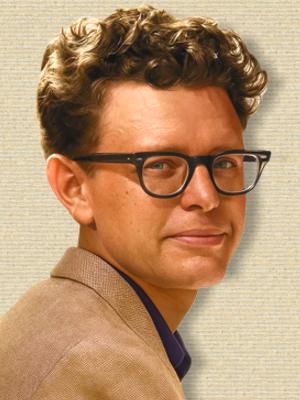
Poul (William) Anderson
(25 Nov 1926 - 31 Jul 2001)
American author whose first story was published in 1946 when 20 years old. He continued writing, and in the next fifty years produced many science fiction books
|
Science Quotes by Poul (William) Anderson (11 quotes)
A fanatic is a man who, when he’s lost sight of his purpose, redoubles his effort.
— Poul (William) Anderson
In Harvest of Stars (1993), 46.
A man can do but little. Enough if that little be right.
— Poul (William) Anderson
In There Will Be Timeî (1972), 125.
Colonization means potential immortality for the human genus. Man’s safety on Earth was never great, and it dwindles hourly. Disarmament, even world government, will not guarantee survival in an age when population presses natural resources to the limit and when the knowledge of how to work mischief on a planetary scale is ever more widely diffused among peoples who may grow ever more desperate.
— Poul (William) Anderson
In Is There Life on Other Worlds? (1963), 186.
He had seen too much of the cosmos to have any great faith in man’s ability to understand it.
— Poul (William) Anderson
From 'Ghetto', The Magazine of Fantasy and Science Fiction (May 1954), collected in William F. Nolan (ed.), A Wilderness of Stars: Stories of Man in Conflict With Space (1972), 157.
I’ve yet to see any problem, however complicated, which, when you looked at it in the right way, didn’t become still more complicated.
— Poul (William) Anderson
In novelette 'Call Me Joe', Astounding Science Fiction (Apr 1957), 58, 12. Collected in The Dark Between the Stars (1981), 178. Also often seen quoted with contractions written in full: “I have” and “did not”.
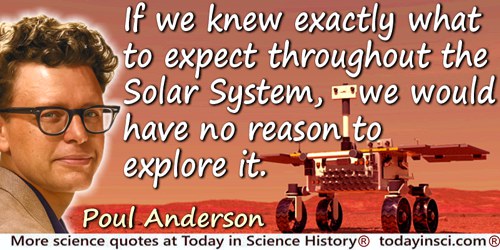
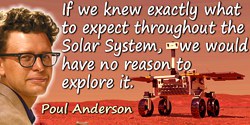
If we knew exactly what to expect throughout the Solar System, we would have no reason to explore it.
— Poul (William) Anderson
In 'The Saturn Game', Analog (1981). Collected in Terry Carr (ed.), The Best Science Fiction of the Year: Volume 11 (1982), 43.
Ninety-nine per cent of the human race, no matter how smart they are, will do the convenient thing instead of the wise thing, and kid themselves into thinking they can somehow escape the consequences.
— Poul (William) Anderson
In Brain Wave (1954), 28.
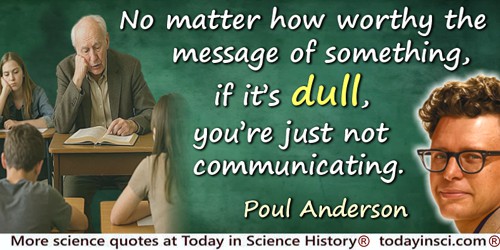
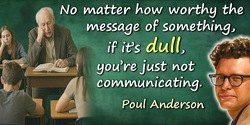
No matter how worthy the message of something, if it’s dull, you’re just not communicating.
— Poul (William) Anderson
From Interview (Apr 1975) with Dave Truesdale and Paul McGuire III, in Tangent (May 1975), No. 2.
That was the worst of it. The sky didn’t care. The Earth went on turning through an endlessness of dark and silence, and what happened in the thin scum seething over its crust didn’t matter.
— Poul (William) Anderson
In Brain Wave (1954), 40.
When facts are insufficient, theorizing is ridiculous at best, misleading at worst.
— Poul (William) Anderson
In novella, 'The Queen of Air and Darkness', The Magazine of Fantasy Science Fiction (Apr 1971), collected in The Many Worlds of Poul Anderson (1974), 53.
Will none wipe the sneer off the face of the cosmos?
— Poul (William) Anderson
In The Broken Sword (1954, 1971), 9.
 In science it often happens that scientists say, 'You know that's a really good argument; my position is mistaken,' and then they would actually change their minds and you never hear that old view from them again. They really do it. It doesn't happen as often as it should, because scientists are human and change is sometimes painful. But it happens every day. I cannot recall the last time something like that happened in politics or religion.
(1987) --
In science it often happens that scientists say, 'You know that's a really good argument; my position is mistaken,' and then they would actually change their minds and you never hear that old view from them again. They really do it. It doesn't happen as often as it should, because scientists are human and change is sometimes painful. But it happens every day. I cannot recall the last time something like that happened in politics or religion.
(1987) -- 




