 (source)
|
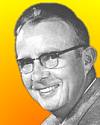
Luis W. Alvarez
(13 Jun 1911 - 1 Sep 1988)
American physicist who was awarded the Nobel Prize for Physics in 1968 for work that included the discovery of many resonance particles. He participated in the development of the atomic bomb at the Los Alamos.
|
Science Quotes by Luis W. Alvarez (20 quotes)
[Edward Teller is a conceptual thinker,] an ‘order of magnitude’ man. That’s his language. He’s like the architect who likes to make the big drawing, the broad sketch, and not worry himself about the plumbing details.
— Luis W. Alvarez
As quoted in Robert Coughlan, 'Dr. Edward Teller’s Magnificent Obsession', Life (6 Sep 1954), 62.
All the good experimental physicists I have known have had an intense curiosity that no Keep Out sign could mute.
— Luis W. Alvarez
In Adventures of a Physicist (1987), 14.
At the Lawrence Radiation Laboratory, we have long had a tradition of close cooperation between physicists and technicians.
— Luis W. Alvarez
From Nobel Lecture (11 Dec 1968). Collected in Yong Zhou (ed.), Nobel Lecture: Physics, 1963-1970 (2013), 250.
![Luis W. Alvarez quote: Dad [Walter C. Alvarez] … advised me to sit every few months in my reading chair for an entire evening, c](https://todayinsci.com/A/Alvarez_Luis/AlvarezLuis-Problems500x250px.jpg)
Dad [Walter C. Alvarez] … advised me to sit every few months in my reading chair for an entire evening, close my eyes and try to think of new problems to solve. I took his advice very seriously and have been glad ever since that he did.
— Luis W. Alvarez
In Alvarez: Adventures of a Physicist (1987), 58.
Dirac politely refused Robert’s [Robert Oppenheimer] two proffered books: reading books, the Cambridge theoretician announced gravely, “interfered with thought.”
— Luis W. Alvarez
Alvarez: Adventures of a Physicist (1987), 87.
Experimental physicists … walk a narrow path with pitfalls on either side. If we spend all our time developing equipment, we risk the appellation of “plumber,” and if we merely use the tools developed by others, we risk the censure of our peers for being parasitic.
— Luis W. Alvarez
In Nobel Lecture (11 Dec 1968), 'Recent Developments in Particle Physics', collected in Nobel Lectures: Physics 1963-1970 (1972), 241.

I don’t like to say bad things about paleontologists, but they’re really not very good scientists. They’re more like stamp collectors.
— Luis W. Alvarez
Defending his dinosaur extinction comet theory against skeptics. Quoted as from a telephone interview, Malcolm W. Browne, 'The Debate Over Dinosaur Extinctions Takes an Unusually Rancorous Turn', New York Times (19 Jan 1988), C1.
I’m convinced that a controlled disrespect for authority is essential to a scientist.
— Luis W. Alvarez
In Adventures of a Physicist (1987), 14.
In my considered opinion the peer review system, in which proposals rather than proposers are reviewed, is the greatest disaster visited upon the scientific community in this century. No group of peers would have approved my building the 72-inch bubble chamber. Even Ernest Lawrence told me he thought I was making a big mistake. He supported me because he knew my track record was good. I believe that U.S. science could recover from the stultifying effects of decades of misguided peer reviewing if we returned to the tried-and-true method of evaluating experimenters rather than experimental proposals. Many people will say that my ideas are elitist, and I certainly agree. The alternative is the egalitarianism that we now practice and I’ve seen nearly kill basic science in the USSR and in the People's Republic of China.
— Luis W. Alvarez
Alvarez: Adventures of a Physicist (1987), 200-1.
In that same year [1932], the number of [known] particles was suddenly doubled. In two beautiful experiments, Chadwick showed that the neutron existed, and Anderson photographed the first unmistakable positron track.
— Luis W. Alvarez
In Nobel Lecture (11 Dec 1968), 'Recent Developments in Particle Physics', collected in Nobel Lectures: Physics 1963-1970 (1972), 241.
In the years since 1932, the list of known particles has increased rapidly, but not steadily. The growth has instead been concentrated into a series of spurts of activity.
— Luis W. Alvarez
From Nobel Lecture (11 Dec 1968). Collected in Yong Zhou (ed.), Nobel Lecture: Physics, 1963-1970 (2013), 241.
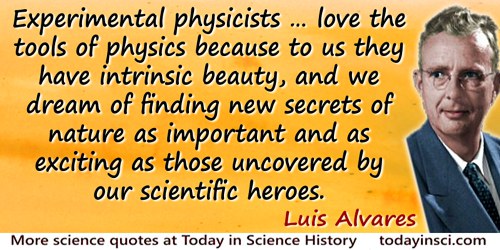
Most of us who become experimental physicists do so for two reasons; we love the tools of physics because to us they have intrinsic beauty, and we dream of finding new secrets of nature as important and as exciting as those uncovered by our scientific heroes.
— Luis W. Alvarez
In Nobel Lecture (11 Dec 1968), 'Recent Developments in Particle Physics', collected in Nobel Lectures: Physics 1963-1970 (1972), 241.
My observations of the young physicists who seem to be most like me and the friends I describe in this book tell me that they feel as we would if we had been chained to those same oars. Our young counterparts aren’t going into nuclear or particle physics (they tell me it’s too unattractive); they are going into condensed-matter physics, low-temperature physics, or astrophysics, where important work can still be done in teams smaller than ten and where everyone can feel that he has made an important contribution to the success of the experiment that every other member of the collaboration is aware of. Most of us do physics because it’s fun and because we gain a certain respect in the eyes of those who know what we’ve done. Both of those rewards seem to me to be missing in the huge collaborations that now infest the world of particle physics.
— Luis W. Alvarez
Alvarez: Adventures of a Physicist (1987), 198.
One indicator of Ernest Lawrence’s influence is the fact that I am the eighth member of his laboratory staff to receive the highest award that can come to a scientist—the Nobel Prize.
— Luis W. Alvarez
From Nobel Banquet Speech (10 Dec 1968). Collected in Wilhelm Odelberg (ed.), Les Prix Nobel en 1968 (1969).
Physicists do, of course, show a healthy respect for High Voltage, Radiation, and Liquid Hydrogen signs. They are not reckless. I can think of only six who have been killed on the job.
— Luis W. Alvarez
In Adventures of a Physicist (1987), 14.
The bomb took forty-five seconds to drop thirty thousand feet to its detonation point, our three parachute gauges drifting down above. For half that time we were diving away in a two-g turn. Before we leveled off and flew directly away, we saw the calibration pulses that indicated our equipment was working well. Suddenly a bright flash lit the compartment, the light from the explosion reflecting off the clouds in front of us and back through the tunnel. The pressure pulse registered its N-shaped wave on our screen, and then a second wave recorded the reflection of the pulse from the ground. A few moments later two sharp shocks slammed the plane.
— Luis W. Alvarez
Alvarez: Adventures of a Physicist (1987), 7.
The last few centuries have seen the world freed from several scourges—slavery, for example; death by torture for heretics; and, most recently, smallpox. I am optimistic enough to believe that the next scourge to disappear will be large-scale warfare—killed by the existence and nonuse of nuclear weapons.
— Luis W. Alvarez
Alvarez: Adventures of a Physicist (1987), 152.
The world of mathematics and theoretical physics is hierarchical. That was my first exposure to it. There's a limit beyond which one cannot progress. The differences between the limiting abilities of those on successively higher steps of the pyramid are enormous. I have not seen described anywhere the shock a talented man experiences when he finds, late in his academic life, that there are others enormously more talented than he. I have personally seen more tears shed by grown men and women over this discovery than I would have believed possible. Most of those men and women shift to fields where they can compete on more equal terms
— Luis W. Alvarez
Alvarez: Adventures of a Physicist (1987), 20.
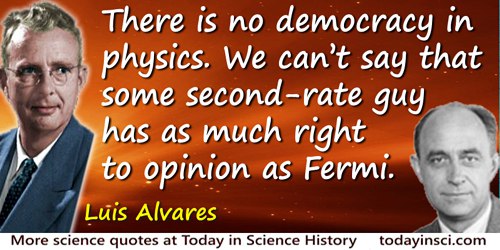
There is no democracy in physics. We can’t say that some second-rate guy has as much right to opinion as Fermi.
— Luis W. Alvarez
Quoted in Daniel S. Greenberg, The Politics of American Science (1968), 43.
When I received my B.S. degree in 1932, only two of the fundamental particles of physics were known. Every bit of matter in the universe was thought to consist solely of protons and electrons.
— Luis W. Alvarez
From Nobel Lecture (11 Dec 1968). Collected in Yong Zhou (ed.), Nobel Lecture: Physics, 1963-1970 (2013), 241.
Quotes by others about Luis W. Alvarez (4)
To connect the dinosaurs, creatures of interest to everyone but the veriest dullard, with a spectacular extraterrestrial event like the deluge of meteors … seems a little like one of those plots that a clever publisher might concoct to guarantee enormous sales. All the Alvarez-Raup theories lack is some sex and the involvement of the Royal family and the whole world would be paying attention to them.
In The Canberra Times (20 May 1984).
[Luis] Alvarez's whole approach to physics was that of an entrepreneur, taking big risks by building large new projects in the hope of large rewards, although his pay was academic rather than financial. He had drawn around him a group of young physicists anxious to try out the exciting ideas he was proposing.
As quoted in Walter Sullivan, 'Luis W. Alvarez, Nobel Physicist Who Explored Atom, Dies at 77: Obituary', New York Times (2 Sep 1988).
Alvarez seemed to care less about the way the picture in the puzzle would look, when everything fit together, than about the fun of looking for pieces that fit. He loved nothing more than doing something that everybody else thought impossible. His designs were clever, and usually exploited some little-known principle that everyone else had forgotten.
As quoted in Walter Sullivan, 'Luis W. Alvarez, Nobel Physicist Who Explored Atom, Dies at 77: Obituary', New York Times (2 Sep 1988).
[Luis] Alvarez could no more refrain from invention than he could from breathing. In the midst of an illness so severe as to incapacitate him for most of a summer, he amused himself by attempting to build a better detector of gallstones.
In 'Luie's Gadgets: A Profile of Luis Alvarez', The American Scholar (Winter 1992), 61, No. 1, 90.
![Luis W. Alvarez quote: Dad [Walter C. Alvarez] … advised me to sit every few months in my reading chair for an entire evening, c](https://todayinsci.com/A/Alvarez_Luis/AlvarezLuis-ProblemsThm.jpg)
See also:
- 13 Jun - short biography, births, deaths and events on date of Alvarez's birth.
- Adventures of a Physicist, by Luis W. Alvarez. - book suggestion.
 In science it often happens that scientists say, 'You know that's a really good argument; my position is mistaken,' and then they would actually change their minds and you never hear that old view from them again. They really do it. It doesn't happen as often as it should, because scientists are human and change is sometimes painful. But it happens every day. I cannot recall the last time something like that happened in politics or religion.
(1987) --
In science it often happens that scientists say, 'You know that's a really good argument; my position is mistaken,' and then they would actually change their minds and you never hear that old view from them again. They really do it. It doesn't happen as often as it should, because scientists are human and change is sometimes painful. But it happens every day. I cannot recall the last time something like that happened in politics or religion.
(1987) --