 (source)
|
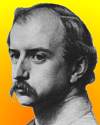
Henry Brooks Adams
(16 Feb 1838 - 27 Mar 1918)
American historian and man of letters who won a Pulitzer Prize for his autobiographical work, The Education of Henry Adams (1919) and authored other biographical works. He wrote an essay, 'The Rule of Phase Applied to History' (1909) which was published postumously as A Letter to American Teachers of History (1919). In it, he drew an upon the idea of entropy (the universal tendency to the dissipation of mechanical energy) in the second law of thermodynamics to make an analogy with the progressive evolution in human history toward some state of perfection. He was great grandson of President John Adams.
|
Science Quotes by Henry Brooks Adams (27 quotes)

[Adams] supposed that, except musicians, everyone thought Beethoven a bore, as every one except mathematicians thought mathematics a bore.
— Henry Brooks Adams
The Education of Henry Brooks Adams: An Autobiography (1918), 80.
[P]olitical and social and scientific values … should be correlated in some relation of movement that could be expressed in mathematics, nor did one care in the least that all the world said it could not be done, or that one knew not enough mathematics even to figure a formula beyond the schoolboy s=(1/2)gt2. If Kepler and Newton could take liberties with the sun and moon, an obscure person ... could take liberties with Congress, and venture to multiply its attraction into the square of its time. He had only to find a value, even infinitesimal, for its attraction.
— Henry Brooks Adams
The Education of Henry Adams: An Autobiography? (1918), 376.
[Saint-Gaudens and Matthew Arnold] felt a railway train as power; yet they, and all other artists, constantly complained that the power embodied in a railway train could never be embodied in art. All the steam in the world could not, like the Virgin, build Chartres.
— Henry Brooks Adams
After viewing the Palace of Electricity at the 1900 Trocadero Exposition in Paris. In The Education of Henry Brooks Adams: An Autobiography (1918), 388.
A science cannot be played with. If an hypothesis is advanced that obviously brings into direct sequence of cause and effect all the phenomena of human history, we must accept it, and if we accept it, we must teach it.
— Henry Brooks Adams
In The Degradation of the Democratic Dogma (1919), 131.
A science cannot be played with. If an hypothesis is advanced that obviously brings into direct sequence of cause and effect all the phenomena of human history, we must accept it, and if we accept it, we must teach it.
— Henry Brooks Adams
In The Degradation of the Democratic Dogma (1919), 131.
A stone arrowhead is as convincing as a steam-engine.
— Henry Brooks Adams
As proof that there has been a continuing advance of technology since prehistoric times. In 'A Law of Acceleration' (1904), The Education of Henry Adams: An Autobiography (1918), 493.
A teacher effects eternity; [s]he can never tell where [her] his influence stops.
— Henry Brooks Adams
The Education of Henry Adams: An Autobiography? (1918), 300.
After Gibbs, one the most distinguished [American scientists] was Langley, of the Smithsonian. … He had the physicist’s heinous fault of professing to know nothing between flashes of intense perception. … Rigidly denying himself the amusement of philosophy, which consists chiefly in suggesting unintelligible answers to insoluble problems, and liked to wander past them in a courteous temper, even bowing to them distantly as though recognizing their existence, while doubting their respectability.
— Henry Brooks Adams
The Education of Henry Adams: An Autobiography? (1918), 377.
All experience is an arch to build upon.
— Henry Brooks Adams
The Education of Henry Adams (1907, 1918), 87.
Chaos often breeds life when order breeds habit.
— Henry Brooks Adams
The Education of Henry Adams (1907, 1918), 249.
Chaos was the law of nature; order was the dream of man.
— Henry Brooks Adams
From his autobiography, The Education of Henry Adams (1907, 1918), 451.
Energy is the inherent effort of every multiplicity to become unity.
— Henry Brooks Adams
Mont-Saint-Michel and Chartres (1904, 1913), 332.
If finally, the science should prove that society at a certain time revert to the church and recover its old foundation of absolute faith in a personal providence and a revealed religion, it commits suicide.
— Henry Brooks Adams
In The Degradation of the Democratic Dogma (1919), 131.
Laplace would have found it child's-play to fix a ratio of progression in mathematical science between Descartes, Leibnitz, Newton and himself
— Henry Brooks Adams
The Education of Henry Adams: An Autobiography? (1918), 491.
Man has mounted science, and is now run away with. I firmly believe that before many centuries more, science will be the master of men. The engines he will have invented will be beyond his strength to control. Someday science may have the existence of mankind in its power, and the human race commit suicide, by blowing up the world. Not only shall we be able to cruise in space, but I’ll be hanged if I see any reason why some future generation shouldn’t walk off like a beetle with the world on its back, or give it another rotary motion so that every zone should receive in turn its due portion of heat and light.
— Henry Brooks Adams
Letter to his brother, Charles Francis Adams Jr., London, (11 Apr 1862). In J. C. Levenson, E. Samuels, C. Vandersee and V. Hopkins Winner (eds.), The Letters of Henry Adams: 1858-1868 (1982), Vol. 1, 290.
Man is an imperceptible atom always trying to become one with God.
— Henry Brooks Adams
Mont-Saint-Michel and Chartres (1904, 1913), 332.
Mathematicians assume the right to choose, within the limits of logical contradiction, what path they please in reaching their results.
— Henry Brooks Adams
In A Letter to American Teachers of History (1910), Introduction, v.
Mathematicians practice absolute freedom.
— Henry Brooks Adams
In A Letter to American Teachers of History (1910), 169.
No one means all he says, and yet very few say all they mean, for words are slippery and thought is viscous.
— Henry Brooks Adams
From his autobiography, The Education of Henry Adams (1907, 1918), 451.
Nothing in education is so astonishing as the amount of ignorance it accumulates in the form of inert facts.
— Henry Brooks Adams
The Education of Henry Adams (1907, 1918), 379.
Philosophy … consists chiefly in suggesting unintelligible answers to insoluble problems..
— Henry Brooks Adams
In The Education of Henry Adams: An Autobiography (1918), 377.
Practical politics consists in ignoring facts.
— Henry Brooks Adams
In The Education of Henry Adams: An Autobiography (1906, 1918), 373.
Some day science may have the existence of man in its power, and the human race may commit suicide by blowing up the world.
— Henry Brooks Adams
Letter to his brother Charles Francis Adams, Jr. (11 Apr 1862). In The Letters of Henry Adams: Vol 1: 1858-1868 (1982), 290.
The future of Thought, and therefore of History, lies in the hands of the physicists, and … the future historian must seek his education in the world of mathematical physics. A new generation must be brought up to think by new methods, and if our historical departments in the Universities cannot enter this next phase, the physical departments will have to assume this task alone.
— Henry Brooks Adams
In The Degradation of the Democratic Dogma (1920), 283.
The hostility of the state would be assured toward any system or science that might not strengthen its arm.
— Henry Brooks Adams
In The Degradation of the Democratic Dogma (1919), 129.
The two poles of social and political philosophy seem necessarily to be organization or anarchy; man’s intellect or the forces of nature.
— Henry Brooks Adams
In Mont-Saint-Michel and Chartres (1913), 344.
Truth, indeed, may not exist;… but what men took for truth stares one everywhere in the eye and begs for sympathy. The architects of the twelfth and thirteenth centuries took the Church and the universe for truths, and tried to express them in a structure which should be final.
— Henry Brooks Adams
In Mont-Saint-Michel and Chartres (1913), 382.
See also:
- The Education of Henry Adams, by Henry B. Adams. - book suggestion.
 In science it often happens that scientists say, 'You know that's a really good argument; my position is mistaken,' and then they would actually change their minds and you never hear that old view from them again. They really do it. It doesn't happen as often as it should, because scientists are human and change is sometimes painful. But it happens every day. I cannot recall the last time something like that happened in politics or religion.
(1987) --
In science it often happens that scientists say, 'You know that's a really good argument; my position is mistaken,' and then they would actually change their minds and you never hear that old view from them again. They really do it. It doesn't happen as often as it should, because scientists are human and change is sometimes painful. But it happens every day. I cannot recall the last time something like that happened in politics or religion.
(1987) -- 




