Born 3 Jul 1935. quotes
Harrison Hagan “Jack” Schmitt is an American geologist and astronaut who was the Lunar Module pilot on Apollo 17, the last manned mission to land on the Moon in the 20th Century. Launched on 6 Dec 1972, this was his first space journey, having been selected as a scientist-astronaut by NASA in Jun 1965. He landed in the lunar module Challenger with Eugene Cernan and began three days of exploration, including 22 hours of extravehicular activity. They collected a total of about 249 lbs (115 kg) of lunar samples. After his return, he continued activities with NASA, and by Feb 1974 became the Chief of Scientist-Astronauts and in May 1974 was appointed as NASA Assistant Administrator for Energy Programs. He resigned in Aug 1975 to run for the U.S. Senate, and was elected.«
Harrison Hagan “Jack” Schmitt is an American geologist and astronaut who was the Lunar Module pilot on Apollo 17, the last manned mission to land on the Moon in the 20th Century. Launched on 6 Dec 1972, this was his first space journey, having been selected as a scientist-astronaut by NASA in Jun 1965. He landed in the lunar module Challenger with Eugene Cernan and began three days of exploration, including 22 hours of extravehicular activity. They collected a total of about 249 lbs (115 kg) of lunar samples. After his return, he continued activities with NASA, and by Feb 1974 became the Chief of Scientist-Astronauts and in May 1974 was appointed as NASA Assistant Administrator for Energy Programs. He resigned in Aug 1975 to run for the U.S. Senate, and was elected.«
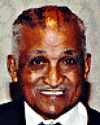
Born 3 Jul 1919; died 10 Apr 2005 at age 85. quotes
Samuel Proctor Massie was a Black-American chemist who was the U.S. Naval Academy’s first African-American professor. He graduated from high school at age 13, and received his B.S. degree at age 18. In 1943, while working on his Ph.D., Massie joined a team of scientists working for the Manhattan Project on the development of the atomic bomb. He was asked to develop liquid compounds of uranium, though this research later proved to be a dead end. His major contributions include studies in silicon chemistry, the chemistry of phenothiazine, antimalarial-antibacterial agents, and studies on environmental agents. He is recognized for encouraging disadvantaged students into science careers.
Samuel Proctor Massie was a Black-American chemist who was the U.S. Naval Academy’s first African-American professor. He graduated from high school at age 13, and received his B.S. degree at age 18. In 1943, while working on his Ph.D., Massie joined a team of scientists working for the Manhattan Project on the development of the atomic bomb. He was asked to develop liquid compounds of uranium, though this research later proved to be a dead end. His major contributions include studies in silicon chemistry, the chemistry of phenothiazine, antimalarial-antibacterial agents, and studies on environmental agents. He is recognized for encouraging disadvantaged students into science careers.
Catalyst: The Autobiography of an American Chemist, by Samuel Proctor Massie and Robert C. Hayden. - book suggestion.
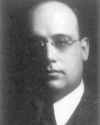
Born 3 Jul 1897; died 7 Oct 1965 at age 68.
American mathematician who was awarded one of the first two Fields Medals in 1936 for solving the Plateau problem. which had first been posed by the Italian-French mathematician Joseph-Louis Lagrange in 1760. The Plateau problem is one of finding the surface with minimal area determined by a fixed boundary. Experiments (1849) by the Belgian physicist Joseph Plateau demonstrated that the minimal surface can be obtained by immersing a wire frame, representing the boundaries, into soapy water. Douglas developed what is now called the Douglas functional, so that by minimizing this functional he could prove the existence of the solution to the Plateau problem. Douglas later developed an interest in group theory.
American mathematician who was awarded one of the first two Fields Medals in 1936 for solving the Plateau problem. which had first been posed by the Italian-French mathematician Joseph-Louis Lagrange in 1760. The Plateau problem is one of finding the surface with minimal area determined by a fixed boundary. Experiments (1849) by the Belgian physicist Joseph Plateau demonstrated that the minimal surface can be obtained by immersing a wire frame, representing the boundaries, into soapy water. Douglas developed what is now called the Douglas functional, so that by minimizing this functional he could prove the existence of the solution to the Plateau problem. Douglas later developed an interest in group theory.
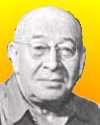
Born 3 Jul 1879; died 1 Mar 1950 at age 70. quotes
Polish-born American scientist and philosopher. Korzybski was the originator of general semantics, a system of linguistic philosophy that attempts to increase humanity's capacity to transmit ideas from generation to generation (what Korzybski called man's "time-binding capacity") through the study and refinement of ways of using and reacting to language.
Polish-born American scientist and philosopher. Korzybski was the originator of general semantics, a system of linguistic philosophy that attempts to increase humanity's capacity to transmit ideas from generation to generation (what Korzybski called man's "time-binding capacity") through the study and refinement of ways of using and reacting to language.
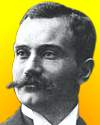
Born 3 Jul 1874; died 29 Oct 1960 at age 86. quotes
Swedish geologist and archaeologist whose work laid the foundation for the study of prehistoric China. In 1914, he accepted the offer to become a consultant to the Geological Survey of China, where he stayed until 1924 and became deeply involved in the excavations at Chou-k'ou-tien outside Peking. In 1921, at a cave near there, on the basis of bits of quartz that he found in a limestone region, he predicted that a fossil man would be discovered. Six years later, the first evidence of the fossil hominid Sinanthropu (Peking man) was found there. In 1923-24, he organized an expedition to Gansu province in Western china where he localised and examined some 50 sites of prehistoric China.
Swedish geologist and archaeologist whose work laid the foundation for the study of prehistoric China. In 1914, he accepted the offer to become a consultant to the Geological Survey of China, where he stayed until 1924 and became deeply involved in the excavations at Chou-k'ou-tien outside Peking. In 1921, at a cave near there, on the basis of bits of quartz that he found in a limestone region, he predicted that a fossil man would be discovered. Six years later, the first evidence of the fossil hominid Sinanthropu (Peking man) was found there. In 1923-24, he organized an expedition to Gansu province in Western china where he localised and examined some 50 sites of prehistoric China.
Children of the Yellow Earth, by Johan Gunnar Andersson. - book suggestion.
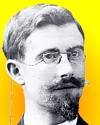
Born 3 Jul 1867; died 10 May 1910 at age 42.
French geophysicist and physicist who, at the beginning of the 20th century discovered volcanic lava and clay samples that recorded the Earth’s inversion of its magnetic field.
French geophysicist and physicist who, at the beginning of the 20th century discovered volcanic lava and clay samples that recorded the Earth’s inversion of its magnetic field.
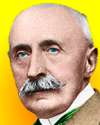
Born 3 Jul 1859; died 23 Oct 1920 at age 61.
Pierre-Marie Termier was a French geologist whose interests covered metamorphic petrology, structural geology, and geotectonics. He is noted for his comprehensive study of the Alps (1930). His vocation began in 1880 at the Écoles des Mines in Paris. By 1883, he was appointed an inspector of mines. Termier made a substantial contribution to knowledge of Alpine geology, with his initial report (1891) which was the first time the progressive stages of the regional metamorphism were mapped over a considerable distance. In 1911, Termier was appointed as director of the Service of Geologic Maps of France. Although he overall did not believe Wegener’s idea of continental drift, Termier still believed in crustal block motion forming the Alps.« more
Pierre-Marie Termier was a French geologist whose interests covered metamorphic petrology, structural geology, and geotectonics. He is noted for his comprehensive study of the Alps (1930). His vocation began in 1880 at the Écoles des Mines in Paris. By 1883, he was appointed an inspector of mines. Termier made a substantial contribution to knowledge of Alpine geology, with his initial report (1891) which was the first time the progressive stages of the regional metamorphism were mapped over a considerable distance. In 1911, Termier was appointed as director of the Service of Geologic Maps of France. Although he overall did not believe Wegener’s idea of continental drift, Termier still believed in crustal block motion forming the Alps.« more
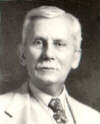
Born 3 Jul 1858; died 20 Nov 1942 at age 84. quotes
American invertebrate paleontologist who was a leader in the development of paleogeography, the study of the distribution of lands and seas in the geological past. During the 1880s he made a living drawing fossil illustrations for state geological surveys, while continuing to search for specimens for his own growing collection. After serving as curator of the U.S. National Museum (1894-1904), Charles Schuchert joined the Yale University faculty following their first invertebrate paleontologist, Charles E. Beecher.
American invertebrate paleontologist who was a leader in the development of paleogeography, the study of the distribution of lands and seas in the geological past. During the 1880s he made a living drawing fossil illustrations for state geological surveys, while continuing to search for specimens for his own growing collection. After serving as curator of the U.S. National Museum (1894-1904), Charles Schuchert joined the Yale University faculty following their first invertebrate paleontologist, Charles E. Beecher.
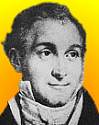
Born 3 Jul 1782; died 24 Aug 1861 at age 79.
French mineralogist and mining engineer who discovered bauxite (aluminium ore) on 23 Mar 1821 near the village Les Baux de Provence in southern France. On 24 May 1806, he joined the central laboratory at the Board of Mines. From 1816, he was chief of the laboratory at the École des Mines, and professor of assaying. Berthier analyzed kaolin along with dozens of other minerals and ores. He sought out phosphate deposits valuable for agriculture. He published a treatise (1834) of practical analytical procedures that were widely used by other mineralogists. In another field, Berthier noticed - before Mitscherlich - that isomorphism occurred whereby chemically different substances can have the same crystalline form and even co-crystallise.« more
French mineralogist and mining engineer who discovered bauxite (aluminium ore) on 23 Mar 1821 near the village Les Baux de Provence in southern France. On 24 May 1806, he joined the central laboratory at the Board of Mines. From 1816, he was chief of the laboratory at the École des Mines, and professor of assaying. Berthier analyzed kaolin along with dozens of other minerals and ores. He sought out phosphate deposits valuable for agriculture. He published a treatise (1834) of practical analytical procedures that were widely used by other mineralogists. In another field, Berthier noticed - before Mitscherlich - that isomorphism occurred whereby chemically different substances can have the same crystalline form and even co-crystallise.« more

Born 3 Jul 1780; died 26 Nov 1830 at age 50.
(Anglicized name: Andrew Parmentier) Belgian-American, André Joseph Ghislain Parmentier, born in Enghien, Belgium, was a horticulturist, responsible for exhibiting many plant species in America. He was the second of four sons of a linen merchant. Little is known about his early life. In 1824 Parmentier emigrated to America where he lived for only six years until his untimely death in 1830. Soon after arriving he established a nursery in Brooklyn from which he supplied seeds and root stock he had imported or propagated himself. In 1825, he established the first botanic garden in Brooklyn, at Atlantic and Carleton Avenues. His work is also preserved at the Vanderbilt Mansion, Hyde Park, NY, the most impressive of the four known Parmentier designs.
(Anglicized name: Andrew Parmentier) Belgian-American, André Joseph Ghislain Parmentier, born in Enghien, Belgium, was a horticulturist, responsible for exhibiting many plant species in America. He was the second of four sons of a linen merchant. Little is known about his early life. In 1824 Parmentier emigrated to America where he lived for only six years until his untimely death in 1830. Soon after arriving he established a nursery in Brooklyn from which he supplied seeds and root stock he had imported or propagated himself. In 1825, he established the first botanic garden in Brooklyn, at Atlantic and Carleton Avenues. His work is also preserved at the Vanderbilt Mansion, Hyde Park, NY, the most impressive of the four known Parmentier designs.

Died 3 Jul 2022 at age 88 (born 23 Aug 1933). quotes
Robert Floyd Curl Jr. was an American chemist who shared the 1996 Nobel Prize for Chemistry (with Richard E. Smalley and Sir Harold W. Kroto) for discovering the first fullerene, a spherical cluster of carbon atoms. Their discovery opened a new branch of chemistry. In Sep 1985, Curl met with Kroto of the University of Sussex, England, and Smalley, a colleague at Rice Institute, and, in 11 days of research, they discovered fullerenes. Their technique vaporized carbon from the surface of a solid disk of graphite into a high-density helium flow, using a focused pulsed laser. They announced their findings to the public as 'C60: Buckminsterfullerene', in a letter in the 14 Nov 1985, issue of the journal Nature.«
Robert Floyd Curl Jr. was an American chemist who shared the 1996 Nobel Prize for Chemistry (with Richard E. Smalley and Sir Harold W. Kroto) for discovering the first fullerene, a spherical cluster of carbon atoms. Their discovery opened a new branch of chemistry. In Sep 1985, Curl met with Kroto of the University of Sussex, England, and Smalley, a colleague at Rice Institute, and, in 11 days of research, they discovered fullerenes. Their technique vaporized carbon from the surface of a solid disk of graphite into a high-density helium flow, using a focused pulsed laser. They announced their findings to the public as 'C60: Buckminsterfullerene', in a letter in the 14 Nov 1985, issue of the journal Nature.«
Died 3 Jul 1937 at age 59 (born 16 Sep 1877).
American inventor and manufacturer of the first successful electric dry razor. He started in the razor business in 1925 to design and manufacture his invention of the Magazine Repeating Razor. By 1926, he was selling clips of blades that could be loaded into a safety razor without touching the blade to avoid cuts during handling. While this product was successful, he turned his attention to developing a dry razor. By 1927 he had designed a dry razor with a reciprocating head powered by a flexible drive shaft to an external motor. Although he marketed this model from 1929, it was not until 1931 that he had improved the idea as a new one-handed electric shaver with self-contained motor that sales took off. He lived only six year after that.«.
American inventor and manufacturer of the first successful electric dry razor. He started in the razor business in 1925 to design and manufacture his invention of the Magazine Repeating Razor. By 1926, he was selling clips of blades that could be loaded into a safety razor without touching the blade to avoid cuts during handling. While this product was successful, he turned his attention to developing a dry razor. By 1927 he had designed a dry razor with a reciprocating head powered by a flexible drive shaft to an external motor. Although he marketed this model from 1929, it was not until 1931 that he had improved the idea as a new one-handed electric shaver with self-contained motor that sales took off. He lived only six year after that.«.
Died 3 Jul 1935 at age 57 (born 5 Feb 1878).
French engineer and industrialist who introduced Henry Ford's methods of mass production to the European automobile industry. In 1908 he helped the Mors automobile firm increase its production from 125 cars to 1,200 cars per year. At the outbreak of World War I Citroën persuaded the French army of the need to mass-produce munitions. In 1915 he built a munitions plant whose production of shells reached 55,000 per day. Upon this success he was given the responsibility of organizing the supplying of all French munitions plants with certain vital raw materials. After the war Citroën converted his original arms factory into a plant to mass-produce a small, inexpensive automobile; the first Citroën car came off the assembly line in 1919.
French engineer and industrialist who introduced Henry Ford's methods of mass production to the European automobile industry. In 1908 he helped the Mors automobile firm increase its production from 125 cars to 1,200 cars per year. At the outbreak of World War I Citroën persuaded the French army of the need to mass-produce munitions. In 1915 he built a munitions plant whose production of shells reached 55,000 per day. Upon this success he was given the responsibility of organizing the supplying of all French munitions plants with certain vital raw materials. After the war Citroën converted his original arms factory into a plant to mass-produce a small, inexpensive automobile; the first Citroën car came off the assembly line in 1919.
A.I.enhanced
Died 3 Jul 1920 at age 65 (born 3 Oct 1854).
American army surgeon who played a decisive role in the construction of the Panama Canal by introducing large-scale mosquito control to combat yellow fever and malaria. At first, he doubted the 1900 findings of Walter Reed’s Yellow Fever Commission in Cuba, which showed that mosquitoes were the sole carriers of the disease. However, once convinced, Gorgas became the leading advocate of the mosquito theory in the United States. In Cuba, he helped eliminate breeding grounds, and beginning in 1904, he directed a ten-year anti-mosquito campaign in Panama that succeeded in eradicating yellow fever from the canal zone.«
American army surgeon who played a decisive role in the construction of the Panama Canal by introducing large-scale mosquito control to combat yellow fever and malaria. At first, he doubted the 1900 findings of Walter Reed’s Yellow Fever Commission in Cuba, which showed that mosquitoes were the sole carriers of the disease. However, once convinced, Gorgas became the leading advocate of the mosquito theory in the United States. In Cuba, he helped eliminate breeding grounds, and beginning in 1904, he directed a ten-year anti-mosquito campaign in Panama that succeeded in eradicating yellow fever from the canal zone.«
Died 3 Jul 1790 at age 53 (born 26 Aug 1736). quotes
French crystallographer who, with his Essai de Cristallographie (1772), confirmed Nicolas Steno’s observation that the angles between corresponding faces of quartz crystals are always the same, although various samples of quartz crystals may differ in appearance. Further, Romé showed that different crystal substances have their own characteristic angles. For example diamond crystals appear with an octahedral form, whereas pyrite crystals are based on the cube. In his first book, he had 100+ descriptions of crystal forms, which he expanded to 450 by 1784. Romé thus formulated the Law of Constancy of Interfacial Angles suggested by Steno in 1669; used it to identify different minerals; and firmly established modern crystallography.«[Name also written as Romé Delisle.]
French crystallographer who, with his Essai de Cristallographie (1772), confirmed Nicolas Steno’s observation that the angles between corresponding faces of quartz crystals are always the same, although various samples of quartz crystals may differ in appearance. Further, Romé showed that different crystal substances have their own characteristic angles. For example diamond crystals appear with an octahedral form, whereas pyrite crystals are based on the cube. In his first book, he had 100+ descriptions of crystal forms, which he expanded to 450 by 1784. Romé thus formulated the Law of Constancy of Interfacial Angles suggested by Steno in 1669; used it to identify different minerals; and firmly established modern crystallography.«[Name also written as Romé Delisle.]

In 2002, NASA launched Contour (Comet Nucleus Tour), a U.S. unmanned satellite on a mission to get within 60 miles of a comet nucleus to study frozen samples of the solar system from its infancy. It was launched aboard a Boeing Delta 2 rocket from Cape Canaveral. After orbiting Earth until 15 Aug 2002, the satellite's onboard rockets sent it toward an encounter with Comet Enke in 2003, then Comet Schwassman- Wachman 3 in 2006. It is equipped with a special debris shield so it can navigate closer to the comets and survive bombardment from the minute particles of dust and frozen water that form a comet's most distinctive feature, the tail. The shield includes a layer of Kevlar, the material used in bullet-proof vests.
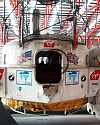
In 1987, British millionaire Richard Branson and Per Lindstrand became the first to cross the Atlantic by hot-air balloon, named Virgin Atlantic Flyer. They jumped into the sea as their craft went down off the Scottish coast. They travelled a distance of 2,900 miles from from Sugarloaf Mountain, Maine, in 33 hours to set a new record for hot air ballooning. At the time, the balloon was the largest ever flown having 2.3 million cubic feet of capacity. Three years later, they crossed the Pacific in another balloon from Japan to Arctic Canada, a distance of 6,700 miles, breaking all existing records with speeds of up to 245 miles per hour.
In 1961, three men were killed in the first fatal nuclear accident in the U.S. when an experimental reactor exploded. The Stationary Low-Power Plant No.1 (SL-1), was part of the National Reactor Testing Station (NRTS), near Idaho Falls, Idaho. An 80-lb control rod was lifted by hand beyond its safe position, causing a core meltdown and explosion of the reactor. Four days were spent to devise a safe method to recover one of the corpses. All three bodies were extremely radioactivity, causing problems for their burial. Clean-up took 18 months. Investigators were never able to determine why this “abnormal act” occurred. Two decades later, a documentary speculated one of the men had marital problems and sabotaged the reactor.«
Proving the Principle: A History of the Idaho National Engineering and Environmental Laboratory, 1949-1999, by Susan M. Stacy. - book suggestion.
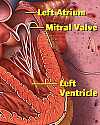
In 1952, the first surgical operation in the U.S. to expose the heart's mitral valve for a prolonged time was undertaken by Dr Forest Dewey Dodrill at the Harper Hospital, Detroit, Mich. The patient, a 41-year-old man, was provided with The Michigan Heart as a substitute for the lower left ventricle.
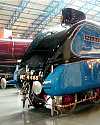
In 1938, the Mallard was documented as the world's fastest steam locomotive travelling at 126 mph (202-km/h) at milepost 90¼, on straight, slightly downhill tracks, between Little Bytham and Essendine, on the East Coast Mainline of the London and North Eastern Railway, in England. It hauled six coaches and a dynamometer car recording the speed—a total tare of 240 tons. The Mallard was designed as a streamlined express locomotive with an aerodynamic body, 70-ft long, weighing 165 tons with tender. Its build date was 3 Mar 1938, and was in service until retired in 1963. After restoration in the 1980s, it made a few special runs. It is now in the National Railway Museum, York. Video.
In 1929, foam rubber was developed at the Dunlop Latex Development Laboratories in Birmingham, England. British scientist E.A. (Edward Arthur) Murphy (1897-1986) whipped up the first batch in 1929, using an ordinary kitchen mixer and a steam oven to froth and vulcanize natural latex rubber. Marketed as “Dunlopillo”, within five years it was everywhere, on motorcycle seats, cinema seats, on London bus seats, Shakespeare Memorial Theatre seats, eventually in mattresses, and even used to make a special seat for Donald Campbell’s water speed record-breaking craft, the Bluebird (1955). After tires, foam rubber became the second largest use of rubber hydrocarbons.
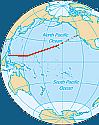
In 1903, the first cable across the Pacific Ocean between Hawaii, Midway, Guam and Manila was completed and spliced at Manila, Philippine Islands. After testing, the first official message was sent the next day. The first section of the cable across the Pacific Ocean between San Francisco and Hawaii had already been established at the beginning of the same year, with its first official message sent on 1 Jan 1903. That technological event ended Hawaii's isolation by connecting it to the mainland U.S. and the rest of the world. The cable was a mainstay of communications into the early 1950s when newer technology rendered it obsolete. (The 1902 all-British telegraph line from Canada to Australia and New Zealand was the first line to cross the Pacific Ocean.)
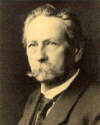
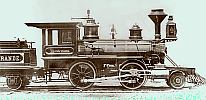
Benz
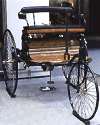
The Invention of the Automobile (Karl Benz and Gottlieb Daimler), by St. John C Nixon. - book suggestion.
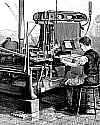
(1889)
In 1886, the first U.S. newspaper with part of a page set by Linotype was the New York Daily Tribune for their editorial page on this day. (The editorial made no mention of their new machine. The Tribute did not publish an article about their Linotype until 19 May 1889. Ottmar Mergenthaler invented the Linotype, the world’s first line casting machine. It eliminated the time-consuming process of setting type by hand. The machine was originally called “Blower” but later renamed “Linotype” (short for “Line of type”). Within six years of this day’s demonstration, 1,000 Linotype machines had been made. By 1904, worldwide there were 10,000 Linotype casting machines in service.«
more
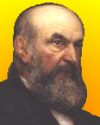
In 1841, John Couch Adams decided to determine the position of an unknown planet by the irregularities it causes in the motion of Uranus. He entered in his journal; “Formed a design in the beginning of this week in investigating, as soon as possible after taking my degree, the irregularities in the motion of Uranus... in order to find out whether they may be attributed to the action of an undiscovered planet beyond it…” In Sep 1845 he gave James Challis, director of the Cambridge Observatory, accurate information on where the new planet, as yet unobserved, could be found; but unfortunately the planet was not recognized at Cambridge until much later, after its discovery at the Berlin Observatory on 23 Sep 1846.
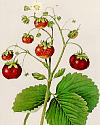
Keens Imperial
In 1806, Michael Keens, a market gardener of Isleworth near London, exhibited the first cultivated strawberry that combined size, flavor, and color at the Royal Horticultural Society. The 600 strawberry varieties found today stem from five or six original wild species, and are a member of the rose family. The wild, small, fragrant forest strawberry of Europe was available to the Romans in the Middle Ages. Europeans discovered wild strawberries in Virginia when their ships landed there in 1588, grown by local American Indians who had cultivated strawberries as early as 1643. When Virginia sent a better flavored, strawberry to England in 1642, and a large white strawberry from Chile was introduced in 1806, the big fruit we know today, emerged. Strawberries are unique, because they are the only fruit with seeds on the outside.





