
Born 30 Jun 1942. quotes
Robert Duane Ballard is an American oceanographer and explorer who, as a pioneer of deep-sea submarines, has conducted over than 120 expeditions, including the discovery and exploration of the deep-sea wreck of R. M. S. Titanic. He has also made underwater explorations of the wrecks of the Bismarck, Lusitania and Britannic. His interest in marine technology began when at age 19, he had a job at the Ocean Systems Group. By 1974 he had a Ph.D. in geology and geophysics, joined Woods Hole as a marine scientist and began years of marine mapping. He made the first discovery of deep-sea thermal vents off the Galápagos Islands, with abundant plant and animal life in warm springs. He later investigated the “black smokers” of underwater volcanoes in the Pacific Rise. From 1980, he pursued deep-sea exploration of lost history.«
Robert Duane Ballard is an American oceanographer and explorer who, as a pioneer of deep-sea submarines, has conducted over than 120 expeditions, including the discovery and exploration of the deep-sea wreck of R. M. S. Titanic. He has also made underwater explorations of the wrecks of the Bismarck, Lusitania and Britannic. His interest in marine technology began when at age 19, he had a job at the Ocean Systems Group. By 1974 he had a Ph.D. in geology and geophysics, joined Woods Hole as a marine scientist and began years of marine mapping. He made the first discovery of deep-sea thermal vents off the Galápagos Islands, with abundant plant and animal life in warm springs. He later investigated the “black smokers” of underwater volcanoes in the Pacific Rise. From 1980, he pursued deep-sea exploration of lost history.«
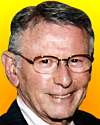
Born 30 Jun 1926.
American biochemist who made “fundamental studies of the biochemistry of nucleic acids, with particular regard to recombinant-DNA” techniques for which he shared the Nobel Prize for Chemistry in 1980 (with Walter Gilbert and Frederick Sanger). Berg's pioneering experiment, in which he was the first person to construct a recombinant-DNA molecule, initiated genetic engineering. Such molecules contain parts of DNA from different species, for example, a chromosome from a virus combined with genes from a bacterial chromosome. DNA molecules from viruses, being relatively small, are useful for such investigations. Important practical applications now include the manufacture of human hormone with the aid of bacteria.«
American biochemist who made “fundamental studies of the biochemistry of nucleic acids, with particular regard to recombinant-DNA” techniques for which he shared the Nobel Prize for Chemistry in 1980 (with Walter Gilbert and Frederick Sanger). Berg's pioneering experiment, in which he was the first person to construct a recombinant-DNA molecule, initiated genetic engineering. Such molecules contain parts of DNA from different species, for example, a chromosome from a virus combined with genes from a bacterial chromosome. DNA molecules from viruses, being relatively small, are useful for such investigations. Important practical applications now include the manufacture of human hormone with the aid of bacteria.«
Dealing With Genes: The Language of Heredity, by Paul Berg, Maxine Singer. - book suggestion.
Born 30 Jun 1915; died 22 Jan 1984 at age 68.
American paleontologist whose continuing investigations of plant fossils successively pushed back the estimates of the origin of life to more than 3.4 thousand million years ago. In the 1950s, near Lake Superior, Barghoorn discovered fossilized colonies of blue-green algae and aquatic fungi dating to two thousand million years old. By the 1960s, he had found fossil evidence dating back another thousand million years, suggesting life appearing shortly after Earth's origin provided suitable environment conditions. The oldest fossil remains of life were organisms closely resembling today's blue-green algae (bacteria using chlorophyll for photosynthesis), found in rock from South Africa. He also contributed to understanding the early evolution of flowering plants, vegetational changes during the Pleistocene ice age, and the formation of coal.«
American paleontologist whose continuing investigations of plant fossils successively pushed back the estimates of the origin of life to more than 3.4 thousand million years ago. In the 1950s, near Lake Superior, Barghoorn discovered fossilized colonies of blue-green algae and aquatic fungi dating to two thousand million years old. By the 1960s, he had found fossil evidence dating back another thousand million years, suggesting life appearing shortly after Earth's origin provided suitable environment conditions. The oldest fossil remains of life were organisms closely resembling today's blue-green algae (bacteria using chlorophyll for photosynthesis), found in rock from South Africa. He also contributed to understanding the early evolution of flowering plants, vegetational changes during the Pleistocene ice age, and the formation of coal.«
Cradle of Life: The Discovery of Earth's Earliest Fossils, by J. William Schop. - book suggestion.
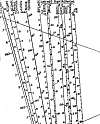
part of Henderson's nomogram of blood
American physiologist and biochemist who discovered the chemical means by which acid-base equilibria are maintained in nature. He concentrated on giving a description of the many chemical variables influencing the neutrality of blood, since its most significant and most conspicuous property was its ability to neutralise large amounts of acids or bases without losing its neutral reaction. Henderson published The Fitness of the Environment (1913) and The Order of Nature (1917). In these books he offered a detailed chemical analysis to support the view that the properties of hydrogen, oxygen, carbon and other elements are so improbably well suited for the evolution of life that no mere “mechanism” can be responsible, and the universe shows the hand of “teleology” or God.
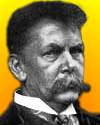
Born 30 Jun 1853; died 10 Oct 1907 at age 54.
German archaeologist whose important publications include a volume on the bronzes found at Olympia, vast works on ancient gems and Greek vases, and the invaluable Masterpieces of Greek Sculpture in which he presented the pioneering method for prehistorical stylistic categorization of small artworks that he devised while excavating at the Olympia site in Greece (1878). His use of photography in research supplanted the use of drawings because a camera gives objective reproduction with more accuracy, which enabled fragments to be scrutinized, even when they were miles apart. Studying photographs, he reconstructed the statue of Athena, by demonstrating that a marble head in Bologna belonged to a marble body in Dresden.«
German archaeologist whose important publications include a volume on the bronzes found at Olympia, vast works on ancient gems and Greek vases, and the invaluable Masterpieces of Greek Sculpture in which he presented the pioneering method for prehistorical stylistic categorization of small artworks that he devised while excavating at the Olympia site in Greece (1878). His use of photography in research supplanted the use of drawings because a camera gives objective reproduction with more accuracy, which enabled fragments to be scrutinized, even when they were miles apart. Studying photographs, he reconstructed the statue of Athena, by demonstrating that a marble head in Bologna belonged to a marble body in Dresden.«
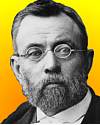
Born 30 Jun 1825; died 10 Oct 1896 at age 71.
German-Australian botanist and explorer who migrated to Australia in 1848 for health reasons, and there became the country's greatest 19th-century scientist. Mueller gained an international reputation as a great botanical collector and writer. His contributions covered a wide field of sciences such as geography, pharmacy, horticulture, agriculture, forestry, paleontology, and zoology. His activity as a botanist is shown by hundreds of Australian plant names which are followed by 'F. Muell'. From 1853, he held the post as the first Government Botanist of Victoria until his death, 43 years later. He travelled widely throughout the colonies on botanical exploration, including as naturalist to the Gregory expedition to northern Australia (1855-57).«
German-Australian botanist and explorer who migrated to Australia in 1848 for health reasons, and there became the country's greatest 19th-century scientist. Mueller gained an international reputation as a great botanical collector and writer. His contributions covered a wide field of sciences such as geography, pharmacy, horticulture, agriculture, forestry, paleontology, and zoology. His activity as a botanist is shown by hundreds of Australian plant names which are followed by 'F. Muell'. From 1853, he held the post as the first Government Botanist of Victoria until his death, 43 years later. He travelled widely throughout the colonies on botanical exploration, including as naturalist to the Gregory expedition to northern Australia (1855-57).«
1896
Born 30 Jun 1817; died 10 Dec 1911 at age 94. quotes
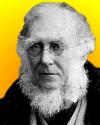
English botanist and explorer who was assistant on Sir James Ross's Antarctic expedition and whose botanical travels to foreign lands included India, Palestine and the U.S., from which he became a leading taxonomists in his time. His Student's Flora of the British Islands became a standard text. He was a great friend of Charles Darwin, and they collaborated in research. With Charles Lyell, Hooker encouraged the publication of Darwin's theory of evolution. He served (1855-65) as assistant director to his father, Sir William Jackson Hooker, of the Royal Botanic Gardens at Kew, whom he succeeded as director for another 20 years. He was also a president of the Royal Society. At age 94, he died in his sleep and was buried at Kew.«
English botanist and explorer who was assistant on Sir James Ross's Antarctic expedition and whose botanical travels to foreign lands included India, Palestine and the U.S., from which he became a leading taxonomists in his time. His Student's Flora of the British Islands became a standard text. He was a great friend of Charles Darwin, and they collaborated in research. With Charles Lyell, Hooker encouraged the publication of Darwin's theory of evolution. He served (1855-65) as assistant director to his father, Sir William Jackson Hooker, of the Royal Botanic Gardens at Kew, whom he succeeded as director for another 20 years. He was also a president of the Royal Society. At age 94, he died in his sleep and was buried at Kew.«
Sir Joseph Dalton Hooker: Traveller and Plant Collector, by Ray Desmond. - book suggestion.
Born 30 Jun 1795; died 5 May 1877 at age 81.
French chemist who is noted for the research he did in partnership with Pierre-Joseph Pelletier into vegetable bases and the resulting contributions of alkaloid chemistry to the field of medicine. They helped found the chemistry of vegetable alkaloids. They isolated chlorophyll (1817), for which they coined the French name chlorophyle in Ann. de Chimie(1818), IX, 195. Their alkaloid discoveries included strychnine (1818), brucine (1819), quinine (1820), caffeine (1821), and cinchonine. In 1823, using elementary closed-tube analyses in which the alkaloids were combusted, they discovered nitrogen was present in the compounds. Alkaloids are organic compounds which form water-soluble salts that perform various functions in medicine, including analgesics (pain-killers), and respiratory stimulants.
French chemist who is noted for the research he did in partnership with Pierre-Joseph Pelletier into vegetable bases and the resulting contributions of alkaloid chemistry to the field of medicine. They helped found the chemistry of vegetable alkaloids. They isolated chlorophyll (1817), for which they coined the French name chlorophyle in Ann. de Chimie(1818), IX, 195. Their alkaloid discoveries included strychnine (1818), brucine (1819), quinine (1820), caffeine (1821), and cinchonine. In 1823, using elementary closed-tube analyses in which the alkaloids were combusted, they discovered nitrogen was present in the compounds. Alkaloids are organic compounds which form water-soluble salts that perform various functions in medicine, including analgesics (pain-killers), and respiratory stimulants.
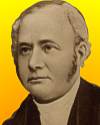
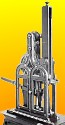
English inventor whose ticket printing and numbering machine pioneered a system of fare collection in the development of the railways. While working for the Newcastle and Carlisle Railway, he found handwriting the tickets irksome and delaying, and it occurred to him that the work could be done by a machine. He evolved a process for preparing receipts in advance, serial numbering all the tickets (for accountability of monies collected), and inventing a basic stamping system on wooden blocks. Edmondson's early wooden dating presses were developed into iron ones and mass produced. By 1843, twenty-seven English companies, and the Paris and Rouen railway were using the system, which had now become the standard one to adopt.
Born 30 Jun 1791; died 16 Mar 1841 at age 49.
French physicist who researched various manifestations of vibration. With Jean-Baptiste Biot, he developed the Biot-Savart Law (1820) concerning the magnetic field intensity around a current-carrying wire. After earning a degree in medicine (1816), he took an interest in physics, beginning with a study of the violin to explain the contributions from its components to the sound from the strings. He presented a memoir on the subject to the Paris Academy of Sciences in 1819. He conducted extensive research in acoustics, the nodal patterns of vibrating systems (including air columns), and related enquiries into the elasticity of substances. He also investigated the voice and hearing. He devised a rotating toothed wheel to produce a sound of any frequency by a reed held against it, to measure high frequency hearing limits.«
French physicist who researched various manifestations of vibration. With Jean-Baptiste Biot, he developed the Biot-Savart Law (1820) concerning the magnetic field intensity around a current-carrying wire. After earning a degree in medicine (1816), he took an interest in physics, beginning with a study of the violin to explain the contributions from its components to the sound from the strings. He presented a memoir on the subject to the Paris Academy of Sciences in 1819. He conducted extensive research in acoustics, the nodal patterns of vibrating systems (including air columns), and related enquiries into the elasticity of substances. He also investigated the voice and hearing. He devised a rotating toothed wheel to produce a sound of any frequency by a reed held against it, to measure high frequency hearing limits.«

Died 30 Jun 1961 at age 87 (born 26 Aug 1873). quotes
American inventor of the Audion vacuum tube, which made possible live radio broadcasting and became the key component of all radio, telephone, radar, television, and computer systems before the invention of the transistor in 1947. He held 300 patents.
American inventor of the Audion vacuum tube, which made possible live radio broadcasting and became the key component of all radio, telephone, radar, television, and computer systems before the invention of the transistor in 1947. He held 300 patents.
Died 30 Jun 1919 at age 76 (born 12 Nov 1842). quotes
John William Strutt, Third Baron Rayleigh was an English physical scientist, 3rd Baron of Rayleigh (of Terling Place) who made fundamental discoveries in the fields of acoustics and optics that are basic to the theory of wave propagation in fluids. He received the Nobel Prize for Physics in 1904 for his investigations into the densities of the most important gases and his successful isolation of argon, an inert atmospheric gas.
John William Strutt, Third Baron Rayleigh was an English physical scientist, 3rd Baron of Rayleigh (of Terling Place) who made fundamental discoveries in the fields of acoustics and optics that are basic to the theory of wave propagation in fluids. He received the Nobel Prize for Physics in 1904 for his investigations into the densities of the most important gases and his successful isolation of argon, an inert atmospheric gas.
Died 30 Jun 1916 at age 70 (born 23 Jun 1846).
French Egyptologist and director general of excavations and antiquities for the Egyptian government, who was responsible for locating a collective royal tomb of prime historic importance.
French Egyptologist and director general of excavations and antiquities for the Egyptian government, who was responsible for locating a collective royal tomb of prime historic importance.
Died 30 Jun 1898 at age 66 (born 18 Sep 1831).
German-Austrian inventor who built four of the world's earliest gasoline-powered automobiles. Marcus held about 76 patents (though none on his automobiles) in about a dozen countries, including an electric lamp (1877), various other electrical devices, a carburetor and an igniter for explosives. He installed the first electric bell in the bedroom of Empress Elisabeth, and he became an instructor in physics to the ill-fated Crown Prince Rudolf. He built and marketed internal combustion engines. Marcus first started working on a self-propelled vehicle about 1860, making significant contributions in the course of further development. Photographs of his first car, built about 1864, were taken in 1870. The second car - the landmark - was built about 1875 in his Vienna factory. It was first equipped with a two-cycle engine, and later, a four-cycle engine.
German-Austrian inventor who built four of the world's earliest gasoline-powered automobiles. Marcus held about 76 patents (though none on his automobiles) in about a dozen countries, including an electric lamp (1877), various other electrical devices, a carburetor and an igniter for explosives. He installed the first electric bell in the bedroom of Empress Elisabeth, and he became an instructor in physics to the ill-fated Crown Prince Rudolf. He built and marketed internal combustion engines. Marcus first started working on a self-propelled vehicle about 1860, making significant contributions in the course of further development. Photographs of his first car, built about 1864, were taken in 1870. The second car - the landmark - was built about 1875 in his Vienna factory. It was first equipped with a two-cycle engine, and later, a four-cycle engine.
Died 30 Jun 1857 at age 54 (born 6 Sep 1802).
French paleontologist and zoologist who founded the science of micropaleontology. From 1826-33, on commission for the Musée d' Histoire Naturelle, he travelled for eight years in South America, then produced a 10-volume report (1834-47) on its zoology, botany, paleontology and antrhropology. He made detailed studies of tiny marine fossils, pollen, grain and spores found in sedimentary rocks. In 1850, Orbigny undertook the detailed assignment of stages represented by Jurassic Period fossils in geologic formations of northwestern Europe. In 1926, he established the classification Foraminifera for microscopic cephalopods. Because of their evolutionary changes through geological time, they are very helpful for the purpose of dating rock strata. In particular, this now has great practical value in petroleum exploration when inspecting core samples.«
French paleontologist and zoologist who founded the science of micropaleontology. From 1826-33, on commission for the Musée d' Histoire Naturelle, he travelled for eight years in South America, then produced a 10-volume report (1834-47) on its zoology, botany, paleontology and antrhropology. He made detailed studies of tiny marine fossils, pollen, grain and spores found in sedimentary rocks. In 1850, Orbigny undertook the detailed assignment of stages represented by Jurassic Period fossils in geologic formations of northwestern Europe. In 1926, he established the classification Foraminifera for microscopic cephalopods. Because of their evolutionary changes through geological time, they are very helpful for the purpose of dating rock strata. In particular, this now has great practical value in petroleum exploration when inspecting core samples.«
(EB)
Died 30 Jun 1817 at age 66 (born 25 Sep 1750). quotes
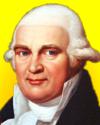
Abraham Gottlob Werner was a German geologist who founded the Neptunist school, holding that all rocks have aqueous origins. This contrasts with the Plutonists, or Vulcanists, who maintain that granite among other rocks were of igneous origin. Werner also rejected the idea of uniformitarianism whereby geological evolution has been a uniform and continuous process.«
Abraham Gottlob Werner was a German geologist who founded the Neptunist school, holding that all rocks have aqueous origins. This contrasts with the Plutonists, or Vulcanists, who maintain that granite among other rocks were of igneous origin. Werner also rejected the idea of uniformitarianism whereby geological evolution has been a uniform and continuous process.«
Died 30 Jun 1660 at age 85 (born 5 Mar 1575).
English mathematician and Episcopal minister who invented the earliest form of the slide rule, two identical linear or circular logarithmic scales held together and adjusted by hand. Improvements involving the familiar inner rule with tongue-in-groove linear construction came later. He introduced the familiar multiplication sign x in a 1631 textbook, along with the first use of the abbreviations sin, cos and tan.[DSB gives date of birth as 5 Mar 1575. EB gives 5 Mar 1574.]
English mathematician and Episcopal minister who invented the earliest form of the slide rule, two identical linear or circular logarithmic scales held together and adjusted by hand. Improvements involving the familiar inner rule with tongue-in-groove linear construction came later. He introduced the familiar multiplication sign x in a 1631 textbook, along with the first use of the abbreviations sin, cos and tan.[DSB gives date of birth as 5 Mar 1575. EB gives 5 Mar 1574.]
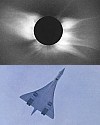
In 1973, a solar eclipse, predicted as the longest for 1,000 years, was observed by British, French and American scientists aboard the French prototype Concorde 001 supersonic aircraft on a flight from Las Palmas, Canaries to Fort Lamy, Chad. The path of totality crossed the Atlantic, the Sahara Desert and East Africa. The moon’s shadow travelled at over 3,000 km per hour. Flying at 55,000 feet, the jet’s speed made possible a continuous view of the solar eclipse for 74 minutes, ten times longer than could be seen by an observer on the ground. Four months later, Concorde 001, the first prototype to fly, was retired on 19 Oct 1973, to the French Air Museum at Le Bourget Airport. It had made 225 supersonic flights in a total of 397.«

In 1972, the first leap second day, one second was added to the world's time in order to keep the super-accurate atomic clocks in step with the Earth's rotation. Since the adoption of this system in 1972, firstly due to the initial choice of the value of the second (1/86400 mean solar day of the year 1900) and secondly to the general slowing down of the Earth's rotation. By 2015, it has been necessary to add 26 seconds to Coordinated Universal Time (UTC).[Image: part of the master clock system at the U.S. Naval Observatory.]

In 1971, a Soviet space mission ended in tragedy when all three cosmonauts aboard Soyuz 11 died as their capsule depressurized during reentry. G.T. Dobrovolsky, V.I. Patsayev, and V.N. Volkov had successfully completed their objective, the first (and now only) manned mission to both dock and occupy the first space station, Salyut 1 (launched 19 Apr 1971). After orbiting the earth for over 23 days, they were on the return journey. While still far outside the earth’s atmosphere, their reentry capsule separated from the lower stage of their spacecraft by firing explosive bolts. That shock caused an air vent valve to open prematurely, rapidly depressurizing the capsule. Wearing no space suits, the crew died within a minute. The capsule landed automatically on Earth, returning their lifeless bodies.«
Lawrence
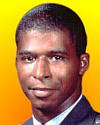
In 1967, a press conference announced four Air Force officers selected for training in the U.S. Air Force's Manned Orbital Laboratory (MOL) program, El Segundo, California. One of the four, Major Robert Lawrence, was the first African-American to qualify for training in the US space program. His career was cut short only a few months later, when he died on 8 Dec 1967 on a training flight in a Starfighter jet that crashed at Edwards Air Force Base, California. (Several years earlier, another African-American had been selected for the MOL program, on 31 Mar 1961, but not subsequently selected for training). It was not until 30 Aug 1983 that thefirst African-American entered space: Col. Guion S. Bluford, Jr.*
In 1963, it was announced that the first U.S. plutonium-fueled nuclear reactor to produce useful amounts of electricity was installed in the experimental reactor of the Argonne National Labboratory's Idaho division, near Idaho Falls, Idaho.*
In 1962, the 60-in. cyclotron at the Crocker Lab, which had been in operation for 23 years, to the day, since the first experiments began on 30 Jun 1939, was closed down. It had been superceded by a new, larger cyclotron built earlier in 1962 on the same campus of the University of California at Berkeley. A lecture hall was to be built at the location of the retired cyclotron. The 60-in diameter D-shaped guts of the cyclotron were saved, but other components were to be reconstructed into a 72-in cyclotron at the Davis campus of the university, paid for by the U.S. Atomic Energy Commission. Although research included results used in the construction of the atomic bomb, new elements had been produced by the cyclotron; and artificial radioisotopes useful for medical applications and tracer experiments.«
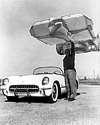
In 1953, production of the first laminated fiberglass-body sports car model in the U.S. was marked as the first Chevrolet Corvette was driven out of the General Motors factory in Flint, Michigan. It was designed by Harley J. Earl, who had been with GM since 1927 when he updated their LaSalle mid-range car. For the industry's first concept car the 1938 Y-Job he added innovations including electric windows and disappearing headlamps. He went on to design the 1950 Buick LeSabre. GM built 300 Corvettes in 1953, all with white exterior, red interior and black canvas convertible roof. The Corvette line continues to the present year (2016). Before joining GM, Earl began his career at his father's automobile works, where he fashioned custom auto bodies for movie celebraties like Fatty Arbuckle. He spent 31 years with GM.«[Image shows the Corvette and its fiberglass body being easily held in the air.]
A Century of Automotive Style: 100 Years of American Car Design, by Michael Lamm and Dave Holls. - book suggestion.
In 1948, the transistor was demonstrated by its inventors, John Bardeen and Walter Brattain, scientists at the Bell Telephone Laboratory in Murray Hill, NJ. It was a simple, tiny device utilizing the electronic semiconducting properties of a germanium wafer. The transistor represented a significant advance in technology. As it was developed over the next few years, it was incorporated into electronic equipment as a functional replacment for the vacuum tube. Such use of transistors provided great savings in space and electrical power consumption. This made possible the small portable, battery-powered transistor radios which were sold to the public by late 1954.*
In 1948, the telephone recording devices were first authorized for public use in the U.S. To comply with the Federal Communications Commission regulations, when the devices were being used, a periodic "beep" tone signal was used to advise those on the telephone line that their conversations were being recorded. The recording devices has been in use by government and business prior to the adoption of the FCC regulations.*
In 1946, the first U.S. atomic bomb dropped from an airplane over water was named "Able," a part of Operation Crossroads. A U.S. Air Force B-29 Superfortress, Dave's Dream, was used to deliver the bomb, which was dropped over the Bikini Lagoon in the Pacific Ocean onto a target group of 73 ships moved there for the purpose. The explosion caused a 520-foot burst. The Gilliam and Carlisle transport ships were sunk, and 18 other ships were damaged.
In 1939, the 60-in. diameter cyclotron was set in operation by Ernest O. Lawrence at the Crocker Lab, University of California, Berkeley. The particle accelerator was located in a building provided by a donation from William H. Crocker. Seven elements were discovered or made using the cyclotron, beginning with the discovery of neptunium by Edwin McMillan, followed by plutonium by Glenn Seaborg and his team. After months of bombardment, by 1942, enough plutonium had been produced to be seen with a microscope. The other elements produced were americium (atomic number 95), curium (96), berkelium (97), californium (98) and by 1955 mendeleevium (101). After many other uses, the cyclotron was closed down on 30 Jun 1962.«
In 1930, the first round-the-world broadcast from the U.S. used a series of short-wave radio relays and took only one-eighth of a second, carrying the voice of Clyde D. Wagoner. Beginning in Schnectady, New York, the signal from W2XAD was relayed through Holland, Java, Australia, across the Pacific Ocean and back to Schnectady.*
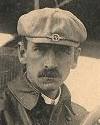
1909
In 1910, the first trials in the U.S. investigating the use of an airplane to drop bombs were conducted by pilot Glenn H. Curtiss. He dropped lead dummy bombs on 500-ft by 90-ft targets from a height of 50-ft. His aim was successful 10 times out of 14 tries. For visibility, the missiles trailed coloured streamers. The tests were observed by Admiral William Wirt Kimball at Lake Keuka, Hammondsport, New York.*
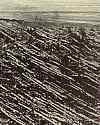
In 1908, at around 7:15 am, northwest of Lake Baikal, Russia, a huge fireball nearly as bright as the Sun was seen crossing the sky. Minutes later, there was a huge flash and a shock wave felt up to 650 km (400 mi) away. Over Tunguska, a meteorite over 50-m diameter, travelling at over 25 km per second (60,000 mph) penetrated Earth's atmosphere, heated to about 10,000 ºC and detonated 6 to10 km above the ground. The blast released the energy of 10-50 Megatons of TNT, destroying 2,200 sq km of forest leaving no trace of life. The Tunguska rock came out of the Taurid Meteor storm that crosses Earth's orbit twice a year. The first scientific expedition for which records survive was made by Russian mineralogist Leonid Kulik in 1927.[Image: a view of charred forest trees blown to the ground show the direction of the blast.]

1905
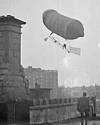
Eagle, Chicago 1906
In 1896, the first U.S. patent for an electric stove was patented by William.S. Hadaway, Jr., in New York City. (No. 563,032). It provided a uniform surface distribution of heat from a one-ring spiral coiled conductor. An earlier apparatus, described as an "electrical heating apparatus," which the inventor termed an "electroheater," was patented by George B. Simpson of Washington, D.C. on 20 Sep 1859 (No. 25,532). Simpson's device utilized the heating effect resulting from passing electric current through coils of wire made from platina or other metals.*
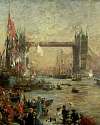
In 1894, the Tower Bridge across the River Thames in London was officially opened by the Prince of Wales. A procession of vessels passed under the bridge. In 1878, City architect Horace Jones proposed a new bridge was needed to improve city traffic. It was approved by Act of Parliament in 1885 and the foundation stone was laid 21 Jun 1886. Including approaches, the bridge is a half-mile long, having a roadway 35-ft wide flanked by footways 12.5 ft wide. From their foundations, the towers rise 293-ft, giving 140-ft clearance for ships beneath the central span which carries two footways. The roadway is a bascule (drawbridge), opening at the centre to permit ship traffic on the Thames. The piers also house the bascule-lifting machinery and their counterweights.«[Image: detail from The Opening of Tower Bridge by William Lionel Wyllie, oil on canvas, 1894.] more

In 1886, the U.S. Division of Forestry was recognized and established by an Act of Congress (24 Stat. L.103), in the Department of Agriculture. Forestry as a division had been at first organized by simple order of the Commissioner of Agriculture in 1881 under N.H. Egleston. Its next chief, Dr. Bernhard E. Fernow was appointed 15 Mar 1886, and served until 1898. It became the Bureau of Forestry in 1901, and the Forest Service in 1905. During the term of President Theodore Roosevelt (1905), the Forest Reserves were transferred by Act of Congress from the Dept. of the Interior to the Dept of Agriculture. The same Act opened these natural resources for legitimate uses, and further outlined the principles for these federally owned lands to be reserved for public purposes (33 Stat. L.628, 1 Feb 1905).
Brush arc light
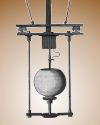
In 1879, the first U.S. electricity production central station, the California Electric Light Company, filed articles of incorporation in San Francisco, with a capital of $5,000,000. The entrepreneurs at first had in mind to use the obscure Titzell system, but instead settled on Brush equipment. Within three months, by Sep 1879, it had a central generating station supplying power for lighting Brush arc light lamps. It was a small, rather makeshift operation with a boiler to power a steam engine driving two dynamos. It provided enough electricity for just 21 lamps, which were rented to nearby shops and hotels for $10 weekly. It was not until 1882 that Thomas Edison had his New York City central station in production. Meanwhile most profits of the C.E.L. Co. came from installing more public and private plants.«
more
In 1864, by Act of Congress (13 Stat., 325) a grant was made to the State of California of the “Yo-Semite Valley” and the land embracing the “Mariposa Big Tree Grove.” Thus for all time the area was protected for “public use, resort, and recreation.” An Act on 1 Oct 1890 reserved additional areas of forest land in California, and created Yosemite National Park under the control of the Secretary of the Interior. On 3 Mar 1905, the State of California receded and regranted the Yosemite Valley land to the United States of America. Thus responsibility and maintenance costs were transferred to the federal government for the National Park, now the third oldest.«
The Yosemite, by John Muir. - book suggestion.
In 1838, the first U.S. patent for a furniture caster was issued to Philos Blake, Eli Whitney Blake and John A. Blake, of New Haven, Connecticut (No. 821). The patent was titled a "mode of constructing casters and applying them to bedsteads."*
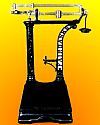
In 1831, the first U.S. patent for a platform scale was issued to brothers Erastus and Thaddeus S. Fairbanks of St. Johnsbury, Vermont. Thaddeus invented and built it during the previous year, revolutionized weighing methods; earlier scales had been of the even-balance or steel-yard types. With the invention of the platform scale, the E. and T. Fairbanks and Company (which had until then been produced stoves, plows, forks, machines) began to specialize in manufacturing scales of all sizes. The business was successful, and grew to supply scales worldwide. On 13 Jan 1857, Thaddeus received the first U.S. patent for a railway track scale (No. 16381) which was introduced by their business. The company survives to the present day.
Davy
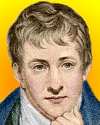
In 1808, Humphry Davy announced in a paper read to the Royal Scociety that he had separated the element boron. Davy had taken boric acid with potassium in a copper tube and heated it to dull redness for fifteen minutes. The resulting olive-gray powder did not effervesce with water or acids, indicating that the potassium had disappeared. However, working independently, French chemist, Joseph Louis Gay-Lussac had announced the same accomplishment nine days earlier, on 21 Jun 1808.«*
Humphry Davy: Life Beyond the Lamp, by Raymond Lamont-Brown. - book suggestion.





