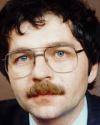
Born 16 May 1950.
Johannes Georg Bednorz is a German physicist who shared the 1987 Nobel Prize for Physics (with Karl Alex Müller) for their joint discovery of superconductivity in a new class of materials at temperatures higher than had previously been thought attainable. They startled the world by reporting superconductivity in a layered, ceramic material at a then record-high temperature of 33 kelvin (that is 33 degrees above absolute zero, or roughly -460 degrees Fahrenheit). Their discovery set off an avalanche of research worldwide into related materials that yielded dozens of new superconductors, eventually reaching a transition temperature of 135 kelvin. Today, he develops complex oxide compounds with novel crystal structures for possible uses in microelectronics.
Johannes Georg Bednorz is a German physicist who shared the 1987 Nobel Prize for Physics (with Karl Alex Müller) for their joint discovery of superconductivity in a new class of materials at temperatures higher than had previously been thought attainable. They startled the world by reporting superconductivity in a layered, ceramic material at a then record-high temperature of 33 kelvin (that is 33 degrees above absolute zero, or roughly -460 degrees Fahrenheit). Their discovery set off an avalanche of research worldwide into related materials that yielded dozens of new superconductors, eventually reaching a transition temperature of 135 kelvin. Today, he develops complex oxide compounds with novel crystal structures for possible uses in microelectronics.
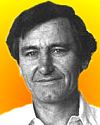
Born 16 May 1934.
Roy P(atrick) Kerr is a New Zealander mathematician who solved (1963) Einstein's field equations of general relativity to describe rotating black holes, thus providing a major contribution to the field of astrophysics. He deduced a unique two-parameter family of solutions which describes the space-time around black holes in July 1963. The two parameters are the mass of the black hole and the angular momentum of the black hole. (The static solution, with zero angular momentum, was discovered by Karl Schwarzschild in Dec 1915.) Rotating black holes are often called Kerr Black Holes. He showed that there is a vortex-like region outside the event horizon, called the ergo-region, that drags space and time around with the rotating black hole.
Roy P(atrick) Kerr is a New Zealander mathematician who solved (1963) Einstein's field equations of general relativity to describe rotating black holes, thus providing a major contribution to the field of astrophysics. He deduced a unique two-parameter family of solutions which describes the space-time around black holes in July 1963. The two parameters are the mass of the black hole and the angular momentum of the black hole. (The static solution, with zero angular momentum, was discovered by Karl Schwarzschild in Dec 1915.) Rotating black holes are often called Kerr Black Holes. He showed that there is a vortex-like region outside the event horizon, called the ergo-region, that drags space and time around with the rotating black hole.
Born 16 May 1925; died 26 Dec 2018 at age 93. quotes
Nancy Grace Roman was an American astronomer who was the first woman to hold an executive position at NASA. She was the first Chief of Astronomy at the headquarters Office of Space Science. Her “Mother of Hubble” nickname resulted from planning the development of the Hubble Space Telescope. Other programs included theCosmic Background Explorer. Starting her lifelong career interest at age 11, she formed an astronomy club with classmates, and went on to a PhD in astronomy (1949). After joining NASA (1959), she rose to become manager of the Astronomical Data Center at Goddard Space Flight Center. Even after retiring, she continued as a contractor at Goddard. Encouraging young women to pursue careers in science and engineering was also a lifetime passion.«
Nancy Grace Roman was an American astronomer who was the first woman to hold an executive position at NASA. She was the first Chief of Astronomy at the headquarters Office of Space Science. Her “Mother of Hubble” nickname resulted from planning the development of the Hubble Space Telescope. Other programs included theCosmic Background Explorer. Starting her lifelong career interest at age 11, she formed an astronomy club with classmates, and went on to a PhD in astronomy (1949). After joining NASA (1959), she rose to become manager of the Astronomical Data Center at Goddard Space Flight Center. Even after retiring, she continued as a contractor at Goddard. Encouraging young women to pursue careers in science and engineering was also a lifetime passion.«
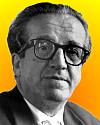
Born 16 May 1901; died 25 Nov 1980 at age 79.
German-born American architect notable for his contributions to the mass production of building components. After emigrating to the U.S., together with Walter Gropius, he developed the General Panel System that was to become known as the "post-war dream house." Using prefabricated modular building units, five workers were able to assemble a house on site in under nine hours. Wachsmann developed a universal standard joint. It was this technique of invisible joinery that allowed prefabrication to become integrated in every aspect of building. The joint was to emerge as the central architectonic theme within this modular approach and has since become the standard for wood working and prefabrication.
German-born American architect notable for his contributions to the mass production of building components. After emigrating to the U.S., together with Walter Gropius, he developed the General Panel System that was to become known as the "post-war dream house." Using prefabricated modular building units, five workers were able to assemble a house on site in under nine hours. Wachsmann developed a universal standard joint. It was this technique of invisible joinery that allowed prefabrication to become integrated in every aspect of building. The joint was to emerge as the central architectonic theme within this modular approach and has since become the standard for wood working and prefabrication.
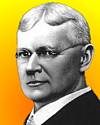
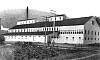
American inventor and manufacturer whose process for fabricating continuous sheets of flat glass made the mass production of glass for windows possible. Colburn began his experiments in 1899 which resulted in his patent for a sheet glass drawing machine on 25 Mar 1902. He formed the Colburn Machine Glass Co. in Aug 1906, installed drawing machines at two factories in 1908 but went bankrupt in 1911 before the technology was perfected. The Toledo Glass Company bought Colburn's patents in 1912 and hired him shortly thereafter. He began refining the process at the Toledo Glass experimental plant where its first draw of sheet glass took place on 25 Nov 1913. The company subsequently organized as the Libbey-Owens Sheet Glass Company in 1916. Colburn died in the following year, before seeing the eventual full success of his process.[Image right: Colburn Machine Glass Co., Reynoldsville, Pa, 1907.] more
Born 16 May 1850; died 4 Jun 1905 at age 55.
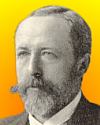
Polish surgeon whose innovations in operative technique for a wide variety of diseases helped develop modern surgery. He contributed prodigiously to cancer surgery, especially on organs of the digestive system. He was first to suture a perforated gastric ulcer (1885), surgically restore part of the oesophagus (1886), remove a malignant part of the colon (1903), and describe what is now known as Mikulicz' disease. In 1881 he developed improved models of the oesophagoscope and gastroscope. As an ardent advocate of antiseptics he did much to popularize Joseph Lister's antiseptic methods. He used a gauze mask and was one of the first to use gloves during surgery.
Polish surgeon whose innovations in operative technique for a wide variety of diseases helped develop modern surgery. He contributed prodigiously to cancer surgery, especially on organs of the digestive system. He was first to suture a perforated gastric ulcer (1885), surgically restore part of the oesophagus (1886), remove a malignant part of the colon (1903), and describe what is now known as Mikulicz' disease. In 1881 he developed improved models of the oesophagoscope and gastroscope. As an ardent advocate of antiseptics he did much to popularize Joseph Lister's antiseptic methods. He used a gauze mask and was one of the first to use gloves during surgery.
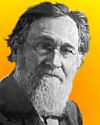
Elie Metchnikoff (a.k.a. Ilya Ilych Mechnikov) was a Russian-French biologist and immunologist who shared, the 1908 Nobel Prize for Physiology or Medicine with Paul Ehrlich “in recognition of their work on immunity.” Metchnikoff's research was on phagocytosis, a fundamental process in immunology whereby macrophages and other specialized cells engulf and digest bacteria and other foreign particles. In 1882, leaving his university teaching career, he set up a private laboratory at Messina to better pursue his interest in microbes and the immune system. He discovered phagocytosis by experiments on the larvae of starfish. His theory that certain white blood cells could engulf and destroy harmful bacteria was at first disbelieved, then slowly accepted by other scientists.«[(also spelled Ilich). DSB and a NYT obituary give the date of death as 15 Jul 1916. EB gives 16 Jul 1916.]
The Life of Elie Metchnikoff, by Olga Metchnikoff. - book suggestion.
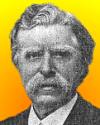
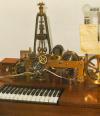
Anglo-American inventor of the carbon microphone, which was a significant contribution to telephony. His family emigrated to the U.S. when he was age seven. In 1850 he became professor of music at St. Joseph's College, Bardstown, Ky. Five years later, after he resigned, he took out a U.S. patent for the first telegraph system printing the text at the sending and at the receiving end, thus doing away with a special alphabetic code as required with the Morse telegraph. It was produced before the typewriter was even invented. Also, Hughes's loose-contact microphone, invented in 1878, was the forerunner of the various carbon microphones now in use. He also invented the induction balance and worked with the theory of magnetism.«[Image right: Hughes telegraph]
Born 16 May 1821; died 8 Dec 1894 at age 73. quotes
Russian mathematician who founded the St. Petersburg mathematical school (sometimes called the Chebyshev school), who is remembered primarily for his work on the theory of prime numbers, including the determination of the number of primes not exceeding a given number. He wrote about many subjects, including the theory of congruences in 1849, probability theory, quadratic forms, orthogonal functions, the theory of integrals, the construction of maps, and the calculation of geometric volumes. Chebyshev was also interested in mechanics and studied the problems involved in converting rotary motion into rectilinear motion by mechanical coupling. The Chebyshev parallel motion is three linked bars approximating rectilinear motion.[Old style dates: Born 4 May 1821; died 26 Nov 1894]
Russian mathematician who founded the St. Petersburg mathematical school (sometimes called the Chebyshev school), who is remembered primarily for his work on the theory of prime numbers, including the determination of the number of primes not exceeding a given number. He wrote about many subjects, including the theory of congruences in 1849, probability theory, quadratic forms, orthogonal functions, the theory of integrals, the construction of maps, and the calculation of geometric volumes. Chebyshev was also interested in mechanics and studied the problems involved in converting rotary motion into rectilinear motion by mechanical coupling. The Chebyshev parallel motion is three linked bars approximating rectilinear motion.[Old style dates: Born 4 May 1821; died 26 Nov 1894]
Born 16 May 1763; died 14 Nov 1829 at age 66.
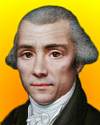
French chemist who discovered the elements chromium (1797) and beryllium (1798).
French chemist who discovered the elements chromium (1797) and beryllium (1798).
Born 16 May 1718; died 9 Jan 1799 at age 80.
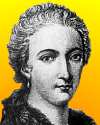
Italian mathematician and philosopher who was the first woman in the Western world considered to be a mathematician. In Propositiones Philosophicae (1738) she presented a series of essays on philosophy and natural science that she had defended in discourses with invited intellectuals who were invited her father's home. In 1748, her two volumes of Analytical Institutions, were acclaimed by the academic world as one of the first and complete publications that brought together the works of various mathematicians on finite and infinitesimal analysis. After the death of her father in 1752, Agnesi entirely devoted herself and spent her money to do charitable work. She died in total poverty in the poorhouse of which she had been the director.
Italian mathematician and philosopher who was the first woman in the Western world considered to be a mathematician. In Propositiones Philosophicae (1738) she presented a series of essays on philosophy and natural science that she had defended in discourses with invited intellectuals who were invited her father's home. In 1748, her two volumes of Analytical Institutions, were acclaimed by the academic world as one of the first and complete publications that brought together the works of various mathematicians on finite and infinitesimal analysis. After the death of her father in 1752, Agnesi entirely devoted herself and spent her money to do charitable work. She died in total poverty in the poorhouse of which she had been the director.

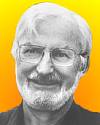
Died 16 May 2013 at age 79 (born 6 Jun 1933).
Swiss physicist who, with Gerd Binnig, received half of the 1986 Nobel Prize for Physics for their joint invention of the scanning tunneling microscope. (Ernst Ruska received the other half of the prize.) Ruska's electron microscope of the 1930s was unable to show surface structure at the atomic level. Rohrer and Binnig began work in 1978 on a scanning tunneling microscope in which a fine probe passes within a few angstroms of the surface of the sample. A positive voltage on the probe enables electrons to move from the sample to the probe by the tunnel effect, and the detected current can used to keep the probe at a constant distance from the surface. As the probe moves in parallel lines, a 3D image of the surface can be constructed.
Swiss physicist who, with Gerd Binnig, received half of the 1986 Nobel Prize for Physics for their joint invention of the scanning tunneling microscope. (Ernst Ruska received the other half of the prize.) Ruska's electron microscope of the 1930s was unable to show surface structure at the atomic level. Rohrer and Binnig began work in 1978 on a scanning tunneling microscope in which a fine probe passes within a few angstroms of the surface of the sample. A positive voltage on the probe enables electrons to move from the sample to the probe by the tunnel effect, and the detected current can used to keep the probe at a constant distance from the surface. As the probe moves in parallel lines, a 3D image of the surface can be constructed.
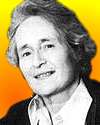
Died 16 May 2007 at age 86 (born 25 Mar 1921). quotes
Mary Douglas (née Tew) was an English anthropologist who was one her era’s most influential anthropologists and scholars of classification systems and institutions. In Purity and Danger (1966), she made a cross-cultural study of ritual systems of cleanliness, pollution, and taboo. She considered these did not merely establish hygienic conditions but went further to establish order with rules of behaviours; rituals bind people together. In social anthropology, she was much influenced by Émile Durkheim. However, she disagreed him associating purity with “the sacred” and impurity with “the profane,” which she questioned concerning the “busy scrubbings” of housework. She held that “dirt is essentially disorder.”
Mary Douglas (née Tew) was an English anthropologist who was one her era’s most influential anthropologists and scholars of classification systems and institutions. In Purity and Danger (1966), she made a cross-cultural study of ritual systems of cleanliness, pollution, and taboo. She considered these did not merely establish hygienic conditions but went further to establish order with rules of behaviours; rituals bind people together. In social anthropology, she was much influenced by Émile Durkheim. However, she disagreed him associating purity with “the sacred” and impurity with “the profane,” which she questioned concerning the “busy scrubbings” of housework. She held that “dirt is essentially disorder.”
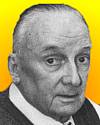
Died 16 May 1995 at age 84 (born 7 May 1911).
English mathematician and theoretical astronomer who researched stellar evolution and composition. In 1939, with Fred Hoyle, he demonstrated the large scale existence of interstellar hydrogen, refuting the existing belief of that space was devoid of interstellar gas. Together, in the early 1940's, they applied nuclear physics to explain how energy is generated by stars. In his own mongraph (1953) Lyttleton described stability of rotating liquid masses, which he extended later to explain that the Earth had a liquid core resulting from a phase change associated with a combination of intense pressure and temperature. With Hermann Bondi, in 1959, he proposed the electrostatic theory of the expanding universe. He authored various astronomy books.
English mathematician and theoretical astronomer who researched stellar evolution and composition. In 1939, with Fred Hoyle, he demonstrated the large scale existence of interstellar hydrogen, refuting the existing belief of that space was devoid of interstellar gas. Together, in the early 1940's, they applied nuclear physics to explain how energy is generated by stars. In his own mongraph (1953) Lyttleton described stability of rotating liquid masses, which he extended later to explain that the Earth had a liquid core resulting from a phase change associated with a combination of intense pressure and temperature. With Hermann Bondi, in 1959, he proposed the electrostatic theory of the expanding universe. He authored various astronomy books.
Mysteries of the solar system, by Raymond Arthur Lyttleton. - book suggestion.
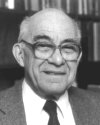
Died 16 May 1994 at age 82 (born 28 May 1911).
Alfred Otto Carl Nier was an American physicist who refined the mass spectrometric process to distinguish isotopes. In 1934, with Lyman T. Aldrich he applied the decay of potassium-40 to argon-40 to measure the age of geological materials. He discovered (1936-38) a number of new isotopes of such low abundance they had not been previously detected, including S36, Ca46, Ca48, and Os186. Nier showed how the ratio of radioactive isotopes of uranium and its decay products was a second method to estimate the age of rocks. During WW-II, with others, he showed (1940) that the rarer uranium-235 undergoes fission, not common U-238. Thereafter, Nier was active in the separaton of these two isotopes, important in developing atomic bombs.
Alfred Otto Carl Nier was an American physicist who refined the mass spectrometric process to distinguish isotopes. In 1934, with Lyman T. Aldrich he applied the decay of potassium-40 to argon-40 to measure the age of geological materials. He discovered (1936-38) a number of new isotopes of such low abundance they had not been previously detected, including S36, Ca46, Ca48, and Os186. Nier showed how the ratio of radioactive isotopes of uranium and its decay products was a second method to estimate the age of rocks. During WW-II, with others, he showed (1940) that the rarer uranium-235 undergoes fission, not common U-238. Thereafter, Nier was active in the separaton of these two isotopes, important in developing atomic bombs.
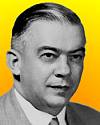
1936
Died 16 May 1959 at age 71 (born 14 Aug 1887).
Edward Winslow Gifford was an American anthropologist and archaeologist who was self-taught in these fields. After high school, he became an assistant with the California Academy of Sciences, and on its expedition to the Galapagos Islands (1905-06) he observed and later described how the Pallid Tree Finch used a thorn or twig pry insects out from tree bark. He became assistant curator (1912) then curator (1925) at the University of California Museum of Anthropology. He made ethnographical field studies of native culture in California, Tonga, Fiji, New Caledonia and Yap. He succeeded Alfred L. Kroeber as the museum director in 1947. Gifford developed the museum into a major U.S. collection, and wrote over 100 treatises related to ethnology, folklore and museum collections.«
Edward Winslow Gifford was an American anthropologist and archaeologist who was self-taught in these fields. After high school, he became an assistant with the California Academy of Sciences, and on its expedition to the Galapagos Islands (1905-06) he observed and later described how the Pallid Tree Finch used a thorn or twig pry insects out from tree bark. He became assistant curator (1912) then curator (1925) at the University of California Museum of Anthropology. He made ethnographical field studies of native culture in California, Tonga, Fiji, New Caledonia and Yap. He succeeded Alfred L. Kroeber as the museum director in 1947. Gifford developed the museum into a major U.S. collection, and wrote over 100 treatises related to ethnology, folklore and museum collections.«
California Indian Nights Entertainment, by Edward Gifford, Gwendoline Gifford. - book suggestion.

Died 16 May 1947 at age 85 (born 20 Jun 1861). quotes
English biochemist who shared (with Christiaan Eijkman) the 1929 Nobel Prize for Physiology or Medicine for discovery of essential nutrient factors (now called vitamins), needed in animal diets to maintain health. Hopkins fed young rats on a basic diet with the necessary salts, in a carefully purified mixture of lard, starch, and casein (the most abundant protein in milk). After some time the animals ceased to grow. Then Hopkins showed that it was necessary to add only a very small daily amount of whole milk, 2-3 cc for each animal, for growth to renew. Thus seemingly sufficient food consumed without whole milk could not be fully utilized by the body, until a growth-promoting nutrient in milk was present.«
English biochemist who shared (with Christiaan Eijkman) the 1929 Nobel Prize for Physiology or Medicine for discovery of essential nutrient factors (now called vitamins), needed in animal diets to maintain health. Hopkins fed young rats on a basic diet with the necessary salts, in a carefully purified mixture of lard, starch, and casein (the most abundant protein in milk). After some time the animals ceased to grow. Then Hopkins showed that it was necessary to add only a very small daily amount of whole milk, 2-3 cc for each animal, for growth to renew. Thus seemingly sufficient food consumed without whole milk could not be fully utilized by the body, until a growth-promoting nutrient in milk was present.«
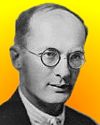
Died 16 May 1942 at age 58 (born 7 Apr 1884). quotes
Bronislaw Kasper Malinowski was a Polish-British anthropologist, one of the most important in the 20th century, who is widely recognized as the founder of social anthropology. He is principally associated with field studies of the peoples of Oceania. In 1914, on a research assignment to Australia, the outbreak of WW I kept him partially confined to the Trobriand Islands, off the eastern tip of New Guinea. In 1920, he returned to teaching in London, and in 1938 moved to teach in the U.S. He was the pioneer of “participant observation” as a method of fieldwork, used in his works on the Trobriand Islanders, especially Argonauts of the Western Pacific (1922) and Coral Gardens and their Magic (2 vols, 1935), which set new standards for ethnographic description.
Bronislaw Kasper Malinowski was a Polish-British anthropologist, one of the most important in the 20th century, who is widely recognized as the founder of social anthropology. He is principally associated with field studies of the peoples of Oceania. In 1914, on a research assignment to Australia, the outbreak of WW I kept him partially confined to the Trobriand Islands, off the eastern tip of New Guinea. In 1920, he returned to teaching in London, and in 1938 moved to teach in the U.S. He was the pioneer of “participant observation” as a method of fieldwork, used in his works on the Trobriand Islanders, especially Argonauts of the Western Pacific (1922) and Coral Gardens and their Magic (2 vols, 1935), which set new standards for ethnographic description.
Magic, Science and Religion and Other Essays, by Bronislaw Malinowski. - book suggestion.

Died 16 May 1938 at age 68 (born 9 Jan 1870). quotes
Joseph Baermann Strauss was an American civil engineer who was chief engineer for the construction of the Golden Gate Bridge, San Francisco. His career began as a draftsman. A few years later had become a principal assistant engineer. By 1904 he had his own Strauss Bascule Bridge Company which constructed hundreds of drawbridges around the U.S. From 1919, he spent a decade campaigning for the idea of the Golden Gate Bridge, which was eventually funded by a vote on 4 Nov 1930 to issue bonds. It was his first suspension bridge, and he was assisted by engineers Charles Ellis and Leon Moissieff. The bridge opened to the public 27 May 1937. He was exhausted by the major task, and died within a year afterwards.«
Joseph Baermann Strauss was an American civil engineer who was chief engineer for the construction of the Golden Gate Bridge, San Francisco. His career began as a draftsman. A few years later had become a principal assistant engineer. By 1904 he had his own Strauss Bascule Bridge Company which constructed hundreds of drawbridges around the U.S. From 1919, he spent a decade campaigning for the idea of the Golden Gate Bridge, which was eventually funded by a vote on 4 Nov 1930 to issue bonds. It was his first suspension bridge, and he was assisted by engineers Charles Ellis and Leon Moissieff. The bridge opened to the public 27 May 1937. He was exhausted by the major task, and died within a year afterwards.«
The Gate: The True Story of the Design and Construction of the Golden Gate Bridge, by John Van Der Zee. - book suggestion.
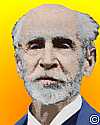
Died 16 May 1928 at age 94 (born 13 Mar 1834).
English inventor who invented linoleum (pat. app. 19 Dec 1863, No. 3210). His 88 patents included artificial leather, distillation, plastics, flexible metal tubing, and Lincrusta, an embossed linoleum wall covering (1877). He was a self-described “practical utilitarian of the nineteenth century,” with no education in chemistry or engineering. Before linoleum, he patented (Sep 1861) a varnish applicable to the waterproofing and coating of fabrics. In Jan 1862 he applied with his brother for a patent in which textile card brushes had the short wire bristles held in an india rubber backing. Walton started in the family business of processing India rubber. He developed linoleum from observing the plastic dried surface layer of linseed oil-based paint, which he first investigated as an alternative to rubber and led to linoleum.« more
English inventor who invented linoleum (pat. app. 19 Dec 1863, No. 3210). His 88 patents included artificial leather, distillation, plastics, flexible metal tubing, and Lincrusta, an embossed linoleum wall covering (1877). He was a self-described “practical utilitarian of the nineteenth century,” with no education in chemistry or engineering. Before linoleum, he patented (Sep 1861) a varnish applicable to the waterproofing and coating of fabrics. In Jan 1862 he applied with his brother for a patent in which textile card brushes had the short wire bristles held in an india rubber backing. Walton started in the family business of processing India rubber. He developed linoleum from observing the plastic dried surface layer of linseed oil-based paint, which he first investigated as an alternative to rubber and led to linoleum.« more
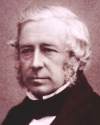
Died 16 May 1861 at age 65 (born 6 Feb 1796). quotes
English clergyman, botanist and geologist who mentored Charles Darwin. Henslow popularized botany at the University of Cambridge by introducing new methods of teaching the subject. He fostered independent discovery and utilized unusual field trips for his students. In order to persuade farmers to apply scientific methods to their operations, Henslow gave public lectures on the fermentation of manure and wrote newsletters for publication in local newspapers. During the potato famine (1845-46) in Ireland, he showed stricken farmers how to extract starch from rotten potatoes.
English clergyman, botanist and geologist who mentored Charles Darwin. Henslow popularized botany at the University of Cambridge by introducing new methods of teaching the subject. He fostered independent discovery and utilized unusual field trips for his students. In order to persuade farmers to apply scientific methods to their operations, Henslow gave public lectures on the fermentation of manure and wrote newsletters for publication in local newspapers. During the potato famine (1845-46) in Ireland, he showed stricken farmers how to extract starch from rotten potatoes.
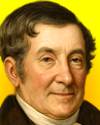
Died 16 May 1845 (born 1779).
English inventor and entrepreneur, who began his career as a ship’s ironmonger, initially in Winchester, then Portsea (Portsmouth). In 1818, following his younger brother Jeremiah’s patent (3 Feb 1818) for the Detector Lock, Charles co‑founded a locksmith business in Wolverhampton. He patented significant improvements to the lock in 1824, 1828, and 1833 and then took out patents in the mid‑1830s for burglar‑resistant and fire‑resistant safes. The firm scaled rapidly—in its first century producing more than 2.5 million locks and thousands of safes and strongrooms—and later evolved into a global security company manufacturing locks, safes, alarms, fire protection systems, and security equipment.«
English inventor and entrepreneur, who began his career as a ship’s ironmonger, initially in Winchester, then Portsea (Portsmouth). In 1818, following his younger brother Jeremiah’s patent (3 Feb 1818) for the Detector Lock, Charles co‑founded a locksmith business in Wolverhampton. He patented significant improvements to the lock in 1824, 1828, and 1833 and then took out patents in the mid‑1830s for burglar‑resistant and fire‑resistant safes. The firm scaled rapidly—in its first century producing more than 2.5 million locks and thousands of safes and strongrooms—and later evolved into a global security company manufacturing locks, safes, alarms, fire protection systems, and security equipment.«
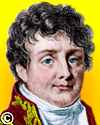
Died 16 May 1830 at age 62 (born 21 Mar 1768). quotes
French mathematician, Egyptologist and administrator who exerted strong influence on mathematical physics through his Théorie analytique de la chaleur (1822; The Analytical Theory of Heat). He introduced an infinite mathematical series to aid in solving conduction equations. This analysis technique allows the function of any variable to be expanded into a series of sines of multiples of the variable, which is now known as the Fourier series. His equations spawned many new areas of study in mathematics and physics, including the branch of optics named for him, have subsequently been applied other natural phenomena such as tides, weather and sunspots. more
French mathematician, Egyptologist and administrator who exerted strong influence on mathematical physics through his Théorie analytique de la chaleur (1822; The Analytical Theory of Heat). He introduced an infinite mathematical series to aid in solving conduction equations. This analysis technique allows the function of any variable to be expanded into a series of sines of multiples of the variable, which is now known as the Fourier series. His equations spawned many new areas of study in mathematics and physics, including the branch of optics named for him, have subsequently been applied other natural phenomena such as tides, weather and sunspots. more
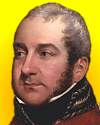
Died 16 May 1828 at age 55 (born 20 May 1772). quotes
English artillery officer and inventor (2nd Baronet) who invented a rocket (about 1804) for use in warfare that improved on simple black-powder rockets. They were first used militarily against the French on 8 Oct 1806 at Boulogne and later at Copenhagen and Leipzig. By 1830, most European armies had copied them. He also invented a gun-recoil mounting, a steam engine, a triple-paper process for coloured watermarks and a “perpetual-motion” machine. He created a wheelchair for himself after losing the use of his legs. He designed a vessel propelled by a “wave-wheel” and a human-powered aircraft. His 18 patents also include making of gunpowder, gas lighting, “hydropneumatic” canal locks, a rolling-ball clock and a built-in sprinkler system.« more
English artillery officer and inventor (2nd Baronet) who invented a rocket (about 1804) for use in warfare that improved on simple black-powder rockets. They were first used militarily against the French on 8 Oct 1806 at Boulogne and later at Copenhagen and Leipzig. By 1830, most European armies had copied them. He also invented a gun-recoil mounting, a steam engine, a triple-paper process for coloured watermarks and a “perpetual-motion” machine. He created a wheelchair for himself after losing the use of his legs. He designed a vessel propelled by a “wave-wheel” and a human-powered aircraft. His 18 patents also include making of gunpowder, gas lighting, “hydropneumatic” canal locks, a rolling-ball clock and a built-in sprinkler system.« more
Commodore Squib: The Life, Times and Secretive Wars of England's First Rocket Man, Sir William Congreve, by James Earle. - book suggestion.
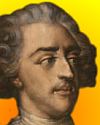
Died 16 May 1741 at age 73 (baptized 23 May 1667).
German-French inventor who invented the modern system of four-colour printing. Influenced by Newton's work on the light spectrum, after many printing trials, Le Blon in 1710 proposed that three primary colours - cyan, magenta and yellow (blue, red, yellow) and black - are sufficient for mixing in varying proportions to produce all other colours. He used this process to print engravings that mimic the full colour of paintings by superimposing mezzotint plates in each primary colour. For each hand-engraved plate, the individual contribution of each colour estimated. In 1719, George I granted him a priviledge of a monopoly for the reproduction of pictures and drawings in full colour. Nevertheless, by 1725, his company failed.«[Also spelled Jacob Christoph Le Blon; in French as French Jacques-Christophe Le Blond.]
German-French inventor who invented the modern system of four-colour printing. Influenced by Newton's work on the light spectrum, after many printing trials, Le Blon in 1710 proposed that three primary colours - cyan, magenta and yellow (blue, red, yellow) and black - are sufficient for mixing in varying proportions to produce all other colours. He used this process to print engravings that mimic the full colour of paintings by superimposing mezzotint plates in each primary colour. For each hand-engraved plate, the individual contribution of each colour estimated. In 1719, George I granted him a priviledge of a monopoly for the reproduction of pictures and drawings in full colour. Nevertheless, by 1725, his company failed.«[Also spelled Jacob Christoph Le Blon; in French as French Jacques-Christophe Le Blond.]
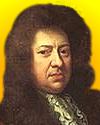
Died 16 May 1703 at age 70 (born 23 Feb 1633). quotes
English diarist whose almost ten years of entries from 1 Jan 1660 document both his personal life and also contemporary life, including during the Great Plague of London (1665-66) and the Great Fire (1666). (Concerned with failing eyesight, Pepys discontinued his diary writings on 31 May 1669.) From 1665, he was a Fellow of the Royal Society. He wrote brief references to the points of interest when he attended a Society meeting. He became its President (1 Dec 1684-30 Nov 1686). Pepys' name is printed on the title page of Isaac Newton's Principia Mathematica which was published during his tenure. He was appointed Secretary of the Admiralty Commission (1673) and served as a Member of Parliament.«
English diarist whose almost ten years of entries from 1 Jan 1660 document both his personal life and also contemporary life, including during the Great Plague of London (1665-66) and the Great Fire (1666). (Concerned with failing eyesight, Pepys discontinued his diary writings on 31 May 1669.) From 1665, he was a Fellow of the Royal Society. He wrote brief references to the points of interest when he attended a Society meeting. He became its President (1 Dec 1684-30 Nov 1686). Pepys' name is printed on the title page of Isaac Newton's Principia Mathematica which was published during his tenure. He was appointed Secretary of the Admiralty Commission (1673) and served as a Member of Parliament.«
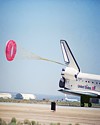
In 1992, the space shuttle Endeavour completed its maiden voyage with a safe landing on runway 22 at Edwards Air Force Base in the California desert. It was the first use of a drag-chute for a Shuttle landing. Endeavour had been launched 7 May 1992, on a voyage lasting 8 days, 21 hrs. The mission STS-49 included the first three-person spacewalk, which captured Intelsat VI, a private communications satellite, for repair and reboost. The 4.5 ton satellite had been stranded in an unusable orbit since it was launched on Mar 1990. After capture, it was equipped with a new perigee kick motor. When released, the satellite reached an operational geosynchronous orbit.«
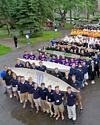
In 1971, the world’s first inter-collegiate concrete canoe race took place, by students from University of Illinois at Urbana-Champaign (UIUC) and Purdue University. Engineering professor, Clyde E. Kesler, in 1970, gave his UIUC students in the concrete design class a challenge to build a canoe out of concrete. By year’s end, the result vaguely resembled a canoe, weighted 370 pounds and was named Mis-Led. Purdue heard of the project and proposed a race. Since then, annual events racing concrete canoes became organized nationally and went international. Now, the American Society of Civil Engineers (ASCE) National Concrete Canoe Competition involves many hundreds of students.«
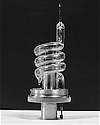
In 1960, a synthetic ruby crystal laser was first operated at Hughes Research Laboratories in Malibu, California. The laser is a device that produces monochromatic coherent light (light in which the rays are all of the same wavelength and phase). This first operable laser device was invented by American physicist Theodore Maiman, for which he was issued U.S. Patent 3,353,115 on 14 Nov 1967.
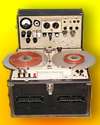
Type K4 AEG Magnetophon

Jack Mullin

In 1943, during WW II, an RAF squadron carrying “bouncing bombs” (invented by Dr Barnes Wallis) took off, to destroy the Möhne and Eder dams in the industrial area of Ruhr Valley, Germany. Wallace had realized that breaching the dams would destroy vital enemy war factories and hydroelectricity plants. He overcame skepticism from military planners, and designed an innovative bomb that could be delivered against the side of the dam. Shortly after midnight on 17 May 1943, very large, cylindrical bombs were delivered at the pre-planned height and place, rotating backwards at high speed, to skip along the surface of the water, right up to the base of the dam. Wallis based his idea on the simple pastime of skipping stones on a pond.«[Image: Dr Barnes Wallis at his drawing board]
The Dam Busters, by Paul Brickhill. - book suggestion.
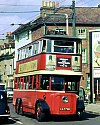
In 1931 the London United Tramways (LUT) started London's first trolleybus service. It replaced trams service on the Twickenham Junction to Teddington route. The trolleybus had been demonstrated in London as early as 1909, and were running in Leeds since 1911. Like trams, the trolleybus ran on electricity drawn from a "trolley" running along overhead lines. Trolleybuses had pneumatic tyres to run on the same road surface with other traffic. London trams, their rail maintenance expense and trouble to other vehicles, were thus all abandoned by 1952. Yet by 1959, the era of the trolleybus was closing, as diesel-fuelled buses became economical alternatives. London's last trolleybus ran from Wimbledon to Fulwell on 8 May 1962.«[Image: An “A” class, first design of London trolleybus brought out of preservation retirement making its Last Day Run, 8 May 1962, on King's Road, Kingston.]
The London Trolleybus: 1931-1945, by Ken Blacker. - book suggestion.

In 1893, black American inventor L.W. Benjamin received a U.S. patent for “Broom Moisteners and Bridles” (No. 497,747). The object of the invention was described as, “to keep the broom moist while sweeping without being so wet as to drip, and to prevent the dust from rising, also to bind together the straws of the broom, thereby preventing them from spreading, causing the broom to last longer and enabling it to do better work.” This was achieved with a reservoir secured with a band, “upon one side of the brush part of a broom with a series of perforations near its lower edge.” The reservoir was described as,“a metal box, preferably of tin,” tapering downward.«
The Inventive Spirit of African Americans: Patented Ingenuity, by Patricia Carter Sluby. - book suggestion.
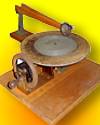
detached from horn