Born 9 Mar 1943. quotes
American atmospheric chemist.
American atmospheric chemist.
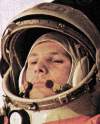
Born 9 Mar 1934; died 27 Mar 1968 at age 34. quotes
Soviet cosmonaut who on 12 Apr 1961 became the first man to travel into space when he was 27 years old. He graduated from the Soviet Air Force cadet school in 1957. He volunteered to become a cosmonaut and joined a group of test pilots for training. Three days before the launch, he was informed he had been selected to pilot the Vostok 1 spacecraft. He orbited the Earth once in 1 hour 29 minutes at a maximum altitude of 187 miles (301 km). He never went into space again but trained other cosmonauts and toured several other nations. Gagarin was killed with another pilot in the crash of a two-seat jet aircraft while on what was described as a routine training flight. His ashes were placed in a niche in the Kremlin wall.
Soviet cosmonaut who on 12 Apr 1961 became the first man to travel into space when he was 27 years old. He graduated from the Soviet Air Force cadet school in 1957. He volunteered to become a cosmonaut and joined a group of test pilots for training. Three days before the launch, he was informed he had been selected to pilot the Vostok 1 spacecraft. He orbited the Earth once in 1 hour 29 minutes at a maximum altitude of 187 miles (301 km). He never went into space again but trained other cosmonauts and toured several other nations. Gagarin was killed with another pilot in the crash of a two-seat jet aircraft while on what was described as a routine training flight. His ashes were placed in a niche in the Kremlin wall.
Starman: The Truth Behind the Legend of Yuri Gagarin, by Jamie Doran. - book suggestion.
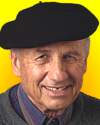
Born 9 Mar 1923; died 19 Apr 2016 at age 93. quotes
Austrian-American physicist who shared (with John A. Pople) the 1998 Nobel Prize in Chemistry. The award recognized their individual work on computations in quantum chemistry. Kohn’s share of the prize was for the development of his density-functional theory. This applied complicated mathematics to provided a modeling technique that incorporated quantum mechanics in the study of materials’ electronic properties. Kohn’s theory so revolutionized materials science, that it has been said it has been referenced in about half of all publications in quantum chemistry that have followed. He made major contributions to the physics of semiconductors, superconductivity, surface physics and catalysis.«
Austrian-American physicist who shared (with John A. Pople) the 1998 Nobel Prize in Chemistry. The award recognized their individual work on computations in quantum chemistry. Kohn’s share of the prize was for the development of his density-functional theory. This applied complicated mathematics to provided a modeling technique that incorporated quantum mechanics in the study of materials’ electronic properties. Kohn’s theory so revolutionized materials science, that it has been said it has been referenced in about half of all publications in quantum chemistry that have followed. He made major contributions to the physics of semiconductors, superconductivity, surface physics and catalysis.«
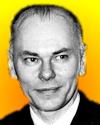
Born 9 Mar 1900; died 14 Mar 1973 at age 73. quotes
American mathematician who invented the Harvard Mark I, forerunner of the modern electronic digital computer. While a graduate student and instructor Harvard University, Aiken's research had led to a system of differential equations which could only be solved using numerical techniques, for which he began planning large computer. His idea was to use an adaptation of Hollerith's punched card machine. When eventually built, (1943) it weighed 35 tons, had 500 miles of wire and could compute to 23 significant figures. There were 72 storage registers and central units to perform multiplication and division. It was controlled by a sequence of instructions on punched paper tapes, and used punched cards to enter data and give output from the machine.
American mathematician who invented the Harvard Mark I, forerunner of the modern electronic digital computer. While a graduate student and instructor Harvard University, Aiken's research had led to a system of differential equations which could only be solved using numerical techniques, for which he began planning large computer. His idea was to use an adaptation of Hollerith's punched card machine. When eventually built, (1943) it weighed 35 tons, had 500 miles of wire and could compute to 23 significant figures. There were 72 storage registers and central units to perform multiplication and division. It was controlled by a sequence of instructions on punched paper tapes, and used punched cards to enter data and give output from the machine.
Howard Aiken: Portrait of a Computer Pioneer, by I. Bernard Cohen. - book suggestion.
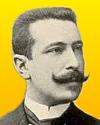
Born 9 Mar 1862; died 14 Jan 1929 at age 66.
(Georges-) Fernand-Isidore Widal was a French physician and bacteriologist who made important contributions to the diagnosis, treatment, and prevention of many diseases. In 1896, he developed the Widal reaction, a procedure for diagnosing typhoid fever based on the fact that antibodies in the blood of an infected individual cause the bacteria to bind together into clumps. In 1906, he recognized that the retention of sodium chloride was a feature found in cases of nephritis and cardiac edema, and he recommended salt deprivation as part of the treatment for both diseases. During WW I, Widal prepared a vaccine that appreciably reduced typhoid contagion among the allied armies.
(Georges-) Fernand-Isidore Widal was a French physician and bacteriologist who made important contributions to the diagnosis, treatment, and prevention of many diseases. In 1896, he developed the Widal reaction, a procedure for diagnosing typhoid fever based on the fact that antibodies in the blood of an infected individual cause the bacteria to bind together into clumps. In 1906, he recognized that the retention of sodium chloride was a feature found in cases of nephritis and cardiac edema, and he recommended salt deprivation as part of the treatment for both diseases. During WW I, Widal prepared a vaccine that appreciably reduced typhoid contagion among the allied armies.
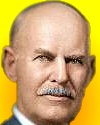
Born 9 Mar 1856; died 6 Jul 1931 at age 75.
American inventor who discovered the abrasive carborundum, the second hardest substance (next to diamonds) and later perfected a method for making graphite. In his early career, he had worked at Thomas Edison’s Menlo Park (1880-84), but left to become an independent inventor. In 1891, he was experimenting with an electric furnace, trying to make diamonds from a molten mixture of powdered coke and clay. Instead of diamonds, he found he had made small, gritty, hard crystals almost as hard as diamonds. He determined that this crystalline substance was silicon carbide. It was very effective as an abrasive, which Acheson patented (28 Feb 1892) and called “carborundum.” He established the Carborundum Company (1894), to make grinding wheels, whetstones, and powdered abrasives.« more
American inventor who discovered the abrasive carborundum, the second hardest substance (next to diamonds) and later perfected a method for making graphite. In his early career, he had worked at Thomas Edison’s Menlo Park (1880-84), but left to become an independent inventor. In 1891, he was experimenting with an electric furnace, trying to make diamonds from a molten mixture of powdered coke and clay. Instead of diamonds, he found he had made small, gritty, hard crystals almost as hard as diamonds. He determined that this crystalline substance was silicon carbide. It was very effective as an abrasive, which Acheson patented (28 Feb 1892) and called “carborundum.” He established the Carborundum Company (1894), to make grinding wheels, whetstones, and powdered abrasives.« more
Edward Goodrich Acheson: inventor, scientist, industrialist; A biography, by Raymond Szymanowitz. - book suggestion.
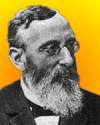
Born 9 Mar 1845; died 31 Jan 1920 at age 74.
Wilhelm (Friedrich Philipp) Pfeffer was a German botanist whose work on osmotic pressure made him a pioneer in the study of plant physiology. With Julius von Sachs, he was a leader in systematizing the fundamentals of plant physiology. In 1877, while investigating cell metabolism, he devised a semi-permeable membrane for the study osmosis. By measuring osmotic pressure, a technique he developed, Pfeffer found that pressure depends on the size of the molecules that are too large to pass through the membrane. Thus, he had a method to measure the size of such giant molecules. However, he was unable to find a mathematical relationship to predict osmotic pressure, which was furthered by the work of Van't Hoff.
Wilhelm (Friedrich Philipp) Pfeffer was a German botanist whose work on osmotic pressure made him a pioneer in the study of plant physiology. With Julius von Sachs, he was a leader in systematizing the fundamentals of plant physiology. In 1877, while investigating cell metabolism, he devised a semi-permeable membrane for the study osmosis. By measuring osmotic pressure, a technique he developed, Pfeffer found that pressure depends on the size of the molecules that are too large to pass through the membrane. Thus, he had a method to measure the size of such giant molecules. However, he was unable to find a mathematical relationship to predict osmotic pressure, which was furthered by the work of Van't Hoff.
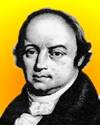
Born 9 Mar 1758; died 22 Aug 1828 at age 70. quotes
German physician, anatomist and physiologistt who pioneered in linking cerebral functions to localized areas of the brain and associated with underlying attributes of the human personality. As early as the 1790s, he was developing theories on the anatomy and function of the parts of the brain. He was first to identify recognize that the brain's gray matter was made up of nerve cell bodies, and that the white matter has the fibers that carry impulses from the nerves. He believed an external examination of the skull could reveal individual intellect and personality, which he termed “cranioscopy,” later called “phrenology” by his protegé, Johann G. Spurzheim. In 1805, they travelled on a long lecture tour of Europe, also studying at prisons and asylums.«
German physician, anatomist and physiologistt who pioneered in linking cerebral functions to localized areas of the brain and associated with underlying attributes of the human personality. As early as the 1790s, he was developing theories on the anatomy and function of the parts of the brain. He was first to identify recognize that the brain's gray matter was made up of nerve cell bodies, and that the white matter has the fibers that carry impulses from the nerves. He believed an external examination of the skull could reveal individual intellect and personality, which he termed “cranioscopy,” later called “phrenology” by his protegé, Johann G. Spurzheim. In 1805, they travelled on a long lecture tour of Europe, also studying at prisons and asylums.«
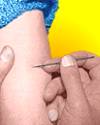
Born 9 Mar 1676; died 1 Mar 1766 at age 89. quotes
American physician who introduced smallpox inoculation into the American colonies. Small-pox had broken out again in Boston in 1721. Rev. Cotton Mather had learned of a technique being practiced abroad that was reported to give protection. When a small wound was infected with pus taken from a smallpox sore, a person would thereupon develop a trivial case of the disease, but would likely suffer no further more serious infection later. After Mather was rebuffed by other medical practitioners in Boston, he approached Boylston with the idea to experiment with the technique. Boyston thought a trial to be so worthwhile that he inoculated his own son and two others on 26 Jun 1721. Their resulting illness was mild; they recovered by 4 Jul 1721. more
American physician who introduced smallpox inoculation into the American colonies. Small-pox had broken out again in Boston in 1721. Rev. Cotton Mather had learned of a technique being practiced abroad that was reported to give protection. When a small wound was infected with pus taken from a smallpox sore, a person would thereupon develop a trivial case of the disease, but would likely suffer no further more serious infection later. After Mather was rebuffed by other medical practitioners in Boston, he approached Boylston with the idea to experiment with the technique. Boyston thought a trial to be so worthwhile that he inoculated his own son and two others on 26 Jun 1721. Their resulting illness was mild; they recovered by 4 Jul 1721. more
The Speckled Monster: A Historical Tale of Battling the Smallpox Epidemic, by Jennifer Lee Carrell. - book suggestion.
Born 9 Mar 1564; died 7 May 1617 at age 53. quotes
A German astronomer, friend of Tycho Brahe and Kepler, and one of the first to follow Galileo in telescope observation of the skies. He is best known for a naked-eye observation of a star in Aug 1596, subsequently named Omicron Ceti, the first variable star to be discovered, and now known as Mira. Its existence with variable brightness contradicted the Aristotelian dogma that the heavens were both perfect and constant. With his son, Johannes Fabricius, he observed the sun and noted sunspots. For further observations they invented the use of a camera obscura and recorded sun-spot motion indicating the rotation of the Sun. David Fabricius, a Protestant minister, was killed by a parishioner angered upon being accused by him as a thief.
A German astronomer, friend of Tycho Brahe and Kepler, and one of the first to follow Galileo in telescope observation of the skies. He is best known for a naked-eye observation of a star in Aug 1596, subsequently named Omicron Ceti, the first variable star to be discovered, and now known as Mira. Its existence with variable brightness contradicted the Aristotelian dogma that the heavens were both perfect and constant. With his son, Johannes Fabricius, he observed the sun and noted sunspots. For further observations they invented the use of a camera obscura and recorded sun-spot motion indicating the rotation of the Sun. David Fabricius, a Protestant minister, was killed by a parishioner angered upon being accused by him as a thief.
Born 9 Mar 1451; died 22 Feb 1512 at age 60.
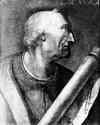
Italian-Spanish navigator, explorer and cartographer whose name was given to the New World - America - because it was he and not Columbus, who realized and announced that Columbus had discovered a new continent. He was well educated, including studies of physics, geometry and astronomy. On 10 May 1497, he began his first voyage of discovery. Three ships were provided by by King Ferdinand of Spain. After four voyages of exploration, on 14 Apr 1505, he naturalized as a Spaniard. He made two more voyages. In 1507, German mapmaker Martin Waldseemuller, printed the first map applying the name America for the New World. The title piloto mayor de España (chief of navigation) for Spain was bestowed on Vespucci, by royal decree, on 6 Aug 1508.«[a.k.a. Americus Vespucius. EB gives years 1454?-1512.]
Italian-Spanish navigator, explorer and cartographer whose name was given to the New World - America - because it was he and not Columbus, who realized and announced that Columbus had discovered a new continent. He was well educated, including studies of physics, geometry and astronomy. On 10 May 1497, he began his first voyage of discovery. Three ships were provided by by King Ferdinand of Spain. After four voyages of exploration, on 14 Apr 1505, he naturalized as a Spaniard. He made two more voyages. In 1507, German mapmaker Martin Waldseemuller, printed the first map applying the name America for the New World. The title piloto mayor de España (chief of navigation) for Spain was bestowed on Vespucci, by royal decree, on 6 Aug 1508.«[a.k.a. Americus Vespucius. EB gives years 1454?-1512.]

Died 9 Mar 1983 at age 78 (born 7 Feb 1905).
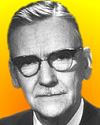
Swedish physiologist who shared the 1970 Nobel Prize for Physiology or Medicine (with Sir Bernard Katz and Julius Axelrod) for their independent study of transmitter mechanisms of nerve cells. Since 1906, when Thomas Elliott first proposed that nerve cells communicate with each other and the muscles they control by the release of chemicals, there had been efforts to identify these substances. Euler's recognition was for his discovery (1946) of noradrenaline which serves as neurotransmitter at the nerve terminals of the sympathetic nervous system. He further showed how noradrenaline is stored in small nerve granules within the nerve fibres of this system. Euler had earlier, in 1935, discovered the substance he named prostaglandin.«
Swedish physiologist who shared the 1970 Nobel Prize for Physiology or Medicine (with Sir Bernard Katz and Julius Axelrod) for their independent study of transmitter mechanisms of nerve cells. Since 1906, when Thomas Elliott first proposed that nerve cells communicate with each other and the muscles they control by the release of chemicals, there had been efforts to identify these substances. Euler's recognition was for his discovery (1946) of noradrenaline which serves as neurotransmitter at the nerve terminals of the sympathetic nervous system. He further showed how noradrenaline is stored in small nerve granules within the nerve fibres of this system. Euler had earlier, in 1935, discovered the substance he named prostaglandin.«
Release and uptake functions in adrenergic nerve granules, by Ulf von Euler. - book suggestion.
Died 9 Mar 1981 at age 74 (born 4 Sep 1906). quotes
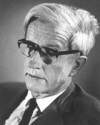
German-American microbiologist, who pioneered in the study of molecular genetics. He shared (with Alfred Day Hershey and Salvador Luria), the 1969 Nobel Prize for Physiology or Medicine for work on the replication mechanism and the genetic structure of bacteriophages (a type of virus that infects bacteria, rather than ordinary cells). Bacteriophages serve as models for the more complex, less approachable cells of animals and humans. This insight into the nature of viruses and of virus diseases leads to understanding the mechanism of inheritance, development growth and function of tissues and organs.
German-American microbiologist, who pioneered in the study of molecular genetics. He shared (with Alfred Day Hershey and Salvador Luria), the 1969 Nobel Prize for Physiology or Medicine for work on the replication mechanism and the genetic structure of bacteriophages (a type of virus that infects bacteria, rather than ordinary cells). Bacteriophages serve as models for the more complex, less approachable cells of animals and humans. This insight into the nature of viruses and of virus diseases leads to understanding the mechanism of inheritance, development growth and function of tissues and organs.
Died 9 Mar 1974 at age 58 (born 19 Nov 1915).
American pharmacologist and physiologist who was awarded the 1971 Nobel Prize for Physiology or Medicine for isolating cyclic adenosine monophosphate (cyclic AMP) and demonstrating its involvement in numerous metabolic processes that occur in animals.
American pharmacologist and physiologist who was awarded the 1971 Nobel Prize for Physiology or Medicine for isolating cyclic adenosine monophosphate (cyclic AMP) and demonstrating its involvement in numerous metabolic processes that occur in animals.
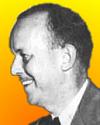
Died 9 Mar 1962 at age 59 (born 23 Jun 1902).
American computer designer who promoted the first commercially available digital computer, the Univac. As a Yale professor he had written a paper on the mathematical basis for cryptanalysis techniques. During WW II he was called to the Navy and placed in command of the OP-20-G automated machines "Research Section" for message decryption. After the war, he was a co-founder of Engineering Research Associates, a private company to work on electronic digital circuit technology for the Navy on a contract basis, with former Navy researchers. ERA delivered its first Atlas computer to the National Security Agency in Dec 1950. As vice president for research, Engstrom took the initiative to make a commercial version, renamed Univac.
American computer designer who promoted the first commercially available digital computer, the Univac. As a Yale professor he had written a paper on the mathematical basis for cryptanalysis techniques. During WW II he was called to the Navy and placed in command of the OP-20-G automated machines "Research Section" for message decryption. After the war, he was a co-founder of Engineering Research Associates, a private company to work on electronic digital circuit technology for the Navy on a contract basis, with former Navy researchers. ERA delivered its first Atlas computer to the National Security Agency in Dec 1950. As vice president for research, Engstrom took the initiative to make a commercial version, renamed Univac.
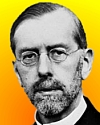
Died 9 Mar 1954 at age 79 (born 3 May 1874).
Swedish physical oceanographer and mathematical physicist whose research into the dynamics of ocean currents led to his name remaining associated with terms for particular phenomena of the ocean or atmosphere, including Ekman spiral, Ekman transport and Ekman layer. Fridtjof Nansen pointed out to Ekman that he had noticed that icebergs drift at an angle of 20°-40° to the prevailing wind, rather than directly with the wind. In 1902, Ekman published an explanation, known now as the Ekman spiral, describing movement of ocean currents influenced by the Earth's rotation. He also developed experimental techniques and instruments such as the Ekman current meter and Ekman water bottle.«
Swedish physical oceanographer and mathematical physicist whose research into the dynamics of ocean currents led to his name remaining associated with terms for particular phenomena of the ocean or atmosphere, including Ekman spiral, Ekman transport and Ekman layer. Fridtjof Nansen pointed out to Ekman that he had noticed that icebergs drift at an angle of 20°-40° to the prevailing wind, rather than directly with the wind. In 1902, Ekman published an explanation, known now as the Ekman spiral, describing movement of ocean currents influenced by the Earth's rotation. He also developed experimental techniques and instruments such as the Ekman current meter and Ekman water bottle.«
Died 9 Mar 1942 at age 80 (born 23 Sep 1861).
German engineer and industrialist who was responsible for the invention of the spark plug and magneto for automobiles and whose firm produced a wide range of precision machines and electrical equipment in plants throughout the world.
German engineer and industrialist who was responsible for the invention of the spark plug and magneto for automobiles and whose firm produced a wide range of precision machines and electrical equipment in plants throughout the world.
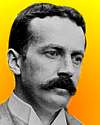
Died 9 Mar 1930 at age 73 (born 24 Jun 1856).
American archaeologist, collector, and tilemaker. In his early years, he pursued archaeology. In 1897, while searching for fireplace tools in a junk dealer's barn, Mercer found a jumble of American Pioneer handicraft tools made obsolete by the Industrial Revolution. He realized these pre-1850 work related implements might one day be the prized findings of future archeologists. Mercer seized upon opportunity to preserve such endangered artifacts. He spent a lifetime building his collection, which he called "The Tools of the Nation Maker." In 1898, he founded the Moravian Pottery and Tile Works in Doylestown, PA., to manufacture hand-worked relief-decorated ceramic tiles by a system he developed and patented.
American archaeologist, collector, and tilemaker. In his early years, he pursued archaeology. In 1897, while searching for fireplace tools in a junk dealer's barn, Mercer found a jumble of American Pioneer handicraft tools made obsolete by the Industrial Revolution. He realized these pre-1850 work related implements might one day be the prized findings of future archeologists. Mercer seized upon opportunity to preserve such endangered artifacts. He spent a lifetime building his collection, which he called "The Tools of the Nation Maker." In 1898, he founded the Moravian Pottery and Tile Works in Doylestown, PA., to manufacture hand-worked relief-decorated ceramic tiles by a system he developed and patented.
Ancient Carpenter's Tools: Illustrated and Explained..., by Henry Chapman Mercer. - book suggestion.
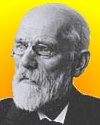
Died 9 Mar 1923 at age 85 (born 23 Nov 1837).
Dutch physicist who was awarded the 1910 Nobel Prize for Physics for his research on the gaseous and liquid states of matter. He was largely self-taught in science and he originally worked as a school teacher. His main work was to develop an equation (the van der Waals equation) that—unlike the laws of Charles Boyle and Jacques Charles—applied to real gases. Since the molecules do have attractive forces and volume (however small), van der Waals introduced into the theory two further constants to take these properties into account. The weak electrostatic attractive forces between molecules and between atoms are called van der Waals forces in his honour. His valuable results enabled James Dewar and Heike Kamerlingh-Onnes to work out methods of liquefying the permanent gases.[Note: Alphabetizing under rules for Dutch names, usage is "Waals, Johannes van der". Notice use of lower case for "van der". Contrast German names like "Von Braun, Werner".]
Dutch physicist who was awarded the 1910 Nobel Prize for Physics for his research on the gaseous and liquid states of matter. He was largely self-taught in science and he originally worked as a school teacher. His main work was to develop an equation (the van der Waals equation) that—unlike the laws of Charles Boyle and Jacques Charles—applied to real gases. Since the molecules do have attractive forces and volume (however small), van der Waals introduced into the theory two further constants to take these properties into account. The weak electrostatic attractive forces between molecules and between atoms are called van der Waals forces in his honour. His valuable results enabled James Dewar and Heike Kamerlingh-Onnes to work out methods of liquefying the permanent gases.[Note: Alphabetizing under rules for Dutch names, usage is "Waals, Johannes van der". Notice use of lower case for "van der". Contrast German names like "Von Braun, Werner".]
Died 9 Mar 1908 at age 81 (born 10 May 1826).
English geologist whose microscopic studies of thin slices of rock earned him the title "father of microscopical petrography."
English geologist whose microscopic studies of thin slices of rock earned him the title "father of microscopical petrography."
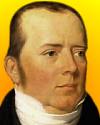
Died 9 Mar 1851 at age 73 (born 14 Aug 1777). quotes
Hans Christian Ørsted was a Danish physicist and chemist whose discovery (1820) that an electric current in a wire causes a nearby magnetized compass needle to deflect, indicating the electric current in a wire induces a magnetic field around it, marks the starting point for the development of electromagnetic theory. For this, he can be called “the father of electromagnetism,” for which his name was adopted for the magnetic field strength in the CGS system of units (for which the SI system now uses the henry unit). Philosophically, he had believed nature's forces had a common origin. Oersted was the first to isolate aluminium as a metal (1825). He also made the first accurate determination of the compressibility of water (1822). Late in his career, he researched diamagnetism. In his final years, he turned back to philosophy, and started writing The Soul in Nature.«
Hans Christian Ørsted was a Danish physicist and chemist whose discovery (1820) that an electric current in a wire causes a nearby magnetized compass needle to deflect, indicating the electric current in a wire induces a magnetic field around it, marks the starting point for the development of electromagnetic theory. For this, he can be called “the father of electromagnetism,” for which his name was adopted for the magnetic field strength in the CGS system of units (for which the SI system now uses the henry unit). Philosophically, he had believed nature's forces had a common origin. Oersted was the first to isolate aluminium as a metal (1825). He also made the first accurate determination of the compressibility of water (1822). Late in his career, he researched diamagnetism. In his final years, he turned back to philosophy, and started writing The Soul in Nature.«
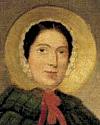
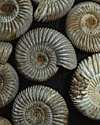
English fossil collector who made her first significant discovery at the age of 11 or 12 (sources differ on the details), when she found a complete skeleton of an Ichthyosaurus, from the Jurassic period. The ten-meter (30 feet) long skeleton created a sensation and made her famous. Anning's determination and keen scientific interest in fossils derived from her father's interest in fossil hunting, and a need for the income derived from them to support her family after his death. in 1810. She sold large fossils to noted paleontologists of the day, and smaller ones to the tourist trade. In 1823, Anning made another great discovery, found the first complete Plesiosaurus. Later in her life, the Geological Society of London granted Anning an honorary membership.
The Fossil Hunter: Dinosaurs, Evolution, and the Woman Whose Discoveries Changed the World, by Shelley Emling. - book suggestion.
Died 9 Mar 1823 at age 55 (born 24 Aug 1767).
Swiss scientist and politician who was president of the Great Council of the Helvetic Republic (1798-1799) and who was an outspoken opponent of federalism. He directed the canalization of the Linth River.
Swiss scientist and politician who was president of the Great Council of the Helvetic Republic (1798-1799) and who was an outspoken opponent of federalism. He directed the canalization of the Linth River.
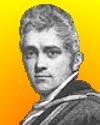
Died 9 Mar 1822 at age 52 (born 5 Jun 1769).
English mineralogist and traveller who amassed a valuable collection of minerals. In 1799, he began a 3-year tour through Asia Minor, Italy, Greece, Scandinavia and Siberia, where he also collected maps, statues and sarcophagi, manuscripts, and Greek coins. He was the first professor of mineralogy at Cambridge University (1808). In 1817 he became librarian there, until his health failed, though he continued to lecture until 1821. He had a significant impact through his teaching of minerology in terms of crystallography and the new chemistry, and through the topological geology and volcanological observations in his widely read Travels (6 vols. 1810-23). His mineral collection was bought by Cambridge at his death for 1,500 pounds.
English mineralogist and traveller who amassed a valuable collection of minerals. In 1799, he began a 3-year tour through Asia Minor, Italy, Greece, Scandinavia and Siberia, where he also collected maps, statues and sarcophagi, manuscripts, and Greek coins. He was the first professor of mineralogy at Cambridge University (1808). In 1817 he became librarian there, until his health failed, though he continued to lecture until 1821. He had a significant impact through his teaching of minerology in terms of crystallography and the new chemistry, and through the topological geology and volcanological observations in his widely read Travels (6 vols. 1810-23). His mineral collection was bought by Cambridge at his death for 1,500 pounds.
Died 9 Mar 886 at age 98 (born 10 Aug 787).
Persian astrologer, a.k.a. Abu Ma'shar al-Balkhi, or Ja'far ibn Muhammad, who was the leading astrologer of the Muslim world. He is known primarily for his theory that the world, created when the seven planets were in conjunction in the first degree of Aries, will come to an end at a like conjunction in the last degree of Pisces.
Persian astrologer, a.k.a. Abu Ma'shar al-Balkhi, or Ja'far ibn Muhammad, who was the leading astrologer of the Muslim world. He is known primarily for his theory that the world, created when the seven planets were in conjunction in the first degree of Aries, will come to an end at a like conjunction in the last degree of Pisces.
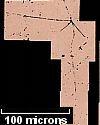
In 1948, the University of California at Berkeley and the Atomic Energy Commission officially announced the artificial production of mesons using the 184-inch cyclotron at the university's Radiation Laboratory. Mesons in nature had previously been seen as cloud chamber tracks by Carl Anderson, and others (formed by cosmic rays) had been detected by other scientists in photographic plates made at high altitude. Now, at the limits of energy available from the cyclotron, these short-lived particles were generated artificially by Eugene Gardner and C.M.G. Lattes, using a beam of accelerated alpha particles fired at a thin carbon target. Time reported the discovery and hinted that the study of mesons might “lead in the direction of a vastly better source of atomic energy than the fission of uranium.”«[Image: Part of a photomicrograph of the track of one of the first mesons found by Gardener and Lattes, 1948. The meson enters from the bottom of this image. The star track shows a nuclear disintegration resulting from a colliding meson.]
In 1893, Professor James Dewar communicated to the meeting of the Royal Society that he had succeeded in freezing air into a clear, transparent solid. The precise nature of this solid was not known, and needed further research. It was speculated that it may be “a jelly of solid nitrogen containing liquid oxygen, much as calves'foot jelly contains water diffused in solid gelatine. Or it may be a true ice of liquid air, in which both oxygen and nitrogen exist in the solid form.” At this time, Dewar had not been able to solidify pure oxygen, although nitrogen had been frozen with comparative ease. It also had already been proved that in the evaporation of liquid air, nitrogen boils off first.
more
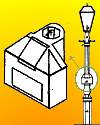
In 1858, the first U.S. patent for a street mailbox was patented by Albert Potts of Philadelphia (No.19,578). It comprised a simple metal box designed to attach to a lamppost. By August, these boxes were found along the streets of Boston, Mass., and New York City, N.Y. His patent described the "object of this improvement is to afford greater facilities to the inhabitants of large cities for the depositing of letters, and to enable the carriers to collect, or the citizens to deposit therein, at any period of time." The boxes had a central hole for the shaft of a lamp post, lids covering the drop hole to exclude weather, a sight hole so a carrier could see if any letters had been deposited, and a small door secured with a lock for the carrier to empty the box.
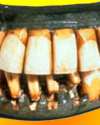
In 1822, Charles M. Graham of N.Y. was issued the first U.S. patent for artificial teeth. The record, and its details, was lost in the Patent Office fire of 15 Dec 1836. Similarly lost, the patent by William R. Eagleson for setting natural and artificial teeth (4 Oct 1817). False teeth had been used since Colonial years, with various attempts to replace rotten teeth, which were extraacted to avoid illness. George Washington had at least four sets of false teeth (though none were wooden, despite a myth to that effect). His first dentures were made using human teeth set into carved ivory. In 1789, dentist John Greenwood of New York, made Washington a complete set from hippopotamus ivory, gold wire springs and brass screws holding human teeth. His one natural remaining tooth was a molar, and a hole was left for it.«[Image: Closeup of George Washington's dentures (c.1790) with human teeth and modeled teeth carved from cow teeth and elephant ivory.]
The American Dentist: A Pictorial History, by Richard A. Glenner. - book suggestion.
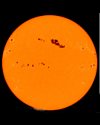
In 1611, Johannes Fabricius, a Dutch astronomer, observed the rising sun through his telescope, and observed several dark spots on it. This was perhaps the first ever observation of sunspots. He called his father to investigate this new phenomenon with him. The brightness of the Sun's center was very painful, and the two quickly switched to a projection method by means of a camera obscura. Johannes was the first to publish information on such observations. He did so in his Narratio de maculis in sole observatis et apparente earum cum sole conversione. ("Narration on Spots Observed on the Sun and their Apparent Rotation with the Sun"), the dedication of which was dated 13 Jun 1611.




