Born 29 Feb 1928. quotes
Caleb Vance Haynes, Jr. is an American archeologist and geologist who was active (1996-2004) in the effort to keep the remains of prehistoric Kennewick Man for academic purposes, rather than letting the Army Corps of Engineers repatriate them to a modern Indian tribe. Haynes was one of eight scientists that sued on 16 Oct 1996 for the right to study the bones. He provided the court deciding the matter with arguments that because the bones had been carbon dated to be about 9,000 years old, the remains could not be a direct ancestor of any modern tribe. The court's judgment was that Kennewick Man did not meet the definition of a native American, as used in the Native American Graves and Protection Act. The almost complete skeleton of Kennewick Man, found beside the Columbia River in Kennewick, Washington (28 Jul 1996), is one of the very few specimens available to understand the peopling of America in that era, and offers great value to science.«
Caleb Vance Haynes, Jr. is an American archeologist and geologist who was active (1996-2004) in the effort to keep the remains of prehistoric Kennewick Man for academic purposes, rather than letting the Army Corps of Engineers repatriate them to a modern Indian tribe. Haynes was one of eight scientists that sued on 16 Oct 1996 for the right to study the bones. He provided the court deciding the matter with arguments that because the bones had been carbon dated to be about 9,000 years old, the remains could not be a direct ancestor of any modern tribe. The court's judgment was that Kennewick Man did not meet the definition of a native American, as used in the Native American Graves and Protection Act. The almost complete skeleton of Kennewick Man, found beside the Columbia River in Kennewick, Washington (28 Jul 1996), is one of the very few specimens available to understand the peopling of America in that era, and offers great value to science.«
Skull Wars: Kennewick Man, Archaeology, And The Battle For Native American Identity, by David Hurst Thomas and Vine Deloria Jr. - book suggestion.
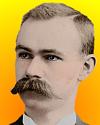
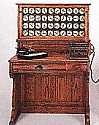
American inventor of a tabulating machine that was an important precursor of the electronic computer. For the 1890 U.S. census, he invented several punched-card machines to automate the sorting of data. The machine which read the cards used a pin going through a hole in the card to make an electrical connection with mercury placed beneath. The resulting electrical current activated a mechanical counter. It saved the U.S. 5 million dollars for the 1890 census by completing the analysis of the data in a fraction of the time it would have taken without it and with a smaller amount of manpower than would have been necessary otherwise. In 1896, he formed the Tabulating Machine Company, a precursor of IBM.
Herman Hollerith: Forgotten Giant of Information Processing, by Geoffrey Austrian. - book suggestion.
Born 29 Feb 1840; died 12 Aug 1914 at age 74.
Irish inventor known as the “father of the modern submarine,” who designed and built the first underwater vessel accepted by the U.S. Navy. In 1873, he emigrated to the U.S. where, with financial support from the Irish Fenian Society (who hoped to use submarines against England), he built the Fenian Ram, a small sub that proved a limited success in a test run. In 1895, his J.P. Holland Torpedo Boat Company received a contract from the U.S. Navy to build a submarine, and in 1898 a successful Holland, the first truly practical submarine, was launched. The U.S. government ordered six more; similar orders came from England, Japan, and Russia. Holland’s final years were marked by litigation with his financial backers.[EB gives birth date as 29 Feb. Some sources give 24 Feb.] more
Irish inventor known as the “father of the modern submarine,” who designed and built the first underwater vessel accepted by the U.S. Navy. In 1873, he emigrated to the U.S. where, with financial support from the Irish Fenian Society (who hoped to use submarines against England), he built the Fenian Ram, a small sub that proved a limited success in a test run. In 1895, his J.P. Holland Torpedo Boat Company received a contract from the U.S. Navy to build a submarine, and in 1898 a successful Holland, the first truly practical submarine, was launched. The U.S. government ordered six more; similar orders came from England, Japan, and Russia. Holland’s final years were marked by litigation with his financial backers.[EB gives birth date as 29 Feb. Some sources give 24 Feb.] more
John P. Holland, 1841-1914: Inventor of the Modern Submarine, by Richard Knowles Morris. - book suggestion.
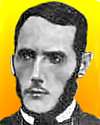
Born 29 Feb 1804; died 27 Mar 1879 at age 75.
Antoine Hercule Romuald Florence was a French inventor, photographer and printer who coined the word “photographie” in French (before the use of “photography” in English suggested by John Herschel). Florence pioneeried a process of reproducing drawings on paper sensitized with silver salts. He developed his ideas from 1832, before the better known Louis Daguerre. He was then living in Brazil, where he had settled in 1824 after working on board ships. During 1825-30, he had joined a scientific expedition as an illustrator and topographic draftsman. By 1832, his goal was document reproduction (in publications as illustrations) rather than portraits. He never published his discoveries to the larger scientific world in Europe, and his name was forgotten in history. In 1976, a Brazilian historian, Boris Kossoy, uncovered Florence's work, and studied his notes. Kossoy presented the results of his research at a photography symposium in 1976, and in a book published in 1980.
Antoine Hercule Romuald Florence was a French inventor, photographer and printer who coined the word “photographie” in French (before the use of “photography” in English suggested by John Herschel). Florence pioneeried a process of reproducing drawings on paper sensitized with silver salts. He developed his ideas from 1832, before the better known Louis Daguerre. He was then living in Brazil, where he had settled in 1824 after working on board ships. During 1825-30, he had joined a scientific expedition as an illustrator and topographic draftsman. By 1832, his goal was document reproduction (in publications as illustrations) rather than portraits. He never published his discoveries to the larger scientific world in Europe, and his name was forgotten in history. In 1976, a Brazilian historian, Boris Kossoy, uncovered Florence's work, and studied his notes. Kossoy presented the results of his research at a photography symposium in 1976, and in a book published in 1980.

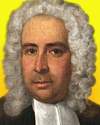
Died 29 Feb 1744 at age 60 (born 12 Mar 1683). quotes
French-English chaplain and physicist who studied at Oxford, became experimental assistant to Sir Isaac Newton. As curator at the Royal Society, his experimental lectures in mechanical philosophy and electricity (advocating, substantiating and popularizing the work of Isaac Newton) attracted a wide audience. In electricity, he coined the terms conductor and insulator. He repeated and extended the work of Stephen Gray in electricity. He proposed a scheme for heating vessels such as salt-boilers by steam instead of fire. He made inventions of his own, such as a planetarium, and improvements to machines, such as Thomas Savery's steam engine (by adding a safety valve, and using an internal water jet to condense the steam in the displacement chambers) and a ventilator at the House of Commons. He was a prolific author and translator.
French-English chaplain and physicist who studied at Oxford, became experimental assistant to Sir Isaac Newton. As curator at the Royal Society, his experimental lectures in mechanical philosophy and electricity (advocating, substantiating and popularizing the work of Isaac Newton) attracted a wide audience. In electricity, he coined the terms conductor and insulator. He repeated and extended the work of Stephen Gray in electricity. He proposed a scheme for heating vessels such as salt-boilers by steam instead of fire. He made inventions of his own, such as a planetarium, and improvements to machines, such as Thomas Savery's steam engine (by adding a safety valve, and using an internal water jet to condense the steam in the displacement chambers) and a ventilator at the House of Commons. He was a prolific author and translator.
John Theophilus Desaguliers: A Natural Philosopher, Engineer and Freemason in Newtonian England, by Audrey T. Carpenter. - book suggestion.
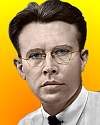
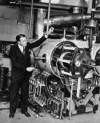
Lawrence standing with back to larger portion of his cyclotron.
An American Genius: The Life of Ernest Orlando Lawrence, by Childs Herbert. - book suggestion.
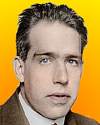
Niels Bohr

Suspended In Language: Niels Bohr's Life, Discoveries, And The Century He Shaped, by Jim Ottaviani. - book suggestion.
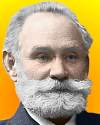
Pavlov
In 1936, two days after the death of Ivan Pavlov, the Soviet government preserved his memory by ordering a monument to be erected in Leningrad (St. Petersburg), renaming the First Leningrad Medical Institute “The Pavlov Institute,” maintaining his laboratory as a museum, preserving his brain, granting a pension to his widow, and publishing his collected works in four languages.
Ivan Pavlov: Exploring the Animal Machine, by Daniel Todes. - book suggestion.
In 1916, Maria Montessori of Rome, Italy, received a U.S. patent for “Cut-Out Geometrical Figure for Didactical Purposes” (No. 1,173,298). Montessori is famous for her educational methods. The patent covered her invention of a plate with recesses into which geometrical shapes can be fitted so the “fundamental principles of geometry may be easily and rapidly taught to young pupils.” The recesses can be filled with, for example, several smaller trianges that fill the larger triangular cavity.«
The Montessori Method, by Maria Montessori. - book suggestion.
Freezing Physics: Heike Kamerlingh Onnes and the Quest for Cold, by Dirk van Delft. - book suggestion.
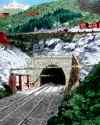
In 1880, the St. Gotthard Tunnel was connected, linking Switzerland and Italy, when workers boring from both ends met and broke through the last rock wall remaining between them. It is 5 miles (15-km) long, connecting Göschenen with Airolo. About 200 construction workers had died during the years of digging, many from water inrushes, others crushed by equipment and from disease. Swiss engineer and tunnel surveyor, Louis Favre, suffered a fatal heart attack inside the tunnel in 1879. The double-track standard-guage railway was completed and opened for traffic in 1882. This provided a much faster passage through the Swiss Alps than had been possible before, when a steep, difficult overland route had to be travelled. Initially, steam locomotives made the journey, but the route was electrified starting in1920.«
more
The Gotthard Railway, by documentary DVD. - book suggestion.
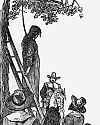
In 1692, Sarah Osborne, Sarah Good, and Tituba, a slave woman, were arrested in Salem Township (now Danvers), Massachusetts, charged with using witchcraft to inflict suffering on four girls. Accusations of witchcraft spread and 20 accused witches were eventually executed between 10 Jun and 22 Sep 1692. Sarah Good was hanged on 19 Jul 1692. Sarah Osborn died in prison. Tituba, an Indian woman from South America, sold into slavery, avoided trial by making an early confession. After 13 months in jail, an unknown person bought her release from prison. The Salem witchcraft trials provide a subject for modern commentary by abnormal and social psychologists. Modern parallels are the McCarthy Communist hunts of the 1950s, and the McMartin Preschool Abuse Trial of the 1980s.«[Image by artist F. T. Merrill depicting the execution of Mrs. Ann Hibbins on Boston Commons from Clarence W. Hobbs, Lynn and Surroundings (1886).]





