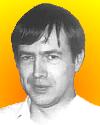
Born 28 Feb 1954; died 22 Dec 2018 at age 64.
Belgian mathematician who was awarded the Fields Medal in 1994 for his work in analysis. His achievements in several fields included the problem of determining how large a section of a Banach space of finite dimension n can be found that resembles a Hilbert subspace; a proof of Luis Antonio Santaló's inequality; a new approach to some problems in ergodic theory; results in harmonic analysis and classical operators; and nonlinear partial differential equations. Bourgain's work was noteworthy for the versatility it displayed in applying ideas from wide-ranging mathematical disciplines to the solution of diverse problems.
Belgian mathematician who was awarded the Fields Medal in 1994 for his work in analysis. His achievements in several fields included the problem of determining how large a section of a Banach space of finite dimension n can be found that resembles a Hilbert subspace; a proof of Luis Antonio Santaló's inequality; a new approach to some problems in ergodic theory; results in harmonic analysis and classical operators; and nonlinear partial differential equations. Bourgain's work was noteworthy for the versatility it displayed in applying ideas from wide-ranging mathematical disciplines to the solution of diverse problems.
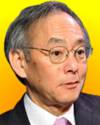
Born 28 Feb 1948. quotes
American physicist who (with Claude Cohen-Tannoudji and William D. Phillips) was awarded the 1997 Nobel Prize for Physics for their independent, pioneering research in cooling and trapping atoms using laser light. In their normal state the constant random thermal motion of atoms limits precise measurements of atomic states. Thus, physicists sought to cool and slow atoms down as much as possible. Chu used six laser beams and worked with a hot gas of sodium atoms. He managed to cool and trap atoms in what he called “optical molasses.” By 1985, he had cooled sodium atoms to a temperature of about 240 millionth of a degree above absolute zero. The atoms could be trapped in the laser beams for a period of about half a second. He was chosen by President Obama to become the 12th U.S. Secretary of Energy (2009-2013).
American physicist who (with Claude Cohen-Tannoudji and William D. Phillips) was awarded the 1997 Nobel Prize for Physics for their independent, pioneering research in cooling and trapping atoms using laser light. In their normal state the constant random thermal motion of atoms limits precise measurements of atomic states. Thus, physicists sought to cool and slow atoms down as much as possible. Chu used six laser beams and worked with a hot gas of sodium atoms. He managed to cool and trap atoms in what he called “optical molasses.” By 1985, he had cooled sodium atoms to a temperature of about 240 millionth of a degree above absolute zero. The atoms could be trapped in the laser beams for a period of about half a second. He was chosen by President Obama to become the 12th U.S. Secretary of Energy (2009-2013).
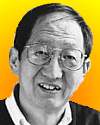
Born 28 Feb 1939.
Chinese-American physicist who shared (with Horst L. Störmer and Robert B. Laughlin) received the 1998 Nobel Prize for Physics for the discovery and explanation that the electrons in a powerful magnetic field at very low temperatures can form a quantum fluid whose particles have fractional electric charges. This effect is known as the fractional quantum.
Chinese-American physicist who shared (with Horst L. Störmer and Robert B. Laughlin) received the 1998 Nobel Prize for Physics for the discovery and explanation that the electrons in a powerful magnetic field at very low temperatures can form a quantum fluid whose particles have fractional electric charges. This effect is known as the fractional quantum.
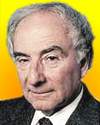
Born 28 Feb 1930; died 23 Oct 2024 at age 94. quotes
American physicist who shared (with John Bardeen and John Robert Schrieffer) the 1972 Nobel Prize in Physics, for contributing the concept of Cooper electron pairs which forms the basis of the BCS (their initials) theory of superconductivity, which he worked on in his 20s. He went on to become a cofounder and cochairman of Nestor, Inc., an industry leader in applying neural-network systems to commercial and military applications. The company built computer-based adaptive pattern-recognition and risk-assessment systems, with such applications as accurately classifying complex patterns like targets in sonar, radar or imaging systems. He also founded and was director of Brown University’s Institute for Brain and Neural Systems to develop cognitive pharmaceuticals and intelligent systems for electronics, automobiles and communications.«[Born Leon N. Kupchik, in which the N represented nothing beyond a letter.]
American physicist who shared (with John Bardeen and John Robert Schrieffer) the 1972 Nobel Prize in Physics, for contributing the concept of Cooper electron pairs which forms the basis of the BCS (their initials) theory of superconductivity, which he worked on in his 20s. He went on to become a cofounder and cochairman of Nestor, Inc., an industry leader in applying neural-network systems to commercial and military applications. The company built computer-based adaptive pattern-recognition and risk-assessment systems, with such applications as accurately classifying complex patterns like targets in sonar, radar or imaging systems. He also founded and was director of Brown University’s Institute for Brain and Neural Systems to develop cognitive pharmaceuticals and intelligent systems for electronics, automobiles and communications.«[Born Leon N. Kupchik, in which the N represented nothing beyond a letter.]
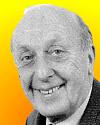
Born 28 Feb 1916; died 21 Nov 2004 at age 88.
British inventor and manufacturer of skin-care products who invented Swarfega hand cleaner, a green jelly that mechanics, printers and others use to wash grease, grime, and ink from their hands. "AB," as he was known, started his company, Deb Ltd., in 1941, selling a mild detergent to treat silk stocking, a market which collapsed with the arrival of nylons after WW II. However, he knew that mechanics cleaned their hands with petrol, paraffin and sand which was effective at removing oil, but also caused dry skin and dermatitis. He adapted his detergent formula to clean oil from skin without these side effects, and named it by combining "swarf" (term for greasy grit) and "-ega" (eager). By the time he retired, the company had 20 brands.«
British inventor and manufacturer of skin-care products who invented Swarfega hand cleaner, a green jelly that mechanics, printers and others use to wash grease, grime, and ink from their hands. "AB," as he was known, started his company, Deb Ltd., in 1941, selling a mild detergent to treat silk stocking, a market which collapsed with the arrival of nylons after WW II. However, he knew that mechanics cleaned their hands with petrol, paraffin and sand which was effective at removing oil, but also caused dry skin and dermatitis. He adapted his detergent formula to clean oil from skin without these side effects, and named it by combining "swarf" (term for greasy grit) and "-ega" (eager). By the time he retired, the company had 20 brands.«
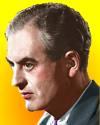
Born 28 Feb 1915; died 2 Oct 1987 at age 72. quotes
Sir Peter Brian Medawar was an English immunologist and author who shared, with Sir Frank Burnet, the 1960 Nobel Prize in Physiology or Medicine for their discovery of acquired immunological tolerance, which enabled organ and tissue transplantation. Medawar inoculated the embryos of mice, before they had developed the ability to form antibodies, with tissue cells from another strain. Subsequently, the “foreign” proteins were accepted, even when later the capability to form antibodies existed. Skin grafts from the second strain were then accepted by the inoculated mice.
Sir Peter Brian Medawar was an English immunologist and author who shared, with Sir Frank Burnet, the 1960 Nobel Prize in Physiology or Medicine for their discovery of acquired immunological tolerance, which enabled organ and tissue transplantation. Medawar inoculated the embryos of mice, before they had developed the ability to form antibodies, with tissue cells from another strain. Subsequently, the “foreign” proteins were accepted, even when later the capability to form antibodies existed. Skin grafts from the second strain were then accepted by the inoculated mice.
Advice to a Young Scientist, by Sir Peter Brian Medawar. - book suggestion.
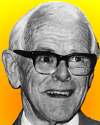
Born 28 Feb 1911; died 23 Mar 1993 at age 82. quotes
Denis Parsons Burkitt was an Irish surgeon and medical researcher who first identified Burkitt's lymphoma. In 1957, in Uganda, Burkitt found several children suffering from fast-spreading tumours in the head and neck. When they died within weeks, Burkitt recognised this was a previously undescribed cancer disease. He showed that these and all cases were characterized by infiltration of the affected tissues by lymphocytes. With colleagues Edward Williams and Clifford Nelson, he plotted the geographical incidence of the disease, and found it in the same areas endemic with malaria. This survey is regarded as one of the pioneering studies of geographical pathology. Burkitt helped to develop chemotherapy for the disease. Later, he championed high fibre diets.«
Denis Parsons Burkitt was an Irish surgeon and medical researcher who first identified Burkitt's lymphoma. In 1957, in Uganda, Burkitt found several children suffering from fast-spreading tumours in the head and neck. When they died within weeks, Burkitt recognised this was a previously undescribed cancer disease. He showed that these and all cases were characterized by infiltration of the affected tissues by lymphocytes. With colleagues Edward Williams and Clifford Nelson, he plotted the geographical incidence of the disease, and found it in the same areas endemic with malaria. This survey is regarded as one of the pioneering studies of geographical pathology. Burkitt helped to develop chemotherapy for the disease. Later, he championed high fibre diets.«
Fiber Man: The Life Story of Dr Denis Burkitt, by Brian Kellock. - book suggestion.
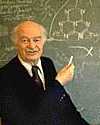
Born 28 Feb 1901; died 19 Aug 1994 at age 93. quotes
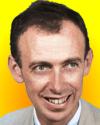
Linus Carl Pauling was an American chemist, physicist and author who applied quantum mechanics to the study of molecular structures, particularly in connection with chemical bonding. Pauling was the only person ever to win two unshared Nobel prizes. The first was the Nobel Prize for Chemistry awarded in 1954 for charting the chemical underpinnings of life itself. In addition, because of his work for nuclear peace, he received the Nobel Prize for Peace in 1962. He is remembered also for his strong belief in the health benefits of large doses of vitamin C.
Linus Carl Pauling was an American chemist, physicist and author who applied quantum mechanics to the study of molecular structures, particularly in connection with chemical bonding. Pauling was the only person ever to win two unshared Nobel prizes. The first was the Nobel Prize for Chemistry awarded in 1954 for charting the chemical underpinnings of life itself. In addition, because of his work for nuclear peace, he received the Nobel Prize for Peace in 1962. He is remembered also for his strong belief in the health benefits of large doses of vitamin C.
Linus Pauling in His Own Words: Selections From his Writings, Speeches and Interviews, by Barbara Marinacci. - book suggestion.
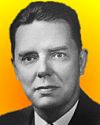
Born 28 Feb 1896; died 30 Mar 1965 at age 69. quotes
American physician who was one of the leaders in American rheumatology. He shared the Nobel Prize for Physiology or Medicine in 1950 for discoveries relating to the hormones of the adrenal cortex, their structure and biological effects (with Edward C. Kendall and Tadeus Reichstein of Switzerland). In 1948, Hench was working at the Mayo Clinic, Rochester, Minnesota. He noticed that during pregnancy and in the presence of jaundice the severe pain of arthritis may decrease and even disappear. With Kendall, he successfully applied an adrenal hormone (later known as cortisone) in the treatment of rheumatoid arthritis.
American physician who was one of the leaders in American rheumatology. He shared the Nobel Prize for Physiology or Medicine in 1950 for discoveries relating to the hormones of the adrenal cortex, their structure and biological effects (with Edward C. Kendall and Tadeus Reichstein of Switzerland). In 1948, Hench was working at the Mayo Clinic, Rochester, Minnesota. He noticed that during pregnancy and in the presence of jaundice the severe pain of arthritis may decrease and even disappear. With Kendall, he successfully applied an adrenal hormone (later known as cortisone) in the treatment of rheumatoid arthritis.
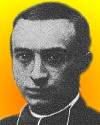
Born 28 Feb 1877; died 14 Aug 1961 at age 84.
Henri-Édouard-Prosper Breuil was a French archaeologist, who was an authority on Paleolithic cave paintings, especially in France and Spain. He was ordained a priest (1900). At various important sites, he diligently recorded cave art in colour reproductions. When making interpretations, and related them, he was careful to avoid unsubstantiated conclusions regarding the religious or social aspects of the primitive painters. In a classic paper (1912), he made a reclassification of Paleolithic industries. In 1940, he was the first to visit and describe Lascaux. After WW II, he travelled extensively in Africa for nearly six years examining and creating images of the art in thousands of rock shelters.«
Henri-Édouard-Prosper Breuil was a French archaeologist, who was an authority on Paleolithic cave paintings, especially in France and Spain. He was ordained a priest (1900). At various important sites, he diligently recorded cave art in colour reproductions. When making interpretations, and related them, he was careful to avoid unsubstantiated conclusions regarding the religious or social aspects of the primitive painters. In a classic paper (1912), he made a reclassification of Paleolithic industries. In 1940, he was the first to visit and describe Lascaux. After WW II, he travelled extensively in Africa for nearly six years examining and creating images of the art in thousands of rock shelters.«
Father of Prehistory: The Abbe Henri Breuil: His Life and Times, by Alan Houghton Brodrick. - book suggestion.
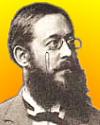
Born 28 Feb 1849; died 5 Jan 1908 at age 58.
Friedrich Everhard Anton Joseph Julius Freiherr von Mering was a German physiologist, physician, pharmacologist and experimental pathologist, who jointly discovered that removal of the pancreas in a dog produces the symptoms of diabetes. He worked with Oskar Minkowski, who recognized the resulting polyuria and tested the animal’s blood for glucose, an indicator of diabetes. This led Minkowski to propose that the pancreas secreted some antidiabetic substance. Though they did not isolate it, they wrote a paper* reporting this finding. Thus diabetes, which had long been held to be a kidney disease, was recognized as pancreatic disorder. Edward Sharpey-Schafer coined the term insulin in 1915, some years in advance of its eventual isolation. Insulin is a hormone synthesized in the pancreas that is important for the body to make proper use of sugar.«[* Archiv für experimentelle Pathologie und Pharmakologie (26, 371; 1890). Note: A few sources give Dec or Sep as the birth month, but the Feb birth date appears on the extant birth certificate in the German archives.]
Friedrich Everhard Anton Joseph Julius Freiherr von Mering was a German physiologist, physician, pharmacologist and experimental pathologist, who jointly discovered that removal of the pancreas in a dog produces the symptoms of diabetes. He worked with Oskar Minkowski, who recognized the resulting polyuria and tested the animal’s blood for glucose, an indicator of diabetes. This led Minkowski to propose that the pancreas secreted some antidiabetic substance. Though they did not isolate it, they wrote a paper* reporting this finding. Thus diabetes, which had long been held to be a kidney disease, was recognized as pancreatic disorder. Edward Sharpey-Schafer coined the term insulin in 1915, some years in advance of its eventual isolation. Insulin is a hormone synthesized in the pancreas that is important for the body to make proper use of sugar.«[* Archiv für experimentelle Pathologie und Pharmakologie (26, 371; 1890). Note: A few sources give Dec or Sep as the birth month, but the Feb birth date appears on the extant birth certificate in the German archives.]
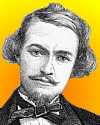
1864
Born 28 Feb 1840; died 25 Apr 1892 at age 52.
French explorer who contributed to African ethnology with his study of the Tuareg people of the Sahara. He travelled through the region south of the Atlas Mountains, between Morocco and Tunisia. There he spent months living with the Tuareg, a pastoral people, observing their customs, speech, and their interest in poetry.«
French explorer who contributed to African ethnology with his study of the Tuareg people of the Sahara. He travelled through the region south of the Atlas Mountains, between Morocco and Tunisia. There he spent months living with the Tuareg, a pastoral people, observing their customs, speech, and their interest in poetry.«
Born 28 Feb 1814; died 2 Feb 1894 at age 79.
French chemist best known for his discovery of hydrogen fluoride and investigations of fluorine compounds. Among other compounds, Frémy investigated those of iron, tin, and lead. He also studied osmic acid, ozone, the colouring substances of leaves and flowers, and the composition of animal substances. He applied chemistry to the commercial saponification of fats, and to the technology of iron, steel, sulfuric acid, glass and paper. He tried, but failed, to isolate the element fluorine. He also failed in attempts to make crystals of aluminium oxide, but instead found he could create rubies.[DSB gives date of death 2 Feb 1894. EB gives 3 Feb 1894.]
French chemist best known for his discovery of hydrogen fluoride and investigations of fluorine compounds. Among other compounds, Frémy investigated those of iron, tin, and lead. He also studied osmic acid, ozone, the colouring substances of leaves and flowers, and the composition of animal substances. He applied chemistry to the commercial saponification of fats, and to the technology of iron, steel, sulfuric acid, glass and paper. He tried, but failed, to isolate the element fluorine. He also failed in attempts to make crystals of aluminium oxide, but instead found he could create rubies.[DSB gives date of death 2 Feb 1894. EB gives 3 Feb 1894.]
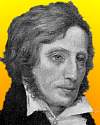
Born 28 Feb 1792; died 28 Nov 1876 at age 84. quotes
Karl Ernst Ritter von Baer, Edler von Huthorn was a German-Russian embryologist who discovered the mammalian egg (1827) and the notochord. He established the new science of comparative embryology alongside comparative anatomy with the publication of two landmark volumes (in 1828 and 1837) covering the range of existing knowledge of the prebirth developments of vertebrates. He showed that mammalian eggs were not the follicles of the ovary but microscopic particles inside the follicles. He described the development of the embryo from layers of tissue, which he called germ layers, and demonstrated similarities in the embryos of different species of vertebrates. He was also a pioneer in geography, ethnology, and physical anthropology.EB gives b. 29 Feb 1792. O.S. dates 17 Feb 1792 – 16 Nov 1876. (a.k.a. Charles de Baer)
Karl Ernst Ritter von Baer, Edler von Huthorn was a German-Russian embryologist who discovered the mammalian egg (1827) and the notochord. He established the new science of comparative embryology alongside comparative anatomy with the publication of two landmark volumes (in 1828 and 1837) covering the range of existing knowledge of the prebirth developments of vertebrates. He showed that mammalian eggs were not the follicles of the ovary but microscopic particles inside the follicles. He described the development of the embryo from layers of tissue, which he called germ layers, and demonstrated similarities in the embryos of different species of vertebrates. He was also a pioneer in geography, ethnology, and physical anthropology.EB gives b. 29 Feb 1792. O.S. dates 17 Feb 1792 – 16 Nov 1876. (a.k.a. Charles de Baer)
Autobiography of Dr Karl Ernest Von Baer, by Karl Ernst von Baer. - book suggestion.
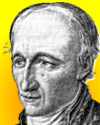
Born 28 Feb 1743; died 1 Jun 1822 at age 79. quotes
French mineralogist who was the founder of the science of crystallography through his discovery of the geometrical law of crystallization. In 1781, he saw an accidentally dropped calcite crystal broke into rhombohedral pieces. Deliberately breaking various forms of calcite, he found the same result. He concluded that all the molecules of calcite have the same form and it is only how they are joined together that produces different gross structures. Hence, he suggested that other minerals should show different basic forms. He thought that there were, in fact, six different primitive forms from which all crystals could be derived by being linked in different ways. His theory was able to predict in many cases the correct angles of a crystal face.
French mineralogist who was the founder of the science of crystallography through his discovery of the geometrical law of crystallization. In 1781, he saw an accidentally dropped calcite crystal broke into rhombohedral pieces. Deliberately breaking various forms of calcite, he found the same result. He concluded that all the molecules of calcite have the same form and it is only how they are joined together that produces different gross structures. Hence, he suggested that other minerals should show different basic forms. He thought that there were, in fact, six different primitive forms from which all crystals could be derived by being linked in different ways. His theory was able to predict in many cases the correct angles of a crystal face.
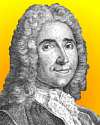
Born 28 Feb 1683; died 17 Oct 1757 at age 74. quotes
René Antoine Ferchault de Réaumur was a French entomologist and physicist, who was active in various fields, a distinguished entomologist, and appointed by King Louis XIV (1710) to inventory French natural and industrial resources. His name is applied to a thermometric scale he defined. In 1720, he built the first cupola furnace, for economically melting gray iron. He also improved techniques for making iron and steel. By study of Chinese porcelain, he created his own Réaumur porcelain (1740). In biology, he noted the ability of crayfish to regenerate lost limbs. Between 1734 and 1742, Réaumur wrote six volumes of Mémoires pour servir à l'histoire des insectes (Memoirs Serving as a Natural History of Insects). Although unfinished, this work was a lasting contribution to entomology. In 1752, he isolated gastric juice and investigated how it acted in food digestion.«[DSB gives date of death 18 Oct 1757. EB gives 17 Oct 1757.] more
René Antoine Ferchault de Réaumur was a French entomologist and physicist, who was active in various fields, a distinguished entomologist, and appointed by King Louis XIV (1710) to inventory French natural and industrial resources. His name is applied to a thermometric scale he defined. In 1720, he built the first cupola furnace, for economically melting gray iron. He also improved techniques for making iron and steel. By study of Chinese porcelain, he created his own Réaumur porcelain (1740). In biology, he noted the ability of crayfish to regenerate lost limbs. Between 1734 and 1742, Réaumur wrote six volumes of Mémoires pour servir à l'histoire des insectes (Memoirs Serving as a Natural History of Insects). Although unfinished, this work was a lasting contribution to entomology. In 1752, he isolated gastric juice and investigated how it acted in food digestion.«[DSB gives date of death 18 Oct 1757. EB gives 17 Oct 1757.] more
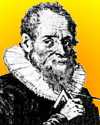
Born 28 Feb 1552; died 31 Jan 1632 at age 79.
Swiss watchmaker and mathematician who invented logarithms independently of the Scottish mathematician John Napier. He was the most skilful, and the most famous, clockmaker of his day. He also made astronomical and practical geometry instruments (notably the proportional compass and a triangulation instrument useful in surveying). This led to becoming an assistant to the German astronomer Johannes Kepler. Bürgi was a major contributor to the development of decimal fractions and exponential notation, but his most notable contribution was published in 1620 as a table of antilogarithms. Napier published his table of logarithms in 1614, but Bürgi had already compiled his table of logarithms at least 10 years before that, and perhaps as early as 1588.
Swiss watchmaker and mathematician who invented logarithms independently of the Scottish mathematician John Napier. He was the most skilful, and the most famous, clockmaker of his day. He also made astronomical and practical geometry instruments (notably the proportional compass and a triangulation instrument useful in surveying). This led to becoming an assistant to the German astronomer Johannes Kepler. Bürgi was a major contributor to the development of decimal fractions and exponential notation, but his most notable contribution was published in 1620 as a table of antilogarithms. Napier published his table of logarithms in 1614, but Bürgi had already compiled his table of logarithms at least 10 years before that, and perhaps as early as 1588.

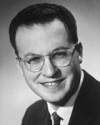
Died 28 Feb 2013 at age 86 (born 21 Sep 1926). quotes
Donald Arthur Glaser was an American physicist who received the 1960 Nobel Prize for Physics for his invention of the bubble chamber in which the behaviour of subatomic particles can be observed by the tracks they leave. A flash photograph records the particle's path. Glaser’s chamber contains a superheated liquid maintained in a superheated, unstable state without boiling. A piston causing a rapid decrease in pressure creates a tendency to boil at the slightest disturbance in the liquid. Then any atomic particle passing through the chamber leaves a track of small gas bubbles caused by an instantaneous boiling along its path where the ions it creates act as bubble-development centers.«
Donald Arthur Glaser was an American physicist who received the 1960 Nobel Prize for Physics for his invention of the bubble chamber in which the behaviour of subatomic particles can be observed by the tracks they leave. A flash photograph records the particle's path. Glaser’s chamber contains a superheated liquid maintained in a superheated, unstable state without boiling. A piston causing a rapid decrease in pressure creates a tendency to boil at the slightest disturbance in the liquid. Then any atomic particle passing through the chamber leaves a track of small gas bubbles caused by an instantaneous boiling along its path where the ions it creates act as bubble-development centers.«
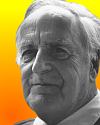
Died 28 Feb 2007 at age 98 (born 26 Jan 1909).
Scottish chemist who pioneered in environmental awareness, warning of the dangers to the environment from extensive industrial development. He co-commissioned the 1972 Limits to Growth report, which initiated international attention to environmental concerns. It is still one of the world's best-selling books on the environment. After directing scientific research as part of the war effort in WW II, he turned to the application of science for the improvement of life. In particular, he was chief scientist at the department of scientific and industrial research (1950-56), working to help British factories become more productive. After the publication of Limits to Growth, he cofounded the Club of Rome, an think tank focussed on how to establish sustainable development. He was that group's president 1984-90.«
Scottish chemist who pioneered in environmental awareness, warning of the dangers to the environment from extensive industrial development. He co-commissioned the 1972 Limits to Growth report, which initiated international attention to environmental concerns. It is still one of the world's best-selling books on the environment. After directing scientific research as part of the war effort in WW II, he turned to the application of science for the improvement of life. In particular, he was chief scientist at the department of scientific and industrial research (1950-56), working to help British factories become more productive. After the publication of Limits to Growth, he cofounded the Club of Rome, an think tank focussed on how to establish sustainable development. He was that group's president 1984-90.«
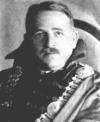
Died 28 Feb 1956 at age 76 (born 22 Jan 1880).
Hungarian mathematician and pioneer of functional analysis, which has found important applications to mathematical physics. His theorem, now called the Riesz-Fischer theorem, which he proved in 1907, is fundamental in the Fourier analysis of Hilbert space. It was the mathematical basis for proving that matrix mechanics and wave mechanics were equivalent. This is of fundamental importance in early quantum theory. His book Leçon's d'analyse fonctionnelle (written jointly with his student B Szökefalvi-Nagy) is one of the most readable accounts of functional analysis ever written. Beyond any mere abstraction for the sake of a structure theory, he was always turning back to the applications in some concrete and substantial situation.
Hungarian mathematician and pioneer of functional analysis, which has found important applications to mathematical physics. His theorem, now called the Riesz-Fischer theorem, which he proved in 1907, is fundamental in the Fourier analysis of Hilbert space. It was the mathematical basis for proving that matrix mechanics and wave mechanics were equivalent. This is of fundamental importance in early quantum theory. His book Leçon's d'analyse fonctionnelle (written jointly with his student B Szökefalvi-Nagy) is one of the most readable accounts of functional analysis ever written. Beyond any mere abstraction for the sake of a structure theory, he was always turning back to the applications in some concrete and substantial situation.
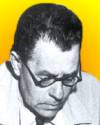
Died 28 Feb 1953 at age 63 (born 12 Aug 1889).
Eliezer Lipa Sukenik was a Polish-Israeli archaeologist who established the date and provenance of the Dead Sea Scrolls. He settled in Israel in 1912, began teaching in 1914 and eventually became field archaeologist at the Hebrew University. He directed the excavations of the synagogues and Jewish tombs. In 1947, within the eleven caves near Qumran, north-west of the Dead Sea, Israel, parts of more than 700 ancient Jewish manuscripts were discovered. Most were written in Hebrew, some in Aramaic and fewer in Greek. The Dead Sea Scrolls, as they came to be known, are assumed to have been the library of a sectarian community at Qumran. Sukenik devoted the rest of his life to their study.«
Eliezer Lipa Sukenik was a Polish-Israeli archaeologist who established the date and provenance of the Dead Sea Scrolls. He settled in Israel in 1912, began teaching in 1914 and eventually became field archaeologist at the Hebrew University. He directed the excavations of the synagogues and Jewish tombs. In 1947, within the eleven caves near Qumran, north-west of the Dead Sea, Israel, parts of more than 700 ancient Jewish manuscripts were discovered. Most were written in Hebrew, some in Aramaic and fewer in Greek. The Dead Sea Scrolls, as they came to be known, are assumed to have been the library of a sectarian community at Qumran. Sukenik devoted the rest of his life to their study.«
The Dead Sea Scrolls Today, by James C. Vanderkam. - book suggestion.
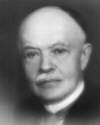
Died 28 Feb 1936 at age 69 (born 21 Sep 1866). quotes
French physician and bacteriologist who received the 1928 Nobel Prize for Physiology or Medicine for his discovery (1909) that typhus is transmitted by the body louse. When appointed as Director of the Pasteur Institute at Tunis, Africa, young Dr. Charles Nicolle was immediately brought into contact with the scientific and practical problems that typhus epidemics had created in this country. His solution began with the simple observation that whilst typhus patients continued to spread infection prior to entering the hospital, they were no longer a danger upon being bathed and in new clothing. This fact pointed to a parasite which lives on the patient's body and in his clothing. He subsequently identified the carrier to be the body louse.
French physician and bacteriologist who received the 1928 Nobel Prize for Physiology or Medicine for his discovery (1909) that typhus is transmitted by the body louse. When appointed as Director of the Pasteur Institute at Tunis, Africa, young Dr. Charles Nicolle was immediately brought into contact with the scientific and practical problems that typhus epidemics had created in this country. His solution began with the simple observation that whilst typhus patients continued to spread infection prior to entering the hospital, they were no longer a danger upon being bathed and in new clothing. This fact pointed to a parasite which lives on the patient's body and in his clothing. He subsequently identified the carrier to be the body louse.
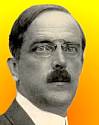
Died 28 Feb 1929 at age 54 (born 12 May 1874). quotes
Austrian physician who originated a skin test for tuberculosis that bears his name, a classic diagnostic test in which tuberculin is applied to a superficial abrasion of the skin of the arm. In 1906 he noticed that patients who had received injections of horse serum or smallpox vaccine usually had quicker, more severe reactions to second injections. While studying the symptoms of cowpox vaccination, he also developed a new theory about the incubation time of infectious diseases and the formation of antibodies. In 1909 he published the results of a series of tuberculin tests of inhabitants of Vienna that showed that 70% of the children tested had been infected by tuberculosis by age 10, and over 90% at age 14. He also studied infant nutrition.
Austrian physician who originated a skin test for tuberculosis that bears his name, a classic diagnostic test in which tuberculin is applied to a superficial abrasion of the skin of the arm. In 1906 he noticed that patients who had received injections of horse serum or smallpox vaccine usually had quicker, more severe reactions to second injections. While studying the symptoms of cowpox vaccination, he also developed a new theory about the incubation time of infectious diseases and the formation of antibodies. In 1909 he published the results of a series of tuberculin tests of inhabitants of Vienna that showed that 70% of the children tested had been infected by tuberculosis by age 10, and over 90% at age 14. He also studied infant nutrition.
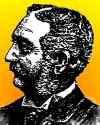
Died 28 Feb 1907 at age 82 (born 11 Jun 1824).
Orson Desaix Munn was an American ornithologist who was the publisher of Scientific American. The Munn & Company, formed with Salem H. Wales and editor Alfred Beach, bought the six-month-old Scientific American magazine from Rufus Porter. Together, they built it over the years into a great and unique periodical. Because they published a weekly list of all patents, and dealt with inventions and inventors, their enterprise led to Munn & Co. establishing the Scientific American Patent Agency. This was partially responsible for the rapid growth of the American patent system. In its percentage-peak years around 1860, one-third of all patents issued by the U.S. Patent Office were prosecuted by Munn & Co
Orson Desaix Munn was an American ornithologist who was the publisher of Scientific American. The Munn & Company, formed with Salem H. Wales and editor Alfred Beach, bought the six-month-old Scientific American magazine from Rufus Porter. Together, they built it over the years into a great and unique periodical. Because they published a weekly list of all patents, and dealt with inventions and inventors, their enterprise led to Munn & Co. establishing the Scientific American Patent Agency. This was partially responsible for the rapid growth of the American patent system. In its percentage-peak years around 1860, one-third of all patents issued by the U.S. Patent Office were prosecuted by Munn & Co
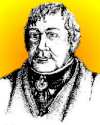
Died 28 Feb 1875 at age 82 (born 14 Feb 1793).
Prolific English inventor who built technically successful steam carriages a half century before the advent of the gasoline-powered automobile. His carriage successfully travelled between London and Bath at an average speed 15 mph. He built several more and opened a passenger service. However, powerful opposition from horse-coach companies ensured that they were soon taxed out of existence. Another of his inventions was the "Bude Light" which lit the House of Commons for 60 years. It was a standard oil lamp with oxygen gas introduced into the middle of the flame. The unburned carbon in the oil flame burned with an intense, white light instead of the weak yellow flame of the oil lamp. He introduced the use of limelight to lighthouses.
Prolific English inventor who built technically successful steam carriages a half century before the advent of the gasoline-powered automobile. His carriage successfully travelled between London and Bath at an average speed 15 mph. He built several more and opened a passenger service. However, powerful opposition from horse-coach companies ensured that they were soon taxed out of existence. Another of his inventions was the "Bude Light" which lit the House of Commons for 60 years. It was a standard oil lamp with oxygen gas introduced into the middle of the flame. The unburned carbon in the oil flame burned with an intense, white light instead of the weak yellow flame of the oil lamp. He introduced the use of limelight to lighthouses.
Died 28 Feb 1863 at age 69 (born 7 Jan 1794). quotes
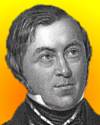
German chemist who spread the principle of isomorphism, after early in his career (about 1820) he discovered the importance of similarity of crystalline form between chemical compounds. He began his education by studying medicine, but his interest shifted to chemistry, and crystallography in particular. He worked in Berzelius’ laboratory (1820-22). Mitscherlich further developed his theory of isomorphism. In 1834, he dry distilled the calcium salt of benzoic acid to obtain benzene, among other notable research on benzene derivatives. Following an interest in geology to mineralogy, he produced artificial minerals. The German cellulose industry grew from the Mitscherlich process to extract cellulose from wood.«[DSB gives dates as 7 Jan 1794 - 28 Feb 1863. EB gives 17 Jan 1794 - 28 Aug 1863.]
German chemist who spread the principle of isomorphism, after early in his career (about 1820) he discovered the importance of similarity of crystalline form between chemical compounds. He began his education by studying medicine, but his interest shifted to chemistry, and crystallography in particular. He worked in Berzelius’ laboratory (1820-22). Mitscherlich further developed his theory of isomorphism. In 1834, he dry distilled the calcium salt of benzoic acid to obtain benzene, among other notable research on benzene derivatives. Following an interest in geology to mineralogy, he produced artificial minerals. The German cellulose industry grew from the Mitscherlich process to extract cellulose from wood.«[DSB gives dates as 7 Jan 1794 - 28 Feb 1863. EB gives 17 Jan 1794 - 28 Aug 1863.]
Pauling
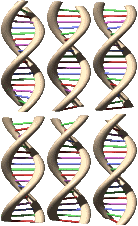
In 1951, their theoretical description of the structure of proteins was published by Linus Pauling and Robert Corey in Proceedings of the National Academy of Sciences.
Linus Pauling in His Own Words: Selections From his Writings, Speeches and Interviews, by Barbara Marinacci. - book suggestion.
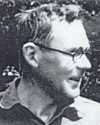
In 1935, nylon was discovered by Dr. Wallace H. Carothers of DuPont.
(s 12 )
In 1893, carborundum was patented by Edward G. Acheson of Monongahela, Penn. He had discovered it accidentally while trying to make artificial diamonds. He had dissolved carbon into molten corundum (a mixture of powdered coke and clay) in an electric furnace, and that yielded dark, hard, gritty crystals. He named the new material carborundum, and found it was one of the hardest industrial substances (second only to diamond), which made it an excellent abrasive material. In 1894, he started the Carborundum Company in Monongahela to produce grindstones, knife sharpeners, and various abrasives. Later, on 19 May 1896, obtained a patent for an electric furnace, suitable for making carborundum.«
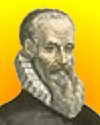
In 1561, Ambroise Paré published La méthode curative des playes et fractures de la teste humaine (Treatment Method for Wounds and Fractures of the Human Head). It was written in response to an inquiry following the accidental death of Henri II (1559), who was struck in the eye by a lance during a tournament. The first part (which was reprinted in Paré's Anatomie Universelle, 15 Apr 1561), covered the anatomy of the cranium with woodcut illustrations after Andreas Vesalius. In the second part, Paré described his methods of treatment of head wounds, skull fractures and diseases of the facial organs. The text included abundant figures of his surgical instruments. For his innovative methods, Paré is known as “the father of modern surgery.” more
more
more Ambroise Pare: Surgeon of the Renaissance, by Wallace B. Hamby. - book suggestion.





