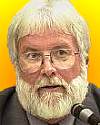
Born 19 Jan 1944.
[np who applies a knowledge of the anatomy, physiology, stages of development, and behavior of insects to legal matters, most often to murder investigations. His work in pathology began with a two-year tour of duty in the army, assigned to work in the morgue of the Fort Ord, California, army hospital. Here, he gained expertise in human anatomy, and became accustomed to working with corpses. He analyses the insects, insect eggs and larvae, or evidence of the past presence of insects from decomposing corpses. Knowing the time of year when a particular insect species reproduces, for example, can point to a victim's time of death.
[np who applies a knowledge of the anatomy, physiology, stages of development, and behavior of insects to legal matters, most often to murder investigations. His work in pathology began with a two-year tour of duty in the army, assigned to work in the morgue of the Fort Ord, California, army hospital. Here, he gained expertise in human anatomy, and became accustomed to working with corpses. He analyses the insects, insect eggs and larvae, or evidence of the past presence of insects from decomposing corpses. Knowing the time of year when a particular insect species reproduces, for example, can point to a victim's time of death.
A Fly for the Prosecution: How Insect Evidence Helps Solve Crimes, by M. Lee Goff. - book suggestion.
Born 19 Jan 1933; died 12 Feb 2020 at age 87.
George Vincent Coyne was an American astrophysicist who was ordained as a priest in 1965, then in 1969, joined the Vatican Observatory. He directed its Catalina Observatory. In 1978, Pope John Paul I appointed Father Coyne as director of the Vatican Observatory, a post he held for nearly three decades. Because of light pollution, in 1980, a new division of the Observatory was established with its own telescope, hosted by The University of Arizona’s Steward Observatory, Tucson, Arizona. The new location was named the Vatican Observatory Research Group (VORG). Fr. Coyne presided over the installation of a new Advanced Technology Telescope (VATT) on Mount Graham, in southern Arizona, dedicated in 1993. He retired in 2006.«
George Vincent Coyne was an American astrophysicist who was ordained as a priest in 1965, then in 1969, joined the Vatican Observatory. He directed its Catalina Observatory. In 1978, Pope John Paul I appointed Father Coyne as director of the Vatican Observatory, a post he held for nearly three decades. Because of light pollution, in 1980, a new division of the Observatory was established with its own telescope, hosted by The University of Arizona’s Steward Observatory, Tucson, Arizona. The new location was named the Vatican Observatory Research Group (VORG). Fr. Coyne presided over the installation of a new Advanced Technology Telescope (VATT) on Mount Graham, in southern Arizona, dedicated in 1993. He retired in 2006.«
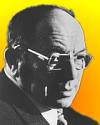
Born 19 Jan 1912; died 7 Apr 1986 at age 74.
Soviet mathematician and economist who shared the 1975 Nobel Prize for Economics with Tjalling Koopmans for their work on the optimal allocation of scarce resources. Kantorovich's background was entirely in mathematics but he showed a considerable feel for the underlying economics to which he applied the mathematical techniques. He was one of the first to use linear programming as a tool in economics and this appeared in a publication Mathematical methods of organising and planning production which he published in 1939. The mathematical formulation of production problems of optimal planning was presented here for the first time and the effective methods of their solution and economic analysis were proposed.
Soviet mathematician and economist who shared the 1975 Nobel Prize for Economics with Tjalling Koopmans for their work on the optimal allocation of scarce resources. Kantorovich's background was entirely in mathematics but he showed a considerable feel for the underlying economics to which he applied the mathematical techniques. He was one of the first to use linear programming as a tool in economics and this appeared in a publication Mathematical methods of organising and planning production which he published in 1939. The mathematical formulation of production problems of optimal planning was presented here for the first time and the effective methods of their solution and economic analysis were proposed.
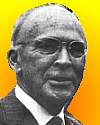
Born 19 Jan 1900; died 31 Mar 1975 at age 75.
Leslie A(lvin) White was an American anthropologist best known for his theories of the evolution of culture and for the scientific study of culture that he called "culturology." Throughout his life, he was interested in general evolution. He strongly supported the ideas of the 19th-century writers Herbert Spencer, Lewis H. Morgan and Edward Tylor. White adopted many of their ideas and gave them a fresh approach. He coined the term "culturology" because he believed that cultures should not be explained in terms of psychology, biology, or physiology, but rather in its own category. He was especially interested by technological advancements pertaining to effects on advancing culture.
Leslie A(lvin) White was an American anthropologist best known for his theories of the evolution of culture and for the scientific study of culture that he called "culturology." Throughout his life, he was interested in general evolution. He strongly supported the ideas of the 19th-century writers Herbert Spencer, Lewis H. Morgan and Edward Tylor. White adopted many of their ideas and gave them a fresh approach. He coined the term "culturology" because he believed that cultures should not be explained in terms of psychology, biology, or physiology, but rather in its own category. He was especially interested by technological advancements pertaining to effects on advancing culture.
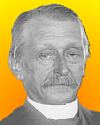
1908
Born 19 Jan 1851; died 18 Jun 1922 at age 71.
Dutch astronomer who used photography and statistical methods in determining the motions and spatial distribution of stars. Such work was the first major step after the works of William and John Herschel. He tried to solve the questions of space density of stars as a function of distance from the sun, and the distribution of starts according to brightness per unit volume. Some of his results had lasting value, but some were superceded because he had failed to account for the interstellar absorption. In studies using proper motion to determine stellar distances, he discovered stellar motions are not random, as previously thought, but that stars move in two "star streams" (1904). He introduced absolute magnitude and colour index as standard concepts.
Dutch astronomer who used photography and statistical methods in determining the motions and spatial distribution of stars. Such work was the first major step after the works of William and John Herschel. He tried to solve the questions of space density of stars as a function of distance from the sun, and the distribution of starts according to brightness per unit volume. Some of his results had lasting value, but some were superceded because he had failed to account for the interstellar absorption. In studies using proper motion to determine stellar distances, he discovered stellar motions are not random, as previously thought, but that stars move in two "star streams" (1904). He introduced absolute magnitude and colour index as standard concepts.
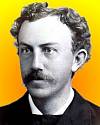
Born 19 Jan 1851; died 19 Sep 1931 at age 80. quotes
American ichthyologist and peace activist who was not only a leading American authority on ichthyology (study of fish) in his time, but also a renowned expert in many fields. At the Scopes Monkey Trial he provided expert testimony supporting the theory of evolution. He wrote extensively on education, philosophy, eugenics and peace, as well as science. In 1885, Indiana University appointed him its President, at the time, the youngest in the nation. He was a leader for international peace. He applied biology in his arguments for peace, stating that war endangered the health of the species because it was the strongest individuals who died, and were lost from the gene pool. Before America engaged in WW I, he opposed being involved, though once war became the reality, he supported the necessity of aggressive measures to terminate the conflict as soon as possible.« more
American ichthyologist and peace activist who was not only a leading American authority on ichthyology (study of fish) in his time, but also a renowned expert in many fields. At the Scopes Monkey Trial he provided expert testimony supporting the theory of evolution. He wrote extensively on education, philosophy, eugenics and peace, as well as science. In 1885, Indiana University appointed him its President, at the time, the youngest in the nation. He was a leader for international peace. He applied biology in his arguments for peace, stating that war endangered the health of the species because it was the strongest individuals who died, and were lost from the gene pool. Before America engaged in WW I, he opposed being involved, though once war became the reality, he supported the necessity of aggressive measures to terminate the conflict as soon as possible.« more
Shore Fishes of Hawaii, by David Starr Jordan and Barton Warren Evermann. - book suggestion.
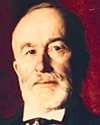
Born 19 Jan 1837; died 7 Jun 1932 at age 95.
American physician who was the first brain surgeon in the U.S. In 1887, at St. Mary's Hospital in Philadelphia, Keen performed the first successful removal of a brain tumor in the U.S. He was the first physician to perform a decompression of the skull and also the first physician in Philadelphia to use Lister's antiseptic surgical practices. His interests included focal epilepsy and microcephaly. Keen edited Gray's anatomy in 1883 and wrote numerous articles and monographs. Keen assisted the American surgeon Joseph Bryant in removing the left upper jaw of U.S. president Grover Cleveland (1893) for a malignant tumour.
American physician who was the first brain surgeon in the U.S. In 1887, at St. Mary's Hospital in Philadelphia, Keen performed the first successful removal of a brain tumor in the U.S. He was the first physician to perform a decompression of the skull and also the first physician in Philadelphia to use Lister's antiseptic surgical practices. His interests included focal epilepsy and microcephaly. Keen edited Gray's anatomy in 1883 and wrote numerous articles and monographs. Keen assisted the American surgeon Joseph Bryant in removing the left upper jaw of U.S. president Grover Cleveland (1893) for a malignant tumour.
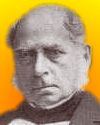
Born 19 Jan 1813; died 15 Mar 1898 at age 85. quotes
English industrialist, metallurgist, inventor and engineer who developed the first process for manufacturing steel inexpensively (1856), leading to the development of the Bessemer converter. Bessemer invented his steel making process to solve a specific problem vexing another of his inventions, the self-spinning artillery shell. The converter removed impurities from molten pig iron by oxidation through air being blown through the molten iron. The oxidation also raised the temperature of the iron mass, keeping it molten. The oxidation process removed impurities such as silicon, manganese, and carbon as oxides, which oxides either escapd as gas or formed a solid slag. He also solved problems about the chemistry of ores, fuels, and steel. He held 110 patents at his death.
English industrialist, metallurgist, inventor and engineer who developed the first process for manufacturing steel inexpensively (1856), leading to the development of the Bessemer converter. Bessemer invented his steel making process to solve a specific problem vexing another of his inventions, the self-spinning artillery shell. The converter removed impurities from molten pig iron by oxidation through air being blown through the molten iron. The oxidation also raised the temperature of the iron mass, keeping it molten. The oxidation process removed impurities such as silicon, manganese, and carbon as oxides, which oxides either escapd as gas or formed a solid slag. He also solved problems about the chemistry of ores, fuels, and steel. He held 110 patents at his death.
Sir Henry Bessemer: An Autobiography, by Henry Bessemer. - book suggestion.
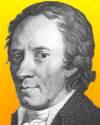
Born 19 Jan 1747; died 23 Nov 1826 at age 79.
German astronomer best known for his popularization of Bode's law. In 1766, his compatriot Johann Titius had discovered a curious mathematical relationship in the distances of the planets from the sun. If 4 is added to each number in the series 0, 3, 6, 12, 24,... and the answers divided by 10, the resulting sequence gives the distances of the planets in astronomical units (earth = 1). Also known as the Titius-Bode law, the idea fell into disrepute after the discovery of Neptune, which does not conform with the 'law' - nor does Pluto. Bode was director at the Berlin Observatory, where he published Uranographia (1801), one of the first successful attempts at mapping all stars visible to the naked eye without any artistic interpretation of the stellar constellation figures.
German astronomer best known for his popularization of Bode's law. In 1766, his compatriot Johann Titius had discovered a curious mathematical relationship in the distances of the planets from the sun. If 4 is added to each number in the series 0, 3, 6, 12, 24,... and the answers divided by 10, the resulting sequence gives the distances of the planets in astronomical units (earth = 1). Also known as the Titius-Bode law, the idea fell into disrepute after the discovery of Neptune, which does not conform with the 'law' - nor does Pluto. Bode was director at the Berlin Observatory, where he published Uranographia (1801), one of the first successful attempts at mapping all stars visible to the naked eye without any artistic interpretation of the stellar constellation figures.
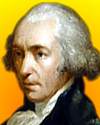
Born 19 Jan 1736; died 19 Aug 1819 at age 83. quotes
Scottish engineer and inventor whose steam engine contributed substantially to the Industrial Revolution. In 1763 he repaired the model of Newcomen's steam engine belonging to Glasgow University, and began experiments on properties of steam. The Newcomen engine was simple in design: it acted as a pump and a jet of cold water was used to condense the steam. Watt improved on this design by adding a separate condenser and a system of valves to make the piston return to the top of the cylinder after descending. He took out a patent for the separate condenser in 1769. He later adapted the engine to rotary motion, making it suitable for a variety of industrial purposes, and invented the flywheel and the governor.[DSB and other sources give dete of death as 19 Aug 1819. EB gives 25 Aug 1819.] more
Scottish engineer and inventor whose steam engine contributed substantially to the Industrial Revolution. In 1763 he repaired the model of Newcomen's steam engine belonging to Glasgow University, and began experiments on properties of steam. The Newcomen engine was simple in design: it acted as a pump and a jet of cold water was used to condense the steam. Watt improved on this design by adding a separate condenser and a system of valves to make the piston return to the top of the cylinder after descending. He took out a patent for the separate condenser in 1769. He later adapted the engine to rotary motion, making it suitable for a variety of industrial purposes, and invented the flywheel and the governor.[DSB and other sources give dete of death as 19 Aug 1819. EB gives 25 Aug 1819.] more
James Watt: Making the World Anew, by Ben Russell. - book suggestion.

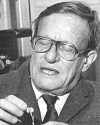
Died 19 Jan 2000 at age 94 (born 6 Jan 1906).
American geneticist who was one of the leading evolutionary biologists. Stebbins is considered one of the "architects" of the modern evolutionary synthesis of the 1930-40s (with Dobzhansky, animal systematist Ernst Mayr, and paleontologist George Gaylord Simpson ) Together, their work was a synthesis of research in cytology, genetics, systematics, paleontology. Stebbins created a modern framework for the study of plant evolution. From the 1940s, he artificially created fertile hybrids having more than twice the basic number of chromosomes (and was the first scientist to do so). This technique had value in both taxonomy and plant breeding.
American geneticist who was one of the leading evolutionary biologists. Stebbins is considered one of the "architects" of the modern evolutionary synthesis of the 1930-40s (with Dobzhansky, animal systematist Ernst Mayr, and paleontologist George Gaylord Simpson ) Together, their work was a synthesis of research in cytology, genetics, systematics, paleontology. Stebbins created a modern framework for the study of plant evolution. From the 1940s, he artificially created fertile hybrids having more than twice the basic number of chromosomes (and was the first scientist to do so). This technique had value in both taxonomy and plant breeding.
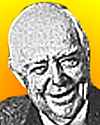
Died 19 Jan 1968 at age 92 (born 7 Feb 1875).
Sir Alfred Chester Beatty was an American-British mining engineer and company director. He perfected a method of extracting copper from low grade ore, and was active in developing the copper deposits of central Africa. Beatty had a keen interest in collecting minerals as a child in the U.S. and which grew into a career as a mining engineer. He moved to England in 1911, continuing his career, and eventually owned copper mines all over the world - in Africa, the U.S. and the Soviet Union. Beatty promoted cancer research, and in 1936 he founded the Chester Beatty Research Institute, London. When he died, he donated his significant art collection to Ireland, now the Chester Beatty Library.«
Sir Alfred Chester Beatty was an American-British mining engineer and company director. He perfected a method of extracting copper from low grade ore, and was active in developing the copper deposits of central Africa. Beatty had a keen interest in collecting minerals as a child in the U.S. and which grew into a career as a mining engineer. He moved to England in 1911, continuing his career, and eventually owned copper mines all over the world - in Africa, the U.S. and the Soviet Union. Beatty promoted cancer research, and in 1936 he founded the Chester Beatty Research Institute, London. When he died, he donated his significant art collection to Ireland, now the Chester Beatty Library.«
Alfred Chester Beatty and Ireland 1950-1968: A study in cultural politics, by Brian P. Kennedy. - book suggestion.
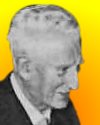
Died 19 Jan 1968 at age 90 (born 26 Oct 1877).
Italian pioneer in aeronauticsand space science who designed revolutionary airships and patented an early cyclic pitch design for helicopter rotors (1906). While the design of helicopters was in its infancy, Crocco recognized that a way to change the pitch cyclically on the blades was needed if a helicopter was to work properly in forward flight. He designed a number of airships in the early part of the 20th century and switched to designing rocket engines in the 1920s. Crocco founded the Italian Rocket Society (1951) and made many contributions to the theory of spaceflight. He calculated that a spacecraft could travel from Earth to Mars, perform a reconnaissance Mars flyby (without orbit), and return to Earth in a total time of about one year.«
Italian pioneer in aeronauticsand space science who designed revolutionary airships and patented an early cyclic pitch design for helicopter rotors (1906). While the design of helicopters was in its infancy, Crocco recognized that a way to change the pitch cyclically on the blades was needed if a helicopter was to work properly in forward flight. He designed a number of airships in the early part of the 20th century and switched to designing rocket engines in the 1920s. Crocco founded the Italian Rocket Society (1951) and made many contributions to the theory of spaceflight. He calculated that a spacecraft could travel from Earth to Mars, perform a reconnaissance Mars flyby (without orbit), and return to Earth in a total time of about one year.«
1930
Died 19 Jan 1954 at age 84 (born 18 Sep 1869).
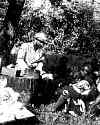
German anthropologist and sociologist whose comparative studies of social institutions, were made based on research expeditions included the Solomon Islands and Micronesia (1906-09, 1932), New Guinea (1912-15), and East Africa (1930). During the first Melanesian expedition (1906-09), he concentrated on South Bougainville (the Buins) and the Bismark Archipelago (Baining and New Ireland). His main objective was collecting objects of museum interest, and making sound and visual recordings. However, he also observed what he regarded as the negative effects of colonization. The plantation policy there was distributing lands to settlers, but Thurwald was particularly concerned that the settlers engaged labour on a more or less forced basis.«[Image: Thurnwald making field recordings in 1930.]
German anthropologist and sociologist whose comparative studies of social institutions, were made based on research expeditions included the Solomon Islands and Micronesia (1906-09, 1932), New Guinea (1912-15), and East Africa (1930). During the first Melanesian expedition (1906-09), he concentrated on South Bougainville (the Buins) and the Bismark Archipelago (Baining and New Ireland). His main objective was collecting objects of museum interest, and making sound and visual recordings. However, he also observed what he regarded as the negative effects of colonization. The plantation policy there was distributing lands to settlers, but Thurwald was particularly concerned that the settlers engaged labour on a more or less forced basis.«[Image: Thurnwald making field recordings in 1930.]
Economics in Primitive Communities, by Richard Thurnwald. - book suggestion.
Died 19 Jan 1930 at age 26 (born 22 Feb 1903). quotes
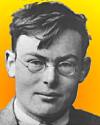
English mathematician, logician and philosopher who died at age 26, but had already made significant contributions to logic, philosophy of mathematics, philosophy of language and decision theory. He remains noted for his Ramsey Theory, a mathematical study of combinatorial objects in which a certain degree of order must occur as the scale of the object becomes large. This theory spans various fields of mathematics, including combinatorics, geometry, and number theory. His papers show he was also a remarkably creative and subtle philosopher. Other gifted thinkers of his generation were Russell, Whitehead, Keynes, Moore, and Wittgenstein.«
English mathematician, logician and philosopher who died at age 26, but had already made significant contributions to logic, philosophy of mathematics, philosophy of language and decision theory. He remains noted for his Ramsey Theory, a mathematical study of combinatorial objects in which a certain degree of order must occur as the scale of the object becomes large. This theory spans various fields of mathematics, including combinatorics, geometry, and number theory. His papers show he was also a remarkably creative and subtle philosopher. Other gifted thinkers of his generation were Russell, Whitehead, Keynes, Moore, and Wittgenstein.«
F.P. Ramsey: Philosophical Papers, by F.P. Ramsey and D.H. Mellor (ed.). - book suggestion.
Died 19 Jan 1927 at age 85 (born 24 Feb 1841).
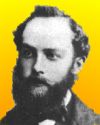
German organic chemist who, assisted by Carl Liebermann, synthesized (1868) the orange-red dye alizarin, which in the textile industry quickly supplanted the natural source of the dye from the madder plant root. Alizarin (dihydroscyanthraquinone) was recognized by Graebe and Liebermann, as a derivative of anthracene, a hydrocarbon contained in coal-tar. Also in 1868, they elaborated a method for preparing it commercially from anthracene. Upon this, one of the early German dyestuff products, arose rapidly a great chemical industry. Graebe also introduced the chemical terms "ortho," "meta," and "para," well known to organic chemistry students, which indicate the position of groups attached to a benzene ring.
German organic chemist who, assisted by Carl Liebermann, synthesized (1868) the orange-red dye alizarin, which in the textile industry quickly supplanted the natural source of the dye from the madder plant root. Alizarin (dihydroscyanthraquinone) was recognized by Graebe and Liebermann, as a derivative of anthracene, a hydrocarbon contained in coal-tar. Also in 1868, they elaborated a method for preparing it commercially from anthracene. Upon this, one of the early German dyestuff products, arose rapidly a great chemical industry. Graebe also introduced the chemical terms "ortho," "meta," and "para," well known to organic chemistry students, which indicate the position of groups attached to a benzene ring.
Died 19 Jan 1904 at age 74 (born 24 Mar 1829).
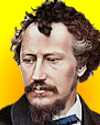
American businessman who was a pioneer in street horse tramways in England, was involved in the formation of the Union-Pacific Railroad, and known as an eccentric reformer. In 1860, following the examples he had seen in America, he established horse tramways in London. Service began on 23 Mar 1860, but was ended within six months, due to opposition caused by his design of rails standing above the road surface sufficiently to cause damage to carriage wheels catching on them. He travelled internationally, and accomplished a speedy round the world trip in 67 days, and may have been the inspiration for Phileas Fogg in Jules Verne's book, Around the World in 80 Days. Train became wealthy from real estate associated with the building of the UP railroad. With age his eccentricity worsened. He died from smallpox. « more
American businessman who was a pioneer in street horse tramways in England, was involved in the formation of the Union-Pacific Railroad, and known as an eccentric reformer. In 1860, following the examples he had seen in America, he established horse tramways in London. Service began on 23 Mar 1860, but was ended within six months, due to opposition caused by his design of rails standing above the road surface sufficiently to cause damage to carriage wheels catching on them. He travelled internationally, and accomplished a speedy round the world trip in 67 days, and may have been the inspiration for Phileas Fogg in Jules Verne's book, Around the World in 80 Days. Train became wealthy from real estate associated with the building of the UP railroad. With age his eccentricity worsened. He died from smallpox. « more
Around the World with Citizen Train: The Sensational Adventures of the Real Phileas Fogg, by Allen Foster. - book suggestion.
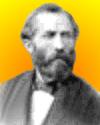
Died 19 Jan 1888 at age 56 (born 26 Jan 1831). quotes
German botanist known as a founder of modern mycology and plant pathology for his research into the roles of fungi and other agents in causing plant diseases. He determined the life cycles of many fungi, for which he developed a classification that has been retained in large part by modern mycologists. Among the first to study host-parasite interactions, and ways in which fungi penetrate host tissues, in 1853, he asserted that rust and smut were fungal diseases. In 1865 he proved that the life cycle of wheat rust involves two hosts, wheat and barberry. De Bary was the first to show (1866) that lichens consist of a fungus and an alga in intimate association. He coined the term symbiosis (1879) for the mutually beneficial partnership between two organisms.
German botanist known as a founder of modern mycology and plant pathology for his research into the roles of fungi and other agents in causing plant diseases. He determined the life cycles of many fungi, for which he developed a classification that has been retained in large part by modern mycologists. Among the first to study host-parasite interactions, and ways in which fungi penetrate host tissues, in 1853, he asserted that rust and smut were fungal diseases. In 1865 he proved that the life cycle of wheat rust involves two hosts, wheat and barberry. De Bary was the first to show (1866) that lichens consist of a fungus and an alga in intimate association. He coined the term symbiosis (1879) for the mutually beneficial partnership between two organisms.
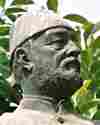
Died 19 Jan 1881 at age 59 (born 11 Feb 1821).
Auguste-Ferdinand-François Mariette was a French archeologist who conducted major excavations throughout Egypt, revealing much about the earlier periods of Egyptian history. Sent by the Louvre, in 1850, to purchase papyruses, at Saqqara he discovered the Serapeum. Its rockcut corridors and burial chambers were excavated for the Apis bulls which were sacred to god Ptah. The corridors form a virtual underground extending for hundreds of metres. The stone sarcophagi weigh as much as 70 tonnes and average some 4 metres long and 3.3 metres high. Twenty chambers still contain sarcophagi. This was the start of French archaeology in Egypt. He won renown too, for his battle against looting and the illicit export of antiquities.
Auguste-Ferdinand-François Mariette was a French archeologist who conducted major excavations throughout Egypt, revealing much about the earlier periods of Egyptian history. Sent by the Louvre, in 1850, to purchase papyruses, at Saqqara he discovered the Serapeum. Its rockcut corridors and burial chambers were excavated for the Apis bulls which were sacred to god Ptah. The corridors form a virtual underground extending for hundreds of metres. The stone sarcophagi weigh as much as 70 tonnes and average some 4 metres long and 3.3 metres high. Twenty chambers still contain sarcophagi. This was the start of French archaeology in Egypt. He won renown too, for his battle against looting and the illicit export of antiquities.
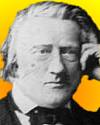

French chemist and physicist noted for his work on the properties of gases. His invaluable work was done as a skilful, thorough, patient experimenter in determining the specific heat of solids, liquids, gases, and the vapour-tensions of water and other volatile liquids, as well as their latent heat at different temperatures. He corrected Mariotte's law of gases concerning the variation of the density with the pressure, determined the coefficients of expansion of air and other gases, devised new methods of investigation and invented accurate instruments. Two laws governing the specific heat of gases are named after him.
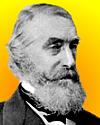
Died 19 Jan 1876 at age 78 (born 10 Mar 1797). quotes
English geologist, political economist and Member of Parliament. He took an early amateur interest in geology and volcanology, and his work helped disprove the Neptunist theory that all Earth's rocks were of oceanic sedimentary origin believed by a number of early 19th century geologists. He studied volcanic features in Italy, Sicily and Germany, and especially in central France and wrote Considerations on Volcanoes (1825) and Memoir on the Geology of Central France. (1827). It was by his observations on the erosion of valleys by rivers, that he was able to extend and confirm the views of James Hutton and John Playfair. His birth name of Thompson became Scrope in 1821 when he married the daughter of the earl William Scrope.«
English geologist, political economist and Member of Parliament. He took an early amateur interest in geology and volcanology, and his work helped disprove the Neptunist theory that all Earth's rocks were of oceanic sedimentary origin believed by a number of early 19th century geologists. He studied volcanic features in Italy, Sicily and Germany, and especially in central France and wrote Considerations on Volcanoes (1825) and Memoir on the Geology of Central France. (1827). It was by his observations on the erosion of valleys by rivers, that he was able to extend and confirm the views of James Hutton and John Playfair. His birth name of Thompson became Scrope in 1821 when he married the daughter of the earl William Scrope.«
Died 19 Jan 1780 (born 1640).
English physician who was an early experimenter on the effects on animals by nicotine, which he reported to the Royal Society on 3 May 1665. Samuel Pepys wrote in his diary that he saw there “a cat killed with the Duke of Florence’s poyson, and saw it proved that the oyle of tobacco … is judged to be the same thing … both in colour and smell, and effect.” Coxe said with tobacco-oil distilled in a retort, by one drop of which given at the mouth he had killed a lusty cat, which being opened, smelled strongly of the oil, and the blood of the heart more strongly than the rest. … One drop of the Florentine oglio di tobacco being again given to a dog, it proved stupefying and vomitive, as before. Coxe became physician to the courts of King Charles II and Anne. He bought over a million acres of land in the American colonies.«
English physician who was an early experimenter on the effects on animals by nicotine, which he reported to the Royal Society on 3 May 1665. Samuel Pepys wrote in his diary that he saw there “a cat killed with the Duke of Florence’s poyson, and saw it proved that the oyle of tobacco … is judged to be the same thing … both in colour and smell, and effect.” Coxe said with tobacco-oil distilled in a retort, by one drop of which given at the mouth he had killed a lusty cat, which being opened, smelled strongly of the oil, and the blood of the heart more strongly than the rest. … One drop of the Florentine oglio di tobacco being again given to a dog, it proved stupefying and vomitive, as before. Coxe became physician to the courts of King Charles II and Anne. He bought over a million acres of land in the American colonies.«
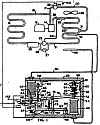
(USPTO)
In 1954, a patent for "Methods and Means of Defrosting a Cold Diffuser" was issued to its Black American inventor, F.M. Jones (No. 2,666,298). It gave a method to defrost using a heating medium when the surface of the diffuser has accumulated a layer of frost or ice which would otherwise reduce its heat transfer capacity. He used a compressor, condenser and evaporator which were interconnected in a manner such that the compressed refrigerant could also accomplish the defrosting of the evaporator in a defrosting cycle. He was a prolific inventor, whose first patent was for a "Ticket Dispensing Machine" in 1939 (No. 2,163,754), accumulating about 20 more patents relating to gas engines and refrigeration devices in 20 years.
The Inventive Spirit of African Americans: Patented Ingenuity, by Patricia Carter Sluby. - book suggestion.

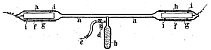
In 1915, the first Zeppelins used in German bombing raids on Britain attacked Great Yarmouth and King's Lynn.«
In 1909, Thomas A. Edison was issued a patent for an improvement related to Telegraphy (No. 909,877).
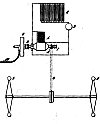
In 1904, Thomas A. Edison was issued a patent for an" Electrical Automobile" (No. 750,102) designed with a driving motor that may be conveniently and effectively utilized for the purpose of charging the batteries. Thus a small steam engine, preferable of the turbine type, was connected to the armature of an electric motor. By reversing the rotation of the motor-armature, the electric motor converts to a generator for charging the batteries. A clutch then is used to disconnect the motor from the driving wheels during charging (or, the wheels could be jacked up during the charging operation). In usual operation, the motor ran from storage batteries to power the carriage.
In 1903, King Edward VII and President Theodore Roosevelt exchanged greetings in a coded radio exchange between Cape Cod and Cornwall, England.
In 1894, Professor James Dewar exhibited several properties of liquid air, and produced solid air, at the Friday meeting of the Royal Institution. He had previously there exhibited, on 5 Jun 1885, liquid air obtained at the temperature of -192ºC. On 9 Mar 1893 he had produced solid air in the form of ice.
more
In 1875, Thomas A. Edison was issued a patent on a Telegraph Apparatus (No. 158,787).
In 1825, the first U.S. patent for food storage in cans - to "preserve animal substances in tin" - was issued to Ezra Daggett and his nephew Thomas Kensett of New York City where they canned salmon, oysters and lobsters since introducing the method in 1819. Tin cans had been used by the military and explorers in Europe since 1813, but their development did not start until after the Civil War.




